Why It Matters to P&C Insurance
Property & Casualty insurance is inherently visual. Damage photographs, vehicle images, property inspections, medical images, aerial imagery, repair estimates, diagrams, and video often contain critical evidence that is difficult to evaluate consistently at scale. Computer vision can help insurers organize and analyze this evidence earlier, faster, and more consistently—while leaving coverage, liability, reserving, underwriting, and settlement decisions with qualified professionals.
Quick Facts
- Computer vision extracts meaning from pixels; it does not merely store or display images.
- Common tasks include image classification, object detection, segmentation, optical character recognition, visual similarity, tracking, and change detection.
- Insurance use cases span claims, underwriting, property inspection, catastrophe response, fraud detection, loss control, and document intelligence.
- Performance depends heavily on image quality, representative training data, labeling standards, and operational context.
- Visual models can be confidently wrong when images are incomplete, manipulated, out of distribution, or missing context.
- Production systems require human review, provenance, privacy controls, model monitoring, and documented escalation paths.
Executive Takeaway
The strongest insurance applications do not ask computer vision to “decide the claim.” They use it to surface visual evidence, quantify observable conditions, identify inconsistencies, and prioritize work so professionals can make better-informed decisions.
Definitions and Essential Vocabulary
Technical Definition
Computer vision applies machine learning, deep learning, image processing, and geometric methods to derive information from visual inputs. A model receives an image or sequence of images, converts pixels into numerical representations, learns relevant patterns, and produces an output such as a label, bounding box, mask, measurement, embedding, or confidence score.
Insurance Definition
In insurance, computer vision is a capability for converting visual evidence into structured, reviewable information that can support claim intake, damage assessment, inspection, underwriting, risk engineering, fraud investigation, catastrophe response, and portfolio monitoring.
Essential Vocabulary
| Term | Practical meaning |
|---|---|
| Pixel | The smallest addressable element in a digital image. |
| Image classification | Assigning one or more labels to an entire image. |
| Object detection | Locating and labeling specific objects with boxes or coordinates. |
| Segmentation | Assigning a class or region label to individual pixels. |
| Visual embedding | A numerical representation used to compare image meaning or similarity. |
| Inference | Running a trained model on a new image or video. |
| Confidence score | A model-generated estimate of certainty, not a guarantee of correctness. |
| Ground truth | The validated label or measurement used to train or evaluate a model. |
| Occlusion | When part of the relevant object is blocked from view. |
| Domain shift | A change between training imagery and real-world production imagery. |
MECHANICS
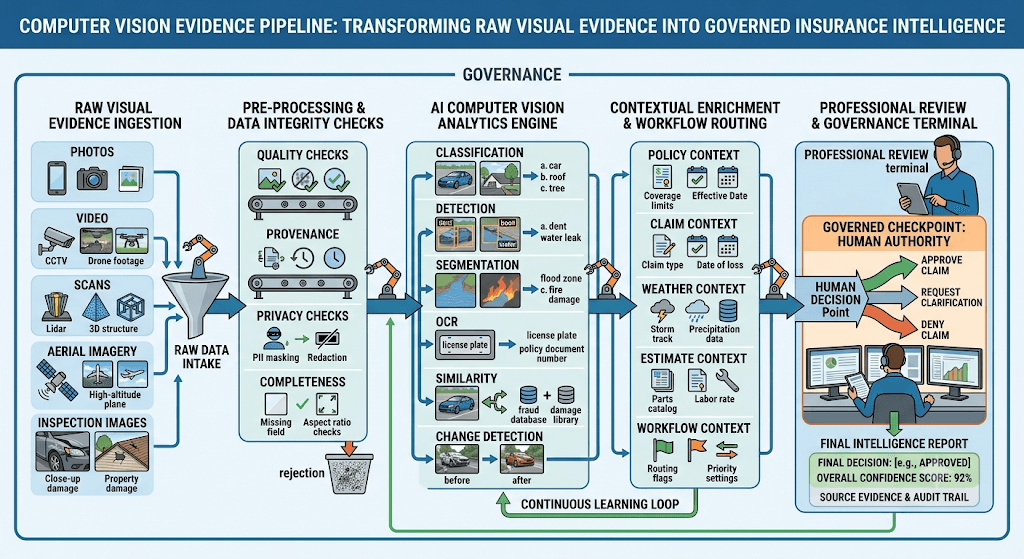
How Computer Vision Works
Acquire visual evidence
Capture photographs, scans, video, aerial imagery, or sensor images with associated metadata and consent.
Validate quality
Check resolution, focus, lighting, orientation, completeness, duplication, and file integrity.
Prepare the data
Resize, normalize, de-identify where required, augment, and organize images for training or inference.
Extract visual features
Use learned neural representations or engineered features to characterize shapes, textures, objects, and relationships.
Perform a task
Classify the image, detect objects, segment damage, read text, measure geometry, or compare against reference imagery.
Apply business context
Combine visual findings with policy, claim, location, peril, estimate, and workflow information.
Present evidence
Show the image, highlighted regions, confidence, source, and reason codes to an authorized professional.
Capture review outcomes
Record confirmation, correction, override, and downstream results for monitoring and controlled improvement.
Capture review outcomes
Critical distinction A visually plausible output is not the same as a reliable insurance conclusion. Computer vision observes image content; policy interpretation, causation, liability, fraud determination, and settlement require broader evidence and professional judgment.
Capture review outcomes
CAPABILITIES
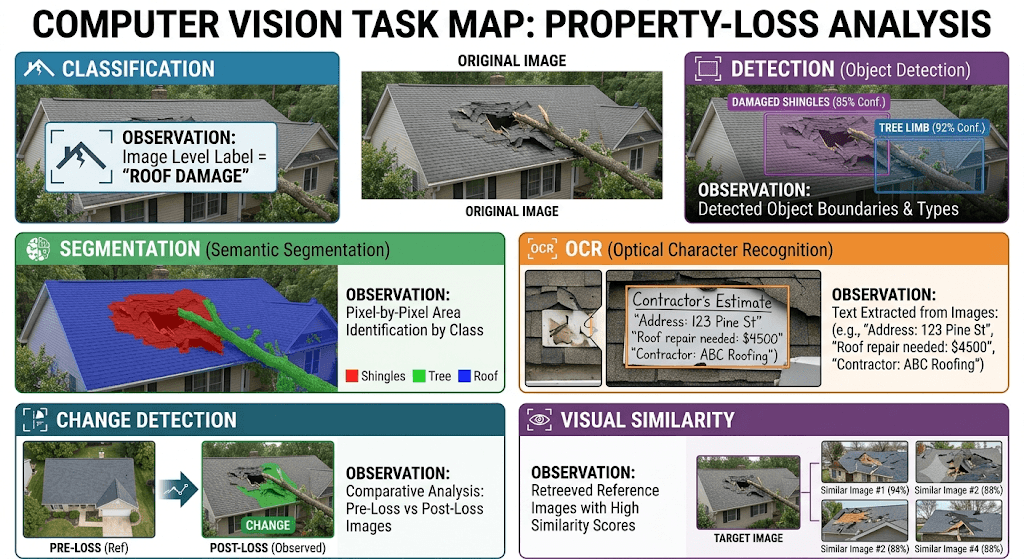
Major Computer Vision Tasks
Capture review outcomes
| Task | What the model produces | Illustrative insurance use |
|---|---|---|
| Classification | A label for the full image | Identify image type, roof material, vehicle view, or damage category. |
| Object detection | Boxes around identified objects | Locate vehicles, building components, safety equipment, or damaged parts. |
| Semantic segmentation | A class for each pixel | Separate roof, water, fire, vegetation, or damaged surface regions. |
| Instance segmentation | A separate mask for each object | Measure multiple hail dents, vehicles, or inventory items. |
| Pose / keypoint estimation | Coordinates for defined landmarks | Analyze vehicle geometry or human posture in controlled contexts. |
| Visual OCR | Text and layout extracted from images | Read forms, labels, serial numbers, invoices, and scene text. |
| Change detection | Differences between two image sets | Compare pre-loss and post-loss property conditions. |
| Visual similarity | Nearest matching images or patterns | Find duplicate submissions, prior images, or similar damage examples. |
| Video analytics | Events, tracks, and temporal patterns | Review inspection footage or detect defined safety events. |
| Measurement / reconstruction | Distances, areas, depth, or 3D structure | Estimate roof dimensions or damaged surface area with validated capture methods. |
Why Task Selection Matters
A project can fail even with a strong model if the task is defined incorrectly. “Assess property damage” is too broad. “Identify visible exterior roof regions with potential missing shingles in policyholder-submitted images and route low-confidence cases for inspection” is more testable, governable, and operationally useful.
TECHNOLOGY
Architectures and Model Families
Convolutional Neural Networks
Convolutional neural networks learn local visual patterns and hierarchical features. They remain effective for many classification, detection, and segmentation tasks, especially when optimized for a defined image domain.
Vision Transformers
Vision transformers represent images as patches and use attention mechanisms to model relationships across the image. They can perform strongly at scale and are increasingly used in multimodal systems.
Foundation and Multimodal Models
Large pretrained vision and vision-language models can interpret images alongside text prompts or documents. They may accelerate prototyping and broaden capability, but they also introduce governance questions regarding provenance, reproducibility, hallucination, data handling, and domain reliability.
Specialized Models
- Detection models optimized for speed or accuracy.
- Segmentation models for precise damage regions.
- Siamese or metric-learning models for visual similarity.
- Optical flow and tracking models for video.
- Geospatial models for satellite and aerial imagery.
- 3D and depth-estimation models for measurement or reconstruction.
Selection principle Choose the simplest model family that reliably supports the business objective. Architectural sophistication does not compensate for weak labels, poor image capture, or an undefined workflow.
DATA FOUNDATION
Visual Data, Labels, and Image Quality
Representative Data Is the Core Requirement
A model trained on clean inspection photographs may perform poorly on policyholder smartphone images. A roof model trained in one region may struggle with different materials, weathering, lighting, architecture, or catastrophe conditions. Training and evaluation data must reflect the intended production environment.
Label Design
Labels should be operationally meaningful, consistently applied, and supported by written annotation guidelines. Ambiguous labels—such as “major damage”—should be decomposed into observable criteria whenever possible.
| Quality dimension | Failure mode | Control |
|---|---|---|
| Resolution | Relevant detail is not visible | Minimum capture standards and quality checks. |
| Lighting | Glare or shadows mimic damage | Capture guidance, augmentation, and low-confidence routing. |
| Viewpoint | The key area is absent or distorted | Required shot list and completeness validation. |
| Label consistency | Experts disagree on what an image shows | Annotation manual, adjudication, and inter-rater testing. |
| Metadata | Date, location, or device context is missing | Capture provenance and preserve metadata appropriately. |
| Representativeness | Training data omit important conditions | Stratified sampling and out-of-distribution testing. |
| Manipulation | Images are edited, duplicated, or synthetic | Integrity checks, provenance, and investigation workflow. |
Data Governance
Visual evidence may contain faces, license plates, addresses, medical information, bystanders, or private property. Data minimization, access controls, retention rules, redaction, consent, and jurisdiction-specific requirements should be addressed before collection and deployment.
CLAIMS
Computer Vision Across the Claims Lifecycle
| Claims stage | Visual capability | Professional use |
|---|---|---|
| FNOL | Classify uploaded photos and confirm required views | Improve intake completeness and route the claim. |
| Triage | Detect visible damage indicators and affected components | Prioritize inspection, expertise, and response. |
| Investigation | Compare images, metadata, and prior evidence | Identify inconsistencies requiring review. |
| Estimating | Segment damage and identify components | Support scope preparation and estimate review. |
| Catastrophe | Analyze aerial or street-level imagery at scale | Prioritize outreach and field deployment. |
| Medical / BI | Organize visual medical evidence where authorized | Support specialist review without replacing clinical judgment. |
| Subrogation | Identify third-party property, products, or conditions | Preserve evidence and flag recovery opportunities. |
| Closure | Check whether required documentation is present | Improve file completeness and audit readiness. |
The Role of Context
A photograph may show a cracked bumper but not whether the damage is new, whether hidden damage exists, whether coverage applies, or what repair is appropriate. Computer vision should therefore be integrated with claim history, policy terms, estimates, statements, documents, and professional review.
Claims operating principle Use computer vision to improve evidence visibility and workflow prioritization—not to make unsupported automatic determinations from a single image.
CLAIMS CASE STUDY
Detailed Scenario: Property Damage Intake and Triage
A homeowners carrier receives storm claims through a digital FNOL channel. Policyholders upload exterior and interior photographs with inconsistent quality and incomplete views. Adjusters spend substantial time organizing images, requesting missing evidence, and determining which claims require immediate field inspection.
Proposed Workflow
The intake application provides a guided shot list based on reported peril and location.
Quality checks detect blur, darkness, duplication, and missing required views before submission.
Computer vision classifies image type and highlights visible conditions such as water staining, missing shingles, broken windows, or tree impact.
The system combines visual observations with weather, policy, claim history, and catastrophe information.
A triage recommendation identifies claims for rapid desk review, specialist review, or field inspection.
The adjuster sees the original images, highlighted regions, confidence, and supporting context before deciding the next action.
Controls
- No automatic coverage or causation decision based solely on visual output.
- Low-quality, low-confidence, high-severity, unusual, or disputed cases route to human review.
- Image provenance and upload history remain attached to the file.
- Performance is tested across construction types, regions, perils, devices, lighting, and demographic proxies.
- Adjuster corrections are recorded for monitoring, not automatically fed into production without validation.
Illustrative Measures
| Measure | Why it matters |
|---|---|
| FNOL completion rate | Shows whether guided capture reduces missing evidence. |
| Time to first meaningful review | Measures operational acceleration. |
| Inspection referral precision | Tests whether field resources are targeted appropriately. |
| Low-confidence rate | Indicates image or model limitations. |
| Override and correction rate | Reveals usability and model fit. |
| Severity / fairness slices | Checks whether performance is consistent across relevant conditions. |
UNDERWRITING
Computer Vision in Underwriting and Risk Engineering
Property Condition and Characteristics
Computer vision can help identify observable building characteristics, roof type, exterior condition, defensible space, occupancy indicators, and visible hazards from authorized imagery. Findings should be verified before influencing eligibility, pricing, terms, or nonrenewal.
Commercial Risk Inspection
Inspection images and video can be organized and analyzed for defined safety controls, housekeeping, storage, protective equipment, and site conditions. The technology is most effective when paired with standardized inspection protocols and risk-engineering review.
Aerial and Geospatial Imagery
Aerial, satellite, and street-level imagery can support exposure verification, catastrophe planning, and portfolio monitoring. Temporal freshness, resolution, licensing, geolocation accuracy, and the difference between observable condition and underwriting conclusion must be documented.
Detailed Underwriting Scenario: Commercial Property Submission
A commercial property submission includes exterior photographs, a loss-control report, and an aerial image. The system identifies image type, tags visible roof and site characteristics, detects missing views, and compares reported attributes with visual observations. The underwriter receives a structured summary with links to the evidence and routes discrepancies to inspection or broker clarification.
Authority boundary The system may surface observable evidence and inconsistencies. The underwriter retains authority over risk selection, terms, conditions, pricing, and referrals.
ENTERPRISE APPLICATIONS
Additional P&C Use Cases
Vehicle damage
Identify vehicle views, affected components, visible damage patterns, and image completeness.
Catastrophe response
Estimate affected areas, classify visible damage, and prioritize field resources.
Fraud and duplication
Detect repeated images, visual inconsistencies, or prior-image reuse for investigation—not automatic accusation.
Loss control
Flag defined hazards or missing controls in inspection imagery.
Inventory and contents
Classify items, organize evidence, and support review of contents submissions.
Subrogation
Surface products, contractors, vehicles, or site conditions that may warrant preservation and review.
Document intelligence
Combine OCR, layout analysis, signatures, stamps, and image understanding.
Operational quality
Verify that required photographs or inspection steps were completed.
Portfolio intelligence
Aggregate visual conditions across locations while controlling for freshness and sampling bias.
Telematics and video
Analyze authorized video events with explicit privacy and use limitations.
COMPARISON
Computer Vision Compared with Adjacent Technologies
Telematics and video
| Technology | Primary input | Typical output | Insurance role |
|---|---|---|---|
| Computer vision | Images and video | Objects, regions, labels, measurements | Interpret visual evidence. |
| OCR | Images containing text | Characters and words | Convert printed or handwritten text into machine-readable form. |
| Document intelligence | Documents and layouts | Fields, tables, entities, document meaning | Understand document content and structure. |
| NLP | Text and language | Entities, classifications, summaries | Interpret written or spoken language. |
| Predictive AI | Structured and unstructured features | Risk or outcome estimate | Estimate future outcomes. |
| Generative AI | Text, images, or multimodal context | New content or explanations | Draft, summarize, and interact with evidence. |
| Remote sensing | Satellite, aerial, or sensor imagery | Geospatial observations | Monitor location and environmental conditions. |
How the Capabilities Work Together
A claims platform may use computer vision to identify damage regions, OCR to read a contractor estimate, NLP to extract medical or legal information, predictive AI to estimate escalation risk, and generative AI to prepare a source-linked summary. The value comes from governed orchestration—not from treating one model as the entire solution.
BUSINESS VALUE
Potential Benefits and How to Measure Them
Operational Benefits
- Faster organization and review of visual evidence.
- More consistent image capture and completeness checks.
- Earlier identification of visible conditions requiring expertise.
- Better prioritization of inspections, catastrophe resources, and specialist review.
- Reduced manual tagging and duplicate handling.
- More structured evidence for audit, quality, and portfolio analysis.
Outcome Measures
| Objective | Illustrative KPI | Guardrail |
|---|---|---|
| Accelerate intake | Minutes from upload to organized evidence | No reduction in required review quality. |
| Improve completeness | Percent of submissions with required views | Avoid burdensome capture requirements. |
| Target inspection | Referral precision and recall | Track missed high-severity or unusual cases. |
| Improve estimate review | Agreement on defined visible components | Do not treat image output as full scope. |
| Reduce leakage | Validated discrepancy findings | Avoid presuming fraud or causation. |
| Support catastrophe response | Time to prioritized affected locations | Validate imagery freshness and geographic coverage. |
Value Attribution
Business cases should separate model accuracy from operational value. A model can be technically strong yet create little benefit if it is not integrated into the workflow, if staff do not trust the output, or if the recommended action does not change the result.
RISK AND GOVERNANCE
Key Risks, Failure Modes, and Controls
| Risk | What can go wrong | Control |
|---|---|---|
| Image quality | Blur, glare, compression, or missing views obscure evidence | Capture standards, automated checks, and human fallback. |
| Dataset bias | Performance varies across regions, materials, devices, or conditions | Representative data, slice testing, and ongoing monitoring. |
| Spurious correlation | The model learns background or camera cues instead of damage | Explainability, stress tests, counterfactuals, and data review. |
| Overconfidence | High confidence is interpreted as certainty | Calibration, thresholds, disclaimers, and review rules. |
| Context loss | Image output is used without policy or claim context | Integrated evidence view and authority boundaries. |
| Privacy | Faces, plates, homes, or medical imagery are exposed | Minimization, redaction, access, consent, and retention controls. |
| Manipulation | Images are altered, duplicated, generated, or misdated | Provenance, metadata, integrity checks, and investigation workflow. |
| Drift | New devices, materials, weather, or practices reduce performance | Monitoring, challenge sets, and controlled retraining. |
| Automation bias | Users defer to highlighted regions or labels | Training, alternative views, override capture, and quality review. |
| Adverse action | Unverified visual findings influence underwriting decisions | Verification, documentation, notice, appeal, and regulatory review. |
GOVERNANCE
Responsible Computer Vision Operating Model
Approved Purpose and Scope
Define the exact visual task, intended users, permitted decisions, excluded uses, image sources, jurisdictions, and populations. A model approved for image organization should not be repurposed for fraud scoring or underwriting without separate review.
Evidence and Explainability
The user should be able to inspect the original image, the highlighted region or extracted observation, confidence, source, date, and relevant limitations. Explanations should describe what the model observed—not imply legal or insurance conclusions it did not establish.
Human Review and Escalation
Define which outputs require confirmation, when low confidence triggers manual handling, how disputes are escalated, and who may override or approve. High-impact decisions should not depend on unverified visual inference.
Monitoring and Controlled Change
Monitor technical performance, calibration, image-quality distributions, business outcomes, overrides, complaints, fairness slices, incidents, and drift. Changes to data, labels, model, thresholds, or workflow should follow documented testing and release control.
Governance loop Approved purpose and image sources → validated visual analysis → evidence and confidence → professional review → documented decision → monitoring, feedback, incident response, and controlled change.
IMPLEMENTATION
Implementation Blueprint
Phase 1 — Frame the business problem
Identify the user, decision, current friction, visual evidence, target action, and measurable outcome.
Phase 2 — Define the visual task
Specify labels, object classes, image requirements, acceptable uncertainty, and exclusions.
Phase 3 — Build the data foundation
Establish image rights, provenance, annotation guidelines, quality standards, and representative datasets.
Phase 4 — Develop and validate
Compare baselines, test across relevant slices, calibrate confidence, and conduct failure analysis.
Phase 5 — Design the workflow
Present evidence, define authority, create fallback paths, and integrate with claims or underwriting systems.
Phase 6 — Pilot in shadow or assist mode
Measure performance and user behavior without allowing unsupported automated action.
Phase 7 — Scale deliberately
Expand only after value, reliability, governance, and change readiness are demonstrated.
Phase 8 — Operate and improve
Monitor drift, incidents, overrides, vendor changes, and controlled updates.
EXECUTIVE DECISION GUIDE
Build, Buy, or Partner?
Phase 8 — Operate and improve
| Question | Build may fit when… | Buy / partner may fit when… |
|---|---|---|
| Data | The carrier owns large, well-labeled proprietary image sets. | The use case benefits from broader pretrained data and existing capture workflows. |
| Talent | Computer vision engineering and MLOps are strategic capabilities. | Specialized expertise is limited or speed is critical. |
| Differentiation | The visual capability is central to competitive advantage. | The task is common, such as quality checks, OCR, or standard damage detection. |
| Integration | The carrier can support model serving, monitoring, and workflow integration. | The vendor offers proven connectors and operational support. |
| Governance | The carrier can document and validate the full lifecycle. | The vendor provides transparent evidence, testing, controls, and audit support. |
| Economics | Volume and reuse justify sustained investment. | A subscription or managed service lowers time, cost, and execution risk. |
Vendor Evaluation Questions
EXECUTION
Best Practices and Common Mistakes
- What exact image sources, perils, materials, and conditions were used for training and testing?
- Can the carrier evaluate performance on its own representative data?
- How are images stored, retained, encrypted, and used for model improvement?
- What evidence, confidence, and provenance are shown to users?
- How are low-quality, manipulated, unusual, or out-of-distribution images handled?
- What monitoring, audit, incident, and change-management capabilities are included?
- Can the carrier export findings, annotations, and review outcomes without vendor lock-in?
- What human-review and appeal workflows are supported?
Best Practices
- Start with a narrow, observable, insurance-relevant task.
- Design image capture and quality controls before model selection.
- Use written labeling standards and expert adjudication.
- Test on realistic production imagery—not only curated datasets.
- Expose original evidence and uncertainty to users.
- Pair visual findings with policy, claim, location, and temporal context.
- Use shadow mode and assisted workflows before any automation.
- Monitor performance by relevant image and business segments.
- Treat user correction as governed feedback, not automatic truth.
- Preserve human authority for high-impact insurance decisions.
Common Mistakes
MYTHS AND REALITIES
What Computer Vision Can—and Cannot—Do
- Defining “assess damage” without specifying an observable task.
- Assuming more images automatically mean better evidence.
- Ignoring image rights, privacy, provenance, and retention.
- Using confidence scores as probabilities of coverage or liability.
- Testing only on clean images or one geographic region.
- Failing to design a workflow for low confidence and missing views.
- Allowing highlighted regions to create automation bias.
- Confusing visible condition with cause, age, scope, or repairability.
- Measuring accuracy without measuring operational value and harm.
- Changing models or thresholds without controlled validation.
Myth: A photograph tells the whole story.
Reality: Images are partial evidence. They may omit hidden damage, timing, causation, policy context, or surrounding conditions.
Myth: High confidence means the model is correct.
Reality: Confidence can be miscalibrated, especially for unfamiliar images.
Myth: Computer vision eliminates inspections.
Reality: It may improve inspection targeting and preparation; many claims and risks still require qualified physical review.
Myth: Foundation models work equally well in every insurance domain.
Reality: General visual knowledge does not guarantee reliability for specific materials, perils, geographies, or decisions.
Myth: More automation always improves consistency.
Reality: Automation can consistently reproduce a flawed label, biased dataset, or poorly defined task.
Myth: Image analysis alone can prove fraud.
Reality: Visual anomalies are investigative leads that require broader evidence and due process.
Myth: Image analysis alone can prove fraud.
Leadership principle Computer vision is most valuable when it makes visual evidence easier to see, organize, test, and act upon responsibly.
Myth: Image analysis alone can prove fraud.
CHARLEE.AI PERSPECTIVE
From Visual Signals to Insurance Intelligence
Computer vision should not operate as an isolated image model. Its observations become more useful when they are combined with claim documents, medical and legal information, policy data, estimates, reserve history, weather, location, and workflow events. This broader context helps distinguish a visible condition from the business question an insurer is trying to answer.
People-Plus-AI Operating Model
- AI organizes images and identifies defined visual signals.
- The platform connects those signals to source evidence and broader claim or underwriting context.
- Professionals review the evidence, apply expertise, and make decisions.
- Governance captures purpose, performance, overrides, incidents, and controlled change.
- Continuous monitoring tests whether the capability improves outcomes without weakening fairness, quality, or accountability.
Design Principle
The objective is not to replace the adjuster, underwriter, inspector, engineer, clinician, or investigator. It is to reduce the effort required to find and interpret relevant visual evidence so those professionals can focus on judgment, communication, and action.
Charlee.ai point of view The best insurance AI turns fragmented signals into explainable, source-linked intelligence—while keeping qualified professionals responsible for decisions.
ILLUSTRATION BRIEFS
Illustrations
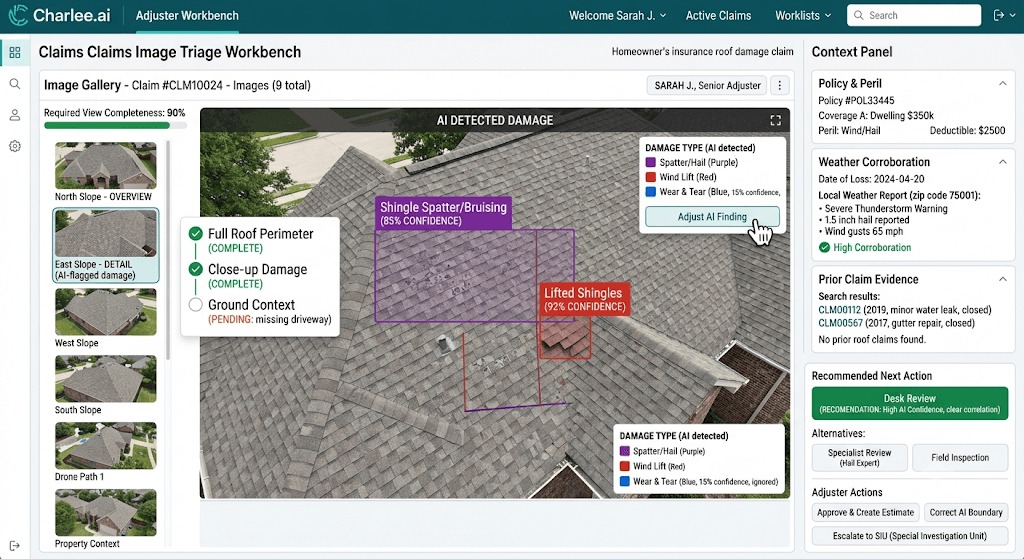
Illustration 2: Claims Image Triage Workbench
ILLUSTRATION BRIEFS
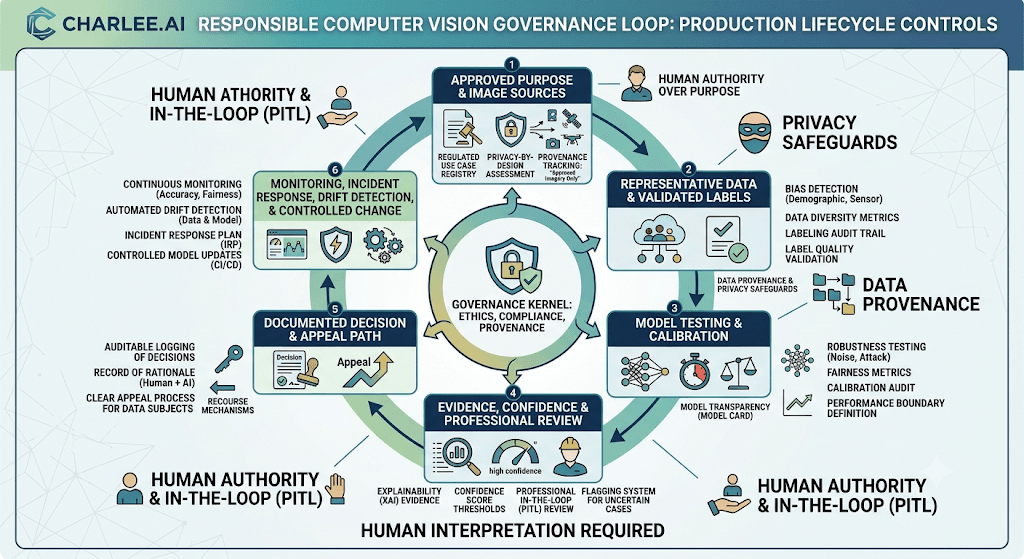
Illustration 4: Responsible Computer Vision Governance Loop
FREQUENTLY ASKED QUESTIONS
FAQs — Part 1
Recommended Knowledge Center Articles
PUBLICATION CLOSE
KEY TAKEAWAY
s and Publication Checklist
- How AI Analyzes Property Damage Images in Insurance Claims
- Computer Vision for Vehicle Damage Assessment
- Using Aerial Imagery for Catastrophe Claims Triage
- AI-Powered Property Inspections in Underwriting
- Combining Document Intelligence and Computer Vision
- Responsible AI Governance for Insurance Images and Video
- How Visual Evidence Supports Subrogation and Fraud Investigation
- Computer Vision vs. OCR in Insurance Operations
Key Takeaways
- Computer vision converts visual evidence into structured observations, not complete insurance decisions.
- Image quality, representative data, label discipline, provenance, and context determine reliability.
- High-value P&C applications include claims intake, damage triage, inspections, catastrophe response, visual fraud leads, and document intelligence.
- Confidence must be calibrated and paired with low-confidence fallback and professional review.
- Privacy, image rights, manipulation, dataset bias, and domain shift require explicit controls.
- Business value depends on workflow integration and measurable action—not model accuracy alone.
- Human expertise remains essential for coverage, causation, liability, pricing, reserving, settlement, and adverse-action decisions.
Property & Casualty insurance is inherently visual. Damage photographs, vehicle images, property inspections, medical images, aerial imagery, repair estimates, diagrams, and video often contain critical evidence that is difficult to evaluate consistently at scale. Computer vision can help insurers organize and analyze this evidence earlier, faster, and more consistently—while leaving coverage, liability, reserving, underwriting, and settlement decisions with qualified professionals.
Frequently Asked Questions
Image recognition is a subset of computer vision. Computer vision also includes detection, segmentation, tracking, measurement, OCR, change detection, and multimodal interpretation.
It can identify visible components and damage patterns that may support estimating, but photographs alone rarely establish full scope, hidden damage, labor, materials, causation, policy coverage, or final cost.
No. It can organize evidence, check completeness, and highlight conditions. Qualified professionals remain necessary for contextual evaluation, communication, authority, and high-impact decisions.
Representative images from the intended production environment, with reliable labels, diverse conditions, sufficient examples of important edge cases, and lawful rights to use the data.
The amount varies by task, model, diversity, class balance, and performance target. Transfer learning can reduce requirements, but high-quality representative labels remain essential.
Segmentation can outline damaged areas or building components at the pixel level, supporting measurement, evidence presentation, and estimate review.
It reflects the model’s internal certainty for a particular output. It is not proof, and it may not be calibrated to the true probability of correctness.
They should route to manual review, request better images, or trigger an alternative process. The model should not be forced to produce a definitive conclusion.
It can surface duplicate images, inconsistent metadata, manipulated content, or unusual patterns. Those are investigative leads, not fraud determinations. FREQUENTLY ASKED QUESTIONS FAQs — Part 2
OCR focuses on extracting characters and words from images. Computer vision is broader and can interpret objects, regions, spatial relationships, damage, and scene content.
Use depends on licensing, permitted purpose, privacy, freshness, resolution, and jurisdiction. Legal and compliance review should confirm rights and limitations.
Test performance across relevant materials, regions, devices, lighting, weather, property types, claim types, and other meaningful slices. Investigate disparities and underlying data or workflow causes.
It is the attempt to identify images that differ materially from the data on which the model was developed, so they can be routed to review rather than treated as routine.
Synthetic data may supplement rare examples, privacy-safe testing, or simulation, but it must be validated carefully because generated images may not reflect real production conditions.
The original image, provenance, relevant metadata, model version, output, confidence, highlighted evidence, user review, override, decision, and applicable policy or workflow context.
Retraining should be triggered by validated need—such as drift, new materials, new image sources, or performance decline—not by an arbitrary schedule alone.
Yes. A vision-language model can describe or answer questions about images, and generative AI can prepare source-linked summaries. Outputs still require grounding, testing, and review.
A narrow, high-volume, low-authority task such as image classification, completeness checking, or visual evidence organization often provides a safer starting point than automated damage or underwriting decisions. KNOWLEDGE CENTER PUBLISHING Related Terms, Articles, and SEO/AEO Metadata