Executive Snapshot
Deep learning is a specialized form of machine learning that uses multi-layer neural networks to learn complex patterns from large volumes of data. It is particularly effective for unstructured information such as images, text, audio, and long sequences of events.
| Business problem | Deep learning capability | Insurance workflow | Business outcome |
|---|---|---|---|
| Large volumes of complex documents and images | Learns representations directly from raw data | Claims document review, damage estimation, underwriting inspection | Faster understanding and more consistent prioritization |
| Patterns too complex for fixed rules | Models nonlinear relationships across many variables | Severity, litigation, fraud, reserve and medical escalation analysis | Earlier intervention and stronger decision support |
| High variability in language and imagery | Recognizes context, objects, sequences and semantic meaning | Medical records, demand packages, property images and claim notes | More accurate extraction, classification and insight |
| Changing operational conditions | Can be retrained and monitored over time | Portfolio monitoring and model governance | Sustained performance with controlled change |
Executive decision point: Deep learning is justified when the business problem involves complex, high-dimensional, unstructured, or sequential data and when the organization has enough quality data, governance, and operational readiness to support a more sophisticated model.
Executive Summary
Deep learning extends machine learning by using neural networks with many processing layers. These networks learn increasingly abstract representations of information: pixels become shapes, words become meaning, and individual events become sequences that can indicate emerging risk. This capability has made deep learning central to modern computer vision, natural language processing, speech recognition, and foundation models.
For Property & Casualty insurers, deep learning is relevant because much of the information required to understand risk is unstructured or difficult to model with simple rules. Claim files contain narratives, medical records, images, estimates, emails, and evolving event histories. Underwriting submissions contain forms, schedules, inspections, loss runs, photographs, and free-form explanations. Deep learning can help transform these inputs into structured evidence, predictions, and prioritization cues.
Deep learning does not make insurance decisions independently. Its outputs should be treated as decision support and evaluated within governed workflows. Insurance professionals remain responsible for interpretation, context, escalation, and final action. The strongest implementations combine deep learning with explainability, source evidence, model monitoring, human review, and clear accountability.
Quick Facts
| Topic | Summary |
|---|---|
| Category | Machine Learning / Artificial Intelligence |
| Primary purpose | Learn complex patterns and representations from large or unstructured data |
| Core technology | Multi-layer artificial neural networks |
| Typical insurance inputs | Documents, images, claim notes, medical records, telematics, sensor data, event histories |
| Common outputs | Classification, prediction, detection, extraction, summarization support, similarity and ranking |
| Strength | High performance on complex data where manual feature design is limiting |
| Primary trade-off | Greater data, compute, monitoring and explainability requirements |
| Human oversight | Required for material insurance decisions |
| Related terms | Neural Network, Machine Learning, NLP, Computer Vision, Foundation Model, Embeddings |
Definitions
Executive Definition
Deep learning is an advanced machine learning approach that uses layered neural networks to identify complex patterns in large amounts of data, especially text, images, audio, and sequences. In insurance, it can improve how organizations understand documents, evaluate imagery, detect emerging risk, and prioritize work.
Technical Definition
Deep learning is a family of representation-learning methods based on artificial neural networks with multiple computational layers. During training, the network adjusts numerical weights through optimization, typically using backpropagation and gradient-based methods, so that intermediate layers learn useful features and the final layer produces a desired output such as a class, probability, score, generated sequence, or embedding.
Insurance Definition
In P&C insurance, deep learning is used to interpret and connect information that is difficult to represent with simple rules or manually engineered variables. Examples include extracting meaning from claim notes and medical records, evaluating property or vehicle images, modeling claim development over time, detecting anomalies across large portfolios, and supporting predictive models for severity or litigation risk.
Why Deep Learning Matters in Insurance
Insurance operations depend on pattern recognition. Professionals assess how facts, timing, treatment, representation, policy language, damage characteristics, and external conditions combine to change exposure. Traditional systems can encode known rules, while conventional machine learning can learn from structured variables. Deep learning adds value when the relevant signal is spread across complex or high-dimensional information.
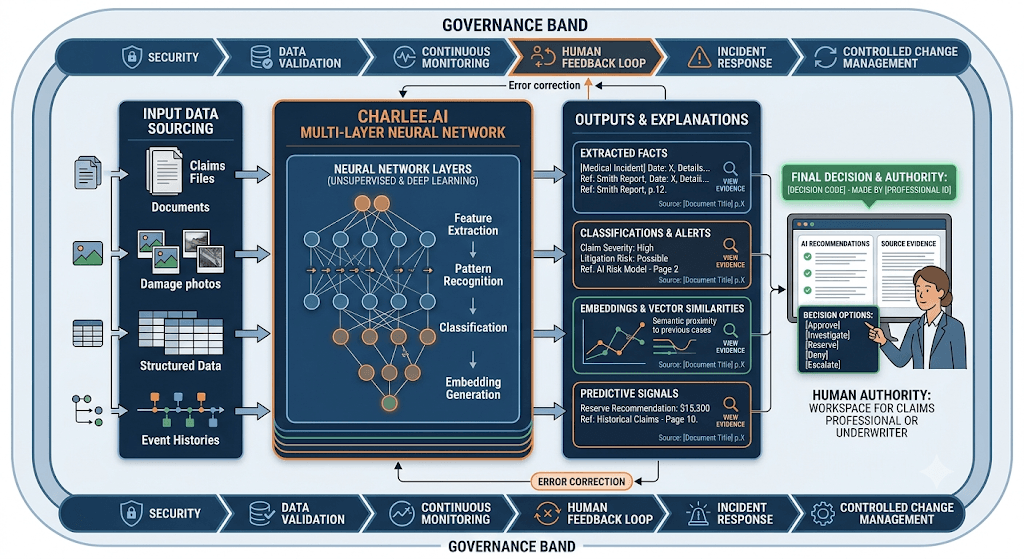
Charlee.ai insight: Deep learning is most valuable when it is invisible to the user. The professional should see the evidence, explanation, and recommended area of attention—not a black-box model label without context.
- Most insurance information is not neatly structured. It appears in documents, images, notes, correspondence, and event sequences.
- The same concept can be expressed in many different ways. Deep language models can learn semantic similarity rather than relying only on exact keywords.
- Important risk indicators may arise from combinations of facts rather than a single variable.
- Claim and underwriting patterns evolve over time, requiring monitored and controlled model updates.
- Large portfolios create scale problems that cannot be solved through manual review alone.
How Deep Learning Works
Data Is Collected and Governed
The process begins with clearly defined business objectives and governed data. Inputs may include policy data, claim transactions, medical records, demand letters, photographs, inspection reports, telematics, weather, litigation events, and outcomes. Data lineage, permissions, privacy controls, retention rules, and quality checks are established before model development.
Information Is Represented Numerically
Neural networks operate on numbers. Text may be converted into tokens or embeddings; images become arrays of pixel values; event histories become ordered sequences; and categorical business data becomes encoded features. The representation should preserve the information needed for the intended task without exposing unnecessary data.
Layers Learn Increasingly Useful Features
Early network layers often learn simple patterns, while deeper layers combine them into more abstract concepts. In an image model, early layers may detect edges, later layers may detect shapes, and higher layers may recognize damage. In language models, early representations capture words and syntax, while later layers capture meaning, relationships, and context.
Training Adjusts Model Weights
The model generates an output, compares it with a known target, calculates error, and adjusts internal weights to reduce that error. This cycle repeats across many examples. Training quality depends on representative data, appropriate objectives, sound labeling, controlled experimentation, and validation against data not used for learning.
Validation Tests Generalization
A model is useful only if it performs well on new cases. Validation assesses discrimination, calibration, error patterns, subgroup performance, stability, and operational usefulness. Insurance validation should also evaluate whether the model supports the intended decision without creating unacceptable bias or false confidence.
Inference Applies the Model
Once deployed, the trained model processes new documents, images, or claim records and produces outputs. These may be classifications, probabilities, extracted entities, similarity scores, or vector representations used by downstream systems.
Human Review Converts Output Into Action
The professional reviews model outputs together with evidence and business context. A deep learning model may flag a claim for early severity review, but the adjuster determines what the facts mean, what additional information is needed, and what action is appropriate.
Monitoring Detects Drift and Degradation
Performance can change when claim mix, legal environments, medical practices, catastrophe patterns, data sources, or operational processes change. Monitoring should track accuracy, calibration, latency, data quality, fairness, usage, overrides, and business outcomes. Material changes should trigger investigation, retraining, or controlled rollback.
Core Deep Learning Architectures
| Architecture | What it is good at | Insurance examples |
|---|---|---|
| Feedforward neural network | Learning nonlinear relationships in structured data | Severity scoring, propensity modeling, reserve support |
| Convolutional neural network (CNN) | Recognizing spatial patterns in images | Vehicle damage, roof condition, property inspection, document image classification |
| Recurrent neural network (RNN/LSTM) | Modeling ordered sequences and temporal dependencies | Claim development histories, payment sequences, telematics, event progression |
| Transformer | Modeling long-range relationships and context in text or sequences | Document intelligence, claim notes, policy language, medical chronology, LLMs |
| Autoencoder | Learning compressed representations and reconstruction patterns | Anomaly detection, feature learning, dimensionality reduction |
| Graph neural network | Modeling connected entities and relationships | Fraud networks, provider relationships, claimant-vehicle-policy connections |
| Multimodal model | Combining text, images and structured data | Property claim review, inspection plus narrative analysis, submission triage |
Types of Learning Used With Deep Models
| Learning approach | Description | Insurance application |
|---|---|---|
| Supervised learning | Learns from labeled examples with known outcomes | Severity, litigation, fraud, damage classification |
| Unsupervised learning | Finds structure without predefined labels | Claim clustering, anomaly detection, portfolio segmentation |
| Self-supervised learning | Creates training signals from the data itself | Language and image representation learning, foundation models |
| Semi-supervised learning | Combines limited labeled data with larger unlabeled data | Document classification when expert labels are scarce |
| Transfer learning | Adapts a pretrained model to a new task | Fine-tuning a language or image model for insurance documents |
| Reinforcement learning | Learns actions from feedback and reward | Workflow optimization research; less common for material claim decisions |
Deep Learning Across the P&C Value Chain
| Function | Deep learning contribution | Human responsibility |
|---|---|---|
| FNOL and triage | Classify loss descriptions, interpret images, identify urgency | Confirm facts, set priority, assign handling strategy |
| Claims severity | Detect complex patterns associated with adverse development | Evaluate exposure, investigate, set strategy and reserves |
| Medical review | Extract treatments, diagnoses, chronology and escalation cues | Assess medical relevance and claim implications |
| Litigation | Identify attorney, venue, treatment and demand patterns | Determine legal strategy and escalation |
| Fraud and SIU | Analyze anomalies, images, text and entity relationships | Investigate evidence and make referral decisions |
| Subrogation | Identify liability cues and third-party involvement | Preserve evidence and pursue recovery |
| Property claims | Assess damage imagery and combine it with claim context | Validate scope, causation and coverage |
| Underwriting | Interpret submissions, loss runs and inspections | Select risk, set terms, pricing and referrals |
| Portfolio management | Detect emerging clusters and adverse trends | Set management priorities and resource allocation |
Detailed Claims Scenario: Commercial Auto Bodily Injury
Initial Report
A commercial auto claim is reported after a delivery vehicle collides with a passenger vehicle. Initial structured data suggests moderate property damage and a soft-tissue injury. A conventional rule-based workflow assigns the claim to routine handling.
Early Deep Learning Signals
As new information arrives, language and sequence models detect a combination of factors associated with adverse development: delayed onset of symptoms, attorney representation, an emergency department visit followed by specialist referrals, repeated imaging, references to neurological complaints, and a venue historically associated with higher litigation severity. An image model also identifies a vehicle intrusion pattern that is inconsistent with the initial low-impact description.
Evidence Presented to the Adjuster
The system does not simply display a high-risk score. It presents the contributing evidence: document excerpts, dates, treatment milestones, venue context, image findings, and similar historical claim patterns. The adjuster can trace each signal to its source.
Professional Action
The adjuster reviews coverage, confirms the injury chronology, obtains missing records, consults a supervisor, and updates the claim strategy. Reserves are reconsidered based on the facts, not automatically changed by the model. Early legal and medical review is initiated because the combined evidence supports escalation.
Business Outcome
The claim receives focused attention before the demand package arrives. The carrier preserves evidence, improves documentation, validates treatment, and enters negotiation with a better understanding of exposure. The value of deep learning is not that it predicted the exact settlement; it connected weak signals early enough to support a better-managed claim.
Case-study principle: A model prediction is useful only when it arrives early enough, is explained clearly enough, and is integrated into a workflow where someone is accountable for acting on it.
Underwriting Scenario: Commercial Property Submission
An underwriter receives a submission containing applications, schedules of values, loss runs, engineering reports, photographs, and broker correspondence. A multimodal deep learning system classifies the documents, extracts risk attributes, identifies inconsistent occupancy descriptions, reviews roof imagery, and summarizes prior losses. It highlights missing sprinkler documentation and a discrepancy between the stated construction type and the inspection narrative.
The underwriter evaluates the evidence, requests clarification, and determines whether the risk fits appetite. The system reduces manual review and improves consistency, but it does not select the risk or set terms. Those decisions remain with the underwriter.
Business Value and Measures
| Value area | Example measure | Caution |
|---|---|---|
| Productivity | Document review time, claims or submissions reviewed per professional | Do not measure speed without quality |
| Early detection | Lead time between model signal and adverse event | Confirm signals produce actionable intervention |
| Accuracy | Precision, recall, calibration and error cost | Use metrics aligned to business consequences |
| Claim outcomes | Severity development, litigation rate, closure duration | Control for claim mix and external factors |
| Underwriting quality | Referral quality, hit ratio, loss ratio by segment | Avoid using model outputs as uncontrolled proxies |
| Adoption | Usage, review completion, override reasons | Low adoption may indicate workflow or trust problems |
| Governance | Drift alerts, incidents, review timeliness | Measure control effectiveness, not just model performance |
Risks and Governance Considerations
Data Quality and Representation
Deep models can learn errors, omissions, historical practices, and hidden proxies. Training data should represent the intended population and business environment. Labels must be defined consistently, and leakage from future information must be prevented.
Bias and Fairness
Models may perform differently across claim types, geographies, business segments, or protected groups. Fairness reviews should evaluate both data and outcomes, while recognizing that the appropriate analysis depends on the use case and applicable legal requirements.
Explainability
Deep learning is often less transparent than simpler models. Insurance implementations should provide source evidence, contributing factors, confidence indicators, reason codes where appropriate, and clear limits on interpretation.
Model Drift
Legal, medical, economic, catastrophe, and operational conditions change. Drift monitoring should identify changes in inputs, outputs, calibration, and business results. Retraining must follow controlled approval and validation processes.
Privacy and Security
Claims and underwriting data can contain sensitive personal, medical, financial, and confidential business information. Access controls, encryption, minimization, retention, audit logging, and vendor oversight are essential.
Automation Bias
Users may over-trust a model because it appears quantitative. Training and workflow design should reinforce that outputs are evidence-based recommendations, not decisions. Material actions require professional judgment and documented accountability.
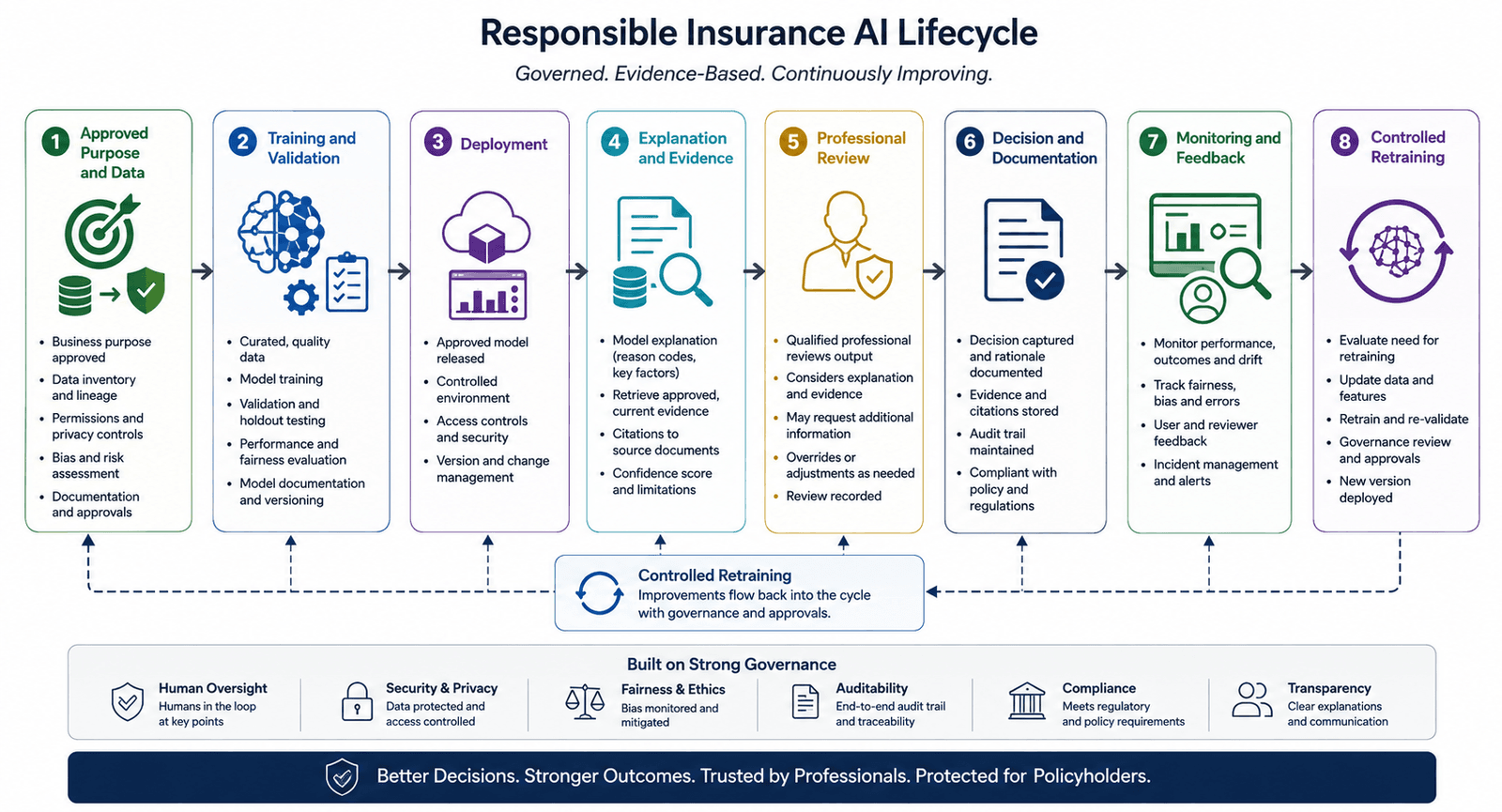
Governance minimum: approved purpose and data -> validated model -> explanation and source evidence -> professional review -> decision and documentation -> monitoring, feedback, incident response, and controlled change.
Best Practices
- Start with a clearly defined insurance problem and measurable business outcome.
- Use the simplest model that can meet the need; deep learning is not automatically the best choice.
- Create representative training, validation, and test sets with strict temporal controls.
- Engage claims, underwriting, legal, compliance, security, and data professionals early.
- Provide explanations and traceable evidence in the user workflow.
- Validate operational usefulness, not just technical accuracy.
- Monitor drift, fairness, adoption, overrides, and business outcomes after deployment.
- Document model versions, training data, limitations, approvals, and change history.
- Maintain human authority for material insurance decisions.
- Use incident response and rollback procedures for unexpected behavior.
Common Mistakes to Avoid
- Choosing deep learning because it is fashionable rather than necessary.
- Training on large but poorly governed datasets.
- Allowing future information to leak into training features.
- Using a single accuracy metric without considering business cost.
- Deploying a model without evidence, explanations, or user training.
- Failing to test performance on new segments and changing conditions.
- Assuming a pretrained model is automatically appropriate for insurance.
- Confusing correlation with causation or prediction with a recommended decision.
- Ignoring override behavior and frontline feedback.
- Failing to define who owns the model after launch.
Executive Decision Guide
When Deep Learning Is a Strong Candidate
- The input includes significant text, imagery, audio, or complex sequences.
- The relationship between inputs and outcomes is too complex for fixed rules.
- There is enough representative data and subject-matter expertise to validate results.
- The business benefit justifies higher development and monitoring costs.
- The workflow can support explanation, human review, and controlled intervention.
Questions to Ask a Vendor or Internal Team
- What specific insurance decision or workflow does the model support?
- Why is deep learning more appropriate than a simpler model?
- What data was used for training, and how representative is it?
- How is information protected, minimized, and retained?
- How are predictions explained and linked to source evidence?
- How is performance measured by claim type, segment, and time period?
- How are drift, bias, incidents, and model changes managed?
- Where is human review required, and how are overrides documented?
- Can the organization test the model using its own data before deployment?
- What happens if the model becomes unavailable or performance degrades?
Readiness Assessment
| Dimension | Ready indicators | Warning signs |
|---|---|---|
| Business | Defined problem, owner, KPI and intervention | Technology-first project without accountable outcome |
| Data | Representative, permissioned, traceable and sufficiently complete | Fragmented data with unclear rights or inconsistent labels |
| People | Subject-matter experts participate in design and validation | Model built without claims or underwriting involvement |
| Workflow | Clear review, escalation and documentation process | Score delivered outside the system of work |
| Governance | Validation, monitoring, incident and change controls | No post-launch ownership or review cadence |
| Technology | Secure integration, resilience and observability | Prototype architecture used as production design |
Charlee.ai Perspective
Deep learning should serve the insurance professional by converting complex information into timely, explainable, and actionable insight. The technology is not the product by itself. The product is a better decision process: one that sees more information, surfaces relevant evidence earlier, and preserves professional accountability.
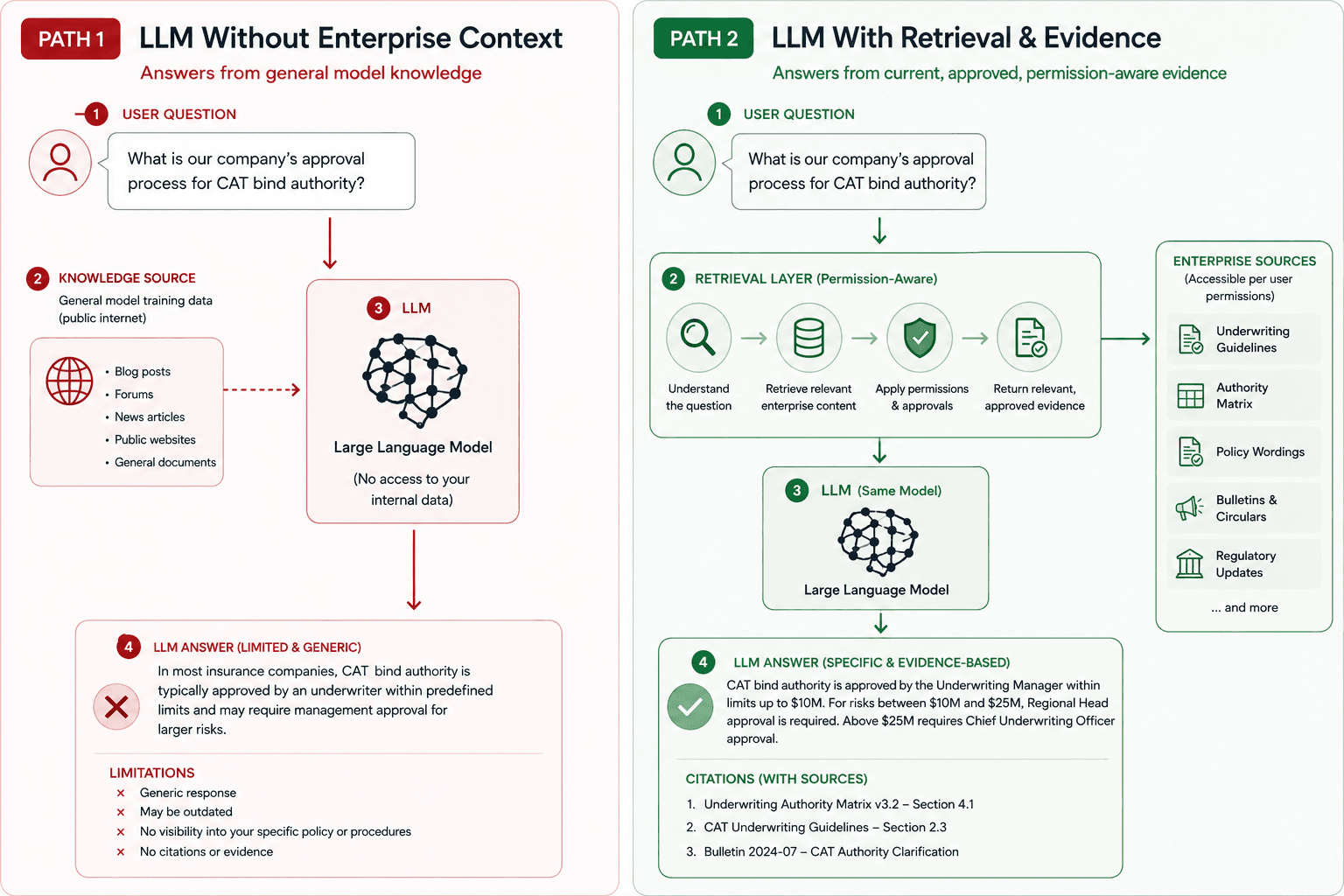
For claims, the greatest value often comes from combining deep language understanding, predictive models, document intelligence, and portfolio monitoring. A single model may identify a pattern, but operational value requires the surrounding system: secure data access, source evidence, workflow integration, human review, documentation, monitoring, and feedback.
For underwriting, deep learning can reduce the burden of intake and analysis while helping underwriters focus on risk selection, judgment, and terms. It should expand the professional’s field of view, not narrow it to a model score.
Charlee.ai principle: Human expertise + governed enterprise data + advanced AI -> better information -> improved decisions -> better business outcomes.
Key Takeaways
- Deep learning is a specialized form of machine learning based on multi-layer neural networks.
- It is especially effective for text, images, audio, sequences, and other complex information.
- Insurance uses include document intelligence, computer vision, severity analysis, fraud detection, medical review, underwriting support, and portfolio monitoring.
- Deep learning is not always the best approach; simpler models should be preferred when they meet the business need.
- Production value depends on representative data, validation, explanation, workflow integration, human oversight, and ongoing monitoring.
- The purpose of deep learning is to improve the quality and timing of information available to insurance professionals—not to replace their authority.
Deep learning is a specialized form of machine learning that uses multi-layer neural networks to learn complex patterns from large volumes of data. It is particularly effective for unstructured information such as images, text, audio, and long sequences of events.
Frequently Asked Questions
No. Artificial intelligence is the broad field. Machine learning is a subset of AI, and deep learning is a subset of machine learning based on multi-layer neural networks.
No. Simpler models may be more accurate, easier to explain, less costly, and more appropriate for structured insurance problems. The model should fit the business need.
It can learn semantic and contextual patterns across long, variable, and unstructured text, supporting classification, extraction, chronology, similarity, and prediction.
Yes. Computer vision models can classify images, detect objects, segment damage, and estimate attributes, subject to image quality and validation.
It often benefits from large datasets, but transfer learning and pretrained models can reduce the amount of task-specific data required. Representative and well-governed data still matters more than raw volume.
A layer is a group of computational units that transforms input values. Multiple layers allow the model to learn increasingly complex representations.
Backpropagation is the process used to calculate how model weights should change to reduce error during training.
It can provide varying levels of explanation through source evidence, attribution methods, examples, confidence information, and reason summaries. Explainability should be designed for the use case.
Model drift is the degradation or change in performance when data, behavior, or external conditions differ from the environment in which the model was developed.
No. It can automate parts of information processing and provide decision support, but material decisions require professional authority, context, and accountability.
Most modern LLMs are deep learning models based on transformer architectures trained on large text datasets.
Transfer learning starts with a model trained on a broad task and adapts it to a more specific task, often reducing data and training requirements.
Common areas include document intelligence, computer vision, severity and litigation analysis, fraud detection, medical review, submission intake, and portfolio monitoring.
They should assess technical performance, calibration, subgroup behavior, business usefulness, explanation quality, security, governance, workflow adoption, and outcomes over time.
The biggest risk is deploying a technically impressive model without the data governance, workflow integration, human review, and monitoring needed to use it responsibly.
Yes. It can be integrated through APIs, batch processes, message streams, document pipelines, and secure data layers without replacing every core system.
A multimodal model processes more than one type of information, such as text, images, and structured data, to produce a combined understanding.
There is no universal schedule. Retraining should be triggered by monitored performance, drift, data changes, business changes, or planned governance cycles.
Artificial Intelligence Machine Learning Neural Network Natural Language Processing Large Language Model Predictive AI Computer Vision Embeddings Explainable AI Human-in-the-Loop Responsible AI Claims Document Intelligence Claims Severity Prediction Litigation Prediction Underwriter Productivity