Executive Snapshot
Two-minute definition Intelligent Document Processing is an end-to-end capability that receives documents, determines what they are, reads their contents, extracts and validates important information, routes exceptions, and delivers evidence-linked results into insurance workflows. OCR is one component of IDP; IDP adds insurance context, controls, integration, and action.
| Business need | IDP contribution | Authority and control |
|---|---|---|
| Reduce manual document intake | Classifies documents and prepopulates structured fields. | People verify exceptions and material values. |
| Find evidence across large files | Creates searchable, source-linked facts and chronology. | Professionals assess relevance and resolve conflict. |
| Accelerate claims and underwriting | Routes documents and tasks based on content and confidence. | Business rules and authorized users control action. |
| Improve consistency | Applies common extraction, validation, and audit logic. | Governance defines approved purpose, data, and thresholds. |
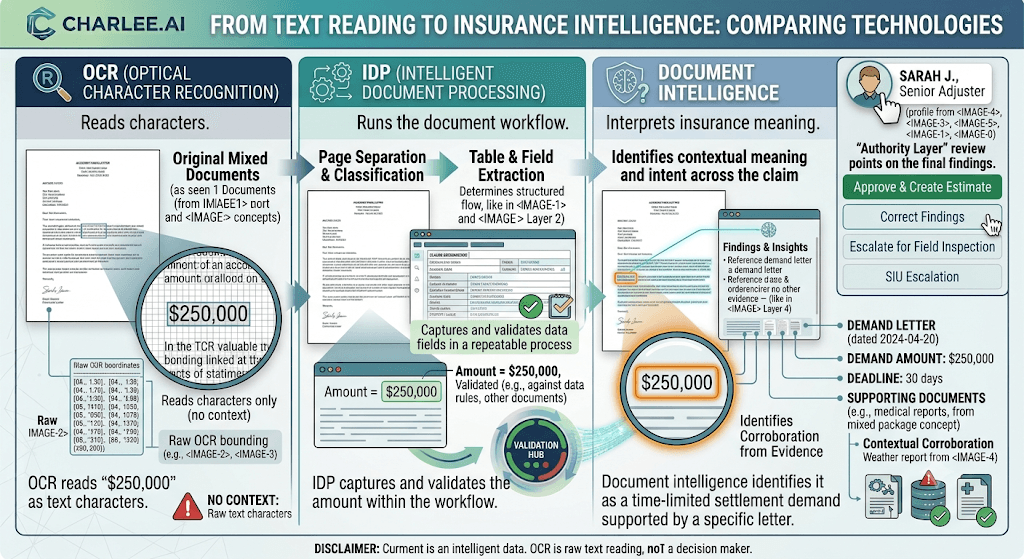
Executive distinction OCR converts visible characters into text. IDP manages the full document workflow: ingest, classify, extract, validate, reconcile, review, integrate, monitor, and improve. Document intelligence is the analytical capability within that workflow that interprets insurance meaning.
Executive Summary
Property & Casualty insurance is document-intensive. Claims and underwriting teams work with applications, loss runs, estimates, medical records, police reports, pleadings, correspondence, inspection reports, invoices, schedules, policy forms, photographs, and many other records. The information is often distributed across PDFs, scans, email attachments, portals, images, and legacy repositories.
IDP turns this unstructured and semi-structured content into controlled, machine-usable information. A mature solution preserves the original evidence, identifies document type, reads or retrieves text, extracts defined facts, validates values, detects conflicts and duplicates, assigns confidence, routes exceptions, and writes approved results to downstream systems.
The goal is not touchless automation at any cost. The goal is reliable acceleration: reducing repetitive reading and rekeying while making evidence easier to find, compare, explain, and act upon. Material decisions—coverage, liability, reserve, settlement, fraud referral, risk selection, pricing, and policy terms—remain subject to professional authority and established controls.
Quick Facts
| Question | Answer |
|---|---|
| What does IDP process? | PDFs, scans, forms, emails, images, spreadsheets, and mixed document packages. |
| What technologies are involved? | OCR, computer vision, NLP, machine learning, rules, validation, workflow, and sometimes generative AI. |
| What is the primary output? | Evidence-linked structured data, document labels, summaries, exceptions, and workflow events. |
| Where is it used? | Claims intake, medical review, litigation, underwriting submissions, loss runs, inspections, invoices, and policy servicing. |
| What is the key risk? | Plausible but incorrect extraction or interpretation that enters a business process without sufficient validation. |
| What is the operating principle? | Automate routine handling; escalate uncertainty and materiality; preserve human authority. |
Definitions and Essential Vocabulary
Executive Definition
Intelligent Document Processing is a governed operating capability that converts incoming documents into usable information and workflow actions while preserving evidence, confidence, and accountability.
Technical Definition
IDP is a pipeline of services that can include file ingestion, integrity checking, text-layer detection, OCR, layout analysis, document classification, field and table extraction, entity recognition, normalization, validation, cross-document reconciliation, confidence scoring, exception management, API integration, audit logging, and performance monitoring.
Insurance Definition
In P&C insurance, IDP is the controlled use of document technologies to organize claim, policy, underwriting, medical, legal, financial, and inspection information so authorized professionals can review evidence and make decisions faster and more consistently.
Essential Vocabulary
| Term | Practical meaning |
|---|---|
| Ingestion | Secure receipt, preservation, and registration of files and metadata. |
| Document classification | Identification of document type, subtype, and sometimes business context. |
| OCR | Recognition of visible text from images or image-only pages. |
| Layout analysis | Detection of text blocks, tables, fields, columns, and reading order. |
| Extraction | Capture of defined fields, entities, relationships, tables, and events. |
| Normalization | Conversion of values into consistent formats without losing the source representation. |
| Validation | Testing extracted information against formats, ranges, totals, reference data, and business logic. |
| Reconciliation | Comparison of facts across pages, documents, systems, and time periods. |
| Confidence score | Estimated reliability of a classification, field, or interpretation. |
| Exception | A result requiring review because of uncertainty, conflict, materiality, or policy. |
| Human in the loop | Authorized professional review at defined control points. |
| Straight-through processing | Completion of a low-risk workflow without manual intervention when all controls pass. |
| Provenance | The source, location, time, and processing history of a fact or output. |
Key principle A structured value without provenance is weaker than a structured value linked to the exact document, page, region, extraction method, confidence, and validation history.
MECHANICS
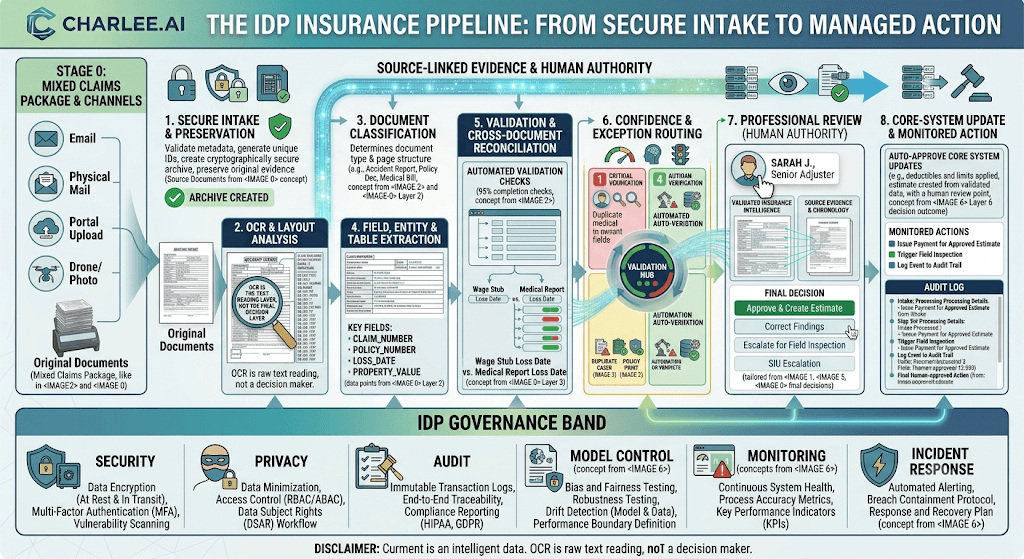
How Intelligent Document Processing Works
Receive and preserve
Capture files from email, portals, APIs, core systems, scanners, or repositories. Retain the original, metadata, hash, source, and receipt time.
Inspect and secure
Check file type, integrity, malware risk, encryption, page count, text availability, and access requirements.
Separate and organize
Split compound packages when appropriate, group related pages, detect duplicates, and maintain package relationships.
Read the content
Use native text when reliable; apply OCR and layout analysis to image-based or mixed documents.
Classify the document
Identify type, subtype, business line, claim or policy association, and routing context.
Extract facts and structure
Capture fields, entities, tables, line items, dates, amounts, parties, events, and relationships.
Normalize and enrich
Standardize formats, map terminology, resolve identifiers, and add controlled reference data.
Validate and reconcile
Apply field rules, cross-foot totals, compare sources, check chronology, and detect conflicts or missing information.
Score confidence and materiality
Estimate reliability and determine whether uncertainty matters to the intended business use.
Route and review
Send accepted results, exceptions, or complete evidence packages to the correct person or workflow.
Integrate and act
Write approved data, create tasks, update status, or trigger downstream analytics through controlled interfaces.
Monitor and improve
Measure accuracy, exceptions, corrections, drift, latency, cost, and business outcomes by document type and use case.
Monitor and improve
Control point Every automated step should have an explicit failure path. Unreadable, unsupported, conflicting, or high-impact documents should be retained and routed—not silently discarded or forced through the process.
Monitor and improve
ARCHITECTURE
Core Components of an IDP Platform
Monitor and improve
| Component | Primary role | Insurance control consideration |
|---|---|---|
| Capture layer | Receives files and metadata from approved channels. | Authenticate source, preserve chain of custody, and prevent duplicate processing. |
| Preprocessing | Improves orientation, quality, segmentation, and text availability. | Retain original evidence and record transformations. |
| Classification | Assigns document and package categories. | Use thresholds by document type and route unknowns safely. |
| Extraction | Captures fields, entities, tables, and relationships. | Prioritize critical fields and preserve coordinates and raw text. |
| Validation engine | Applies formats, ranges, totals, reference data, and cross-document rules. | Separate technical confidence from business acceptance. |
| Human review | Presents source, highlights, confidence, and exceptions. | Use role-based access and record corrections and rationale. |
| Workflow orchestration | Routes documents, tasks, statuses, and service calls. | Use approved rules, segregation of duties, and retry controls. |
| Integration layer | Connects claim, policy, billing, CRM, data, and content systems. | Avoid uncontrolled writes and ensure idempotent transactions. |
| Monitoring and audit | Tracks quality, drift, latency, cost, and user actions. | Support traceability, incident response, and model change control. |
Rules, Models, and Generative AI
Production IDP rarely depends on one technique. Rules are useful for deterministic formats and validation. Machine-learning models classify documents and extract variable layouts. NLP identifies entities and relationships. Generative AI can summarize or explain document content, but it should operate from retrieved evidence and produce source-linked outputs. The appropriate mix depends on document variability, materiality, volume, and tolerance for error.
Document Packages, Not Just Pages
Insurance work often arrives as a package: a demand, submission, claim file, inspection bundle, or litigation update. Page-level processing is necessary but insufficient. The platform should understand package boundaries, document sequence, duplicates, amendments, version history, and relationships among records. A medical bill may be interpreted differently when paired with the corresponding clinical note; a loss run should be evaluated across all years and pages.
Confidence Is Multidimensional
| Confidence type | Question answered | Example |
|---|---|---|
| Image quality | Can the page be read reliably? | The scan is skewed and low resolution. |
| OCR confidence | How certain is the recognized text? | A policy number contains an ambiguous character. |
| Classification confidence | How certain is the document type? | The page may be an invoice or an estimate. |
| Field confidence | How certain is a specific extracted value? | The total incurred amount may be $18,500 or $78,500. |
| Validation confidence | Does the value satisfy business checks? | The amount matches line-item totals and system data. |
| Business materiality | Would an error affect a decision or obligation? | A one-digit error in a settlement demand is material. |
INSURANCE VALUE
IDP Across the P&C Value Chain
| Area | Representative documents | IDP-enabled outcome |
|---|---|---|
| Claims intake | FNOL forms, police reports, correspondence, IDs, estimates. | Organized intake, prepopulated facts, and missing-document checks. |
| Medical review | Records, bills, explanations of benefits, treatment plans. | Provider chronology, billed amounts, treatment events, and exceptions. |
| Litigation | Demands, pleadings, discovery, legal correspondence, expert reports. | Source-linked chronology, deadlines, parties, allegations, and changes. |
| Property claims | Estimates, invoices, inspection reports, inventories, photos. | Line-item capture, reconciliation, damage evidence, and task routing. |
| Subrogation | Contracts, reports, invoices, maintenance records, correspondence. | Potential responsible parties, evidence gaps, and recovery-supporting facts. |
| Fraud review | Applications, bills, statements, identities, prior records. | Inconsistency and anomaly indicators for authorized investigation. |
| Underwriting intake | Applications, SOVs, loss runs, financials, schedules. | Structured submission summary with exceptions and source evidence. |
| Risk engineering | Inspection reports, recommendations, photos, checklists. | Hazard and recommendation tracking with status and provenance. |
| Policy servicing | Endorsements, requests, certificates, forms, correspondence. | Request classification, data capture, routing, and completion checks. |
| Compliance and audit | Notices, forms, approvals, records, evidence packages. | Searchable, traceable records and control evidence. |
Where IDP Creates Value
- Reduce repetitive reading, sorting, indexing, and rekeying.
- Make evidence searchable and accessible at the point of work.
- Improve data completeness and consistency before analytics or AI.
- Shorten time from document receipt to professional review.
- Prioritize exceptions and material changes instead of treating every page equally.
- Create repeatable audit trails for document-derived facts.
- Support portfolio-level analytics without losing source evidence.
Where IDP Does Not Replace Judgment
- Coverage interpretation and legal conclusions.
- Liability and comparative-fault assessment.
- Medical causation, necessity, prognosis, or impairment conclusions.
- Reserve and settlement authority.
- Fraud determination or adverse action.
- Risk selection, pricing, and policy-term authority.
- Compliance interpretation and regulatory reporting judgment.
Business outcome IDP is most valuable when it changes the flow of work—not merely when it extracts fields. The target should be faster, more complete, and more explainable professional decisions.
CLAIMS
Detailed Case Study: Liability Demand Package
Business Scenario
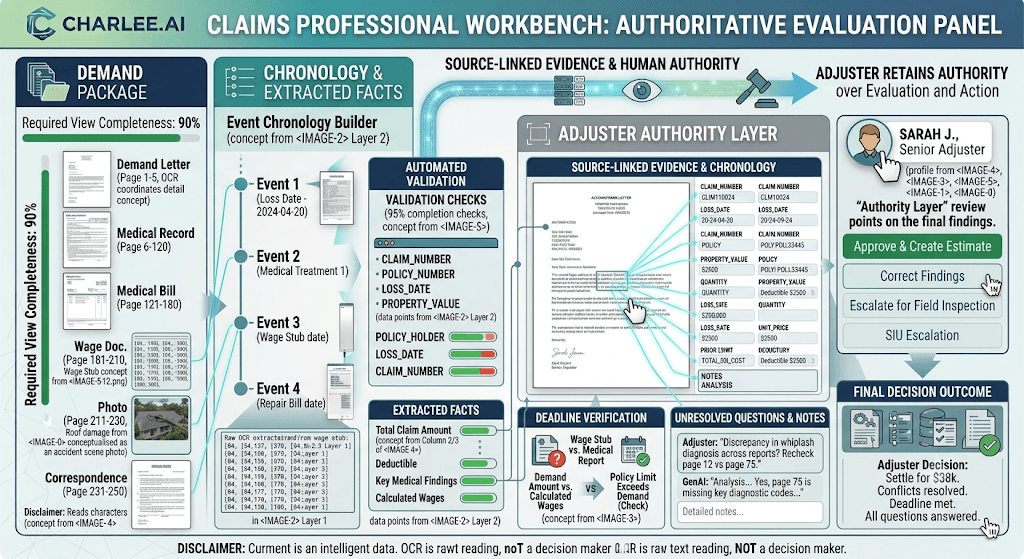
A commercial auto carrier receives a 420-page demand package that includes a cover letter, medical records, itemized bills, wage-loss documentation, police reports, photographs, prior correspondence, and a time-limited settlement demand. Pages contain mixed native text, scans, handwritten notes, duplicates, and inconsistent claimant identifiers.
Controlled IDP Workflow
Register the package, preserve the original files, capture sender and receipt metadata, and associate the material with the correct claim.
Inspect file integrity and text availability; separate attachments while maintaining package relationships.
Apply OCR and layout analysis only where necessary and retain page coordinates and confidence.
Classify records by document type, provider, date range, and business relevance.
Extract demand amount, response deadline, allegations, providers, service dates, diagnoses, procedures, billed amounts, payments, wage-loss values, and named parties.
Build a source-linked chronology and identify duplicate, amended, or conflicting records.
Validate totals, date sequences, claimant identity, provider identity, and correspondence against claim-system data.
Route material conflicts, low-confidence amounts, missing records, and deadline ambiguity for immediate review.
Present the adjuster with the original evidence, highlighted facts, unresolved exceptions, and an organized chronology.
Record professional corrections, decisions, and outcomes for audit and monitored improvement.
Mandatory Controls
- Deadline extraction must be verified against the source and applicable business rules.
- Demand amount, billed totals, and wage-loss values require cross-footing or second-source validation.
- Medical facts are presented as document-derived information, not clinical conclusions.
- Duplicate detection cannot suppress unique annotations or amended pages.
- The system may recommend review priority but cannot accept, deny, reserve, or settle the claim.
- Every displayed fact must link to the supporting page and region.
Illustrative Business Measures
| Measure | Why it matters |
|---|---|
| Receipt-to-organized-review time | Shows how quickly the package becomes usable. |
| Critical-field precision and recall | Tests whether material facts are correct and complete. |
| Deadline exception rate | Measures risk in time-sensitive correspondence. |
| Adjuster correction rate | Identifies weak document types and fields. |
| Duplicate and amendment accuracy | Prevents redundant work and evidence loss. |
| Average professional review time | Measures productivity without assuming elimination of review. |
| Missed-material-fact rate | Tests business effectiveness, not only extraction accuracy. |
Illustrative Business Measures
CLAIMS
Detailed Case Study: Property Estimate and Invoice Review
Business Scenario
A property claim contains contractor estimates, mitigation invoices, contents inventories, inspection reports, photographs, policy correspondence, and supplemental requests. Formats differ by vendor, line items repeat across versions, and totals may include taxes, depreciation, overhead, profit, and prior payments.
IDP Workflow
Identify document type, vendor, version, date, and relationship to prior estimates or supplements.
Extract line items, quantities, units, unit prices, taxes, depreciation, overhead, profit, totals, and payment references.
Normalize common categories while preserving each vendor’s original description and source location.
Reconcile subtotals and totals and flag arithmetic differences, duplicate charges, and unsupported changes.
Compare versions to identify added, removed, or modified line items and changed assumptions.
Associate photographs, inspection notes, and correspondence with relevant areas or line items when supported by metadata and evidence.
Route material discrepancies and coverage-sensitive items to the appropriate adjuster or specialist.
Write approved values and tasks to downstream systems through controlled interfaces.
What the System May Surface
| Indicator | Professional question |
|---|---|
| A line item appears in multiple invoices. | Is it duplicate billing, staged work, or separate scope? |
| A supplement changes quantity and unit price. | What new evidence supports the change? |
| Totals do not cross-foot. | Is there a calculation, OCR, or source-document error? |
| An invoice predates the reported loss. | Is the date wrong, unrelated, or potentially material? |
| A mitigation charge lacks service dates. | Is additional documentation required? |
| Photographs and estimate descriptions conflict. | Does inspection or expert review need to resolve the difference? |
What the System May Surface
Authority boundary IDP can organize and compare the evidence. It does not determine coverage, reasonable cost, causation, necessity, fraud, or payment entitlement.
What the System May Surface
UNDERWRITING
Detailed Case Study: Commercial Property Submission
Business Scenario
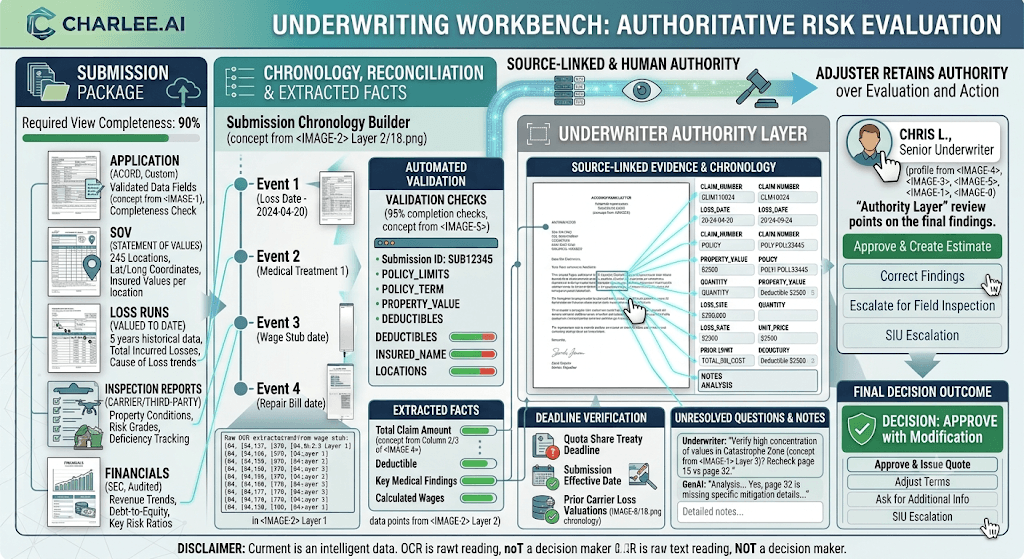
A broker submits an application, statement of values, five years of loss runs, inspection reports, financial statements, schedules, and narrative correspondence. The underwriter needs a consistent view of locations, construction, occupancy, protection, limits, losses, recommendations, and unresolved gaps before risk evaluation begins.
Controlled Workflow
Preserve submission files and broker metadata and identify package, document, and version relationships.
Classify applications, SOVs, loss runs, inspections, financials, and supporting schedules.
Extract named insured, addresses, occupancy, construction, year built, protection, values, limits, deductibles, loss dates, causes, paid and incurred amounts, and open-claim status.
Normalize addresses and entity names and compare them across the application, SOV, loss runs, and policy-system data.
Cross-foot location values and loss totals; identify duplicate rows, missing years, incomplete fields, and conflicting facts.
Extract inspection recommendations, status, due dates, and evidence of completion when present.
Present the underwriter with an evidence-linked summary, data-quality exceptions, and unresolved questions.
Record underwriter corrections and final disposition while preserving the original submission.
Decision-Support Outputs
| Output | Use |
|---|---|
| Submission completeness view | Shows which required documents and fields are present or missing. |
| Location schedule | Organizes exposure values and characteristics by site. |
| Loss history table | Summarizes loss count, cause, paid, incurred, status, and period. |
| Conflict register | Lists facts that differ across documents or systems. |
| Recommendation tracker | Shows inspection recommendations, owners, and status. |
| Source-linked risk summary | Gives the underwriter fast access to supporting evidence. |
Decision-Support Outputs
Underwriter authority The system prepares and organizes the submission. The underwriter retains authority over appetite, risk selection, pricing, limits, deductibles, terms, referrals, and binding.
Decision-Support Outputs
TECHNOLOGY BOUNDARIES
IDP Compared with Related Technologies
Decision-Support Outputs
| Technology | Primary purpose | Relationship to IDP |
|---|---|---|
| OCR | Convert visual text into machine-readable text. | A component used when reliable text is not already available. |
| Document classification | Identify document type or category. | A core IDP step used for routing and extraction selection. |
| Data extraction | Capture fields, entities, tables, and relationships. | A core IDP function that should include validation and provenance. |
| Document intelligence | Interpret document meaning and relationships. | The analytical layer within or adjacent to IDP. |
| Enterprise content management | Store, retrieve, retain, and govern content. | Often supplies and receives documents and metadata. |
| Robotic process automation | Automate user-interface or rule-based tasks. | May execute downstream steps, but does not inherently understand documents. |
| Generative AI | Generate or transform language and images. | May summarize or explain evidence but requires grounding and controls. |
| RAG | Retrieve evidence to support generated answers. | Can use IDP-produced text and metadata as a governed knowledge source. |
| Predictive AI | Estimate future outcomes or probabilities. | May consume validated document-derived features. |
IDP vs. Simple Form Capture
Simple form capture works well when layouts are stable and fields are known. IDP is designed for variable, mixed, and package-based documents. It adds classification, multiple extraction strategies, confidence, validation, reconciliation, workflow, and monitoring.
IDP vs. “Upload and Summarize”
A generic upload-and-summarize tool may produce useful prose, but it does not necessarily preserve provenance, validate critical values, manage document versions, route exceptions, integrate with systems of record, or meet insurance security and audit requirements. Summarization can be one controlled IDP output; it is not the complete operating model.
IDP vs. Straight-Through Automation
IDP enables straight-through processing only when document type, confidence, validation, materiality, and business rules support it. Straight-through processing is an outcome for defined low-risk cases, not a universal design objective.
EVALUATION
How to Measure IDP Quality
Technical Metrics
| Metric | What it measures | Limitation |
|---|---|---|
| Classification precision | How often assigned document labels are correct. | Does not measure missed document types. |
| Classification recall | How often target documents are found. | Does not measure false positives. |
| Field accuracy | Share of extracted values that exactly match reference data. | Exact match may over-penalize harmless formatting differences. |
| Field precision and recall | Correctness and completeness of captured fields. | Must be reported by field and document type. |
| Table accuracy | Correct rows, columns, cells, and structure. | Aggregate scores can hide material total errors. |
| Validation pass rate | Share of results satisfying defined checks. | Weak rules can produce misleadingly high rates. |
| Exception rate | Share requiring manual review. | Lower is not always better if risk is being hidden. |
| Latency | Time from receipt to usable output. | Speed should not displace accuracy or control. |
| Cost per page or package | Processing and review cost. | Must be considered with quality and business value. |
Business-Weighted Metrics
Insurance programs should weight errors by consequence. A wrong page count and a wrong policy limit are not equivalent. Critical fields, deadlines, identifiers, monetary values, and regulatory notices require separate reporting and stronger thresholds.
| Business metric | Illustrative question |
|---|---|
| Critical-fact error rate | How often are decision-relevant dates, amounts, parties, or identifiers wrong? |
| Missed-material-document rate | How often does the workflow fail to identify a document that changes handling? |
| Professional correction rate | Which fields or document types require frequent correction? |
| Time to first meaningful review | How quickly can the authorized user understand the evidence? |
| Rework and reopen rate | Does incomplete or incorrect processing create downstream work? |
| Audit retrieval time | Can reviewers reconstruct the source and processing history quickly? |
| Outcome quality | Did the workflow improve timeliness, completeness, consistency, or service? |
Measurement rule Report performance by document type, source, business line, field, language, and materiality. Portfolio averages can conceal dangerous pockets of poor performance.
DATA
Document Data Requirements and Preparation
Ground Truth and Annotation
Reference labels should define document type, page boundaries, fields, tables, entities, relationships, and acceptable normalization. Annotation instructions must resolve ambiguity consistently. Material fields may require double review or adjudication. Ground truth should preserve the source representation and the normalized business value separately.
Data Leakage and Contamination
- Do not place near-duplicate versions of the same document package across training and test sets.
- Separate documents by claim, policy, insured, provider, vendor, and time when needed to prevent memorization.
- Remove or control labels that expose the answer through filenames, folder paths, or downstream status fields.
- Evaluate new layouts, vendors, and time periods that were not present during development.
- Protect test sets from repeated tuning and operational feedback loops.
Synthetic and Augmented Data
Synthetic data can help test rare layouts, image degradation, or formatting variation, but it should not replace representative production data. Augmentation should mimic realistic capture conditions and should not create artificial patterns that models learn instead of business content.
Retention and Minimization
Retain only what is needed for the approved purpose, legal obligations, audit, and controlled improvement. Separate production evidence from development corpora. Apply access, encryption, retention, deletion, and legal-hold controls to derived text and embeddings as well as original documents.
RISK AND GOVERNANCE
Principal Risks of IDP
| Risk | Insurance consequence | Control response |
|---|---|---|
| Misclassification | Document goes to the wrong workflow or extraction model. | Unknown class, thresholds, fallback routing, and monitoring. |
| Incorrect extraction | Wrong amount, date, party, code, or status enters the process. | Field-level confidence, validation, and materiality-based review. |
| Missed information | A material page, table row, note, or amendment is ignored. | Recall testing, package controls, completeness checks, and source review. |
| Duplicate or version error | Old or repeated information is treated as current. | Version detection, chronology, and explicit supersession rules. |
| Hallucinated interpretation | Generated summary states unsupported facts. | Evidence grounding, constrained output, citation checks, and review. |
| Privacy exposure | Sensitive claim or applicant data is accessed or retained improperly. | Least privilege, encryption, logging, minimization, and retention controls. |
| Bias or disparate impact | Document quality or language differences affect groups unevenly. | Segmented testing, accessible channels, exception paths, and governance. |
| Automation bias | Users over-trust system output. | Visible uncertainty, source access, training, and authority boundaries. |
| Integration failure | Incorrect or duplicate writes affect systems of record. | Idempotency, transaction controls, reconciliation, and rollback. |
| Model or template drift | Performance declines as documents and business practices change. | Monitoring, change detection, controlled updates, and revalidation. |
Risk Tiering
| Tier | Example | Expected control |
|---|---|---|
| Lower | Index a correspondence document or make archive text searchable. | Automated processing with monitoring and easy source access. |
| Moderate | Prepopulate non-material intake fields. | Validation and targeted review of exceptions. |
| High | Extract settlement deadlines, limits, billed totals, or underwriting values. | Strong validation, source confirmation, approval, and audit. |
| Restricted | Make or execute coverage, settlement, fraud, or adverse underwriting decisions. | Do not delegate solely to IDP; retain authorized human decision-making. |
GOVERNANCE
Responsible IDP Operating Model
Governance Loop
Approve the business purpose, document scope, users, outputs, and authority boundaries.
Confirm lawful and authorized data use, privacy requirements, retention, and security controls.
Validate models, rules, templates, integrations, and human-review workflows before deployment.
Provide explanations, source evidence, confidence, and exception reasons to the professional reviewer.
Record decisions, corrections, overrides, approvals, and downstream actions.
Monitor technical performance, business outcomes, user behavior, incidents, drift, and complaints.
Control changes through testing, versioning, approval, deployment, rollback, and communication.
Minimum Control Set
| Control domain | Required practices |
|---|---|
| Purpose and scope | Approved use case, prohibited uses, document inventory, and business owner. |
| Data governance | Authority, minimization, quality, lineage, retention, and deletion. |
| Model governance | Validation, versioning, thresholds, monitoring, drift, and retirement. |
| Security | Encryption, access control, segregation, secrets management, vulnerability response, and logging. |
| Human oversight | Role definitions, review criteria, authority limits, training, and escalation. |
| Evidence and explainability | Source links, coordinates, confidence, validation results, and processing history. |
| Integration controls | Approved interfaces, idempotency, reconciliation, retry, and rollback. |
| Incident response | Detection, containment, impact assessment, correction, notification, and prevention. |
| Third-party oversight | Contractual controls, data location, subprocessors, testing, audit rights, and exit plan. |
Governance principle The standard of control should be driven by the consequence of an error—not by how impressive the model appears or how high its average accuracy score is.
OPERATING MODEL
Human-in-the-Loop Review
| Trigger | Example | Review action |
|---|---|---|
| Low confidence | An amount or identifier is difficult to read. | Verify against the highlighted source. |
| Validation failure | Line items do not equal the total. | Resolve extraction or source-document error. |
| Cross-document conflict | Loss date differs between report and correspondence. | Determine which source is authoritative or request clarification. |
| High materiality | Settlement deadline or limit is extracted. | Require explicit confirmation and logged approval. |
| Unsupported document | Unknown layout or language is received. | Route to trained staff without forcing automation. |
| Policy restriction | Document contains protected or privileged content. | Limit access and apply special handling. |
| User disagreement | Professional believes output is incomplete or wrong. | Correct, document rationale, and escalate systemic issues. |
Reviewer Experience
- Show the original page beside the extracted value.
- Highlight the exact source region and display surrounding context.
- Separate raw text, normalized value, model interpretation, and business rule result.
- Display confidence and the reason for review in plain language.
- Allow correction without requiring rekeying the entire document.
- Capture rationale for material overrides.
- Avoid presenting uncertain output as final or authoritative.
- Provide quick navigation among related pages and conflicting facts.
Learning from Corrections
Corrections can improve rules, models, templates, and training data, but only through a controlled process. User changes should not automatically retrain production models. Review correction quality, protect sensitive data, avoid reinforcing inconsistent practices, and validate any updated component before release.
IMPLEMENTATION
A Practical IDP Deployment Blueprint
Phase 1 — Select and Define
- Choose a document workflow with meaningful volume, repeatability, accessible data, and measurable pain.
- Define document types, business outputs, critical fields, users, authority boundaries, and failure paths.
- Establish baseline time, cost, error, backlog, and service measures.
- Inventory systems, channels, security requirements, and integration constraints.
Phase 2 — Build and Validate
- Collect representative and authorized documents and create an adjudicated evaluation set.
- Configure ingestion, OCR, classification, extraction, validation, and review components.
- Design source-linked reviewer screens and explicit exception categories.
- Test by document type, field, source, quality, language, and materiality.
- Perform privacy, security, legal, compliance, and operational review.
Phase 3 — Pilot in Workflow
- Run in shadow or assisted mode before allowing automated system updates.
- Measure professional corrections, missed facts, latency, and downstream rework.
- Interview users about evidence quality, review burden, and trust calibration.
- Tune thresholds based on business consequence rather than a desire to minimize exceptions.
Phase 4 — Scale and Govern
- Add document types and business units through controlled release plans.
- Automate low-risk paths only after sufficient evidence and approval.
- Monitor drift, new layouts, vendor changes, data quality, incidents, and user behavior.
- Maintain ownership, service levels, change control, rollback, and retirement plans.
Implementation Deliverables
| Deliverable | Purpose |
|---|---|
| Use-case charter | Defines value, scope, owners, users, exclusions, and authority. |
| Document inventory | Lists types, volumes, channels, sensitivity, variability, and business priority. |
| Field and rule specification | Defines outputs, normalization, validation, and materiality. |
| Evaluation set | Supports repeatable technical and business testing. |
| Exception taxonomy | Creates consistent routing and reporting. |
| Integration contract | Defines inputs, outputs, identifiers, retries, and reconciliation. |
| Operating procedure | Defines review, escalation, correction, incident, and support steps. |
| Monitoring dashboard | Tracks quality, value, drift, cost, and operational health. |
STRATEGY
Build, Buy, or Combine
Decision Factors
| Factor | Questions for executives |
|---|---|
| Document complexity | Are documents standardized, variable, package-based, handwritten, multilingual, or table-heavy? |
| Insurance specialization | Does the solution understand loss runs, demands, medical bills, estimates, SOVs, and policy records? |
| Evidence and explainability | Can every result link to the supporting page, region, and processing history? |
| Validation and workflow | Can rules, reconciliation, materiality, and review be configured without fragile custom code? |
| Integration | Does it support APIs, batch, message, document, and core-system patterns? |
| Security and privacy | Are data location, isolation, encryption, access, retention, and subprocessor controls acceptable? |
| Performance and cost | Can it meet volume, latency, accuracy, review, and unit-cost requirements? |
| Change and exit | Can models, templates, prompts, rules, and data be versioned, exported, replaced, and retired? |
Common Operating Models
| Model | Strength | Trade-off |
|---|---|---|
| Packaged IDP platform | Faster deployment and broad document capabilities. | May require configuration and insurance-specific validation. |
| Cloud document services | Scalable OCR, classification, and extraction building blocks. | Customer must assemble workflow, controls, and domain logic. |
| Custom-built solution | Maximum control and tailored insurance behavior. | Higher engineering, governance, support, and model-lifecycle burden. |
| Hybrid approach | Combines vendor capabilities with carrier rules, data, and workflow. | Requires disciplined architecture and ownership across components. |
Executive guidance Most insurers should differentiate in workflow, evidence use, validation, and professional decision support—not in rebuilding every OCR or extraction component from first principles.
EXECUTION
Best Practices and Common Mistakes
Best Practices
- Start with a bounded workflow and a clear business owner.
- Preserve the original document and maintain end-to-end provenance.
- Use native text when reliable and OCR only where needed.
- Test complete packages and workflows—not only isolated pages or fields.
- Separate technical confidence, validation status, and business materiality.
- Measure critical facts independently from average accuracy.
- Design the reviewer experience before scaling automation.
- Use cross-document and system reconciliation for material values.
- Treat unknown documents and unsupported conditions as normal operating cases.
- Integrate through controlled, idempotent, auditable interfaces.
- Monitor corrections, new layouts, drift, latency, cost, and business outcomes.
- Maintain change control, rollback, incident response, and retirement plans.
Common Mistakes
| Mistake | Why it fails | Better approach |
|---|---|---|
| Equating IDP with OCR | Text alone does not classify, validate, reconcile, or route work. | Design an end-to-end document operating model. |
| Optimizing for average accuracy | Material errors can hide inside strong portfolio averages. | Measure by critical field and consequence. |
| Ignoring packages and versions | Pages lose context and old information may appear current. | Track package, sequence, duplicate, and amendment relationships. |
| Automating before validating | Incorrect data reaches systems and users faster. | Pilot in assisted mode with explicit thresholds. |
| Using generic summaries as records | Generated prose may omit, merge, or overstate facts. | Store source-linked structured facts and controlled summaries. |
| Making users review everything | Automation shifts rather than reduces work. | Route by exception, materiality, and authority. |
| Allowing silent failure | Unreadable or unknown documents disappear from the process. | Create visible fallback and completeness controls. |
| Treating corrections as automatic training | Inconsistent changes can degrade models and create privacy risk. | Curate, approve, and validate improvement data. |
EXECUTIVE DECISION GUIDE
Questions Leaders Should Ask
Business value
- Which work is repetitive, document-heavy, delayed, or error-prone?
- What baseline metrics and target outcomes will demonstrate value?
- Does the use case improve decisions and service, not merely reduce touches?
Quality and evidence
- How is performance measured by document type and critical field?
- Can every result be traced to the source page and region?
- How are conflicts, unknowns, and missed information detected?
Risk and governance
- Who owns the use case, data, model, rules, workflow, and incidents?
- How are privacy, privilege, retention, and data location managed?
- What monitoring, change control, and rollback are in place?
Architecture and vendor
- How does the solution integrate with existing content and core platforms?
- Can components be replaced without losing data, evidence, or workflow logic?
- What are the full processing, review, support, and change costs?
People and adoption
- How will professional roles and authority change?
- Is the review experience fast, transparent, and source-linked?
- How will users report errors and learn appropriate trust?
People and adoption
Go/no-go test Proceed when the use case has a defined owner, measurable value, representative documents, validated critical-field performance, source-linked outputs, explicit human authority, controlled integration, and an operational failure path. Delay scale-up when any of these are missing.
People and adoption
CHARLEE.AI PERSPECTIVE
Document Intelligence for Insurance Decisions
From Document Handling to Decision Support
For insurers, the purpose of IDP is not simply to digitize pages. It is to make the evidence inside those pages available at the moment a claims professional, underwriter, manager, or specialist needs it. The most useful solution connects document-derived facts with claim or risk context, presents source evidence, identifies meaningful changes and exceptions, and fits the operating workflow.
Human Judgment—Amplified
A responsible insurance architecture uses AI to continuously analyze information while professionals retain responsibility for decisions. IDP can organize a demand package, extract medical events, reconcile loss runs, identify inspection recommendations, or compare estimate versions. It should explain what it found, where it found it, how confident it is, and what remains unresolved.
A Practical Insurance Pattern
Approved purpose and governed data.
Secure document ingestion and source preservation.
Validated OCR, classification, extraction, and reconciliation.
Evidence-linked facts, chronology, and explanation.
Professional review and accountable decision.
Documentation of action and rationale.
Monitoring, feedback, incident response, and controlled change.
Where Value Compounds
When document intelligence is integrated across claims, underwriting, management, and implementation, value compounds. The same governed capabilities can support intake, triage, severity and litigation monitoring, medical review, reserve oversight, submission review, portfolio analysis, and management reporting—without removing professional authority.
Charlee.ai principle Better AI begins with better information. Better insurance outcomes require that information to be timely, explainable, source-linked, governed, and placed in the hands of accountable professionals.
PRODUCTION NOTES
Illustrations
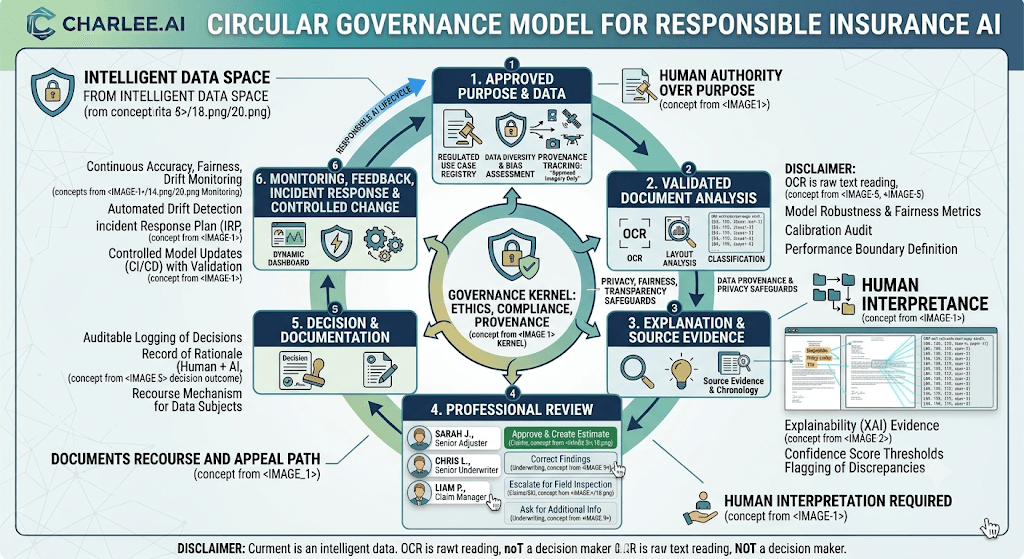
Illustration 5 — Human-in-the-Loop Governance Loop
FREQUENTLY ASKED QUESTIONS
IDP Questions — Part 1
Key Takeaways
- IDP is an operating capability, not a single model or OCR feature.
- It combines document intake, reading, classification, extraction, validation, reconciliation, workflow, integration, and review.
- Insurance value comes from making evidence usable in the professional workflow.
- Every important fact should retain source provenance and processing history.
- Critical-field quality and missed-material-information rates matter more than average accuracy alone.
- Confidence must be combined with validation, materiality, and authority.
- Human review should be designed by exception, consequence, and role.
- Generative AI can explain and summarize, but it should be grounded in document evidence.
- Straight-through processing is appropriate only for approved low-risk cases that pass all controls.
- Governance, monitoring, integration controls, and incident response are part of the product—not administrative afterthoughts.
- IDP should augment claims and underwriting professionals, not remove accountable judgment.
Two-minute definition Intelligent Document Processing is an end-to-end capability that receives documents, determines what they are, reads their contents, extracts and validates important information, routes exceptions, and delivers evidence-linked results into insurance workflows. OCR is one component of IDP; IDP adds insurance context, controls, integration, and action.
Frequently Asked Questions
No. OCR converts visible text into machine-readable text. IDP adds ingestion, classification, extraction, validation, reconciliation, workflow, integration, review, audit, and monitoring.
Not every step. Production solutions typically combine deterministic rules, OCR, machine learning, NLP, validation, and workflow. The mix should match the document and risk.
Yes. It should first inspect and use reliable embedded text rather than automatically re-running OCR, which can introduce errors or duplicate text layers.
Some systems can recognize handwriting, but performance varies materially. Handwritten, abbreviated, or poor-quality content often requires specialized models and human verification.
Yes, but table extraction requires layout and structure recognition, not merely text capture. Totals, row relationships, merged cells, and repeated headers should be validated.
It can support source-grounded summaries after documents are organized and facts are extracted. Summaries should link to evidence and should not replace professional review.
It can, but automated writes should be limited to approved use cases with validation, thresholds, idempotency, reconciliation, logging, and rollback.
High-volume, repetitive, reasonably bounded document sets with measurable pain—such as loss runs, invoices, estimates, applications, correspondence, or defined intake packages.
Low-quality scans, handwriting, complex tables, mixed languages, photographs, long compound packages, frequently changing layouts, and records with conflicting versions. FREQUENTLY ASKED QUESTIONS IDP Questions — Part 2
There is no single acceptable number. Required performance depends on field materiality, intended use, validation, human review, and consequence of error. Critical fields should have separate thresholds and testing.
No. Confidence is model-specific and may be poorly calibrated. Combine confidence with validation, source evidence, materiality, and workflow rules.
Route them to a safe fallback queue, retain the original, capture metadata, and monitor frequency. Do not force them into the closest known category.
Record them for audit and analysis. Curate and approve corrections before using them to change rules or retrain models, and validate changes before release.
It can reduce routine handling and focus review on exceptions, but material and ambiguous information still requires authorized professional judgment.
By preserving the original document, linking outputs to pages and regions, showing raw and normalized values, displaying validation results, and recording processing history.
Least-privilege access, encryption, data minimization, retention and deletion rules, audit logs, protected-data handling, vendor oversight, and legal-hold processes.
IDP can provide structured, source-linked evidence for grounded summarization, question answering, and explanation. Generated outputs should remain constrained to retrieved evidence and reviewed according to risk.
A balanced scorecard: critical-field quality, missed-material-information rate, review time, correction and rework, timeliness, user adoption, auditability, cost, and business outcome improvement. REFERENCE Related Terms and Knowledge Center Links