Executive Summary
Generative AI is a class of artificial intelligence that creates new content - including summaries, explanations, draft communications, structured data, and recommended next steps - based on patterns learned from large volumes of information. Unlike traditional automation, which follows predefined rules, generative AI can interpret context and produce language that is tailored to a specific task.
For Property & Casualty insurers, the technology is especially relevant because insurance work is document intensive. Claim files, medical records, demand packages, underwriting submissions, policy forms, inspection reports, legal correspondence, emails, and notes often contain the information needed for a decision, but that information may be scattered across hundreds or thousands of pages.
Generative AI can help organize and explain that information. It can create claim summaries, medical chronologies, underwriting risk summaries, draft correspondence, portfolio narratives, and question-and-answer experiences grounded in approved enterprise content. The value comes from reducing the time required to find, read, organize, and communicate information - not from transferring decision authority to a model.
Production use requires controls. Outputs should be grounded in trusted sources, linked to evidence, reviewed by qualified professionals, protected by appropriate security and privacy controls, and monitored for quality. In material insurance decisions, generative AI should support human judgment rather than replace it.
EXECUTIVE TAKEAWAY
Generative AI is most valuable when it converts complex insurance information into usable, reviewable work products while preserving human authority, source evidence, and governance.
Quick Facts
| Topic | Information |
|---|---|
| Category | Artificial Intelligence |
| Primary capability | Generate new content from prompts, context, and learned patterns |
| Typical insurance inputs | Claim notes, medical records, demand packages, policy documents, submissions, emails, reports, and structured data |
| Typical outputs | Summaries, chronologies, explanations, draft communications, extracted fields, and question-and-answer responses |
| Common enabling technologies | Foundation models, large language models, natural language processing, embeddings, vector databases, and retrieval-augmented generation |
| Human oversight | Required for material business decisions and quality assurance |
| Primary operational value | Faster information review, more consistent work products, and improved access to enterprise knowledge |
| Primary risks | Unsupported output, incomplete context, privacy exposure, bias, overreliance, and weak change control |
Definitions
Executive Definition
Generative AI is technology that creates new content from instructions and available information. In insurance, it helps professionals turn complex records into usable summaries, explanations, and drafts that can be reviewed and acted upon.
Technical Definition
Generative AI models estimate and generate likely sequences of tokens, pixels, audio elements, or other data based on patterns learned during training. Modern text systems commonly use transformer architectures and may combine a foundation model with retrieval, enterprise data, prompts, rules, and workflow controls.
Insurance Definition
In P&C insurance, generative AI is a decision-support and productivity capability that interprets structured and unstructured insurance information and produces reviewable work products for claims, underwriting, customer service, legal, operations, and management teams.
Why Generative AI Matters to Insurance
Insurance operations depend on language. Professionals must interpret what happened, identify what changed, understand obligations, evaluate evidence, document reasoning, and communicate decisions. The difficulty is rarely a lack of information. More often, the difficulty is that the information is fragmented, repetitive, inconsistent, or buried in lengthy documents.
Generative AI addresses this friction by converting source information into a form that is easier to review. A model can summarize a 400-page claim file, organize a medical chronology, compare an underwriting submission with appetite guidelines, or draft a customer communication. The professional can then validate the output, examine the supporting evidence, correct missing context, and make the decision.
The strategic opportunity is broader than faster writing. Properly implemented, generative AI can create a common layer for accessing enterprise knowledge, standardizing work products, improving handoffs, and helping experienced professionals focus on judgment-intensive activity.
How Generative AI Works
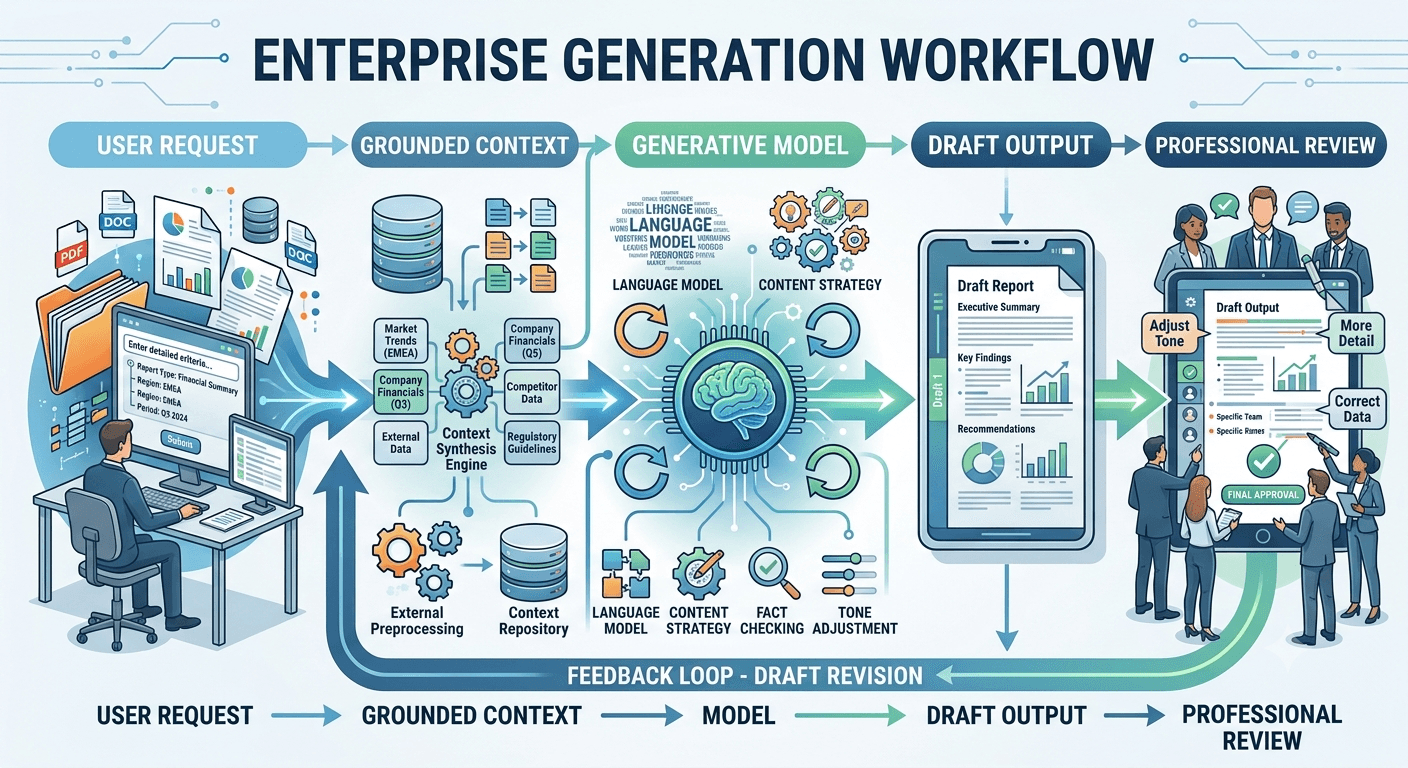
1. Define the task - The user or workflow specifies the business objective, such as summarizing a demand package or preparing an underwriting risk overview.
2. Assemble approved context - The system gathers relevant prompts, documents, structured data, business rules, and enterprise knowledge.
3. Retrieve supporting information - When retrieval-augmented generation is used, the system locates the most relevant passages from approved sources.
4. Generate the output - The model produces a response based on the prompt and available context.
5. Attach evidence and controls - The application may provide citations, confidence indicators, required fields, validation rules, or escalation conditions.
6. Professional review - A claims professional, underwriter, manager, or other qualified user validates the result and determines what action to take.
7. Monitor and improve - Organizations track output quality, user corrections, incidents, drift, and changing business requirements.
GOVERNED WORKFLOW
Approved purpose and data -> validated context -> generated output -> source evidence -> professional review -> decision and documentation -> monitoring, feedback, and controlled change.
Generative AI Compared with Other Approaches
| Approach | Primary purpose | Best suited for | Insurance example |
|---|---|---|---|
| Traditional automation | Execute predefined rules | Stable, deterministic tasks | Route a claim when a known field meets a rule |
| Predictive AI | Estimate an outcome or probability | Scoring, forecasting, prioritization | Predict severity or litigation risk |
| Generative AI | Create or transform content | Summaries, explanations, drafts, knowledge access | Create a medical chronology with evidence |
| Human expertise | Interpret context and exercise judgment | Decisions, exceptions, negotiation, accountability | Set strategy, determine coverage, negotiate settlement |
Foundation Models, LLMs, and RAG
Foundation Model
A broadly trained model that can support many tasks. It becomes useful in an enterprise application when combined with instructions, approved data, security, and workflow controls.
Large Language Model (LLM)
A foundation model designed to process and generate language. It predicts likely token sequences and can perform tasks such as summarization, extraction, classification, drafting, and question answering.
Retrieval-Augmented Generation (RAG)
A method that retrieves relevant content from approved sources and supplies it to the model when generating a response. RAG helps ground the output in current enterprise information and can support source citations.
Prompt and Workflow Layer
The instructions, schemas, business rules, validations, and process logic that shape the output and place it into an insurance workflow.
Human Review Layer
The professional controls that validate the result, resolve ambiguity, correct context, and authorize action.
Applications Across the P&C Insurance Value Chain
| Function | Generative AI contribution | Required professional role |
|---|---|---|
| FNOL | Summarize loss descriptions and identify missing information | Validate facts, determine routing, and contact involved parties |
| Claims | Create claim summaries, timelines, and status narratives | Assess coverage, liability, damages, reserves, and strategy |
| Medical review | Organize treatment history and extract clinical milestones | Evaluate relevance, causation, reasonableness, and next steps |
| Litigation | Summarize pleadings, correspondence, and legal developments | Set litigation strategy and manage counsel |
| Underwriting | Create submission summaries and compare information with appetite criteria | Select risk, determine terms, and approve exceptions |
| Customer service | Draft clear responses based on approved information | Review tone, accuracy, obligations, and customer impact |
| Management | Produce portfolio narratives and operational summaries | Interpret trends, set priorities, and allocate resources |
Real Insurance Scenario: Demand Package Review
A bodily injury adjuster receives a demand package containing medical records, bills, wage information, photographs, a police report, prior correspondence, and a settlement demand. The file exceeds 500 pages and contains duplicative and conflicting information.
A governed generative AI workflow creates a structured summary. It organizes the alleged injuries, treatment chronology, providers, diagnostic findings, procedures, claimed damages, prior conditions mentioned in the records, inconsistencies, and unresolved questions. Each important statement links back to the relevant source passage.
The adjuster reviews the summary, opens the cited documents, corrects a treatment date, identifies a coverage issue that was outside the model context, and requests a follow-up investigation. The adjuster then determines evaluation strategy and documents the reasoning in the claim system.
The model reduces reading and organization time, but the adjuster remains accountable for coverage, liability, causation, damages, negotiation, and settlement authority.
Real Insurance Scenario: Underwriting Submission Review
A commercial underwriter receives an email submission with applications, loss runs, schedules, inspection reports, financial information, and narrative attachments. The submission is incomplete and uses inconsistent terminology across documents.
Generative AI extracts key account information, creates a risk summary, identifies missing items, highlights apparent conflicts, and organizes the information against the carrier's underwriting checklist. It also drafts questions for the broker.
The underwriter verifies the source documents, evaluates risk quality, considers portfolio context, decides whether the account fits appetite, and determines terms. The generated summary improves speed and consistency; it does not select the risk or set the price.
Business Value Snapshot
| Business problem | Generative AI capability | Operational outcome | Potential measure |
|---|---|---|---|
| Lengthy document review | Summarization and extraction | Faster preparation and more consistent work products | Review time, turnaround time, correction rate |
| Fragmented claim history | Chronology and synthesis | Better understanding of claim development | Time to insight, missed-event rate |
| Inconsistent communications | Drafting from approved context | Clearer and more standardized correspondence | Rewrite rate, quality score, response time |
| Knowledge access difficulty | Grounded question answering | Faster access to policy, procedure, and product information | Search time, resolution time, escalation rate |
| Management reporting burden | Narrative generation from governed data | More timely portfolio communication | Report cycle time, manual preparation hours |
Risks and Governance Considerations
- Unsupported or fabricated output: Require grounding, source evidence, structured outputs, validation, and review.
- Incomplete context: Define what sources are authoritative and disclose when important information is unavailable.
- Privacy and confidentiality: Apply access controls, data minimization, encryption, logging, and approved hosting and retention practices.
- Bias and unfair impact: Test use cases, data, outputs, and downstream decisions for inappropriate differences or proxies.
- Overreliance: Design the workflow so users verify outputs and retain authority for material decisions.
- Prompt and model change: Version prompts, models, retrieval sources, and workflow logic; test changes before production release.
- Model drift and quality degradation: Monitor accuracy, completeness, citation quality, user corrections, and incident trends.
- Regulatory and contractual obligations: Map the use case to applicable laws, policy obligations, customer commitments, and internal governance requirements.
RESPONSIBLE AI PRINCIPLE
A generated response is not a business decision. The system should explain what information it used, make uncertainty visible, and route the output to an accountable professional.
Best Practices
- Start with a defined business problem and measurable outcome.
- Use approved, relevant, and current enterprise information.
- Ground outputs in source evidence whenever factual accuracy matters.
- Use structured output formats for repeatable workflows.
- Require qualified human review for material decisions.
- Separate drafting assistance from decision authority.
- Test representative edge cases, not only average examples.
- Monitor user corrections and incorporate them into controlled improvement.
- Establish incident response, rollback, and change-management procedures.
- Train users to understand both capabilities and limitations.
Common Mistakes to Avoid
- Deploying a general chatbot without a defined workflow.
- Assuming fluent language is the same as factual accuracy.
- Allowing the model to answer from unapproved or stale sources.
- Measuring adoption without measuring output quality or business value.
- Using generated content without professional validation.
- Failing to define ownership for prompts, data, models, and incidents.
- Treating a pilot demonstration as proof of production readiness.
- Ignoring integration, security, and operational change management.
Common Myths and Misconceptions
Myth: Generative AI understands insurance the way an experienced professional does.
Reality: It generates language from learned patterns and supplied context. It does not possess professional judgment, accountability, or lived experience.
Myth: A strong model eliminates the need for retrieval and governance.
Reality: Enterprise accuracy depends on current approved information, workflow controls, and review.
Myth: Generative AI and predictive AI are interchangeable.
Reality: Generative AI creates content; predictive AI estimates outcomes. They can complement each other but solve different problems.
Myth: More automation is always better.
Reality: The right design automates preparation and routine transformation while preserving judgment, exceptions, and accountability.
Myth: Once deployed, the capability is complete.
Reality: Models, prompts, data sources, and business requirements change. Production systems require continuous monitoring and controlled updates.
Executive Decision Point
WHAT LEADERS SHOULD KNOW
Generative AI is not a standalone transformation strategy. It becomes valuable when tied to a workflow, trusted information, accountable users, and measurable operational outcomes.
Questions to ask about the use case
- What specific work product will the system create?
- Who reviews it, and who owns the final decision?
- What is the current cost, delay, or quality problem?
- How will success be measured?
Questions to ask about data and evidence
- Which sources can the system use?
- How current and complete are those sources?
- Will users see citations or supporting passages?
- How are sensitive data and customer information protected?
Questions to ask vendors
- What model, retrieval, and workflow components are used?
- How are outputs evaluated before and after deployment?
- How are prompt, model, and source changes governed?
- What logs, controls, audit records, and incident procedures are available?
Readiness indicators
- The business problem is clearly defined.
- Representative data and documents are available.
- Professional reviewers are engaged.
- Security and governance requirements are known.
- The organization can measure quality and business impact.
Charlee.ai Perspective
Generative AI should be part of a broader insurance intelligence architecture. On its own, a language model can create useful text, but it may not know which claims require attention, which developments changed exposure, or which documents contain the most important evidence.
The stronger approach combines document intelligence, natural language processing, predictive models, enterprise data, source retrieval, and governed generative AI. Predictive capabilities help prioritize risk. Document intelligence locates and structures evidence. Generative AI explains and communicates the information. Insurance professionals validate the result and decide what action to take.
This people-plus-AI model improves productivity without confusing assistance with authority. The objective is not to remove the professional from the workflow. It is to help the professional see more, understand faster, and act with greater confidence.
CHARLEE.AI INSIGHT
Better insurance AI is not defined by how much text a model can generate. It is defined by whether the right professional receives the right evidence, explanation, and context early enough to improve the decision.
Key Takeaways
- Generative AI creates new content from prompts, learned patterns, and supplied context.
- Its strongest insurance use cases involve document review, summarization, extraction, drafting, and enterprise knowledge access.
- Fluent output is not proof of accuracy; source grounding, evidence, validation, and professional review are essential.
- Generative AI and predictive AI solve different problems and create more value when combined in a governed workflow.
- The business objective is to improve professional capacity, consistency, and decision support - not to transfer accountability to a model.
Generative AI is a class of artificial intelligence that creates new content - including summaries, explanations, draft communications, structured data, and recommended next steps - based on patterns learned from large volumes of information. Unlike traditional automation, which follows predefined rules, generative AI can interpret context and produce language that is tailored to a specific task.
For Property & Casualty insurers, the technology is especially relevant because insurance work is document intensive. Claim files, medical records, demand packages, underwriting submissions, policy forms, inspection reports, legal correspondence, emails, and notes often contain the information needed for a decision, but that information may be scattered across hundreds or thousands of pages.
Generative AI can help organize and explain that information. It can create claim summaries, medical chronologies, underwriting risk summaries, draft correspondence, portfolio narratives, and question-and-answer experiences grounded in approved enterprise content. The value comes from reducing the time required to find, read, organize, and communicate information - not from transferring decision authority to a model.
Production use requires controls. Outputs should be grounded in trusted sources, linked to evidence, reviewed by qualified professionals, protected by appropriate security and privacy controls, and monitored for quality. In material insurance decisions, generative AI should support human judgment rather than replace it.
Frequently Asked Questions
No. Artificial intelligence is the broader field. Generative AI is a category within AI that creates new content such as text, images, audio, or structured output.
Generative AI commonly uses machine learning, but machine learning also includes prediction, classification, clustering, and other methods that do not generate content.
It can automate parts of information review, summarization, drafting, and knowledge access. Material insurance decisions still require professional judgment, accountability, and authority.
A hallucination is an output that appears plausible but is unsupported, incorrect, or inconsistent with the available evidence. Grounding, citations, validation, and human review help reduce the risk.
Retrieval-augmented generation supplies relevant content from approved sources when the model answers a question or creates a work product. It helps improve currency, relevance, and traceability.
Yes, when deployed with appropriate architecture, access controls, security, privacy, retention, and contractual safeguards. The design should match the sensitivity and purpose of the data.
Evaluation should use representative insurance examples and measure factual support, completeness, citation quality, consistency, required-field performance, and professional correction rates.
Document summarization, information extraction, chronology creation, draft communications, enterprise knowledge access, and narrative reporting are strong candidates when controls and review are in place.
Generative AI creates content. Predictive AI estimates an outcome or probability. A claims platform may use predictive AI to identify a high-risk claim and generative AI to explain the signals and summarize the supporting evidence.
Organizations should monitor output quality, unsupported statements, citations, user corrections, response times, incidents, security events, model and prompt changes, and business impact.