Executive Snapshot
Explainable AI (XAI) is the discipline of making AI outputs sufficiently understandable for the people who must evaluate, challenge, approve, document, and monitor their use. In P&C insurance, explainability is not a decorative feature. It is an operating requirement for responsible decision support in claims, underwriting, fraud, reserving, and management.
| Question | Executive answer |
|---|---|
| What problem does XAI solve? | It converts model output into evidence that professionals can review and use responsibly. |
| Who needs it? | Adjusters, underwriters, supervisors, model validators, compliance teams, auditors, and executives. |
| What does good explainability look like? | Relevant drivers, source evidence, confidence, limitations, alternatives, and a documented human decision. |
| What does it not do? | It does not prove causation, eliminate bias, guarantee accuracy, or replace professional judgment. |
| Where is it most valuable? | High-impact, disputed, regulated, novel, or financially material decisions. |
EXECUTIVE RULE
The greater the potential impact on a claimant, insured, producer, employee, or portfolio, the stronger the explanation, evidence, review, and documentation should be.
Executive Key Takeaways
Insurance organizations increasingly rely on AI to identify severity signals, predict litigation, summarize documents, prioritize work, support underwriting, and detect unusual activity. These systems can improve speed and consistency, but only when users understand what the output means, how much confidence to place in it, and what evidence supports it.
Explainable AI provides that bridge. For predictive models, an explanation may show the factors that most influenced a score and how the score compares with similar claims. For generative AI, it may provide citations, source passages, uncertainty cues, and a record of the instructions and tools used. For AI agents, it should include the plan, tool calls, permissions, retrieved evidence, actions taken, and any points requiring approval.
A mature XAI program connects model design, workflow design, governance, and professional accountability. The goal is not to expose every mathematical detail. The goal is to provide the right explanation to the right person at the right time, in language and evidence appropriate to the decision.
- Explainability must be designed around the decision and user—not only the model.
- Different AI types require different explanation methods.
- Evidence and provenance are often more useful than a technical feature chart.
- Local explanations help review an individual output; global explanations help understand overall model behavior.
- Human review remains the control point for consequential insurance decisions.
Business outcomes supported by XAI
FOUNDATION
- Faster professional review and escalation.
- Better documentation of claim and underwriting decisions.
- More effective model validation and challenge.
- Greater adoption because users can understand and test the output.
- Improved governance, audit readiness, and controlled change.
Definitions and Quick Facts
Executive definition
Explainable AI is the capability to present AI results in a form that allows a business user to understand the principal reasons, supporting evidence, confidence, and limitations relevant to a decision.
Technical definition
Explainable AI comprises model-transparent designs and post-hoc methods that characterize model behavior, attribute output to inputs, retrieve supporting evidence, generate counterfactuals, quantify uncertainty, or expose system actions and provenance.
In insurance, XAI is the set of methods and controls that enables professionals to review, challenge, document, and responsibly act on AI-supported insights affecting claims, underwriting, pricing, fraud, reserving, operations, and portfolio management.
Technical definition
| Term | Practical meaning |
|---|---|
| Interpretability | How inherently understandable a model or rule is. |
| Explainability | How the system communicates reasons, evidence, and limitations. |
| Transparency | Visibility into data, model, process, ownership, and controls. |
| Traceability | Ability to reconstruct the data, version, output, review, and action. |
| Provenance | Origin and lineage of the evidence used. |
| Contestability | Ability for a person to challenge, correct, or override the output. |
Technical definition
BUSINESS CONTEXT
Why Explainability Matters in P&C Insurance
P&C decisions are made under uncertainty, often with incomplete information and material financial or human consequences. A severity score, litigation alert, coverage summary, or underwriting recommendation may be useful, but the user must still understand the basis for the result and determine whether it fits the facts of the case.
| Insurance need | How XAI helps |
|---|---|
| Professional judgment | Shows the signals and evidence that merit attention. |
| Fair treatment | Supports consistent review and challenge of potentially adverse effects. |
| Auditability | Preserves a record of model, data, explanation, reviewer, and action. |
| Operational adoption | Reduces “black box” resistance and teaches users how to use the output. |
| Model risk management | Enables validation, monitoring, drift analysis, and exception review. |
| Dispute readiness | Improves the ability to explain what information informed a decision. |
IMPORTANT LIMIT
An explanation can be plausible but incomplete or misleading. Explanations must be tested for fidelity, stability, usefulness, and consistency with the underlying system.
CONCEPTUAL DISTINCTIONS
Explainability vs. Interpretability and Transparency
| Concept | Primary question | Insurance example |
|---|---|---|
| Interpretability | Can a person understand how the model works? | A short decision tree for triage. |
| Explainability | Can a person understand why this result occurred? | Top drivers and evidence for a litigation-risk alert. |
| Transparency | Can governance teams see what data, model, and process were used? | Model card, data lineage, owner, version, and approval history. |
| Traceability | Can the organization reconstruct the event? | Claim snapshot, score, explanation, reviewer action, and timestamp. |
| Accountability | Who owns and approves the decision? | The adjuster or underwriter—not the model. |
A useful design principle
Do not ask whether an AI system is “explainable” in the abstract. Ask whether a specific user can understand and appropriately act on a specific output in a specific workflow.
TWO COMPLEMENTARY VIEWS
- Executives need portfolio-level behavior, risk, value, and controls.
- Validators need data lineage, performance, sensitivity, and failure analysis.
- Adjusters and underwriters need case-level reasons, evidence, and next-best review steps.
- Auditors need reproducibility, documentation, approvals, and change history.
Global and Local Explanations
Global explanations
Global explanations describe how a model behaves across a population. They help leaders and validators understand major drivers, interactions, segments, thresholds, and stability over time.
Local explanations
Local explanations describe why the system produced a particular result for an individual claim, submission, document, or transaction. They support case-level review and documentation.
Local explanations
| Dimension | Global | Local |
|---|---|---|
| Primary audience | Executives, model owners, validators | Adjusters, underwriters, supervisors |
| Primary purpose | Understand overall behavior and risk | Review one output or decision |
| Common methods | Feature importance, PDP, segment analysis | SHAP values, counterfactuals, evidence citations |
| Common risk | Averages can hide subgroup behavior | One explanation may be unstable or oversimplified |
| Best practice | Pair with segment and drift analysis | Pair with source evidence and professional review |
Local explanations
METHOD SELECTION
Intrinsic and Post-Hoc Explainability
Some models are understandable by design. Others require an additional method to approximate or summarize their behavior after prediction. The choice should reflect accuracy needs, decision impact, user needs, and governance requirements.
| Approach | Examples | Strengths | Limitations |
|---|---|---|---|
| Intrinsic | Linear models, scorecards, small trees | Direct, stable, easier to validate | May not capture complex interactions |
| Post-hoc attribution | SHAP, LIME, permutation importance | Works with complex models | Can be sensitive to assumptions |
| Behavioral analysis | Partial dependence, ICE, sensitivity tests | Shows response patterns | May obscure correlated features |
| Example-based | Similar cases, prototypes | Intuitive for users | Similarity may not imply relevance |
| Counterfactual | What would need to change? | Supports challenge and action | Must respect feasible, lawful changes |
SELECTION PRINCIPLE
Use the simplest method that faithfully answers the user’s question. Multiple complementary explanations are often stronger than one technique used alone.
TECHNICAL TOOLKIT
Feature importance
Ranks variables by their contribution to model behavior. Global importance is useful for oversight; local importance is useful for a specific prediction.
SHAP values
Allocate a prediction across features relative to a baseline. Useful for local and global views, but dependent on background data and feature dependence assumptions.
Partial dependence and ICE
Show how predicted output changes as a feature changes. ICE preserves individual curves; partial dependence averages them.
Counterfactual explanations
Identify feasible changes that would alter a result. In insurance, constraints are essential so the explanation does not suggest impossible or inappropriate changes.
Approximate a complex model with a simpler one. Fidelity must be measured; the surrogate is not the original model.
Example-based explanations
Present similar prior cases or prototypes, with clear warnings that similarity is context—not proof.
SEVERITY, LITIGATION, FRAUD, AND UNDERWRITING
Explaining Predictive AI
Predictive AI typically produces a probability, score, class, ranking, or estimate. A complete insurance explanation should connect the numerical output to business meaning and evidence.
| Explanation layer | What to show |
|---|---|
| Result | Score, band, predicted outcome, time horizon, and model version. |
| Drivers | Factors increasing and decreasing the result, with direction and magnitude. |
| Evidence | The claim facts, document passages, structured fields, or events supporting each driver. |
| Context | Baseline, peer group, threshold, and comparison with similar cases. |
| Confidence | Calibration, data completeness, out-of-distribution warning, or uncertainty range. |
| Action | Recommended review—not an automatic adverse decision—plus escalation criteria. |
CLAIMS EXAMPLE
A litigation-risk alert is more useful when it identifies the new attorney representation, escalating treatment pattern, venue characteristics, and demand-language evidence—rather than displaying only “High Risk: 82.”
EVIDENCE-CENTERED EXPLANATIONS
Explaining Generative AI and RAG
Generative AI does not explain itself merely because it produces fluent text. For insurance use, the explanation should be evidence-centered and should distinguish source facts from model-generated interpretation.
- Citations to the exact source document and passage.
- Clear separation of extracted fact, inferred meaning, and recommended action.
- Disclosure of missing, conflicting, stale, or low-quality evidence.
- A confidence or review indicator tied to the task—not a generic number.
- Prompt, model, retrieval, and response versions sufficient for traceability.
- A professional review step before consequential use.
| Failure mode | Control |
|---|---|
| Unsupported statement | Require citations and verify entailment against sources. |
| Citation points to irrelevant text | Evaluate citation precision, not only citation presence. |
| Missing contradictory evidence | Use broad retrieval, conflict detection, and reviewer prompts. |
| Overconfident summary | Use uncertainty language and explicit missing-information checks. |
| Sensitive information exposure | Apply access controls, redaction, and least-privilege retrieval. |
ACTIONS, TOOLS, AND APPROVALS
Explaining AI Agents
An AI agent may plan, retrieve information, call tools, create work products, or initiate actions. Explainability must therefore extend beyond the final answer to the sequence of decisions and controls that produced it.
| Agent record | Insurance control value |
|---|---|
| Goal and instructions | Shows what the agent was authorized to accomplish. |
| Plan or task decomposition | Allows review of the intended sequence. |
| Tool calls and parameters | Shows systems accessed and operations requested. |
| Evidence retrieved | Supports factual review and source verification. |
| Permission decisions | Confirms least privilege and blocked actions. |
| Human approvals | Documents where authority remained with a professional. |
| Final actions and outputs | Supports reconciliation, audit, and incident response. |
CONTROL RULE
An agent should never make a consequential claim or underwriting decision merely because it can explain the action. Authority, permissions, policy, and human approval remain separate controls.
OPERATIONAL USE CASES
Claims Applications
| Use case | AI output | Explanation needed |
|---|---|---|
| Severity identification | Probability of high ultimate loss | Medical, legal, claimant, damage, and development signals with source evidence. |
| Litigation prediction | Risk of attorney involvement or suit | Representation, venue, treatment, communication, and demand indicators. |
| Reserve monitoring | Potential reserve inadequacy | Changed facts, expected range, comparison to current reserve, and uncertainty. |
| Fraud/SIU referral | Anomaly or fraud-risk score | Network, inconsistency, timing, duplication, and behavioral indicators. |
| Subrogation | Recovery opportunity | Responsible party, evidence, contractual facts, and preservation deadlines. |
| Document intelligence | Summary or extracted facts | Page-level citations, confidence, conflicts, and missing fields. |
Workflow standard
Surface the signal in the professional’s existing work queue.
Show the principal drivers and direct links to supporting evidence.
Explain model confidence, limitations, and changed information.
Require the professional to confirm, reject, or defer the insight.
Capture the decision, rationale, and subsequent outcome for monitoring.
EARLY SEVERITY AND LITIGATION ESCALATION
Claims Case Study
Scenario
A bodily injury claim begins as a moderate-impact auto loss. Over three weeks, new medical records document neurological complaints, a specialist referral, and advanced imaging. An attorney letter arrives, and the claimant’s treatment pattern accelerates. The current reserve remains based on the initial emergency-room visit.
AI insight
The predictive system raises the claim from a standard-monitoring band to a high-attention band for both severity and litigation potential.
Explanation presented to the adjuster
- New attorney representation detected in correspondence received Tuesday.
- Neurological symptoms and specialist referral newly documented on pages 6–8 of the medical record.
- MRI order and increased treatment frequency diverge from the earlier claim trajectory.
- Current reserve is below the model’s calibrated range for comparable fact patterns.
- The alert is based on complete recent documents but does not yet include imaging results.
Professional action
The adjuster reviews the cited evidence, contacts the insured and counsel, requests missing imaging results, updates the action plan, and documents the reserve review. The AI informs attention and timing; the adjuster retains authority.
Professional action
BUSINESS VALUE
The explanation makes the signal reviewable and actionable. A score alone would not tell the adjuster what changed, where to verify it, or what information remains missing.
Professional action
RISK SELECTION AND TERMS
Underwriting Applications and Case Study
| Use case | Explanation expectation |
|---|---|
| Submission triage | Why the account fits appetite, where information is missing, and which facts drive referral. |
| Risk scoring | Principal hazard, exposure, loss-history, and operational drivers. |
| Pricing support | Relationship between risk characteristics, benchmarks, and modeled indication. |
| Coverage review | Policy language and submission facts supporting exclusions, conditions, or referral. |
| Portfolio management | Segments, concentrations, emerging changes, and sensitivity to assumptions. |
Commercial auto scenario
A regional fleet submission receives a referral recommendation. The explanation identifies rapid fleet growth, high driver turnover, adverse loss frequency relative to peers, nighttime operations, and incomplete telematics information. It also notes favorable maintenance controls and a strong formal safety program.
Underwriter response
The underwriter verifies the source documents, requests driver and telematics details, compares the account with appetite guidance, and chooses terms reflecting the complete risk picture. The explanation supports balanced judgment by showing both adverse and favorable factors rather than producing a one-sided score.
HIGH-SENSITIVITY USE
Fraud, SIU, and Network Explanations
Fraud and SIU use cases require especially careful explanation because anomaly signals can be misunderstood as proof of wrongdoing. XAI should support investigative prioritization—not automated accusation.
| Explanation component | Required discipline |
|---|---|
| Anomaly | State what differs from expected patterns without asserting intent. |
| Network relationship | Show the actual connection and data source; distinguish direct from inferred links. |
| Pattern evidence | Provide dates, entities, transactions, and comparable baselines. |
| Alternative explanations | Identify benign reasons that could produce the same pattern. |
| Human review | Require trained investigators to assess context and determine next steps. |
| Documentation | Record rationale, evidence preservation, and disposition. |
FAIRNESS WARNING
Protected characteristics and close proxies require strict governance. A seemingly intuitive explanation does not make an inappropriate feature or biased process acceptable.
CONTROL FRAMEWORK
Governance and Regulatory Readiness
| Control domain | Production expectation |
|---|---|
| Purpose and scope | Approved use case, users, decisions, and prohibited uses. |
| Data governance | Lineage, quality, consent, retention, access, and sensitive-data controls. |
| Model validation | Accuracy, calibration, robustness, subgroup performance, and explanation fidelity. |
| Human oversight | Clear authority, escalation, override, and documentation requirements. |
| Change management | Versioning, testing, approval, rollback, and communication. |
| Monitoring | Performance, drift, exceptions, overrides, complaints, and outcomes. |
| Incident response | Containment, investigation, notification, remediation, and lessons learned. |
Explanation artifacts
WHAT XAI CANNOT GUARANTEE
- Model card and intended-use statement.
- Data and feature documentation.
- Explanation-method design and fidelity tests.
- User interface examples and workflow controls.
- Validation findings and limitations.
- Monitoring thresholds and ownership.
- Decision logs and audit trail.
Risks and Limitations
| Risk | Why it matters | Mitigation |
|---|---|---|
| Plausible but unfaithful explanation | The explanation sounds reasonable but does not reflect actual model behavior. | Fidelity testing, perturbation tests, and independent validation. |
| Instability | Small input changes produce very different reasons. | Stability testing and user warnings. |
| Correlation mistaken for causation | A driver is interpreted as causing the outcome. | Careful language, causal analysis where appropriate. |
| Explanation overload | Too many charts or factors obscure the decision. | Role-based layered explanations. |
| Automation bias | Users defer to the AI despite contradictory facts. | Training, challenge prompts, and documented override. |
| Gaming | Detailed explanations enable manipulation. | Risk-based disclosure and monitoring. |
| Privacy leakage | Explanations reveal sensitive data or other records. | Access controls, minimization, and redaction. |
PRACTICAL TESTA good explanation should help a qualified professional verify the output, identify missing information, recognize limitations, and decide what to do next.
MEASURING EXPLANATION QUALITY
Evaluation and Monitoring
| Metric | Question answered |
|---|---|
| Fidelity | Does the explanation accurately reflect the system’s behavior? |
| Stability | Does it remain reasonably consistent for similar inputs? |
| Completeness | Does it cover the factors and evidence needed for review? |
| Sparsity | Is it concise enough to be usable? |
| Comprehensibility | Can the target user understand it? |
| Actionability | Does it support an appropriate next step? |
| Citation precision | Do cited passages actually support the statement? |
| User reliance | Do users accept, reject, and override appropriately? |
| Outcome monitoring | Do explanations correlate with better decisions and business results? |
Monitoring signals
FROM CONCEPT TO CONTROLLED PRODUCTION
- Changes in driver distributions and explanation patterns.
- Increased overrides, complaints, or unexplained exceptions.
- Performance or calibration drift by segment.
- Citations that fail evidence checks.
- High-confidence outputs with poor downstream outcomes.
- Users repeatedly misunderstanding the same explanation.
Implementation Blueprint
Define the decision, user, authority, and potential impact.
Choose an explanation objective: understanding, verification, challenge, documentation, or action.
Select methods appropriate to the AI type and workflow.
Design layered explanations: summary first, evidence and technical detail on demand.
Validate fidelity, stability, usability, subgroup behavior, and security.
Embed the explanation in the existing claims or underwriting workflow.
Train users on meaning, limitations, and override expectations.
Pilot with controlled scope and compare decisions, cycle time, and outcomes.
Establish monitoring, incident response, and controlled change.
Scale only after governance and business value are demonstrated.
DESIGN PRINCIPLE
The explanation interface is part of the control environment. It should make verification easy, uncertainty visible, and unsupported action difficult.
OPERATING GUIDANCE
Best Practices and Common Mistakes
Best practices
- Start with the user’s decision, not the available chart.
- Provide both unfavorable and favorable drivers.
- Link reasons directly to source evidence.
- Use plain insurance language and define technical terms.
- Show missing information and limitations prominently.
- Separate model recommendation from professional decision.
- Test with actual adjusters, underwriters, supervisors, and validators.
- Monitor whether explanations improve decisions—not only whether users like them.
Common mistakes
QUESTIONS BEFORE APPROVAL
- Treating a feature-importance chart as a complete explanation.
- Showing a confidence number with no definition or calibration context.
- Using generic narratives that are not faithful to the model.
- Allowing a generated explanation to cite nonexistent evidence.
- Hiding contradictory information to make the result look cleaner.
- Providing the same explanation to every audience.
- Assuming explainability cures poor data, bias, or weak model performance.
Executive Decision Guide
| Decision question | Evidence expected |
|---|---|
| Is the use case appropriate? | Defined purpose, benefit, impact, and prohibited uses. |
| Who owns the decision? | Named professional authority and escalation path. |
| What explanation is required? | User-tested reasons, evidence, confidence, and limitations. |
| Can the explanation be trusted? | Independent fidelity, stability, and usability results. |
| Are data and features appropriate? | Lineage, quality, sensitivity, proxy, and fairness review. |
| Can the event be reconstructed? | Versioned logs of input, model, explanation, review, and action. |
| How will harm be detected? | Monitoring, complaints, overrides, subgroup outcomes, and incident process. |
| What is the business value? | Measured improvement in quality, speed, consistency, or loss outcomes. |
GO / NO-GO RULE
Do not approve high-impact AI merely because its output can be explained. Approval requires fit-for-purpose performance, appropriate data, effective controls, qualified human oversight, and measurable business value.
PUBLICATION ASSETS
Charlee.ai Perspective and Illustrations
Charlee.ai’s responsible-AI approach centers on early insight, evidence, professional review, and controlled action. Explainability is strongest when it is embedded in the workflow: the professional sees the signal, the reasons, the source evidence, the limits, and the recommended review path in one coherent experience.
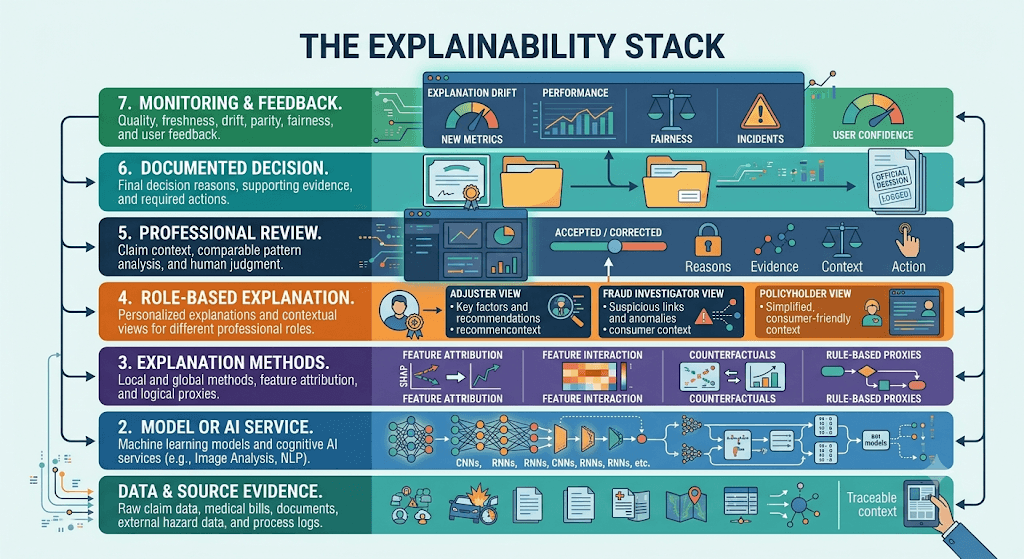
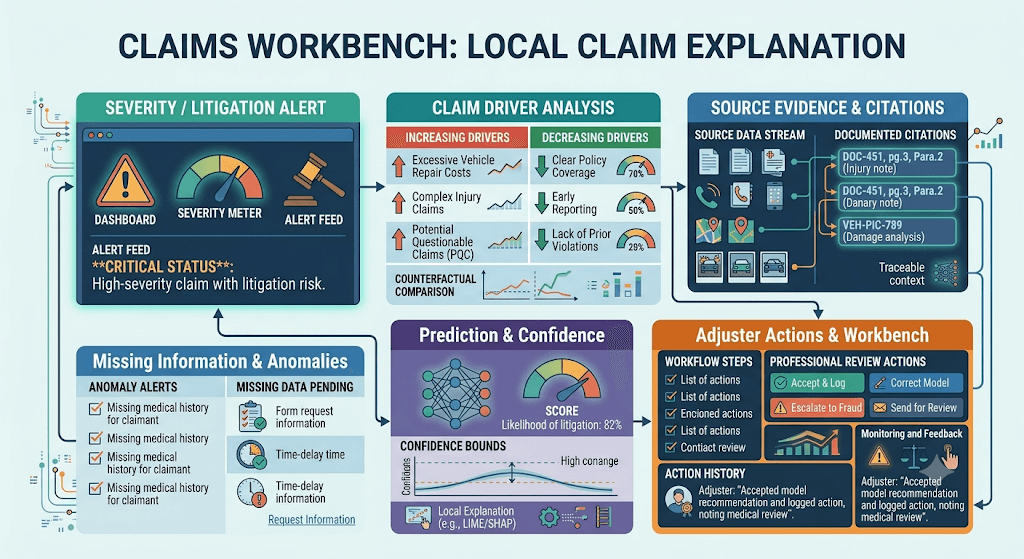
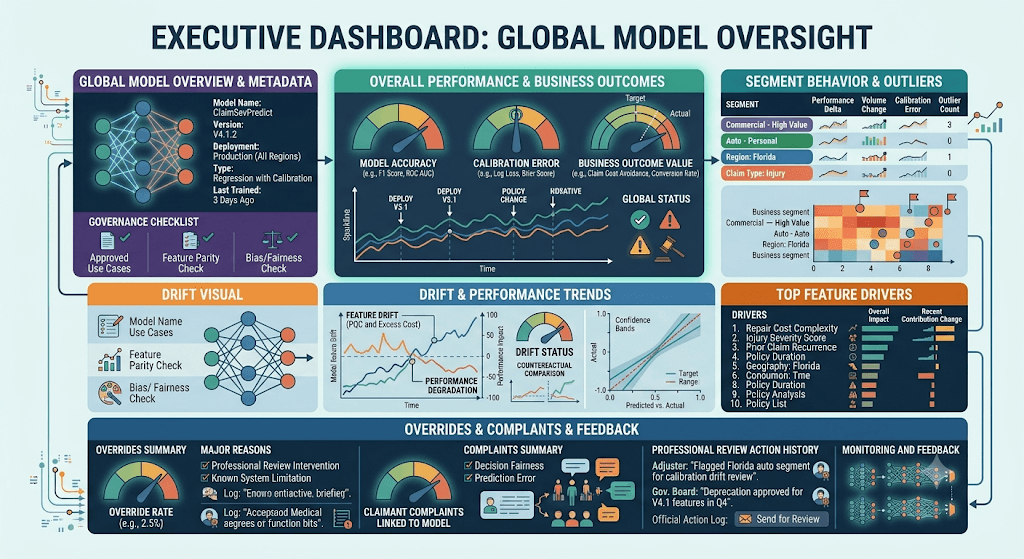
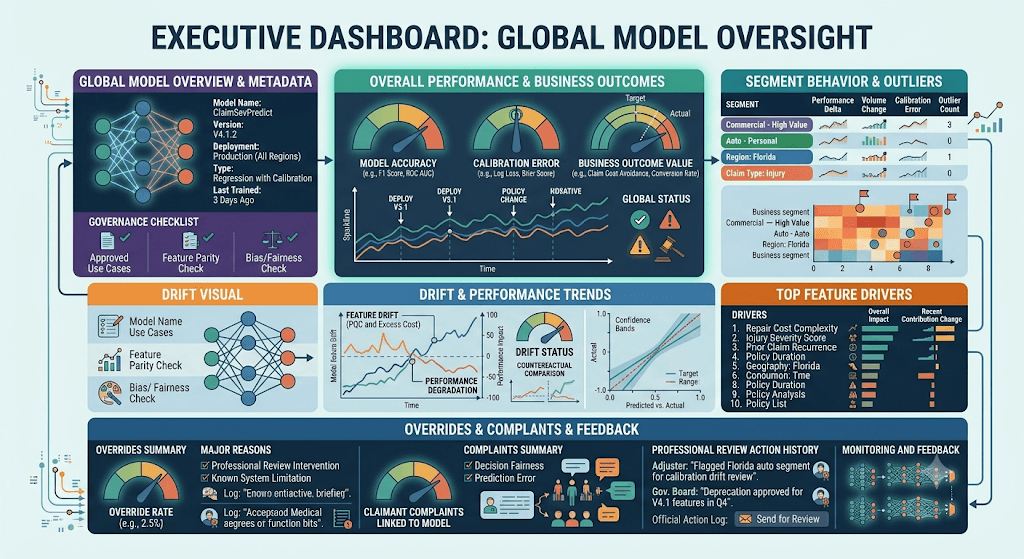
Illustration 5 — Human-in-the-loop governance
EXECUTIVE AND PRACTITIONER FAQ
Key Takeaways
- Explainability is a decision-support and governance capability.
- The right explanation depends on the user, AI type, and decision impact.
- Evidence, fidelity, uncertainty, and traceability matter more than polished narratives.
- Explanations do not replace validation, fairness, security, or professional accountability.
- The best XAI improves both trust and business outcomes.
Explainable AI (XAI) is the discipline of making AI outputs sufficiently understandable for the people who must evaluate, challenge, approve, document, and monitor their use. In P&C insurance, explainability is not a decorative feature. It is an operating requirement for responsible decision support in claims, underwriting, fraud, reserving, and management.
Frequently Asked Questions
No. It explains a result or behavior; accuracy and fitness must be established separately.
Global explanations describe overall model behavior. Local explanations address one specific output.
They are useful but depend on modeling and background-data assumptions. They require validation and careful interpretation.
A generated rationale may be plausible without being faithful. Evidence citations and system traces are more dependable controls.
The signal, principal reasons, direct evidence, confidence or limitations, changed facts, and review options.
No. It can help detect and investigate bias, but data, process, validation, and governance controls remain essential. Not necessarily. The trade-off depends on the model and use case. Complex models can be paired with validated explanation methods.
Enough for the intended user to verify, challenge, document, and appropriately act on the output.
It describes a feasible change that would alter a result. Constraints are necessary to avoid impossible or inappropriate suggestions.
Through fidelity, stability, citation quality, user behavior, overrides, drift, complaints, and downstream outcomes.
Yes. Disclosure depth should be risk-based, and organizations should monitor manipulation attempts.
The professional evaluates context, verifies evidence, challenges the result, and retains decision authority.
No, but it is essential traceability. A complete control environment includes both understandable explanations and reconstructable logs.
Start with a high-value, bounded workflow where the decision, users, evidence, and review process are clear.
Explanations improve professional decisions and are validated, monitored, documented, and integrated with governance.