Executive Snapshot
In one sentence A neural network is a machine learning model composed of interconnected computational units arranged in layers that learn complex patterns from data and transform those patterns into predictions, classifications, or representations.
Why insurance leaders should care
Neural networks power many of the capabilities now associated with advanced insurance AI: document understanding, image analysis, language interpretation, severity prediction, anomaly detection, and generative AI. They are particularly valuable when the data is complex, high-volume, nonlinear, or unstructured. Their value, however, depends on disciplined data preparation, rigorous validation, explainability, and human review.
| Business Need | Neural Network Capability | Insurance Outcome |
|---|---|---|
| Understand complex claim files | Learns patterns across structured and unstructured inputs | Earlier identification of severity, litigation, fraud, or medical escalation |
| Interpret documents and language | Creates contextual representations of text | Faster review of medical reports, demand packages, notes, and submissions |
| Analyze imagery | Detects visual features and patterns | Damage classification, inspection support, and fraud indicators |
| Improve consistency | Applies learned patterns at scale | More consistent triage, prioritization, and decision support |
Executive decision point Do not ask whether a vendor “uses neural networks.” Ask what business problem the model solves, which data it uses, how it is validated, how predictions are explained, where human authority remains, and how performance is monitored after deployment.
Executive Summary
Neural networks are a family of machine learning models inspired loosely by the idea of interconnected neurons. They contain layers of mathematical units that transform input data into progressively more useful representations. During training, the network adjusts internal weights so that its outputs better match known outcomes or objectives.
In Property & Casualty insurance, neural networks can analyze claim notes, medical records, demand letters, photographs, repair estimates, policy documents, telematics, and other information. They can support severity prediction, document classification, image recognition, litigation monitoring, fraud detection, underwriting assessment, customer communication, and portfolio analysis.
Neural networks are powerful because they can discover complex, nonlinear relationships that are difficult to express as static business rules. They are also demanding. They may require substantial data, computing resources, careful validation, and controls for bias, drift, privacy, security, and explainability. A strong insurance implementation therefore combines neural network capabilities with domain expertise, transparent evidence, workflow integration, and human authority.
Quick Facts
| Topic | Summary |
|---|---|
| Category | Machine learning architecture; deep learning uses neural networks with multiple learned layers. |
| Primary purpose | Learn useful representations and relationships from complex data. |
| Common inputs | Structured variables, text, documents, images, audio, time series, and multimodal data. |
| Common outputs | Classification, probability, prediction, ranking, embedding, generated text, or anomaly score. |
| Typical insurance uses | Claims triage, document intelligence, severity prediction, fraud detection, underwriting, and image analysis. |
| Human oversight | Required for material decisions and recommended throughout design, validation, deployment, and monitoring. |
| Key risks | Poor data quality, overfitting, bias, opacity, drift, privacy, security, and misuse of model output. |
What this chapter covers
- Definitions and core concepts
- How neural networks learn
- Major network architectures
- Insurance applications and scenarios
- Business value and measurable outcomes
- Risks, governance, and model controls
- Executive evaluation guidance
- FAQs, related terms, illustration briefs, and SEO metadata
Executive definition
A neural network is a machine learning system that learns patterns by passing data through connected layers of mathematical units. It can recognize relationships that help classify information, estimate outcomes, identify anomalies, or generate new content.
Technical definition
A neural network is a parameterized function composed of interconnected nodes, or artificial neurons, organized into an input layer, one or more hidden layers, and an output layer. Each connection has a weight. During training, an optimization process adjusts the weights to reduce a loss function that measures the difference between predicted and desired outputs.
Insurance definition
In insurance, a neural network is a model architecture used to analyze complex policy, claim, document, image, medical, telematics, and portfolio data. It converts that information into probabilities, classifications, rankings, summaries, or other decision-support outputs for insurance professionals.
Important distinction “Neural network,” “deep learning,” and “generative AI” are related but not interchangeable. A neural network is the underlying model structure. Deep learning generally refers to neural networks with multiple learned layers. Generative AI uses large models—often neural networks—to create new content.
Core vocabulary
| Term | Plain-language meaning |
|---|---|
| Neuron / node | A mathematical unit that receives inputs, applies weights and an activation function, and produces an output. |
| Layer | A group of nodes that transforms information at a particular stage. |
| Weight | A learned number representing the strength and direction of a connection. |
| Bias term | A learned offset that helps the model fit patterns. |
| Activation function | A nonlinear transformation that allows the network to learn complex relationships. |
| Loss function | A measure of prediction error used during training. |
| Epoch | One complete pass through the training dataset. |
| Inference | Using the trained model to evaluate new data. |
| Embedding | A learned numerical representation that captures meaning or similarity. |
The basic flow
Input data enters the network. Examples include claim variables, document tokens, pixels, or time-series measurements.
Each layer transforms the data. Learned weights emphasize patterns that are useful for the task.
Activation functions introduce nonlinearity, allowing the network to represent relationships more complex than a straight-line formula.
The output layer produces a result such as a severity probability, document category, anomaly score, or generated token.
During training, the model compares its output with the known target or training objective.
Backpropagation calculates how each weight contributed to the error.
An optimizer updates the weights to reduce future error.
The cycle repeats across many examples until performance stabilizes or training is stopped.
A simplified mathematical view
At each node, the model combines inputs with learned weights, adds a bias, and applies an activation function. In simplified form:
Node calculation output = activation(weighted inputs + bias)
A full neural network repeats this transformation across many nodes and layers. The network’s overall behavior emerges from the combined effect of these learned parameters.
Training, validation, and testing
| Dataset | Purpose | Insurance example |
|---|---|---|
| Training set | Used to learn model weights. | Historical claims with known outcomes. |
| Validation set | Used to tune design choices and detect overfitting. | A separate period or sample used during development. |
| Test set | Used for an independent final estimate of performance. | Claims the model did not see during training or tuning. |
Why nonlinear learning matters
Insurance outcomes often arise from interactions among many variables. A delayed report may be modestly informative on its own, but the combination of delayed reporting, attorney involvement, escalating treatment, venue, injury type, and prior history may be highly predictive. Neural networks can learn these interactions without requiring every combination to be explicitly programmed.
Anatomy of a Neural Network
| Component | Function | Insurance interpretation |
|---|---|---|
| Input layer | Receives the original data. | Claim attributes, document embeddings, images, financial values, or telematics features. |
| Hidden layers | Learn intermediate representations. | Combinations of factors associated with severity, litigation, fraud, or risk. |
| Output layer | Produces the final task-specific result. | Probability, category, score, ranking, or generated response. |
| Weights and biases | Store what the model learns. | Mathematical relationships derived from historical data. |
| Activation functions | Enable nonlinear behavior. | Allow the model to capture complex interactions. |
| Loss function | Defines what “better” means during training. | Error in severity estimate, classification, ranking, or text prediction. |
| Optimizer | Updates weights to reduce loss. | Training mechanism rather than an insurance workflow component. |
Common activation functions
| Activation | Common role | Practical note |
|---|---|---|
| ReLU | Widely used in hidden layers. | Efficient and effective for many deep networks. |
| Sigmoid | Maps values between 0 and 1. | Often used for binary probabilities, with calibration reviewed separately. |
| Softmax | Produces a probability distribution across categories. | Useful for document or image classification. |
| Tanh | Maps values between -1 and 1. | Used less often in modern deep architectures but still relevant. |
Parameters and capacity
A parameter is a value learned during training. Larger networks can represent more complex functions, but greater capacity can also increase data requirements, computing cost, overfitting risk, and governance complexity. The right model is the simplest model that reliably meets the business objective and control requirements—not necessarily the largest model available.
Charlee.ai insight Insurance value depends on domain-specific performance, evidence, workflow fit, and governed use. Model size alone is not a meaningful measure of business readiness.
Major Neural Network Architectures
| Architecture | Strength | Insurance use examples |
|---|---|---|
| Feedforward network / MLP | Structured prediction and classification. | Severity prediction, propensity models, and risk scoring. |
| Convolutional neural network (CNN) | Spatial and visual pattern recognition. | Property damage imagery, inspection photos, vehicle damage, and document layout. |
| Recurrent neural network (RNN) | Sequential data processing. | Claim event sequences, notes over time, and telematics; often replaced by newer architectures. |
| LSTM / GRU | Longer-term sequence dependencies. | Treatment progression, payment development, and time-series patterns. |
| Transformer | Contextual processing at scale. | NLP, LLMs, document intelligence, multimodal analysis, and generation. |
| Autoencoder | Representation learning and reconstruction. | Anomaly detection, compression, and unusual claim patterns. |
| Graph neural network (GNN) | Relationships among connected entities. | Fraud rings, provider networks, claimant relationships, and subrogation links. |
| Siamese / metric-learning network | Similarity matching. | Duplicate claims, document matching, image comparison, and entity resolution. |
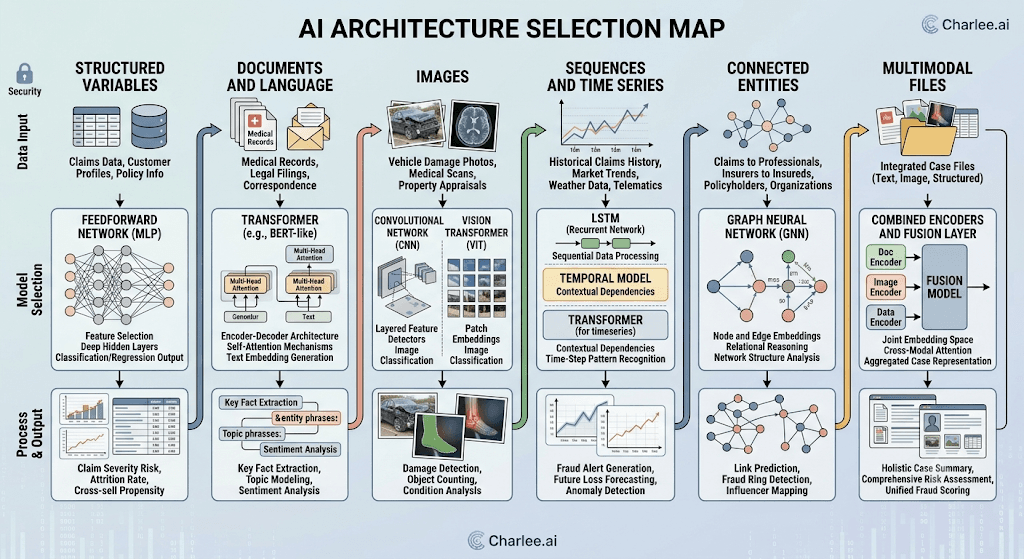
Choosing an architecture
Architecture selection should follow the business problem and data type. A straightforward feedforward network may be suitable for structured claim variables. A transformer may be better for long documents. A CNN or vision transformer may be appropriate for images. A graph neural network may be useful when relationships among parties and entities are central to the problem.
Multimodal networks
Many insurance decisions require more than one type of data. A multimodal model may combine structured claim fields, narrative notes, documents, photographs, and external information. The implementation must preserve traceability so users can understand which inputs contributed to the output.
Neural network vs. traditional statistical model
| Dimension | Traditional model | Neural network |
|---|---|---|
| Interpretability | Often more direct. | May require specialized explanation methods. |
| Feature engineering | Frequently manual and domain-driven. | Can learn representations automatically, especially from unstructured data. |
| Data needs | May perform well with smaller datasets. | Often benefits from larger, richer datasets. |
| Complexity | Usually lower. | Can be high. |
| Best fit | Structured, well-defined relationships. | Complex nonlinear, image, text, sequence, or multimodal problems. |
Practical rule Use neural networks when their additional complexity creates measurable business benefit. Do not use them merely because they are modern.
Neural Networks Across P&C Insurance
| Insurance function | Potential neural network contribution | Human responsibility |
|---|---|---|
| FNOL and triage | Classify reports, estimate complexity, and prioritize review. | Confirm routing, urgency, and customer needs. |
| Claims severity | Estimate probability of high-cost development. | Evaluate evidence, coverage, reserves, and strategy. |
| Litigation monitoring | Identify language and patterns associated with attorney involvement or litigation. | Assess legal context and select response. |
| Medical review | Interpret medical narratives and treatment patterns. | Validate clinical and claim relevance. |
| Fraud / SIU | Detect anomalies, networks, and suspicious combinations. | Investigate facts and make referral decisions. |
| Subrogation | Identify potentially liable parties and recovery signals. | Confirm legal basis and pursue recovery. |
| Property damage | Analyze images and inspection information. | Validate scope, coverage, causation, and estimate. |
| Underwriting | Analyze submissions, documents, images, and loss history. | Select risk, apply appetite, and determine terms. |
| Customer service | Classify intent and draft responses. | Review communications and handle exceptions. |
| Portfolio management | Identify trends, concentrations, and emerging risks. | Set strategy, controls, and actions. |
Where neural networks add the most value
- High-volume workflows with repeated patterns and consistent outcomes.
- Problems involving text, images, sequences, or complex interactions.
- Use cases where faster detection creates time to intervene.
- Decisions supported by explainable evidence and professional review.
- Processes with measurable baselines and feedback loops.
Where they may not be appropriate
- Low-volume tasks with insufficient representative data.
- Problems governed by simple deterministic rules.
- Use cases where model performance cannot be validated reliably.
- Decisions lacking a defined owner, escalation path, or human review.
- Situations where simpler approaches perform equally well with greater transparency.
Workers’ compensation claim development
A carrier receives a workers’ compensation claim involving a back injury. At first notice, the claim appears routine. The employer reports a lifting incident, initial treatment is conservative, and the employee is expected to return to work quickly.
| Stage | New information | Neural network support | Professional action |
|---|---|---|---|
| Day 1 — FNOL | Injury, job, jurisdiction, reporting lag, initial treatment. | Produces an initial complexity and severity probability. | Adjuster validates assignment and contacts the parties. |
| Day 12 — Treatment | Specialist referral and imaging appear in notes. | Sequence and text models detect a pattern associated with escalating treatment. | Adjuster reviews medical plan and return-to-work options. |
| Day 28 — Representation | Attorney representation is identified in correspondence. | Language model updates litigation and severity indicators. | Adjuster engages counsel and reassesses strategy. |
| Day 45 — Work status | Extended restrictions and inconsistent progress are documented. | Model updates expected duration and reserve range. | Adjuster reviews evidence and makes independent reserve decision. |
| Day 90 — Ongoing review | New reports, payments, and events accumulate. | Monitoring model identifies divergence from comparable claims. | Claims leadership reviews intervention opportunities. |
What the neural network does
- Recognizes patterns across structured fields, event sequences, and narrative text.
- Updates outputs as new information arrives.
- Provides probabilities, contributing factors, and supporting evidence.
- Helps prioritize review and intervention.
What the neural network does not do
- Determine coverage or liability on its own.
- Set reserves without professional judgment and authority.
- Replace medical, legal, or claims expertise.
- Guarantee the final outcome.
Outcome The business value is not that the model “decides” the claim. The value is that it helps the carrier see a changing risk profile earlier, organize evidence, and focus professional attention where it can have the greatest effect.
Commercial auto submission review
An underwriter receives a commercial auto submission containing applications, schedules, loss runs, driver information, vehicle lists, inspection material, and broker correspondence. The information is inconsistent across formats and arrives under a tight response deadline.
A document model classifies and separates the submission components.
Language and table models extract vehicles, drivers, limits, operations, losses, and locations.
Entity-matching networks reconcile duplicate or inconsistent names and identifiers.
A structured neural network evaluates patterns associated with frequency, severity, and volatility.
The system creates a risk summary with cited source evidence and highlights missing or conflicting information.
The underwriter reviews the evidence, applies appetite and judgment, requests clarification, and determines whether and how to quote.
Value created
| Value area | Potential improvement | Measurement example |
|---|---|---|
| Speed | Less time spent locating and rekeying information. | Average submission review time. |
| Completeness | More consistent identification of missing data. | Missing-information detection rate. |
| Consistency | Standardized risk factors and referral logic. | Variation in comparable decisions. |
| Quality | Better access to source evidence. | Review corrections and rework. |
| Capacity | More time for risk selection and broker engagement. | Submissions handled per underwriter. |
Human authority The underwriter remains responsible for risk selection, terms, pricing decisions, and exceptions. The model organizes information and surfaces patterns; it does not own the underwriting decision.
Potential business benefits
- Earlier identification of severe or complex claims.
- Faster review of documents, notes, images, and submissions.
- More consistent prioritization and routing.
- Improved detection of anomalies, fraud indicators, and recovery opportunities.
- Better use of professional time and expertise.
- Enhanced portfolio visibility and operational forecasting.
Measure outcomes—not model novelty
| Business objective | Operational KPI | Model KPI | Guardrail |
|---|---|---|---|
| Improve high-risk claim identification | Time from signal to review | Recall, precision, lift | False-negative review and capacity impact |
| Accelerate document review | Minutes per file | Extraction accuracy | Source citation and human validation |
| Improve fraud referral quality | SIU yield | Precision at referral threshold | Fairness and investigation standards |
| Support reserve review | Reserve review timeliness | Calibration and error by segment | Professional approval and audit trail |
| Improve submission throughput | Cycle time and quote ratio | Classification/extraction accuracy | Underwriter override and exception handling |
Key model metrics
| Metric | What it indicates | Executive caution |
|---|---|---|
| Precision | How often positive alerts are correct. | High precision may miss important cases if recall is low. |
| Recall / sensitivity | How many true cases are identified. | Higher recall can increase false positives and workload. |
| Specificity | How well negative cases are excluded. | Should be reviewed with segment and business impact. |
| AUC / ROC | Ranking performance across thresholds. | Does not replace threshold and calibration analysis. |
| Calibration | Whether predicted probabilities match observed outcomes. | Critical when probabilities guide action. |
| Lift | Improvement over baseline selection. | Must be tied to workflow and capacity. |
Risks and Limitations
| Risk | How it appears | Control response |
|---|---|---|
| Data quality | Missing, inconsistent, mislabeled, or unrepresentative data. | Data governance, profiling, lineage, and quality thresholds. |
| Overfitting | Strong development results but weak real-world performance. | Independent testing, regularization, simpler models, and monitoring. |
| Bias and unfairness | Performance differs across groups or proxies. | Fairness testing, feature review, governance, and remediation. |
| Opacity | Users cannot understand why an output changed. | Explanations, evidence, model cards, and constrained use. |
| Model drift | Relationships change after deployment. | Performance monitoring, drift detection, and controlled retraining. |
| Privacy | Sensitive data is exposed or used improperly. | Minimization, access controls, retention rules, and contractual safeguards. |
| Security | Models or pipelines are attacked or manipulated. | Secure development, adversarial testing, monitoring, and incident response. |
| Automation bias | Users over-trust model output. | Training, interface design, documented authority, and review standards. |
| Threshold misuse | A score becomes an automatic decision without context. | Business-owned thresholds, exception handling, and audit trails. |
Hallucination and neural networks
Predictive neural networks do not “hallucinate” in exactly the same way generative language models do, but they can still produce confident, incorrect outputs. Generative models may create unsupported content. Both require validation, evidence, uncertainty handling, and governance appropriate to the use case.
Responsible-use principle A probability is not a fact, a classification is not a decision, and generated text is not verified evidence. The workflow must preserve these distinctions.
Lifecycle controls
| Lifecycle stage | Required controls |
|---|---|
| Purpose and approval | Document the business objective, intended users, prohibited uses, decision authority, and risk classification. |
| Data | Establish ownership, permission, lineage, quality, representativeness, retention, and security. |
| Development | Define architecture, baseline, training process, feature controls, reproducibility, and testing. |
| Validation | Use independent testing, segment analysis, calibration, fairness review, explainability, and stress testing. |
| Deployment | Control versioning, access, integration, thresholds, escalation, rollback, and audit logging. |
| Monitoring | Track performance, drift, data quality, user behavior, overrides, complaints, and incidents. |
| Change management | Review retraining, new data, architecture changes, threshold changes, and vendor updates. |
| Retirement | Define replacement, archival, access removal, and record retention. |
Explainability approaches
- Global explanation: describes the model’s overall behavior and important inputs.
- Local explanation: identifies factors contributing to a specific prediction.
- Example-based explanation: shows comparable historical cases or prototypes.
- Evidence-based explanation: links conclusions to source documents, fields, images, or events.
- Counterfactual analysis: describes what changes might alter the output, where appropriate.
Human-in-the-loop operating model
The system identifies a pattern or produces an output.
The user receives an explanation, evidence, confidence, and limitations.
The professional reviews the source information and business context.
The professional decides, documents, or escalates according to authority.
Outcome s and feedback are captured for monitoring and controlled improvement.
Phase 1 — Define the decision and workflow
- Choose a specific business problem and owner.
- Define the current process, baseline, pain points, and desired outcome.
- Identify where the model will inform—not silently replace—judgment.
- Specify user, evidence, explanation, escalation, and documentation needs.
Phase 2 — Assess data readiness
- Inventory structured and unstructured data.
- Confirm rights, privacy, security, and retention requirements.
- Evaluate labels, outcome definitions, quality, missingness, and segment coverage.
- Determine whether a simpler approach is sufficient.
Phase 3 — Build and validate
- Establish interpretable baselines.
- Select architecture based on data and objective.
- Test across segments, time periods, and operating conditions.
- Evaluate calibration, fairness, robustness, and workflow impact.
Phase 4 — Pilot in workflow
- Start with controlled users and defined authority.
- Measure model performance and operational outcomes.
- Capture overrides, feedback, exceptions, and unintended consequences.
- Adjust thresholds and process design through governed change.
Phase 5 — Scale and monitor
- Expand only after success criteria are met.
- Automate monitoring and incident escalation.
- Review performance and value with business, technology, risk, and compliance owners.
- Retrain or retire through documented governance.
Deployment readiness gate Do not scale until the model is accurate enough for the use, the workflow can absorb its alerts, users understand its limitations, controls are operational, and business value is demonstrated.
Questions to ask vendors and internal teams
| Area | Questions |
|---|---|
| Business fit | What decision or workflow improves? What is the baseline? Who owns the outcome? |
| Data | What data is required? Who owns it? How is quality assessed? What data is excluded? |
| Architecture | Why is a neural network appropriate? What simpler baselines were tested? |
| Performance | How does the model perform by segment, period, and threshold? Is it calibrated? |
| Explainability | What explanations and source evidence do users receive? |
| Human authority | Which decisions remain with professionals? How are overrides handled? |
| Governance | How are versions, changes, validation, monitoring, and incidents controlled? |
| Security and privacy | Where is data processed and retained? What access and contractual controls apply? |
| Integration | How does the output appear in the existing workflow? |
| Value | What operational and financial measures define success? |
Readiness assessment
| Readiness signal | Ready when… |
|---|---|
| Problem clarity | A measurable workflow problem and accountable owner are defined. |
| Data readiness | Representative, permitted, and sufficiently reliable data is available. |
| User readiness | Users understand the output, evidence, limitations, and authority. |
| Control readiness | Validation, monitoring, security, privacy, and change controls are operational. |
| Operational readiness | The organization can act on alerts without creating unmanaged workload. |
| Value readiness | A baseline and benefits-measurement plan exist. |
Build, buy, or partner
The decision should consider domain specificity, data availability, explainability, workflow integration, model risk expertise, speed to value, maintenance burden, and vendor accountability. A technically strong model that is not integrated, governed, or understood will rarely produce durable value.
Common Myths and Misconceptions
Myth: Neural networks think like humans.
Reality: They perform mathematical transformations learned from data. They do not possess human understanding, judgment, or accountability.
Myth: A deeper network is always better.
Reality: Additional depth can help some problems but also increases complexity, data needs, cost, and risk.
Myth: Neural networks eliminate feature engineering.
Reality: They can learn representations, but data selection, preprocessing, labeling, and domain design remain critical.
Myth: High accuracy proves readiness.
Reality: Readiness also requires calibration, segment performance, explainability, security, workflow fit, and governance.
Myth: The model can set reserves or deny claims automatically.
Reality: Material decisions require authority, context, evidence, and professional accountability.
Myth: Once deployed, the model keeps improving on its own.
Reality: Controlled feedback and retraining require governance; unmanaged self-learning creates risk.
Best practices
- Start with the business decision and user workflow.
- Compare against simpler baselines.
- Use representative data and clearly defined outcomes.
- Design explanations and evidence into the user experience.
- Validate by segment and over time.
- Keep professionals accountable for material decisions.
- Monitor performance, drift, workload, and business value.
- Control retraining and model changes.
Common mistakes
- Choosing architecture before defining the problem.
- Treating historical labels as unquestioned truth.
- Optimizing only for a single model metric.
- Ignoring false-positive workload and false-negative cost.
- Deploying scores without context or action guidance.
- Failing to establish ownership after launch.
Charlee.ai Perspective
Neural networks are most valuable in insurance when they transform complex information into timely, explainable insight inside the workflow where professionals already make decisions. The model should help the organization see signals earlier, organize evidence, prioritize attention, and learn from outcomes—without obscuring accountability.
A strong insurance AI platform may use different model types for different tasks. Neural networks may interpret documents and language, detect image patterns, or estimate risk. Other statistical or rules-based methods may be more appropriate for deterministic controls. The platform should select methods based on performance, explainability, governance, and business value rather than novelty.
Charlee.ai principle Business strategy → governed data → appropriate AI models → explainable insight → professional review → documented decision → continuous monitoring and improvement.
What good looks like
- The output is delivered at the right moment in the claims or underwriting workflow.
- Users can see contributing factors and source evidence.
- The model is validated for the carrier’s data, lines, jurisdictions, and use cases.
- Authority remains with qualified insurance professionals.
- Performance, fairness, drift, incidents, and value are monitored continuously.
- Changes are controlled, documented, and reversible.
What to avoid
- Opaque scores with no explanation or evidence.
- Generic models presented as insurance-ready without validation.
- Automation that removes professional review from material decisions.
- Uncontrolled model changes or retraining.
- Value claims based only on technical benchmarks.
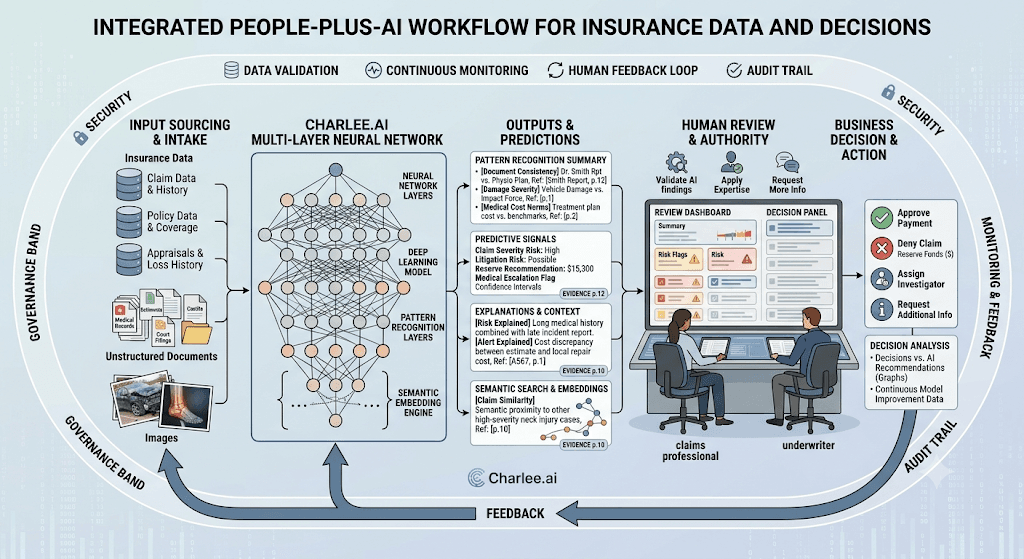
Primary illustration — Neural network decision-support model
| Element | Production direction |
|---|---|
| Title | Neural Networks in Property & Casualty Insurance |
| Format | Horizontal explanatory workflow with a simplified layered network at the center. |
| Inputs | Claim data, policy data, documents, images, medical information, and event history. |
| Model visual | Input layer → hidden representation layers → output layer. Keep the network understandable rather than overly technical. |
| Outputs | Severity probability, document classification, anomaly signal, risk summary, or priority recommendation. |
| Human role | Claims professional or underwriter reviews explanation and source evidence before deciding. |
| Governance layer | Data quality, validation, explainability, security, monitoring, and controlled change. |
| Style | Charlee.ai people-plus-AI visual language; professional, clean, insurance-specific. |
Key Takeaways
- Neural networks are layered machine learning models that learn complex patterns from data.
- They power many modern AI capabilities, including deep learning, language models, document intelligence, image analysis, and generative AI.
- In P&C insurance, they can support claims triage, severity prediction, fraud detection, underwriting, document review, image analysis, and portfolio insight.
- The model should augment professional judgment—not replace insurance authority or accountability.
- Production readiness requires representative data, independent validation, explainability, calibration, security, privacy, monitoring, and controlled change.
- Executives should evaluate workflow outcomes and governance rather than model size or technical novelty.
- The strongest implementations combine the right model, source evidence, human review, and measurable business value.
In one sentence A neural network is a machine learning model composed of interconnected computational units arranged in layers that learn complex patterns from data and transform those patterns into predictions, classifications, or representations.
Frequently Asked Questions
A neural network is a machine learning model made of connected layers of mathematical units that learn patterns from data.
Deep learning generally refers to neural networks with multiple learned layers. All deep learning uses neural networks, but not every neural network is described as deep.
They can analyze complex relationships and unstructured information such as documents, notes, images, and event sequences.
No. They can support prioritization, interpretation, and prediction, but professionals remain responsible for material decisions.
It depends on the task, architecture, data quality, label quality, and use of pretraining or transfer learning. More data is not helpful if it is unrepresentative or poorly governed.
They can be supported with factor attribution, examples, source evidence, and other explanation methods, though explanation quality varies by architecture and use case.
Overfitting occurs when a model learns the training data too specifically and performs poorly on new data.
Backpropagation is the process used to calculate how model weights contributed to error so they can be updated during training.
An embedding is a learned numerical representation that captures similarity or meaning. It is widely used in language, document, image, and retrieval systems.
They can reflect or amplify patterns in data and labels. Bias must be evaluated and managed through data, design, validation, governance, and monitoring.
Retraining should be triggered by governed criteria such as drift, performance decline, new data, business change, or scheduled review—not by an uncontrolled automatic process.
Yes. Convolutional networks and vision transformers can support damage classification, inspection analysis, and visual anomaly detection.
Yes. Transformer and document-layout models can classify, extract, summarize, and represent complex insurance documents.
No. Simpler methods may be more accurate, transparent, economical, or appropriate for a given problem.
Ask about the business objective, data rights and quality, baseline comparison, segment performance, calibration, explanations, human authority, security, monitoring, and measurable value.
Monitoring should trigger investigation, threshold review, retraining, rollback, or retirement through controlled change management.
Yes. Multimodal models can combine text, images, structured fields, and other inputs, but traceability and validation become more complex.
A clearly defined insurance workflow in which trustworthy model output, evidence, professional judgment, governance, and measurable outcomes are aligned.