Executive Snapshot
Two-minute definition Optical Character Recognition is the technology used to detect and convert visible characters in an image into machine-readable text. In insurance, OCR is the first step in making scanned forms, photographed records, faxed correspondence, invoices, estimates, police reports, medical records, and other image-based documents searchable and usable by downstream systems. OCR reads characters; it does not, by itself, understand insurance meaning.
| Business need | OCR contribution | Human and system responsibility |
|---|---|---|
| Make scanned records searchable | Converts document images into a text layer. | Validate quality, preserve the original, and control access. |
| Capture values from forms | Recognizes characters within defined fields or regions. | Use validation rules and review exceptions. |
| Process incoming claim documents | Creates text for classification, extraction, and summarization. | Document intelligence interprets the content; professionals decide. |
| Accelerate underwriting intake | Reads submission documents and schedules. | Confirm extracted values and resolve ambiguity before use. |
Executive distinction OCR answers: “What characters appear on this page?” Document intelligence answers: “What type of document is this, which facts matter, and how do they relate?” Generative AI may explain or summarize those facts. Predictive AI may estimate future outcomes from them.
Executive Summary
Insurance organizations still receive a large share of operational evidence as PDFs, scans, photographs, faxes, screenshots, and image-only attachments. The information may be visually readable to a person but unavailable to search, analytics, workflow automation, and AI. OCR bridges that gap by transforming visible characters into a machine-readable representation.
Modern OCR combines image preprocessing, text detection, character recognition, language modeling, and confidence estimation. It can recognize printed text, handwriting, checkboxes, barcodes, and scene text under controlled conditions. Performance varies materially with document quality, layout, handwriting, language, typography, capture method, and domain-specific vocabulary.
OCR should be treated as a measured extraction component rather than a source of truth. A system can return plausible but incorrect text, especially when scans are blurred, skewed, compressed, obstructed, or visually ambiguous. Insurance workflows therefore need field-level confidence, validation rules, source-image access, exception routing, and documented authority boundaries.
The greatest value comes when OCR is embedded in an end-to-end document workflow: receive the file, verify integrity, improve the image, recognize text, identify the document, extract structured facts, validate against policy and claim context, present evidence for review, and record corrections. This controlled sequence enables faster intake and better information without transferring professional authority to the technology.
Quick Facts
| Topic | Publication-ready guidance |
|---|---|
| Definition | Technology that converts visible text in an image into machine-readable characters and words. |
| Typical inputs | Scanned PDFs, photographs, faxes, screenshots, forms, invoices, estimates, reports, and image-only documents. |
| Typical outputs | Text, words, lines, coordinates, confidence scores, reading order, and sometimes handwriting or checkbox results. |
| Primary insurance role | Create searchable text and supply downstream document-intelligence workflows. |
| What OCR does not do alone | Reliably interpret coverage, causation, medical significance, legal meaning, or business intent. |
| Critical controls | Original-image retention, quality checks, confidence thresholds, validation rules, audit trails, and human review. |
| Success measure | Accurate, complete, timely capture of decision-relevant information—not character accuracy alone. |
Definitions and Essential Vocabulary
Executive Definition
OCR is a digital reading capability that turns text visible in an image into text a computer can search, copy, classify, validate, and pass to other applications.
Technical Definition
Optical Character Recognition is a computer-vision and pattern-recognition process that locates text regions within raster or image-based content, segments or models character sequences, predicts character and word tokens, and returns a machine-readable transcription with positional and confidence metadata. Contemporary OCR systems commonly use convolutional, recurrent, transformer, or multimodal neural architectures.
Insurance Definition
In Property & Casualty insurance, OCR is an enabling technology that converts image-based policy, claim, medical, legal, financial, inspection, and underwriting documents into text that can be searched, classified, extracted, compared, summarized, and reviewed within governed workflows.
Essential Vocabulary
| Term | Practical meaning |
|---|---|
| Raster image | A page represented as pixels rather than selectable text. |
| Text detection | Finding where text appears on a page or image. |
| Text recognition | Predicting the characters or words within a detected region. |
| Reading order | The sequence in which blocks, columns, and lines should be interpreted. |
| Bounding box | Coordinates identifying the location of a word, line, or region. |
| Confidence score | A model estimate of recognition certainty; not proof of accuracy. |
| Character error rate (CER) | The percentage of inserted, deleted, or substituted characters relative to reference text. |
| Word error rate (WER) | A word-level recognition error measure. |
| ICR | Intelligent Character Recognition, commonly used for handwriting or adaptive recognition. |
| OMR | Optical Mark Recognition, used for checkboxes, bubbles, and marked selections. |
| Image preprocessing | Deskewing, denoising, contrast correction, rotation, cropping, and other preparation. |
| Ground truth | Human-verified reference text used for evaluation or training. |
Critical distinction A high page-level OCR score can hide a material field error. Misreading a policy number, date, amount, diagnosis, claimant name, or coverage limit may matter far more than several harmless punctuation errors. Insurance evaluation should weight errors by business impact.
MECHANICS
How OCR Works
Ingest and preserve the source
Receive the file, retain the original binary and metadata, record provenance, and prevent uncontrolled modification.
Identify page type and text availability
Determine whether the document already contains reliable embedded text, is image-only, or requires mixed-mode processing.
Improve image quality
Rotate, deskew, crop, remove noise, normalize contrast, correct perspective, and separate foreground from background.
Detect text regions
Locate printed text, handwriting, labels, tables, stamps, signatures, and other visual regions.
Recognize characters and words
Apply language and visual models to predict the text represented by the pixels.
Reconstruct layout and reading order
Associate words with lines, blocks, columns, pages, tables, and coordinates.
Generate confidence and alternatives
Provide confidence by page, line, word, or character and retain alternate predictions when useful.
Validate against context
Check formats, ranges, cross-field logic, policy and claim data, dictionaries, and known reference values.
Route exceptions and preserve evidence
Send uncertain or material fields to authorized review while keeping the source image available.
Monitor and improve
Measure error patterns by document type, source, language, layout, and field criticality.
OCR Pipeline Components
| Component | Purpose | Insurance consideration |
|---|---|---|
| File inspection | Detects format, corruption, encryption, and embedded text. | Avoid unnecessary OCR and preserve original evidence. |
| Preprocessing | Improves readability before recognition. | Must not alter evidentiary meaning or remove relevant marks. |
| Layout analysis | Identifies columns, tables, headers, and regions. | Essential for estimates, schedules, and multi-column reports. |
| Recognition model | Converts image patterns to characters and words. | Domain vocabulary and handwriting can materially affect accuracy. |
| Language model | Uses likely word sequences to improve recognition. | May “correct” unusual names, codes, or medical terms incorrectly. |
| Post-processing | Applies dictionaries, formatting, and normalization. | Changes should be traceable and distinguish raw from normalized text. |
| Validation layer | Tests extracted values against business rules. | Critical for dates, limits, totals, identifiers, and monetary amounts. |
| Review workflow | Presents evidence and uncertainty to a person. | Should focus attention on material exceptions, not every character. |
Printed Text, Handwriting, and Marks
Printed text recognition is generally the most mature OCR use case, but performance still varies with typeface, scan quality, background texture, small font size, and layout. Handwriting recognition is more difficult because letter shapes, spacing, abbreviations, and writing styles vary. OMR detects marked boxes or bubbles and should not be confused with text recognition. Production systems may combine all three capabilities on a single form.
| Input type | Typical challenge | Recommended control |
|---|---|---|
| Clean printed form | Minor layout variation or small fonts. | Template or layout-aware extraction with field validation. |
| Faxed document | Noise, streaks, low resolution, and compression. | Quality scoring, enhancement, and exception thresholds. |
| Smartphone photo | Perspective distortion, glare, shadows, and cropping. | Guided capture and automatic retake prompts. |
| Handwritten note | Ambiguous characters and abbreviations. | Specialized handwriting model and targeted human verification. |
| Checkbox form | Faint marks, strike-throughs, and multiple selections. | OMR logic plus business-rule validation. |
| Table or schedule | Complex rows, merged cells, and repeated headers. | Layout-aware table extraction and reconciliation. |
INSURANCE VALUE
Why OCR Matters to P&C Insurance
The Business Problem
Insurance decisions depend on evidence distributed across thousands of document types. Much of that evidence arrives as images even when the file extension is PDF. Without a reliable text layer, employees must manually read and rekey information, systems cannot search consistently, and downstream AI receives incomplete input. OCR can reduce that friction, but only when paired with document classification, extraction, validation, and workflow integration.
| Insurance challenge | Operational impact | OCR-enabled response |
|---|---|---|
| Image-only documents | Search and analytics cannot access the content. | Create a searchable text layer linked to the source page. |
| Manual rekeying | Slow intake, transcription errors, and inconsistent data. | Prepopulate fields and route only exceptions for review. |
| High document volume | Backlogs delay claim and underwriting activity. | Process pages continuously and prioritize material documents. |
| Fragmented evidence | Facts remain buried across attachments and systems. | Expose text for document intelligence and cross-document analysis. |
| Legacy archives | Historical records are difficult to retrieve or analyze. | Digitize selected collections with quality and retention controls. |
Operating principle OCR should reduce the time professionals spend finding and retyping information so they can spend more time evaluating evidence, resolving ambiguity, serving customers, and making accountable decisions.
CLAIMS
OCR Across the Claims Lifecycle
| Claims stage | OCR contribution | Professional use |
|---|---|---|
| FNOL | Reads photographed forms, IDs, police reports, and supporting records. | Confirm parties, identifiers, dates, and intake completeness. |
| Investigation | Makes correspondence, statements, reports, and invoices searchable. | Locate facts and compare evidence across the file. |
| Medical review | Converts scanned records and bills into text for structured review. | Validate clinical and billing information with authorized specialists. |
| Estimating | Reads repair estimates, invoices, and line-item documents. | Reconcile values and identify discrepancies requiring review. |
| Litigation | Processes pleadings, demands, discovery, and legal correspondence. | Organize chronology and support counsel and claim strategy. |
| Subrogation | Reads contracts, receipts, reports, and third-party records. | Identify potential responsible parties and preserve evidence. |
| Closure | Improves archive search and completion checks. | Confirm required documentation and retention status. |
Detailed Claims Case Study: Demand Package Intake
A liability carrier receives a 280-page demand package containing a cover letter, medical records, itemized bills, wage documentation, photographs, and scanned correspondence. Some pages contain embedded text; others are image-only, rotated, duplicated, or low quality. Manual intake takes hours and can miss material information.
Controlled Workflow
Retain the original package, hash the file, and record the source, receipt time, and claim association.
Separate pages, detect embedded text, identify image-only pages, and avoid reprocessing usable text.
Apply rotation, deskewing, denoising, and quality checks without altering the source document.
Run OCR with page, line, word, coordinate, and confidence output.
Classify page types and extract dates, providers, billed amounts, diagnoses, procedures, employment information, and demand terms through downstream document intelligence.
Validate totals, date sequences, claimant identity, duplicates, and conflicts against claim-system data.
Route low-confidence and high-materiality fields—such as amounts, dates, and identifiers—to review.
Present the adjuster with the original pages, highlighted evidence, extracted facts, and a traceable chronology.
Record corrections and disposition for monitoring and controlled model improvement.
Controls
- No settlement, coverage, reserve, or medical conclusion is made solely from OCR output.
- The original document remains accessible from every extracted fact.
- Material monetary fields require cross-footing or second-source validation.
- Protected health information follows role-based access, retention, and audit requirements.
- Duplicate and near-duplicate pages are identified but not silently deleted.
- Corrections are logged with user, time, reason, and before/after values.
Illustrative Measures
| Measure | Purpose |
|---|---|
| Time from receipt to organized evidence | Measures intake acceleration. |
| Critical-field accuracy | Tests dates, amounts, identifiers, and other decision-relevant values. |
| Exception rate | Shows the proportion requiring human verification. |
| Duplicate-page detection precision | Measures whether redundant content is identified without suppressing unique evidence. |
| Adjuster correction rate | Reveals field and document types needing improvement. |
| Source-link utilization | Confirms professionals can review the evidence behind extracted facts. |
Illustrative Measures
UNDERWRITING
OCR in Underwriting and Risk Engineering
Submission Intake
Commercial submissions often contain applications, schedules, loss runs, statements of values, inspection reports, financial documents, endorsements, and broker correspondence in mixed formats. OCR can create the text layer needed to identify documents, capture defined values, and organize the submission for underwriter review.
Policy and Schedule Processing
OCR can read values from declarations, schedules, exposure lists, and legacy policy documents. Because rows and columns carry meaning, table structure and reading order matter as much as character recognition. Totals, limits, dates, addresses, and identifiers should be validated against expected formats and reconciled to source pages.
Risk Engineering and Inspections
Inspection reports may include scanned narrative, photographs with labels, checklists, and handwritten observations. OCR can expose the text, while document intelligence identifies recommendations, hazards, and status. Risk engineers and underwriters remain responsible for evaluating significance and action.
Authority boundary OCR may capture what a document appears to say. It does not determine whether the information is current, complete, accurate, material, compliant, or acceptable under underwriting guidelines.
Underwriting Case Study: Commercial Property Submission
An underwriter receives a broker package with a scanned application, a 60-page statement of values, five years of loss runs, and several inspection reports. The objective is to reduce clerical intake and present a consistent risk summary before the underwriter begins evaluation.
Inspect each file and preserve original versions and broker metadata.
Create OCR text for image-only pages and retain coordinates and confidence.
Classify documents and detect the statement-of-values table, loss-run sections, and inspection recommendations.
Extract named insured, locations, construction, occupancy, protection, limits, deductibles, valuation, loss dates, causes, and open-claim status.
Validate addresses, totals, date ranges, and identifiers; compare extracted values with broker-provided structured data.
Route conflicts and low-confidence material fields to an intake specialist.
Present the underwriter with a source-linked summary and the unresolved exceptions.
Record underwriter corrections and final disposition for quality monitoring.
TECHNOLOGY BOUNDARIES
OCR Compared with Related Technologies
| Technology | Primary purpose | Typical output | Insurance role |
|---|---|---|---|
| OCR | Read visible characters in images. | Text, coordinates, confidence. | Create machine-readable text from scans and photos. |
| ICR / handwriting recognition | Recognize handwritten characters and words. | Handwritten transcription and confidence. | Process handwritten forms and notes with review. |
| OMR | Detect marks and selections. | Checked, unchecked, or selected state. | Read questionnaires and checklists. |
| Computer vision | Interpret objects, regions, and visual patterns. | Labels, boxes, masks, measurements. | Analyze damage, property conditions, and visual evidence. |
| Document intelligence | Understand document type, layout, entities, tables, and relationships. | Structured facts and document meaning. | Organize and interpret insurance documents. |
| NLP | Interpret language after text is available. | Entities, classifications, relationships, summaries. | Analyze notes, reports, and correspondence. |
| Generative AI | Generate or explain content from context. | Drafts, summaries, answers, explanations. | Support interaction and synthesis with controls. |
OCR vs. Intelligent Document Processing
OCR is a component. Intelligent Document Processing is an operating solution that may combine ingestion, OCR, classification, extraction, validation, workflow, integration, monitoring, and human review. An insurer buying “OCR” should determine whether the need is character recognition or a complete document workflow.
OCR vs. Native PDF Text
A PDF may already contain selectable text, may contain only page images, or may combine both. Re-running OCR over reliable native text can introduce errors and duplicate layers. A production pipeline should inspect the file first, retain the best available representation, and preserve page coordinates.
EVALUATION
How to Measure OCR Quality
Character and Word Metrics
Character Error Rate and Word Error Rate are useful engineering measures, but they are insufficient for insurance operations. A system may achieve excellent average recognition while failing on the small set of fields that drive payment, coverage, reserving, or underwriting decisions.
| Metric | What it measures | Limitation |
|---|---|---|
| Character Error Rate | Insertions, deletions, and substitutions at character level. | Treats all characters as equally important. |
| Word Error Rate | Recognition errors at word level. | Can penalize tokenization and punctuation inconsistently. |
| Field accuracy | Correctness of a defined value such as date or amount. | Requires field-level ground truth and normalization rules. |
| Document success rate | Percent of documents meeting quality thresholds. | May hide page or field variation. |
| Straight-through rate | Percent processed without manual intervention. | Can be misleading if thresholds are too permissive. |
| Exception precision | How often routed exceptions are genuinely problematic. | Must be balanced with missed material errors. |
| Business-weighted error | Errors weighted by operational or financial impact. | Requires agreed materiality tiers. |
Recommended Evaluation Design
- Create a representative test set by document type, source channel, image quality, language, layout, and business line.
- Define critical fields and materiality tiers before testing.
- Use human-verified ground truth with adjudication for ambiguous cases.
- Measure raw text, normalized values, field extraction, and end-to-end workflow results separately.
- Test handwriting, tables, stamps, signatures, fax artifacts, and low-resolution edge cases explicitly.
- Report performance by slice rather than only as a portfolio average.
- Evaluate failure detection: the system should know when quality is inadequate.
- Repeat testing after model, vendor, preprocessing, or document-source changes.
Evaluation principle The best OCR system is not the one that reads the most characters. It is the one that reliably exposes uncertainty, preserves evidence, and supports accurate completion of the insurance task.
RISKS AND GOVERNANCE
Where OCR Can Fail
| Risk | What can go wrong | Control |
|---|---|---|
| Poor image quality | Blur, skew, noise, compression, or glare changes characters. | Quality scoring, guided capture, preprocessing, and fallback review. |
| Plausible substitution | The system returns a valid-looking but incorrect word or number. | Confidence, domain validation, and source-image verification. |
| Layout loss | Columns, tables, headers, and footnotes are read in the wrong order. | Layout-aware models and structural validation. |
| Handwriting ambiguity | Similar characters or abbreviations are misread. | Specialized models and targeted human review. |
| Domain vocabulary | Names, codes, medical terms, and legal citations are “corrected” incorrectly. | Custom lexicons, alternate predictions, and context checks. |
| Material numeric error | A decimal, minus sign, date, or digit changes the meaning. | Field-level validation, reconciliation, and materiality rules. |
| Privacy exposure | Sensitive documents or extracted text are accessed improperly. | Minimization, encryption, role-based access, retention, and audit. |
| Evidence alteration | Enhancement or normalization obscures the original. | Immutable source retention and traceable derived versions. |
| Automation bias | Users accept extracted text without checking uncertainty. | Evidence-linked UX, training, review rules, and authority boundaries. |
| Drift | New forms, scanners, languages, or document sources reduce quality. | Monitoring by source and controlled revalidation. |
Governance Framework
- Approved purpose and document sources
- Documented data handling and retention
- Validated preprocessing and recognition models
- Field-level confidence and materiality thresholds
- Source-linked evidence and audit trail
- Professional review and correction workflow
- Performance monitoring by document and field type
- Incident response and controlled change management
Governance loop Approved purpose and source → preserved original → validated OCR → confidence and evidence → professional review → downstream use → monitoring, feedback, incident response, and controlled change.
IMPLEMENTATION
Building a Production OCR Capability
Implementation Blueprint
Start with a narrow, high-volume document family
Choose documents with measurable manual effort, stable definitions, and a clear downstream action.
Establish the ground truth and material fields
Define what must be read correctly, what can be tolerated, and what requires review.
Inspect source variability
Analyze scanners, faxes, email attachments, portals, mobile capture, languages, and historical archives.
Benchmark multiple approaches
Compare native text extraction, open-source OCR, cloud services, specialized vendors, and domain-specific models.
Design the complete workflow
Include classification, extraction, validation, source linking, exception routing, integration, and monitoring.
Pilot with operational users
Measure time, accuracy, correction effort, and usability—not just lab metrics.
Define production thresholds
Set thresholds by field materiality and document type rather than one global score.
Deploy in phases
Begin with assistive capture, then expand automation only after evidence supports it.
Monitor drift and incidents
Track source changes, quality degradation, sensitive-data events, and downstream impact.
Govern updates
Revalidate changes to models, preprocessing, forms, languages, and vendor services.
Build, Buy, or Partner
| Question | Build may fit when… | Buy or partner may fit when… |
|---|---|---|
| Data and specialization | The carrier has unique document families and labeled examples. | The need covers common forms and broad document variability. |
| Talent | OCR, computer vision, MLOps, and document engineering are strategic capabilities. | Specialized expertise or operating capacity is limited. |
| Speed | A longer development cycle is acceptable. | Rapid deployment and proven integrations matter. |
| Control | The carrier requires direct model and infrastructure control. | A vendor can meet transparency, residency, security, and audit needs. |
| Economics | Volume and reuse justify sustained engineering and support. | Managed services lower implementation and maintenance burden. |
| End-to-end need | OCR is part of a differentiated proprietary platform. | The business needs classification, extraction, workflow, and support together. |
Best Practices
- Preserve the original document and link every extracted value back to its source location.
- Detect and use reliable native text before applying OCR.
- Measure critical-field and business-weighted accuracy, not only page averages.
- Separate raw OCR text from normalized or corrected values.
- Use confidence and validation together; neither is sufficient alone.
- Route uncertain and material exceptions to appropriately trained reviewers.
- Design for tables, handwriting, stamps, signatures, and mixed content explicitly.
- Test across actual document sources and poor-quality edge cases.
- Control access to both images and extracted text.
- Monitor downstream consequences, user corrections, and source drift.
Common Mistakes
EXECUTIVE GUIDE
Decision Questions for Insurance Leaders
- Calling an end-to-end document problem an “OCR project.”
- Assuming a searchable PDF means the text is accurate.
- Using one accuracy score across all document and field types.
- Discarding page coordinates or the original image.
- Silently autocorrecting domain-specific names, codes, or values.
- Automating material decisions before exception performance is proven.
- Failing to test real faxes, photos, handwriting, and legacy scans.
- Ignoring the cost and usability of human verification.
- Allowing extracted text to bypass privacy and retention controls.
- Treating vendor model updates as operationally risk-free.
| Question | Why it matters |
|---|---|
| What exact business task follows OCR? | Text conversion alone may not create value without classification, extraction, or workflow action. |
| Which fields are material? | Thresholds and controls should be based on consequence, not average accuracy. |
| What is the real source quality? | Lab-quality samples can overstate production performance. |
| How is uncertainty shown? | Users need confidence, evidence, and clear exception handling. |
| Is the original always preserved? | Source evidence is essential for verification, audit, and disputes. |
| How are privacy and retention applied? | Extracted text may be more searchable and therefore more exposed than the image. |
| How will changes be revalidated? | Forms, channels, models, and vendor services evolve. |
| What business outcome will be measured? | Time saved, accuracy, cycle time, and reduced rework matter more than character counts. |
Executive takeaway Treat OCR as a controlled evidence-conversion service. Its role is to make information usable and traceable—not to make insurance judgments independently.
CHARLEE.AI PERSPECTIVE
From Documents to Explainable Insurance Intelligence
OCR is foundational, but it is only the beginning. Insurance professionals do not need a page of recognized characters; they need reliable, relevant, source-linked facts within the context of a claim, policy, submission, or portfolio. The practical value emerges when OCR feeds a governed document-intelligence process that understands document type, extracts defined information, validates relationships, and presents evidence for professional review.
Charlee.ai’s responsible-AI perspective is that document technology should improve visibility and consistency while retaining human authority. The system should show where information came from, how confident it is, what conflicts remain, and why the information matters. This supports faster work without hiding uncertainty or replacing accountable insurance judgment.
Charlee.ai point of view The best insurance AI turns fragmented documents into explainable, source-linked intelligence—while claims professionals, underwriters, medical reviewers, legal professionals, and managers retain responsibility for decisions.
ILLUSTRATION BRIEFS
Illustrations
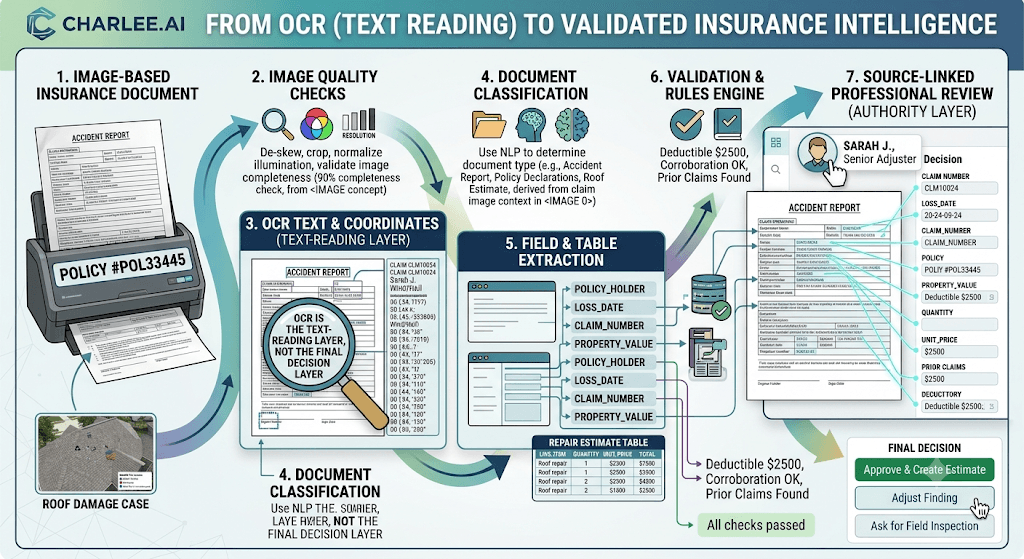
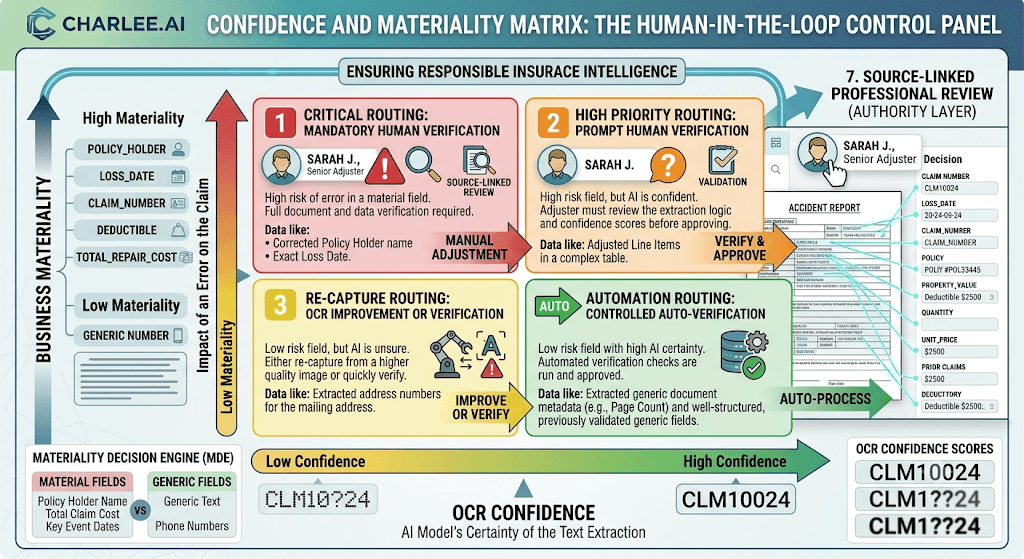
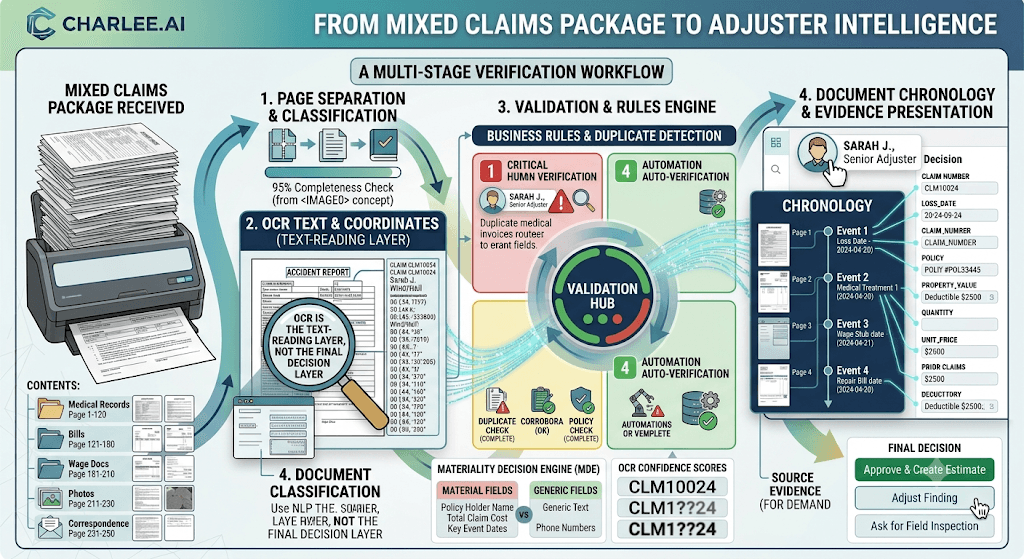
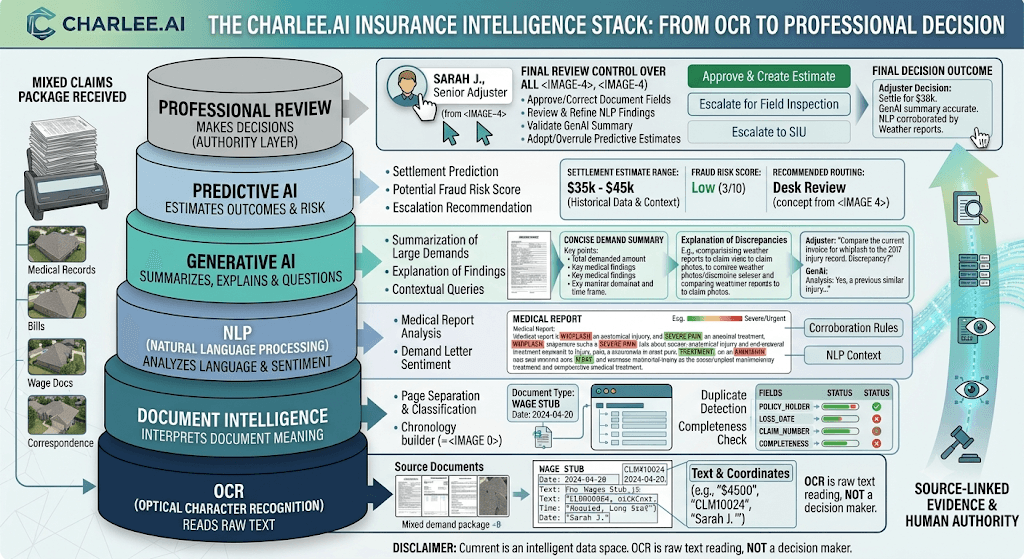
Illustration 4 — OCR Technology Boundaries
FREQUENTLY ASKED QUESTIONS
OCR in Insurance
Recommended Knowledge Center Articles
- How AI Reads and Understands Insurance Documents
- OCR vs. Intelligent Document Processing in Insurance
- How Document Intelligence Improves Claims Intake
- Using AI to Review Medical Records and Demand Packages
- How AI Supports Commercial Underwriting Submission Intake
- Why Source Evidence Matters in Insurance AI
- Human-in-the-Loop Controls for Insurance Document Automation
- Measuring Document AI Accuracy Beyond Character Recognition
Key Takeaways
- OCR converts visible characters into machine-readable text; it does not independently understand insurance meaning.
- The original source, page coordinates, confidence, and corrections should remain traceable.
- Field-level materiality and validation matter more than average character accuracy.
- OCR delivers the greatest value as part of a complete document-intelligence workflow.
- Handwriting, tables, faxes, mobile photos, and domain vocabulary require explicit testing.
- Professional authority remains with claims, underwriting, medical, legal, and management personnel.
- SEARCH PACKAGE
- SEO and AEO Metadata
Two-minute definition Optical Character Recognition is the technology used to detect and convert visible characters in an image into machine-readable text. In insurance, OCR is the first step in making scanned forms, photographed records, faxed correspondence, invoices, estimates, police reports, medical records, and other image-based documents searchable and usable by downstream systems. OCR reads characters; it does not, by itself, understand insurance meaning.
Frequently Asked Questions
OCR converts text visible in scanned or photographed insurance documents into machine-readable text that can support search, extraction, and workflow.
Modern OCR commonly uses computer vision and deep learning. Some basic OCR techniques predate current AI, but contemporary systems are generally AI-enabled.
No. OCR reads characters. Document intelligence identifies document structure and meaning, extracts facts, and relates them to a business context.
Specialized handwriting-recognition models can, but accuracy varies considerably and material handwritten information often requires verification.
OCR can recognize text within tables, but reconstructing rows, columns, merged cells, and reading order requires layout and table-understanding capabilities.
Digits can be visually similar, and blur, compression, handwriting, punctuation, and small fonts can change their appearance. Numeric fields need validation.
There is no universal threshold. Required quality depends on document type, source quality, field materiality, and the availability of validation and review.
CER measures character insertions, deletions, and substitutions against verified reference text. It is useful but does not reflect business impact by itself.
No. Many PDFs already contain reliable native text. The pipeline should inspect and use the best representation rather than applying OCR indiscriminately.
OCR alone should not make coverage, settlement, reserve, causation, or medical decisions. It supplies text and evidence to controlled workflows.
It makes reports, bills, estimates, correspondence, demands, and other records searchable and available for downstream document analysis.
It helps capture information from applications, schedules, loss runs, inspection reports, and legacy policy documents.
They estimate recognition certainty and help route exceptions, but they should be combined with validation rules and materiality.
Yes, in most governed insurance workflows the original should remain available for verification, audit, dispute resolution, and evidentiary integrity.
Extracted text can make sensitive information easier to search and move. Access, encryption, retention, minimization, and audit controls should apply.
Test with representative production documents, inspect field-level errors, assess security and residency, review update controls, and evaluate integration and exception workflow.
Multimodal models may read images, but production document workflows still need reliable coordinates, confidence, deterministic extraction, validation, and evidence preservation.
A high-volume, stable document family with measurable manual effort, clear fields, representative samples, and a defined review workflow is usually the best starting point. REFERENCE LINKS Related Terms and Knowledge Center Topics