Predictive AI
Predictive AI uses historical and current information to estimate likely future outcomes so professionals can prioritize attention, evaluate risk, and act earlier. In P&C insurance, it supports claims severity, litigation, reserve, fraud, subrogation, and underwriting decisions while keeping professionals in control.
EXECUTIVE PROMISE
Predictive AI helps P&C insurers estimate likely future outcomes—such as claim severity, litigation, medical escalation, fraud, subrogation, or underwriting risk—so professionals can act earlier while retaining authority over decisions.
| Publication Detail | Value |
|---|---|
| Category | AI Fundamentals |
| Primary Audience | Insurance executives, claims leaders, underwriters, technology leaders, data and analytics teams |
| Reading Time | 20–25 minutes |
| Difficulty | Intermediate |
| Learning Path | Artificial Intelligence → Machine Learning → Predictive AI → Claims Severity Prediction |
Charlee.ai Insurance AI Dictionary & Reference Guide
HOW TO USE THIS CHAPTER
Executives can begin with the Executive Snapshot and Executive Decision Guide. Claims, underwriting, and analytics leaders should also review the workflow, case studies, governance controls, and KPI sections.
Executive Snapshot
| Executive Question | Answer |
|---|---|
| Business problem | Insurers often recognize severity, litigation, fraud, or cost escalation only after the signals are obvious and options are more limited. |
| Predictive AI capability | Analyzes historical and current data to estimate the probability, magnitude, or timing of future outcomes. |
| Workflow role | Surfaces early warnings, prioritization cues, confidence measures, and contributing factors inside claims and underwriting workflows. |
| Human role | Professionals validate the evidence, apply context, decide what action is appropriate, and document the decision. |
| Business outcome | Earlier intervention, more consistent triage, improved reserve and pricing discipline, lower avoidable leakage, and better resource allocation. |
| Success condition | Reliable data, fit-for-purpose models, explainability, monitoring, governance, and adoption by business users. |
EXECUTIVE DECISION POINT
Predictive AI should not be evaluated only by model accuracy. Leaders should ask whether the insight arrives early enough to change the outcome, whether users understand why the prediction was made, and whether the workflow turns the signal into a governed action.
Business Value Snapshot
| Use Case | Potential Value |
|---|---|
| Claims severity | Prioritize files that may require early management attention. |
| Litigation | Identify signals associated with attorney involvement, suit, or adverse development. |
| Medical escalation | Surface treatment patterns that may increase duration or cost. |
| Reserving | Support earlier review when exposure no longer aligns with current reserves. |
| Fraud and anomaly detection | Prioritize suspicious activity for investigation rather than automate adverse action. |
| Subrogation | Identify recovery potential before evidence or recovery rights are lost. |
| Underwriting | Support risk selection, referral, pricing, and portfolio monitoring. |
| Operations | Direct scarce expertise toward work with the highest expected value. |
Executive Summary
Predictive AI is a category of artificial intelligence that estimates what is likely to happen next. It uses historical outcomes, current observations, and statistical or machine learning methods to produce probabilities, scores, forecasts, rankings, or expected values. In insurance, these outputs can help identify which claims may become severe, which submissions may require referral, which files may litigate, or which exposures may be under-reserved.
Predictive AI differs from generative AI. Generative AI creates new content such as summaries and drafts. Predictive AI estimates future outcomes. The two can work together: document intelligence and generative techniques may organize information, while predictive models estimate risk. The professional then reviews both the evidence and the prediction before acting.
The business case is strongest when the prediction changes a decision. A model that identifies severe claims after the claim is already obviously severe may be accurate but not useful. A model that surfaces emerging risk early, explains the contributing evidence, and fits into the adjuster or underwriter workflow can support better outcomes.
Production deployment requires more than a model. Insurers need data governance, validation, explainability, security, monitoring, change controls, documented human review, and a clear operating model. Predictive AI should support—not replace—professional judgment, especially where decisions materially affect policyholders, claimants, agents, employees, or insureds.
CHARLEE.AI INSIGHT
The most valuable prediction is not merely accurate. It is timely, explainable, operationally relevant, and connected to a professional action that can improve the outcome.
Quick Facts
| Topic | Practical Meaning |
|---|---|
| Primary purpose | Estimate the probability, magnitude, ranking, or timing of future outcomes. |
| Typical outputs | Risk score, probability, predicted value, ranking, alert, confidence measure, or forecast. |
| Common methods | Regression, classification, gradient boosting, random forests, neural networks, survival analysis, time-series forecasting, and ensemble models. |
| Data inputs | Structured data, unstructured text converted into features, images, transactions, notes, external data, and event history. |
| Human oversight | Required for interpretation and material business decisions. |
| Primary risks | Bias, poor data quality, model drift, hidden proxies, overreliance, and weak workflow integration. |
| Best fit | High-volume decisions where historical patterns provide useful signal and earlier action has business value. |
| Not appropriate when | The outcome is too rare, the data is unreliable, the use case lacks a meaningful intervention, or the decision cannot be governed responsibly. |
Definitions
Executive Definition
Predictive AI uses historical and current information to estimate likely future outcomes so professionals can prioritize attention, evaluate risk, and act earlier.
Technical Definition
Predictive AI applies statistical learning and machine learning models to input variables in order to estimate a target outcome. Depending on the problem, the output may be a class probability, continuous value, event likelihood, expected loss, time-to-event estimate, ranking, or forecast. Model performance is evaluated on data not used for training and monitored after deployment.
Insurance Definition
In P&C insurance, predictive AI analyzes claim, policy, exposure, document, medical, legal, operational, and external information to estimate outcomes such as severity, litigation, reserve inadequacy, treatment escalation, fraud risk, subrogation potential, claim duration, loss propensity, or underwriting risk.
What Predictive AI Is Not
- It is not certainty. A probability is not a guaranteed outcome.
- It is not a final decision. Predictions should inform a governed professional judgment.
- It is not the same as reporting. Descriptive analytics explains what happened; predictive AI estimates what may happen.
- It is not automatically objective. Models can reproduce weaknesses or bias in historical data.
- It is not self-maintaining. Models require monitoring, validation, and controlled change.
Why Predictive AI Matters in Insurance
Insurance is fundamentally concerned with uncertain future outcomes. Carriers price risk before losses occur, establish reserves before claims close, and decide where to deploy expertise before all facts are known. Predictive AI is therefore naturally aligned with the core economics and operating model of insurance.
The opportunity is not simply to predict losses more precisely. It is to improve the timing and consistency of attention. Many costly outcomes leave early signals in claim notes, medical records, attorney activity, treatment patterns, reserve movement, policy characteristics, and external events. Those signals are often distributed across systems and difficult to evaluate at portfolio scale.
Predictive AI can compare a current claim or risk with patterns observed across large historical populations. It can then highlight the files that merit additional review. When paired with source evidence and business context, this allows professionals to focus on the situations where earlier action may have the greatest impact.
Five Strategic Reasons Leaders Invest
Earlier visibility: recognize emerging severity or adverse development before it becomes obvious.
Consistency: apply common risk signals across large portfolios while allowing professional judgment.
Prioritization: direct scarce experts toward the claims or risks with the greatest expected value.
Learning at scale: use historical experience across the enterprise rather than relying only on individual memory.
Portfolio control: identify changing patterns, drift, and concentrations that may not be visible file by file.
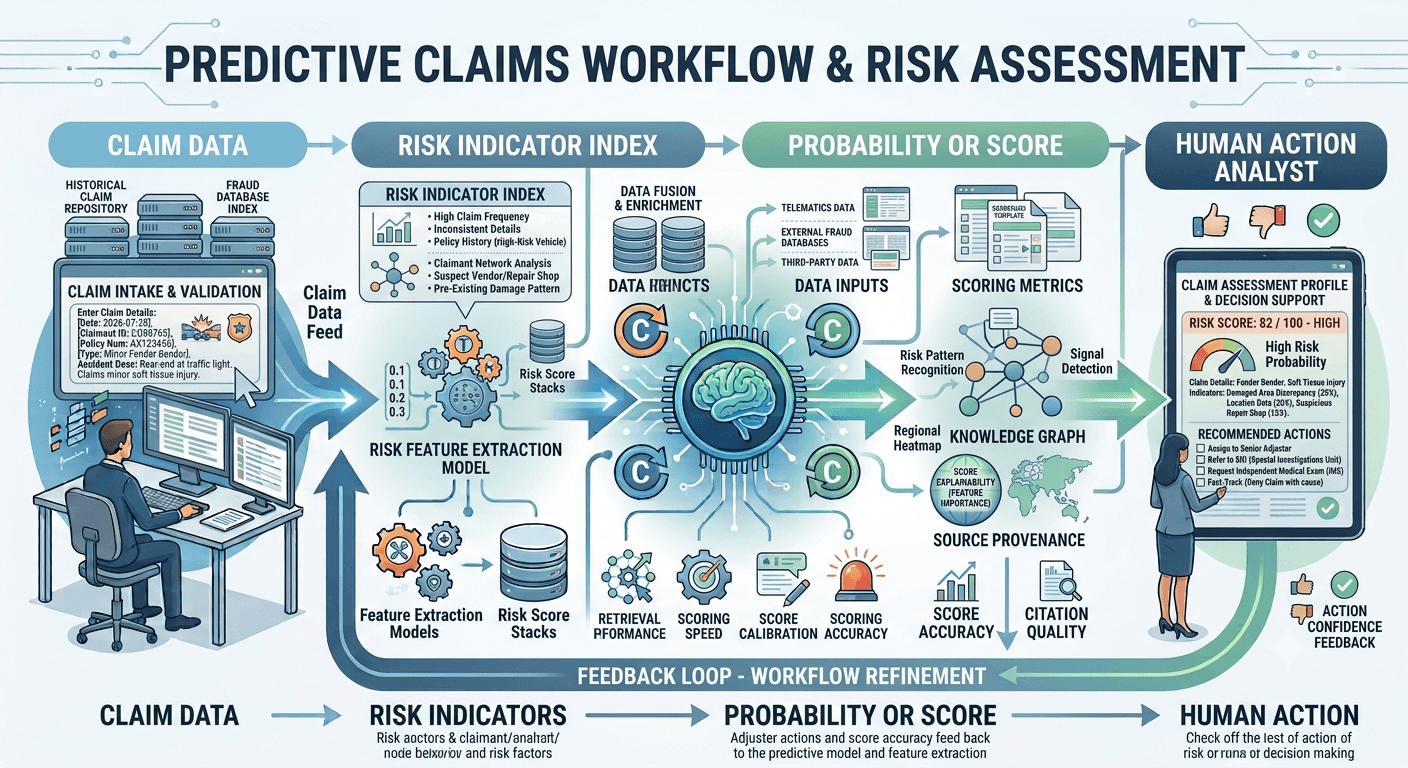
How Predictive AI Works
| Stage | What Happens |
|---|---|
| 1. Define the decision | Start with a business decision, not a model. Specify the user, timing, intervention, and desired outcome. |
| 2. Define the target | Identify what the model will estimate—for example, probability of litigation within 90 days or ultimate incurred loss. |
| 3. Assemble data | Combine relevant structured and unstructured information while documenting source, lineage, quality, and permissions. |
| 4. Create features | Transform raw data into useful model inputs such as treatment velocity, attorney timing, reserve movement, claimant characteristics, or document-derived concepts. |
| 5. Train models | Use historical examples to learn relationships between inputs and known outcomes. |
| 6. Validate | Test performance on unseen data and evaluate calibration, stability, bias, and practical usefulness. |
| 7. Deploy in workflow | Present the prediction, explanation, confidence, and supporting evidence where the professional works. |
| 8. Review and act | The professional evaluates context and determines whether intervention is appropriate. |
| 9. Monitor | Track performance, drift, user behavior, override patterns, and business outcomes. |
| 10. Improve under control | Retrain or replace models through documented validation and change governance. |
Prediction Outputs
| Output Type | Insurance Example |
|---|---|
| Classification | Estimates which category applies, such as likely to litigate versus unlikely to litigate. |
| Probability | Produces a likelihood, such as a 72% estimated probability of attorney involvement. |
| Regression | Predicts a continuous value, such as expected claim cost. |
| Ranking | Orders claims or submissions by expected risk or opportunity. |
| Time-to-event | Estimates when an event may occur, such as time to closure or escalation. |
| Forecasting | Projects future values over time, such as claim volume or portfolio loss emergence. |
| Anomaly score | Highlights observations that differ materially from expected patterns. |
Key Evaluation Concepts
| Concept | Why It Matters |
|---|---|
| Discrimination | How well the model separates higher-risk from lower-risk cases. |
| Calibration | Whether predicted probabilities align with observed outcomes. |
| Precision | Among cases flagged, how many actually experience the outcome. |
| Recall | Among cases that experience the outcome, how many the model identifies. |
| Lift | How much more concentrated the outcome is in the flagged population than in the overall population. |
| Stability | Whether performance remains reliable across time, segments, jurisdictions, or lines of business. |
| Business utility | Whether the prediction arrives early enough and leads to action that improves results. |
Types of Predictive Problems
| Problem Type | Insurance Application |
|---|---|
| Binary classification | Predict whether one of two outcomes is likely, such as litigation versus no litigation. |
| Multiclass classification | Predict among several outcomes, such as low, medium, or high complexity. |
| Regression | Estimate a numeric value, such as ultimate loss or expected repair cost. |
| Survival analysis | Estimate both whether and when an event may occur, such as closure or escalation. |
| Time-series forecasting | Estimate future volumes, costs, or frequencies across time. |
| Ranking and prioritization | Order cases based on expected risk, opportunity, or need for review. |
| Anomaly detection | Identify unusual behavior that may indicate fraud, leakage, or process failure. |
| Propensity modeling | Estimate the likelihood of a behavior or event, such as policyholder response or recovery potential. |
Predictive AI Across the P&C Insurance Value Chain
| Insurance Function | Predictive Contribution |
|---|---|
| FNOL and triage | Estimate complexity, severity, coverage review needs, and required skill level. |
| Claims severity | Identify files with a higher probability of large ultimate loss or adverse development. |
| Litigation | Estimate attorney involvement, suit probability, or litigation escalation. |
| Medical review | Identify treatment patterns associated with prolonged duration or increased cost. |
| Reserving | Support review when predicted exposure differs materially from recorded reserves. |
| Fraud and SIU | Prioritize suspicious claims for investigation based on combined behavioral and contextual signals. |
| Subrogation | Identify recovery opportunities while evidence, notice, and legal rights remain available. |
| Underwriting | Support risk selection, referral, pricing, appetite alignment, and portfolio monitoring. |
| Property risk | Estimate damage potential using location, construction, hazard, inspection, and weather information. |
| Commercial auto | Estimate loss propensity using driver, vehicle, route, safety, and telematics patterns. |
| Customer operations | Forecast call volume, service demand, renewal propensity, or next-best action. |
| Executive management | Monitor concentrations, shifts in severity, workflow performance, and portfolio risk. |
IMPORTANT CONTROL
A prediction should trigger review—not automatically create an adverse outcome. Insurers should define where automation is acceptable, where human approval is mandatory, and how decisions are documented.
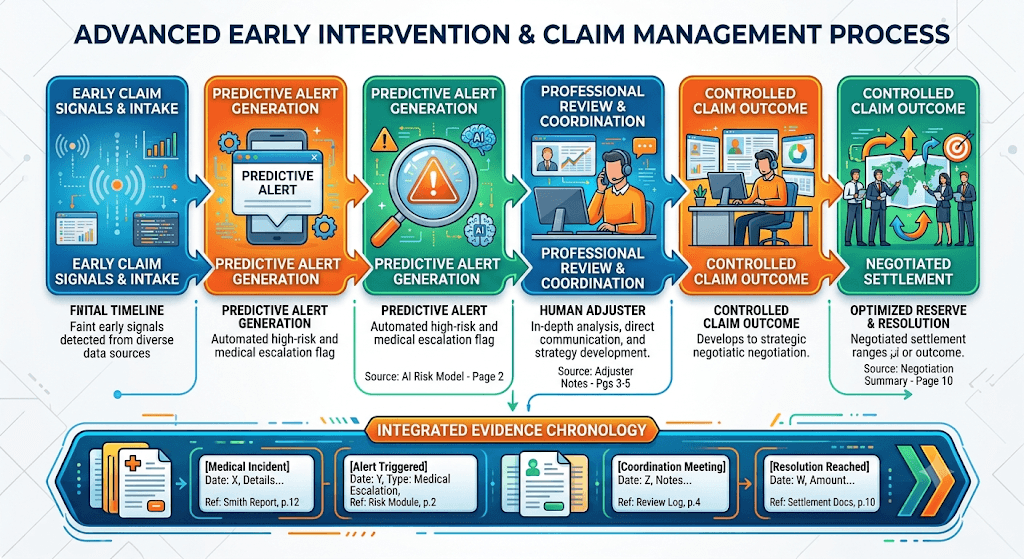
Detailed Claims Case Study: Emerging Severity in Workers’ Compensation
Scenario: A workers’ compensation carrier receives a claim involving a back strain reported as a routine medical-only event. Initial facts appear modest, but the file develops in ways that historically correlate with prolonged disability and higher ultimate cost.
| Timeline | Predictive AI and Human Action |
|---|---|
| Day 1 – FNOL | The claim is reported two days after the incident. Initial diagnosis is lumbar strain. The model assigns a moderate risk score based on job demands, prior history, reporting delay, and claim characteristics. |
| Day 10 – Treatment pattern | The claimant has multiple visits, increasing pain complaints, and referral to a specialist. New documents are processed and predictive features update. |
| Day 18 – Attorney signal | An attorney letter is received. The litigation propensity and severity scores increase. The system shows the contributing evidence and similar historical patterns. |
| Day 25 – Human review | The adjuster reviews the source documents, confirms work-status concerns, contacts the employer, coordinates medical management, and seeks supervisory guidance. |
| Day 40 – Reserve review | Predicted ultimate exposure is materially above the current reserve. The system does not change the reserve; it prompts a documented professional review. |
| Day 75 – Intervention | A nurse case manager, return-to-work planning, and targeted medical review are in place. The claim remains complex, but the carrier is acting earlier than it otherwise might have. |
| Outcome | The value of Predictive AI is not that it guaranteed a better outcome. It provided earlier visibility, supported prioritization, and allowed the claims team to apply judgment sooner. |
Lessons from the Case
- The prediction evolved as new information entered the file.
- The system explained the factors that influenced the score.
- The adjuster retained responsibility for investigation, reserve review, and intervention.
- The workflow connected the signal to specific, governed actions.
- Success was measured by earlier appropriate action—not by whether every flagged claim became severe.
Underwriting Scenario: Commercial Auto Referral
A commercial auto submission includes a mixed fleet, variable driver experience, regional operations, and several years of loss history. Predictive AI combines submission data, historical loss patterns, vehicle and driver characteristics, territory, and exposure measures to estimate expected loss and volatility.
The model identifies a higher-than-average probability of severe loss for one operating segment and provides the primary contributing factors. The underwriter reviews the evidence, requests clarification from the agent, and determines whether the risk fits appetite and what terms are appropriate.
The model does not bind, price, decline, or change terms on its own. It improves consistency and helps the underwriter focus on the aspects of the risk that require deeper analysis.
Predictive AI vs. Generative AI
| Dimension | Predictive AI | Generative AI |
|---|---|---|
| Primary output | Probability, score, forecast, ranking, expected value | Summary, draft, explanation, response, or generated content |
| Core question | What is likely to happen? | What content should be created? |
| Insurance example | Predict likelihood of litigation | Summarize a demand package |
| Key control | Validation, calibration, drift monitoring | Grounding, source evidence, hallucination controls |
| Combined use | Estimate risk and prioritize attention | Explain the evidence and draft a professional summary |
Business Value and Performance Measures
| Value Area | Example Measure |
|---|---|
| Earlier intervention | Time from first meaningful signal to professional action. |
| Triage effectiveness | Concentration of high-value outcomes in the prioritized population. |
| Reserve discipline | Frequency and magnitude of late reserve development or review delays. |
| Severity management | Change in adverse development, leakage, or avoidable cost for comparable populations. |
| Litigation management | Timeliness of attorney detection, strategy review, and escalation. |
| Subrogation recovery | Increase in opportunities identified early enough for action. |
| Underwriting consistency | Reduction in unexplained variation for comparable risks. |
| Productivity | Professional time redirected from low-value review to higher-value work. |
| Adoption | Percentage of alerts reviewed, documented, and acted upon appropriately. |
| Model quality | Calibration, lift, stability, fairness, and segment performance. |
MEASUREMENT PRINCIPLE
Do not measure only whether the model was right. Measure whether the organization responded appropriately and whether earlier action produced better business outcomes.
Risks and Governance
| Risk | Control Focus |
|---|---|
| Data quality | Missing, inconsistent, stale, or incorrectly coded data can degrade predictions. |
| Bias and proxy risk | Historical data may encode inequities or variables that act as inappropriate proxies. |
| Model drift | Relationships can change because of inflation, legal trends, medical practices, climate, product changes, or operational behavior. |
| Overreliance | Users may treat a score as a decision or ignore contradictory evidence. |
| Explainability | A prediction without understandable factors may be difficult to trust, challenge, or govern. |
| Security and privacy | Sensitive claim, medical, policyholder, and employee information must be protected. |
| Feedback loops | Operational actions influenced by the model may alter future training data. |
| Automation risk | Automated adverse action can create legal, regulatory, ethical, and reputational exposure. |
| Weak documentation | Unclear ownership, thresholds, overrides, and change records undermine accountability. |
| Vendor dependency | Insurers need visibility into data use, validation, monitoring, and model changes. |
Governance Lifecycle
Approve the business purpose, user, decision, and acceptable level of automation.
Validate data rights, quality, lineage, representativeness, and security.
Document model design, limitations, intended use, and prohibited use.
Test performance, calibration, segment behavior, explainability, and resilience.
Define human review, override authority, escalation, and documentation requirements.
Monitor model performance, workflow adoption, incidents, drift, and business outcomes.
Control retraining, threshold changes, feature changes, and retirement through formal change management.
Implementation Guidance
Readiness Checklist
- A clearly defined decision and intervention exist.
- The outcome can be measured reliably.
- Historical data is sufficient, lawful, and representative.
- Business users are involved in design and validation.
- The prediction can be delivered inside the workflow.
- Explanations and source evidence are available where appropriate.
- Human review and escalation responsibilities are explicit.
- Monitoring, incident response, and change controls are funded and owned.
- Value will be measured using operational and business outcomes—not only technical metrics.
Recommended Deployment Pattern
| Phase | Objective |
|---|---|
| Phase 1 – Baseline | Document the current process, outcomes, timing, and variation. |
| Phase 2 – Retrospective validation | Test the model on historical data and compare with known outcomes. |
| Phase 3 – Silent mode | Run predictions without changing workflow to evaluate timing and stability. |
| Phase 4 – Assisted pilot | Present signals to a limited user group with required documentation. |
| Phase 5 – Controlled expansion | Broaden use by line, jurisdiction, or team after validation. |
| Phase 6 – Continuous monitoring | Track drift, incidents, overrides, business value, and user behavior. |
Executive Decision Guide
Questions to Ask Before Funding
- What business decision will the prediction improve?
- How early does the signal arrive relative to current recognition?
- What action can the user take when risk is identified?
- How will the system explain the prediction and supporting evidence?
- What populations were represented in training and validation?
- How will segment performance, fairness, and drift be monitored?
- Where is human judgment required?
- How are overrides and disagreements documented?
- What happens when the model is unavailable or uncertain?
- How will business value be measured and attributed?
- Who owns the model after deployment?
- What rights does the insurer have to audit, validate, and control changes?
Vendor Evaluation Criteria
| Criterion | What Good Looks Like |
|---|---|
| Insurance depth | Demonstrated understanding of claims, underwriting, reserving, litigation, medical, and regulatory context. |
| Data flexibility | Ability to work with carrier-specific structured and unstructured data. |
| Explainability | Clear factors, evidence, confidence, and limitations for business users. |
| Validation | Transparent methodology, out-of-sample testing, calibration, and segment results. |
| Workflow integration | Embedded delivery through APIs, core-system integration, work queues, or professional workbenches. |
| Governance | Documented model lifecycle, security, access controls, monitoring, and change management. |
| Human oversight | Configurable review, escalation, override, and documentation controls. |
| Commercial clarity | Clear pricing, implementation obligations, support model, and data-use rights. |
| Measured value | Ability to define and track operational and financial outcomes. |
Charlee.ai Perspective
Predictive AI should help insurance professionals see important developments earlier, understand why a claim or risk deserves attention, and act with greater confidence. It should not turn complex insurance decisions into opaque scores or remove accountability from experienced professionals.
In claims, the greatest value often comes from combining multiple forms of intelligence: structured claim and policy data, unstructured document analysis, medical and legal signals, portfolio context, and predictive models. A score becomes more useful when the professional can review the contributing evidence and understand how the signal relates to the claim’s current posture.
Charlee.ai’s people-plus-AI philosophy places human judgment at the center. Predictive insight should be explainable, governed, integrated into the workflow, and continuously monitored. The goal is not to automate professional responsibility. The goal is to amplify it.
CHARLEE.AI INSIGHT
Business value is created when prediction, explanation, evidence, professional review, and action operate as one governed workflow.
Key Takeaways
- Predictive AI estimates likely future outcomes using historical and current information.
- Its value comes from earlier, explainable, workflow-connected insight—not from a score alone.
- P&C insurers can use it across claims, underwriting, fraud, reserving, litigation, subrogation, and portfolio management.
- Predictions are not decisions. Professionals must review evidence, apply context, and retain authority.
- Strong deployment requires data quality, validation, calibration, explainability, monitoring, governance, and controlled change.
- Success should be measured by better timing, appropriate action, and improved business outcomes as well as technical performance.
Predictive AI uses historical and current information to estimate likely future outcomes so professionals can prioritize attention, evaluate risk, and act earlier. In P&C insurance, it supports claims severity, litigation, reserve, fraud, subrogation, and underwriting decisions while keeping professionals in control.
Frequently Asked Questions
Machine learning is a set of methods for learning patterns from data. Predictive AI is an application category focused on estimating future outcomes. Many Predictive AI systems use machine learning, but the business definition also includes the workflow, controls, explanations, and human use of the prediction.
Often, but not always. Outputs may include probabilities, expected values, rankings, forecasts, anomaly scores, or time-to-event estimates.
No. It estimates likelihood based on available data and learned patterns. New evidence, human behavior, legal developments, and unusual circumstances can change the result.
A rules engine follows explicit logic written by people. Predictive AI learns relationships from historical data. Many production solutions use both: rules for policy or compliance requirements and predictive models for complex patterns.
It can support reserve review by estimating exposure or identifying divergence, but material reserve decisions should remain subject to professional judgment, carrier policy, and governance.
It depends on the outcome, frequency, variability, segmentation, and model type. Data quality and representativeness are often more important than raw volume.
Model drift occurs when relationships between inputs and outcomes change over time, causing performance to weaken. Inflation, legal trends, medical practices, climate, products, and operational behavior can all contribute.
Business users should receive understandable contributing factors, confidence or uncertainty where appropriate, and supporting evidence. Technical explainability alone is not enough; the explanation must support the professional task.
Yes. Bias may enter through historical data, target definitions, sampling, proxy variables, operational behavior, or deployment choices. Testing and governance should evaluate segment performance and potential adverse impact.
No. Alert volume should be designed around user capacity and business value. Poorly tuned alerts create fatigue and reduce trust.
It arrives early enough, relates to a defined decision, includes understandable evidence, and connects to an available intervention.
There is no universal schedule. Retraining should be driven by drift, material business changes, data changes, performance thresholds, and governed review.
Yes. NLP and document intelligence can convert unstructured text into features or concepts used by predictive models.
Use both model metrics and business outcomes, including timing, adoption, appropriate intervention, reserve development, severity, recovery, productivity, and user trust.
Generative AI can summarize the evidence, explain factors, or draft a review note. The predictive estimate should still come from a validated method appropriate to the use case.
No. It can help prioritize and interpret information, but professionals remain responsible for investigation, context, judgment, communication, and decisions.
Starting with a model instead of a business decision. Without a clear user, timing, action, and governance model, technical accuracy may not produce value.
When the data is unreliable, the outcome cannot be measured, there is no meaningful intervention, the use case creates unacceptable risk, or the organization cannot govern the model responsibly.