Embeddings
Embeddings are numerical representations that place words, passages, documents, images, or other insurance objects into a multidimensional space so that items with similar meaning or characteristics are positioned near one another. They enable semantic search, RAG, similarity analysis, and decision support.
Publication Purpose A production-ready reference chapter explaining how embeddings convert insurance language, documents, images, and entities into machine-readable representations that support semantic search, retrieval-augmented generation, similarity analysis, clustering, triage, and decision support.
Executive Snapshot
In One Sentence Embeddings are numerical representations that place words, passages, documents, images, or other insurance objects into a multidimensional space so that items with similar meaning or characteristics are positioned near one another.
| Dimension | What Executives Should Know |
|---|---|
| Primary purpose | Make unstructured information searchable and comparable by meaning—not only by exact keywords. |
| Insurance value | Connect similar claims, documents, injuries, risk descriptions, policy language, and historical outcomes. |
| Common applications | Semantic search, RAG, document retrieval, claim similarity, duplicate detection, clustering, fraud investigation, and submission matching. |
| Key limitation | An embedding is not an explanation or decision. It is a mathematical representation whose quality depends on the model, data, context, and evaluation design. |
| Governance priority | Validate retrieval quality, protect sensitive data, control access, monitor drift, and preserve human authority over consequential decisions. |
| Executive takeaway | Embeddings are foundational infrastructure for modern insurance AI because they make large volumes of unstructured content operationally usable. |
Executive Summary
Property & casualty insurers operate on language-rich information: adjuster notes, police reports, medical records, demand letters, repair estimates, policy forms, inspection reports, underwriting submissions, emails, loss runs, photographs, and legal filings. Traditional systems can store this content, but often cannot understand relationships among documents that use different words to describe the same underlying concept.
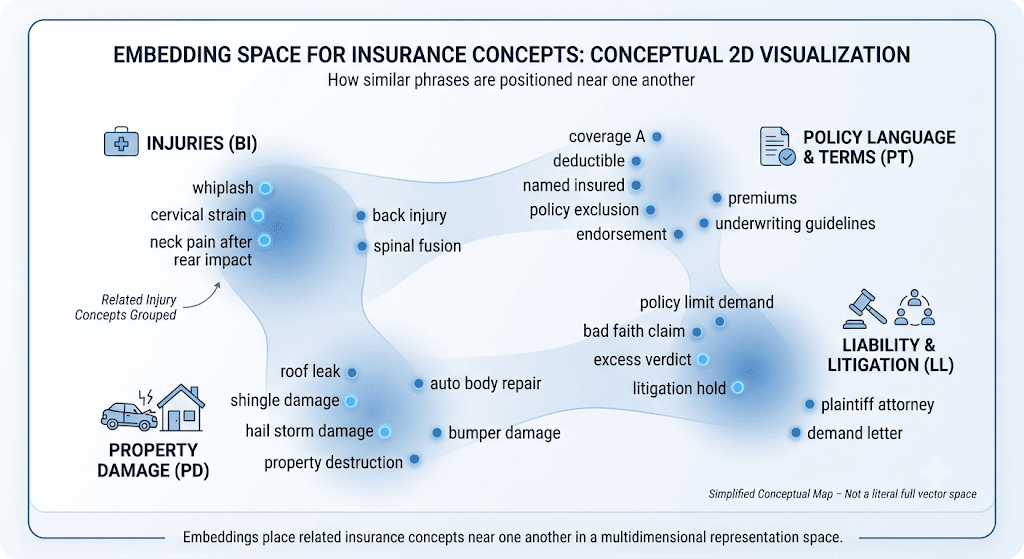
Embeddings address this problem by translating content into vectors—ordered lists of numbers that capture patterns of meaning or structure. A well-designed embedding model can place “rear-end collision with cervical strain” near “whiplash following low-speed impact” even when the words are not identical. This enables semantic search, retrieval-augmented generation, similarity analysis, and other AI workflows that depend on finding relevant information quickly and consistently.
For insurers, the practical value is not the vector itself. The value comes from what the vector enables: locating prior claims with similar characteristics, retrieving the right policy language, assembling evidence for a professional review, identifying duplicate or near-duplicate documents, organizing large document repositories, and improving the grounding of generative AI systems.
Embeddings must nevertheless be treated as governed model components. Similarity can be misleading; context can be lost; sensitive information can be exposed through poorly controlled vector stores; and retrieval performance can vary by line of business, geography, document type, and time period. Production use requires evaluation against real insurance tasks, access controls, lineage, monitoring, and human review.
Quick Facts
| Question | Answer |
|---|---|
| What is embedded? | Text, passages, documents, images, audio, entities, events, claims, policies, accounts, or combinations of these. |
| What is produced? | A vector—often hundreds or thousands of numerical dimensions. |
| How is similarity measured? | Commonly with cosine similarity, dot product, or Euclidean distance. |
| Where are vectors stored? | In a vector database, vector-enabled search engine, or another indexed repository. |
| Are embeddings readable by people? | Not directly. Their meaning is inferred through model behavior, nearest neighbors, probes, and task-level performance. |
| Do embeddings replace metadata? | No. The strongest systems combine vectors with structured fields, filters, permissions, dates, jurisdictions, and business rules. |
| Are embeddings predictive models? | Not by themselves, although they can become inputs to predictive models or retrieval systems. |
| Are they static? | They may become stale as language, products, legal terminology, data sources, and business conditions change. |
Executive Definition
Embeddings are machine-generated numerical representations that allow an insurer to compare information by meaning, context, or similarity. They are a foundational capability for semantic search, retrieval-augmented generation, document intelligence, and AI-assisted decision support.
Technical Definition
An embedding is a dense vector representation produced by a trained model that maps an input—such as a token, sentence, document, image, or entity—into a continuous multidimensional space. The model is trained so that relationships relevant to its objective are reflected in vector geometry: semantically or structurally related inputs tend to have smaller distance or higher similarity than unrelated inputs.
Insurance Definition
In P&C insurance, embeddings convert unstructured or semi-structured insurance information into representations that can be searched, grouped, matched, ranked, or used by downstream models. They help connect the language used across claims, policies, medical records, legal documents, underwriting submissions, inspections, and operational communications.
Important Distinction Embeddings represent relationships in data. They do not independently determine coverage, liability, compensability, reserve adequacy, fraud, or underwriting acceptability. Those conclusions require governed logic, evidence, professional judgment, and often additional models.
Why Embeddings Matter in P&C Insurance
Insurance information is highly variable. The same condition may be described with clinical terminology, claimant language, attorney language, billing codes, or adjuster shorthand. Exact keyword search misses many of these relationships. Embeddings allow systems to retrieve conceptually related information even when the vocabulary differs.
| Insurance Challenge | Embedding-Enabled Response | Business Impact |
|---|---|---|
| Different words describe the same risk or injury | Represent semantic similarity across terminology | Improved retrieval and fewer missed signals |
| Claims files contain thousands of pages | Rank the most relevant passages for a specific question | Faster professional review |
| Historical claims are difficult to compare | Find nearest-neighbor claims based on content and context | Better benchmarking and investigation support |
| Policy language varies by edition and jurisdiction | Retrieve clauses with similar meaning plus metadata filters | More reliable access to relevant language |
| Submission documents are inconsistent | Match risk descriptions to appetite, guidelines, and prior accounts | More efficient underwriting review |
| Duplicate or templated documents create noise | Detect near-duplicate content | Cleaner repositories and reduced review effort |
| Generative AI needs supporting evidence | Retrieve grounded source passages for RAG | More explainable and controlled outputs |
How Embeddings Work
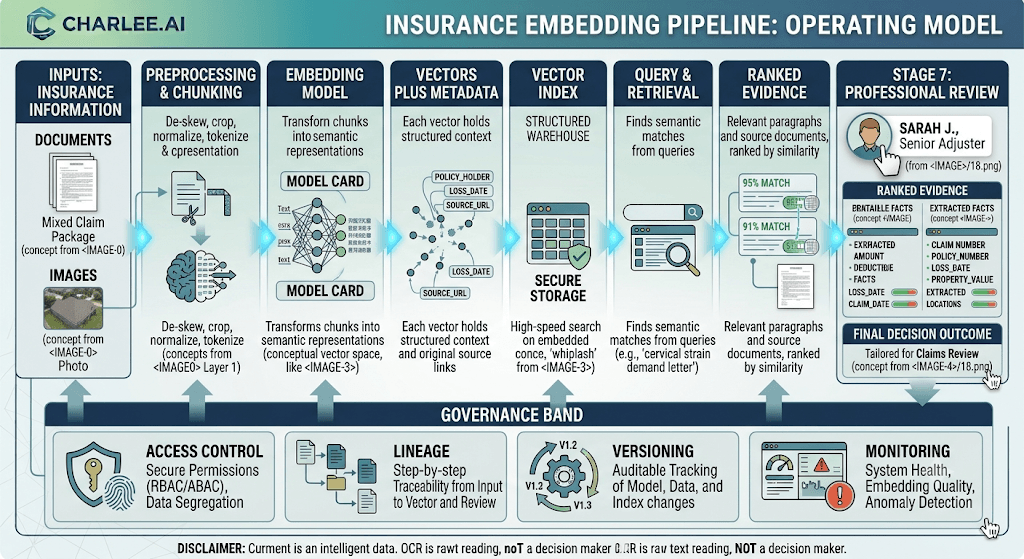
Input preparation
The source content is normalized, segmented, and enriched with metadata. Text may be divided into chunks; images may be resized or encoded; claim and policy identifiers, jurisdiction, line of business, document date, and confidentiality tags may be attached.
Model encoding
An embedding model processes the input and generates a vector. The vector is not a compressed copy of the original document. It is a learned representation that preserves patterns considered important by the model.
Indexing
Vectors are stored in an index designed for fast nearest-neighbor search. The original text or a reference to it is stored alongside metadata and access-control information.
Query encoding
A user question, document, image, or claim is encoded by the same or a compatible model. The resulting query vector is compared with indexed vectors.
Retrieval and ranking
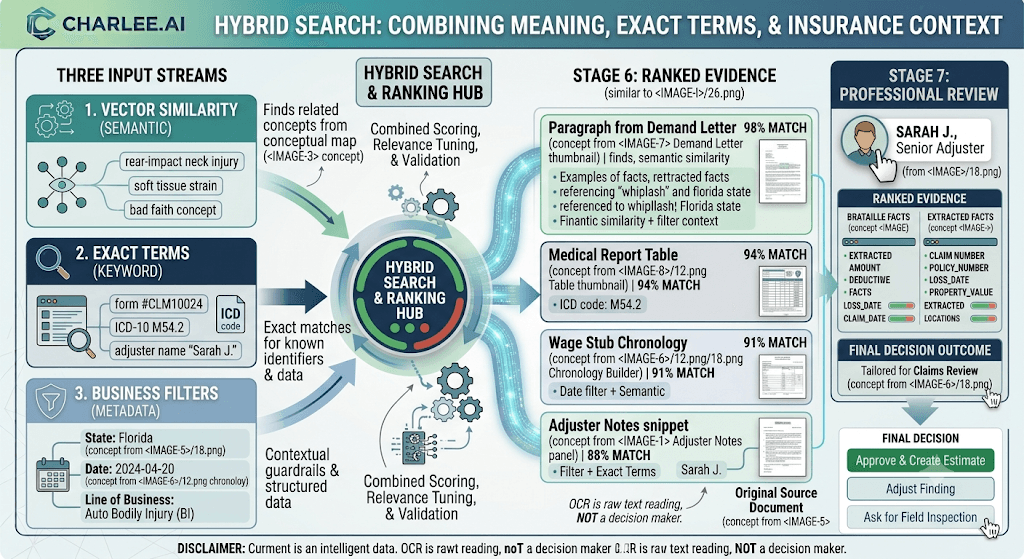
The system returns items with the highest similarity, often combined with keyword scores, metadata filters, recency, jurisdiction, authority level, or business rules.
Human or downstream use
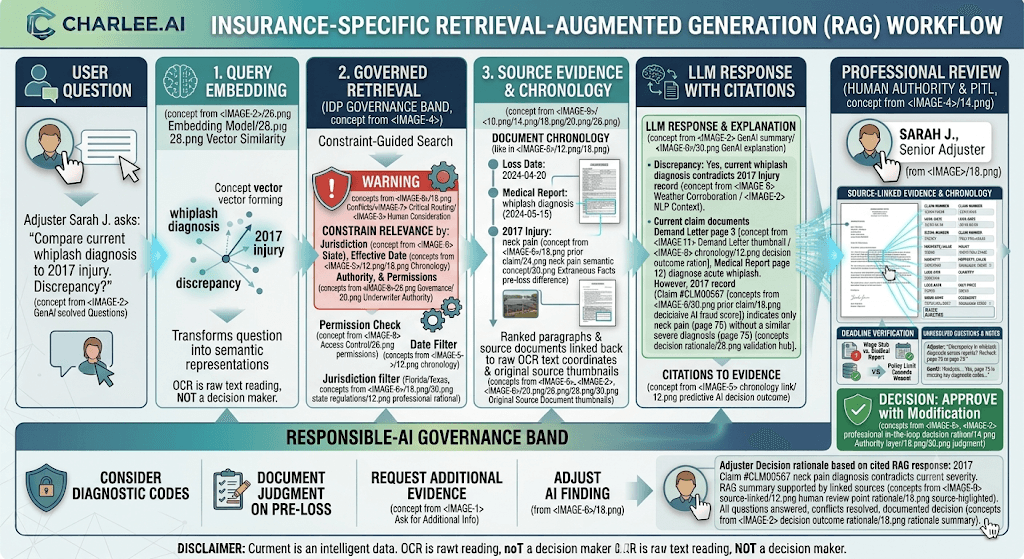
Retrieved content may be shown to an adjuster or underwriter, passed into a RAG workflow, used to build a similarity feature, or sent to another model. The user should be able to inspect sources and understand why the information is relevant.
Human or downstream use
Conceptual Workflow Insurance content → preprocessing and chunking → embedding model → vectors plus metadata → vector index → query vector → similarity search → ranked evidence → professional review or downstream AI.
Core Concepts
| Concept | Plain-Language Meaning | Insurance Example |
|---|---|---|
| Vector | An ordered list of numbers representing an item | A representation of a demand-letter passage |
| Dimension | One coordinate in the vector space | One of many learned features—not usually interpretable by itself |
| Embedding space | The multidimensional environment in which vectors are positioned | Similar claim narratives appear near one another |
| Similarity score | A numerical measure of how close two vectors are | Ranking prior claims related to a new loss description |
| Nearest neighbor | One of the most similar indexed items | A historical workers’ compensation claim with a similar injury pattern |
| Chunk | A segment of a larger document embedded separately | A paragraph from a medical chronology or policy form |
| Metadata filter | A structured constraint applied with vector search | Limit retrieval to Florida commercial auto policies in force on the loss date |
| Hybrid search | Combination of semantic vector search and lexical keyword search | Find conceptually related reserve guidance while preserving exact form numbers |
| Re-ranking | A second-stage model that improves ordering of retrieved items | Prioritize passages most directly responsive to a coverage question |
Similarity Measures
| Measure | What It Captures | Typical Consideration |
|---|---|---|
| Cosine similarity | Angle between vectors; emphasizes direction more than magnitude | Common for text embeddings and normalized vectors |
| Dot product | Combined alignment and magnitude | Efficient when the model is trained for this scoring method |
| Euclidean distance | Straight-line distance between vectors | Useful in some clustering and image applications |
| Learned re-ranker score | Task-specific relevance from a second model | Often improves final retrieval quality at higher computational cost |
The correct measure depends on how the embedding model was trained. Teams should not choose a metric merely because it is popular; they should follow model guidance and validate performance against the insurance task.
Types of Embeddings
| Embedding Type | Description | Insurance Uses |
|---|---|---|
| Word or token embeddings | Represent individual words or subword units | Terminology analysis, legacy NLP features |
| Sentence embeddings | Represent short passages or statements | Search adjuster notes, identify similar allegations |
| Document embeddings | Represent an entire document or large section | Submission matching, document clustering, duplicate detection |
| Entity embeddings | Represent people, organizations, vehicles, providers, attorneys, or other entities | Network analysis, relationship discovery, fraud investigation support |
| Image embeddings | Represent visual characteristics in photographs or scans | Damage similarity, duplicate image detection, inspection comparison |
| Multimodal embeddings | Place text and images in a shared or related space | Retrieve photos using text queries or connect inspection language to images |
| Domain-adapted embeddings | Optimized for a specific industry or corpus | Insurance terminology, policy forms, medical and legal language |
| Sparse embeddings | High-dimensional representations with many zeros, often retaining term-level signals | Hybrid retrieval and explainability support |
Embeddings Across the P&C Value Chain
| Function | Representative Applications |
|---|---|
| Claims intake | Match FNOL narratives to prior losses, route documents, identify related policy or procedure content |
| Claim investigation | Find similar fact patterns, retrieve relevant notes, connect entities and recurring descriptions |
| Medical review | Retrieve related diagnoses, procedures, treatment patterns, and chronology passages |
| Litigation management | Search pleadings, demands, discovery, and prior litigated claims by legal or factual similarity |
| Reserve monitoring | Find historical claims with comparable trajectories and document new exposure signals |
| Subrogation | Retrieve similar third-party responsibility patterns and supporting evidence |
| Fraud investigation | Identify near-duplicate narratives, recurring providers, document templates, and relationship patterns |
| Underwriting | Match submissions to appetite, guidelines, prior accounts, and comparable risk descriptions |
| Policy service | Retrieve relevant forms, endorsements, procedures, and correspondence |
| Catastrophe response | Cluster damage reports, identify similar property conditions, and retrieve event-specific guidance |
| Management | Create portfolio groupings and thematic views of unstructured information |
Case Study 1: Similar-Claim Retrieval for Complex Casualty
Business problem
A claims manager reviewing a severe commercial auto loss wants comparable historical claims. Traditional fields—cause of loss, reserve, jurisdiction, and injury code—provide only a partial match. The most important similarities may be buried in narratives, medical documents, attorney communications, and litigation notes.
Embedding-enabled approach
Create passage and claim-level embeddings from selected, governed content.
Combine vectors with structured metadata such as jurisdiction, policy period, venue, injury category, claimant age band, attorney involvement, and litigation status.
Use a hybrid search to retrieve historically similar claims while enforcing permissions and excluding legally privileged or irrelevant content.
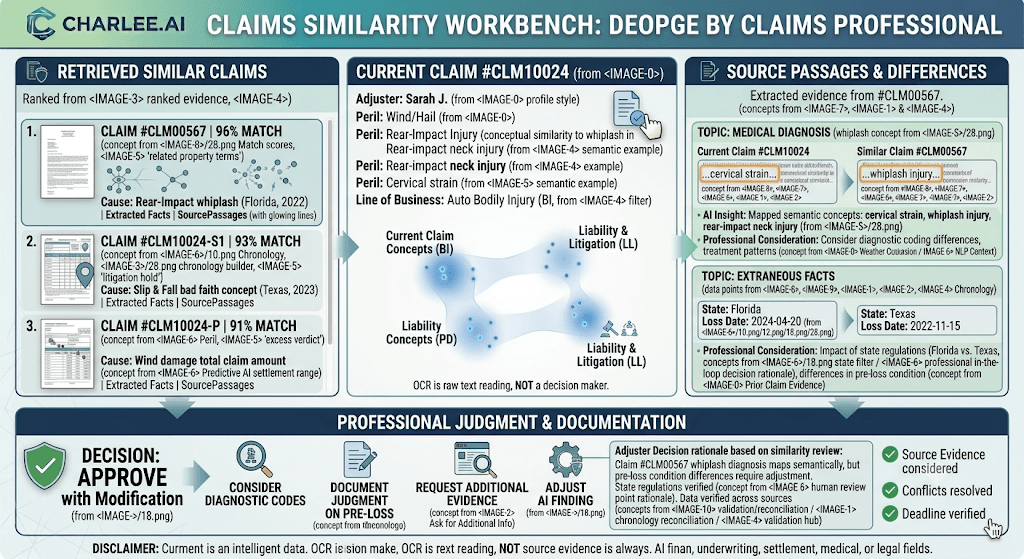
Present ranked claims with the passages that drove similarity, not merely a numeric score.
Allow the claims professional to refine the search and document which comparisons were useful.
Potential value
- Faster access to relevant experience and institutional knowledge.
- More consistent case comparisons across teams and offices.
- Earlier recognition of patterns associated with severity, litigation, or operational complexity.
- Better support for management review without replacing claim-specific judgment.
Required controls
- No automated reserve or settlement decision based solely on similarity.
- Source passages, dates, and claim context must remain visible.
- Similar claims must be treated as references, not deterministic precedents.
- Evaluation should test whether retrieved claims are genuinely useful to experienced reviewers.
Case Study 2: Underwriting Submission and Appetite Matching
Business problem
Commercial submissions arrive in inconsistent formats and use varied language to describe operations, controls, exposures, and risk characteristics. Exact keyword matching may miss submissions that are conceptually aligned with an insurer’s appetite—or may falsely match a submission because it contains a common term in an irrelevant context.
Embedding-enabled approach
The insurer embeds selected sections of underwriting guidelines, appetite statements, prior account summaries, and incoming submission content. Retrieval combines semantic similarity with mandatory filters such as state, class code, premium band, authority level, prohibited operations, and effective date. The system returns potentially relevant guideline passages and comparable accounts for underwriter review.
Potential value
- Faster triage of submissions and more consistent appetite interpretation.
- Improved access to relevant guideline language and prior experience.
- Reduced dependence on exact wording or individual memory.
- Better documentation of what information informed the review.
Required controls
- Hard eligibility rules remain explicit and separate from semantic similarity.
- Underwriters retain authority over risk selection and terms.
- Guideline versions, effective dates, and approval status must be enforced.
- Comparable accounts must be de-identified or access-controlled as appropriate.
Case Study 3: Policy and Procedure Retrieval for RAG
A generative AI assistant is designed to help claims professionals locate relevant policy forms, endorsements, claim procedures, and jurisdictional guidance. Embeddings allow the system to retrieve passages by meaning. However, semantic relevance alone is not enough. The workflow must also enforce policy edition, state, effective date, authority level, and user permissions. Retrieved sources are provided to the language model and displayed with citations so the professional can inspect the evidence.
Operational Principle For insurance RAG, the best semantic match can still be the wrong source if it is outdated, from the wrong jurisdiction, superseded, outside the user’s authority, or not applicable to the policy at issue. Metadata and governance are therefore as important as embedding quality.
Embeddings vs. Keywords
| Dimension | Keyword Search | Embedding Search |
|---|---|---|
| Match basis | Exact terms, stems, synonyms, Boolean logic | Learned semantic or structural similarity |
| Strength | Precision for names, codes, form numbers, and mandatory terms | Recall across varied language and conceptual similarity |
| Weakness | Misses paraphrases and related concepts | Can return plausible but contextually wrong results |
| Best insurance use | Policy numbers, ICD codes, statutes, form editions, names | Narratives, medical descriptions, operational language, thematic retrieval |
| Recommended approach | Use together in hybrid search with metadata filters | Use together in hybrid search with metadata filters |
Chunking and Context Design
Chunking is one of the most important design decisions in embedding systems. If chunks are too small, they may lose context. If too large, they may contain multiple topics and reduce retrieval precision. The correct approach varies by document type.
| Document Type | Practical Chunking Considerations |
|---|---|
| Policy forms | Preserve section, subsection, endorsement, edition, and defined-term relationships |
| Medical records | Respect encounter boundaries, dates, provider sections, and chronology |
| Demand letters | Separate allegations, damages, medical summaries, settlement demands, and exhibits while retaining document context |
| Adjuster notes | Use date and author boundaries; preserve sequence and claim phase |
| Underwriting submissions | Separate operations, locations, exposures, controls, loss history, and attachments |
| Legal documents | Preserve headings, citations, allegations, causes of action, and jurisdiction |
| Repair estimates | Retain line-item groups, totals, labor/material context, and version information |
Many production systems store overlapping chunks or parent-child relationships. A smaller passage can be retrieved for precision while the surrounding parent section is supplied for context.
Data and Model Requirements
Representative data
The evaluation set should reflect the insurer’s actual lines of business, document types, language patterns, abbreviations, jurisdictions, and user questions. General benchmark performance is not a substitute for insurance-specific testing.
Metadata and lineage
Every vector should be connected to the original source, document version, creation date, ingestion date, ownership, permissions, and relevant business metadata. Without lineage, retrieval results cannot be reliably governed or audited.
Model compatibility
A query and indexed content generally need to be encoded using the same embedding model or a deliberately compatible pair. Changing models usually requires re-embedding and re-indexing content.
Version control
Embedding model versions, preprocessing rules, chunking logic, index parameters, and metadata schemas should be documented. A change to any of these may alter retrieval behavior even when the source content is unchanged.
Evaluation Framework
| Evaluation Layer | Questions to Test | Example Metrics |
|---|---|---|
| Representation quality | Do semantically related insurance items appear near one another? | Nearest-neighbor review, clustering coherence, domain probes |
| Retrieval quality | Does the system return relevant passages or items? | Recall@k, precision@k, mean reciprocal rank, nDCG |
| Business usefulness | Do professionals find the results helpful and actionable? | Acceptance rate, time saved, task completion, reviewer rating |
| Safety and governance | Does retrieval respect permissions, jurisdiction, date, and authority? | Unauthorized-result rate, stale-source rate, filter compliance |
| Robustness | Does performance hold across lines, document types, and user phrasing? | Segmented metrics, stress tests, paraphrase tests |
| Operational performance | Is the system fast and reliable enough for workflow use? | Latency, throughput, index freshness, failure rate |
| Downstream impact | Does retrieval improve a RAG or decision-support task? | Grounded-answer rate, citation accuracy, escalation quality |
Common Retrieval Metrics
| Metric | Meaning | Insurance Interpretation |
|---|---|---|
| Recall@k | Share of relevant items found in the top k results | Did the top results include the needed policy clause or claim document? |
| Precision@k | Share of top k results that are relevant | How much irrelevant material must the professional review? |
| Mean reciprocal rank | Rewards placing the first relevant result near the top | How quickly does the correct source appear? |
| nDCG | Measures ranking quality when relevance has levels | Are highly relevant sources ranked above marginal ones? |
| Hit rate | Whether at least one relevant item was retrieved | Did the system find any usable evidence? |
| Citation accuracy | Whether cited sources support the output | Does the generated answer faithfully reflect retrieved insurance content? |
Risks and Governance
| Risk | Why It Matters | Control |
|---|---|---|
| Semantic false positives | Two items may appear similar but differ in coverage, jurisdiction, chronology, or legal significance | Metadata filters, source display, professional review, task-specific evaluation |
| Context loss | A chunk may omit definitions, exclusions, dates, or surrounding facts | Parent-child retrieval, overlap, context windows, document-aware chunking |
| Sensitive-data exposure | Vectors and retrieved content may reveal claim, medical, legal, or personal information | Encryption, permissions, tenant isolation, least privilege, secure deletion |
| Stale vectors | Source content or model versions may change while the index remains old | Freshness monitoring, versioning, re-indexing controls |
| Bias and uneven performance | Language patterns may work better for some lines, regions, or populations | Segmented testing, representative data, human oversight |
| Model drift | Terminology, products, laws, and claim patterns evolve | Monitoring, periodic revalidation, controlled updates |
| Unauthorized inference | Similarity may expose relationships users are not permitted to see | Filter-before-search design, access-aware indexing, auditing |
| Overreliance on similarity | Users may treat nearest neighbors as authoritative precedents | Training, interface warnings, evidence standards, documented judgment |
| Vendor dependency | Proprietary models or vector stores may create lock-in or migration cost | Portability planning, export capability, model abstraction, contract controls |
Human-in-the-Loop Operating Model
| Stage | AI Role | Professional Role |
|---|---|---|
| Search formulation | Convert a natural-language request into an embedding and filters | Define the business question and relevant constraints |
| Retrieval | Rank similar passages, documents, claims, or accounts | Review relevance and applicability |
| Evidence presentation | Show source text, metadata, similarity, and rationale | Interpret the evidence in claim or underwriting context |
| Decision support | Summarize or compare retrieved information | Make the decision and document reasoning |
| Feedback | Capture accepted, rejected, or missing results | Provide domain feedback and identify exceptions |
| Monitoring | Measure quality and detect degradation | Review performance, approve changes, and escalate incidents |
Best Practices
- Start with a clearly defined retrieval or similarity problem, not with a vector database purchase.
- Use hybrid search when exact insurance identifiers and semantic meaning both matter.
- Attach strong metadata and enforce filters for jurisdiction, date, product, authority, and permissions.
- Design chunks around document structure and user tasks rather than a fixed character count alone.
- Evaluate on real insurance questions and have experienced professionals judge usefulness.
- Show the underlying source and context; do not expose only a similarity score.
- Keep consequential business rules explicit rather than hiding them inside similarity behavior.
- Monitor index freshness, retrieval quality, segment performance, and access-control compliance.
- Plan for model upgrades, re-embedding, migration, and rollback.
- Treat user feedback as governed evaluation data, not as automatic approval to retrain.
Common Mistakes
- Assuming a high similarity score means the items are legally or operationally equivalent.
- Embedding entire long documents without preserving section structure or metadata.
- Ignoring exact-match requirements for policy forms, statutes, codes, names, and dates.
- Using a public embedding service with sensitive insurance content without appropriate controls.
- Changing embedding models without rebuilding the index and validating behavior.
- Evaluating only with generic datasets rather than actual insurance tasks.
- Allowing retrieval across unauthorized claims, accounts, or business units.
- Using nearest-neighbor claims as automated settlement, reserve, or underwriting decisions.
- Failing to preserve the source text and lineage needed for audit and explanation.
- Optimizing technical metrics without measuring professional usefulness or business impact.
Implementation Blueprint
| Phase | Objectives | Key Deliverables |
|---|---|---|
| 1. Define | Select the business question, users, content, and decision boundaries | Use-case charter, risk classification, success metrics |
| 2. Prepare | Clean sources, design chunks, attach metadata, define permissions | Governed corpus, metadata schema, access model |
| 3. Prototype | Compare models, search methods, and index settings | Baseline retrieval system and evaluation set |
| 4. Validate | Test relevance, safety, segment performance, and workflow fit | Task-level scorecard, professional review, risk findings |
| 5. Integrate | Embed retrieval in claims, underwriting, or knowledge workflows | User interface, source display, logging, escalation |
| 6. Govern | Establish ownership, monitoring, change control, and incident response | Model card, lineage, controls, review cadence |
| 7. Scale | Expand content and use cases only after measured success | Rollout plan, capacity model, re-indexing strategy |
Build, Buy, or Combine?
| Decision Area | Questions for Insurers |
|---|---|
| Embedding model | Does the model perform well on insurance, medical, legal, and policy language? Can it run in the required environment? |
| Vector infrastructure | Can the platform enforce permissions, filters, encryption, deletion, backup, and scale requirements? |
| Vendor controls | What data is retained? Is customer data used for training? What are the audit, residency, subcontractor, and incident terms? |
| Portability | Can vectors, metadata, source references, and evaluation data be exported? What is required to migrate? |
| Operations | Who owns index freshness, model upgrades, monitoring, and re-embedding? |
| Economics | What are the ingestion, storage, query, model, network, and re-indexing costs at portfolio scale? |
| Integration | Can the capability be embedded in core claim, policy, underwriting, and document systems without forcing users into a separate tool? |
Executive Decision Guide
| Question | Green Light | Caution |
|---|---|---|
| Is the problem based on meaning or similarity? | Users need semantic retrieval, matching, grouping, or grounding | The task is primarily exact lookup or a deterministic rule |
| Are sources governed? | Content has owners, versions, permissions, and reliable metadata | Repositories are duplicated, stale, or poorly controlled |
| Can quality be evaluated? | There is a representative test set and domain reviewers | Success is defined only as “the results look good” |
| Will users see evidence? | The interface shows source passages and context | Only a score or generated answer is presented |
| Are decision boundaries clear? | Professionals retain authority and consequential rules remain explicit | Similarity directly drives reserve, settlement, coverage, or declination |
| Is change manageable? | Model, index, and re-embedding processes are versioned and reversible | Upgrades occur without impact analysis or rollback |
Executive Recommendation Invest in embeddings when the business problem depends on finding meaning across large volumes of unstructured insurance information. Treat embeddings as governed infrastructure—not as an autonomous decision maker—and require evidence, metadata, professional review, and measurable task-level performance.
Business Benefits
| Benefit | How It Is Created | Illustrative Measures |
|---|---|---|
| Faster information access | Semantic retrieval reduces manual searching across documents and systems | Search time, review time, first-useful-result rate |
| Improved consistency | Relevant guidance and comparable experience become easier to find | Variance in handling, retrieval acceptance rate |
| Better grounded AI | RAG receives more relevant evidence and source citations | Grounded-answer rate, citation accuracy, unsupported-answer rate |
| Portfolio insight | Claims, risks, and documents can be grouped by latent similarity | Cluster usefulness, emerging-theme detection |
| Reduced duplication | Near-duplicate content and repeated templates can be identified | Duplicate rate, storage reduction, review avoidance |
| Knowledge preservation | Institutional experience becomes more accessible across teams | Reuse rate, onboarding time, expert-search reduction |
Charlee.ai Perspective
Embeddings are most valuable when they are connected to real insurance workflows and governed evidence. A claims professional should not receive an unexplained list of “similar” files. The system should explain what was retrieved, show the supporting text, preserve chronology and source lineage, and make clear which facts are shared—and which are different.
In claims intelligence, embeddings can help identify relevant documents, comparable claims, evolving themes, and evidence that deserves attention. Their role is to improve access to information and strengthen professional review. Human expertise remains responsible for interpreting the evidence, considering exceptions, and making decisions.
The practical design principle is straightforward: better representations should lead to better retrieval; better retrieval should lead to better information; better information should support better human decisions and business outcomes. Governance, measurement, and workflow integration are the bridge between a promising vector model and dependable insurance value.
Key Takeaways
- Embeddings convert insurance content into numerical representations that support meaning-based comparison.
- Their greatest value is enabling semantic search, RAG, similarity analysis, clustering, and knowledge access.
- Keyword search, metadata, permissions, and business rules remain essential; embeddings do not replace them.
- Chunking, lineage, versioning, and domain-specific evaluation strongly influence quality.
- Similarity does not prove equivalence, causation, coverage, fraud, or outcome.
- Professionals should see source evidence and retain authority over consequential decisions.
- Embeddings should be governed as sensitive, versioned model infrastructure.
- Business value should be measured through retrieval usefulness, workflow improvement, and better-supported decisions.
Embeddings are numerical representations that place words, passages, documents, images, or other insurance objects into a multidimensional space so that items with similar meaning or characteristics are positioned near one another. They enable semantic search, RAG, similarity analysis, and decision support.
Frequently Asked Questions
An embedding is the learned representation of an item; the representation is stored as a vector. In practice, the terms are often used interchangeably, but “embedding” emphasizes how the vector was created and what relationships it is intended to preserve.
Not directly. Individual dimensions usually do not have stable human-readable meanings. Teams interpret embeddings through nearest neighbors, clustering, probes, retrieval results, and task-level evaluation.
No. They are not a complete copy of the source. However, they can still encode sensitive patterns and must be protected. The original text or a secure reference is usually stored separately for retrieval and display.
Exact reconstruction is generally not the intended function, but privacy risks remain. Attackers may infer attributes or exploit the surrounding system. Insurers should treat vectors as sensitive derived data.
Keyword search is excellent for exact identifiers, codes, names, and legal terms but often misses paraphrases and conceptual relationships. Embeddings improve semantic recall. Hybrid search is usually stronger than either method alone.
A vector database or vector-enabled search engine stores embeddings and retrieves nearby vectors efficiently. It should also support metadata filters, permissions, updates, deletion, monitoring, and operational scale.
There is no universal answer. Dimensionality is a model property and involves tradeoffs among quality, cost, storage, latency, and compatibility. Task-level evaluation matters more than selecting the largest vector.
Not always. General models can perform well, but insurers should test them on policy, medical, legal, underwriting, and claims language. Domain adaptation may help when terminology or tasks are specialized.
Chunking divides a document into segments that can be embedded and retrieved. Good chunking preserves enough context to be meaningful while remaining focused enough for precise retrieval.
Hybrid search combines vector similarity with lexical keyword scores and structured filters. It is especially useful in insurance because meaning, exact terms, versions, dates, and jurisdiction can all matter.
Yes, they can support similarity retrieval. The results should be treated as references, not determinations. Similar claims may differ in venue, policy language, liability, medical facts, chronology, or legal posture.
Frequently. The user question and source passages are embedded, and the system retrieves relevant passages for the language model. RAG quality depends heavily on the corpus, chunking, metadata, retrieval, and evaluation.
Evaluation may include nearest-neighbor review, retrieval metrics such as recall@k and precision@k, domain-expert ratings, access-control tests, latency, and downstream grounded-answer quality.
Vectors created by different models are usually not directly comparable. A model change commonly requires re-embedding the corpus, rebuilding the index, validating performance, and planning rollback.
Yes. They inherit patterns from training data and may perform unevenly across language, geography, lines of business, document types, or populations. Segmented testing and human oversight are required.
They can be, but security depends on implementation. Insurers should require encryption, access-aware retrieval, tenant isolation, logging, secure deletion, backup controls, and tested incident response.
Scores can be useful, but they should not be presented as probabilities or certainty unless validated for that meaning. Source passages, metadata, and contextual differences are usually more important.
Embeddings can support retrieval and become model features, but they should not independently make consequential decisions. Coverage, liability, reserves, settlement, compensability, and risk selection require governed processes and professional authority.