Executive Snapshot
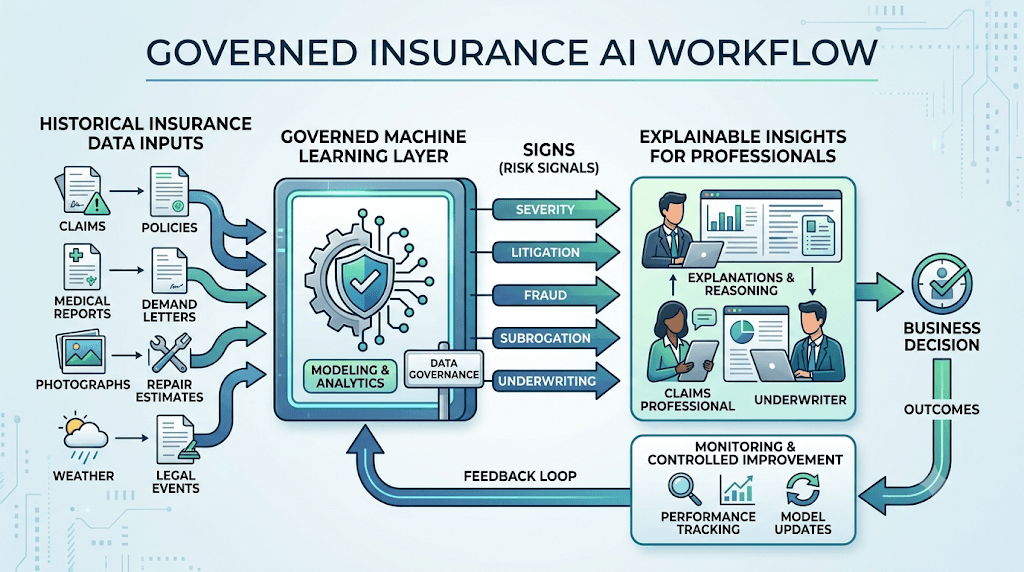
Machine learning enables insurers to learn patterns from historical data and apply those patterns to new claims, submissions, policies, and portfolios. It is especially valuable when the business needs to estimate probability, classify risk, prioritize work, or identify unusual behavior at a scale that manual review alone cannot match.
TWO-MINUTE TAKEAWAY
Machine learning is not a decision-maker. It is a disciplined way to turn historical experience into timely predictions and recommendations. The insurer remains responsible for the business decision, the governance of the model, and the treatment of customers and claimants.
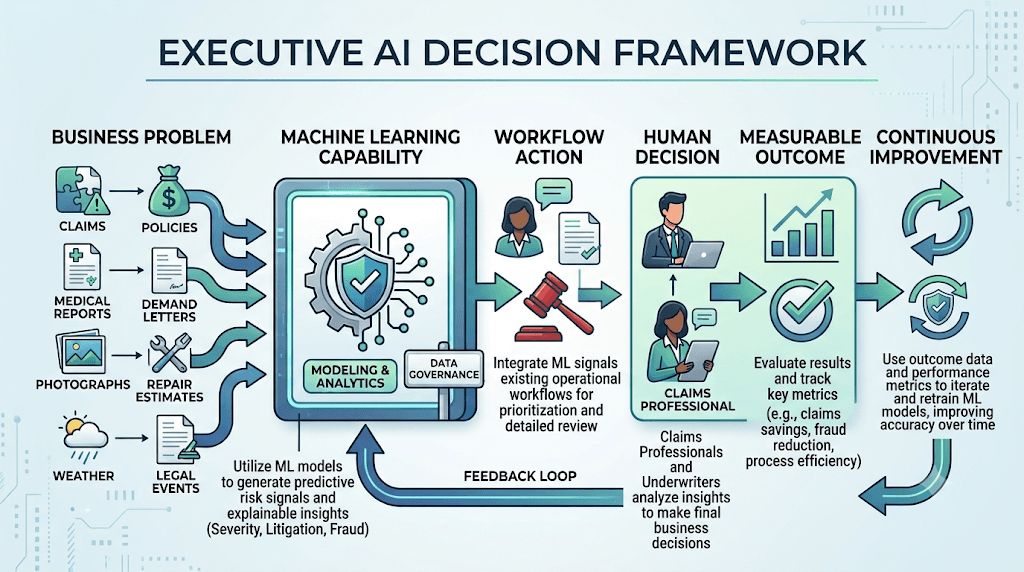
The executive value chain
| Business challenge | Machine learning capability | Workflow use | Business outcome |
|---|---|---|---|
| Too many claims to review equally | Risk scoring and classification | Prioritize high-severity or litigation-prone claims | Earlier intervention and better focus |
| Inconsistent underwriting decisions | Pattern recognition across historical outcomes | Surface comparable risks and risk factors | More consistent appetite and pricing support |
| Hidden fraud or anomaly signals | Anomaly detection | Route suspicious activity for investigation | More targeted SIU resources |
| Late reserve adjustments | Severity and development prediction | Prompt earlier reserve review | Improved reserve discipline |
| Document overload | Features extracted from unstructured data | Combine document signals with structured data | More complete decision context |
What executives should remember
- A prediction is evidence for a decision, not the decision itself.
- Model performance must be measured in business terms as well as technical metrics.
- Data quality, governance, workflow integration, and adoption often matter more than model novelty.
- Explainability should match the consequence of the use case.
- Production models require monitoring, retraining, and accountable ownership.
Executive Summary
Machine learning is a branch of artificial intelligence that uses data and statistical algorithms to learn relationships between inputs and outcomes. Unlike conventional software, which follows explicit rules written in advance, a machine learning model estimates patterns from examples. Once trained and validated, the model applies those patterns to new cases through a process known as inference.
For Property & Casualty insurers, machine learning can support claim triage, severity prediction, litigation risk, fraud detection, subrogation identification, reserve monitoring, underwriting segmentation, loss forecasting, and portfolio management. Its strongest role is not to replace insurance expertise but to help experienced professionals see relevant patterns earlier, apply consistent analysis, and focus attention where it can change the outcome.
A successful machine learning program requires more than an algorithm. The insurer must define a specific business problem, establish reliable training data, choose appropriate performance metrics, validate the model on unseen data, integrate results into workflows, monitor performance, manage bias and drift, and retain human accountability. The effectiveness of the system depends on the combined quality of the model, the operational process, and the decisions people make with the output.
CHARLEE.AI INSIGHT
The most valuable machine learning systems do not merely produce scores. They provide timely, explainable insight in the context of the claim or underwriting workflow, allowing professionals to understand what changed, why it matters, and what deserves review next.
Quick Facts
| Topic | Production-ready guidance |
|---|---|
| Primary purpose | Learn patterns from historical data to classify, rank, estimate, or recommend. |
| Typical inputs | Policy data, claim transactions, notes, documents, medical information, images, weather data, legal events, and external data. |
| Typical outputs | Risk score, probability, classification, anomaly flag, forecast, ranking, or recommended review priority. |
| Common P&C uses | Claims triage, severity, litigation, fraud, subrogation, reserving, underwriting, and portfolio monitoring. |
| Human oversight | Required for material decisions and for investigation of exceptions, uncertainty, and unintended impact. |
| Production requirement | Ongoing monitoring for accuracy, drift, fairness, operational usefulness, and data integrity. |
| Key limitation | A model learns from available historical data; it can reproduce historical gaps, bias, or outdated patterns. |
| Best deployment pattern | Embed explainable insights into the existing work process rather than creating a separate analytics destination. |
Definitions
Executive definition
Machine learning is a way for an organization to use historical data to identify patterns and make informed predictions about new situations. In insurance, it helps professionals recognize risk earlier and direct attention to the claims, submissions, or portfolios that most need review.
Technical definition
Machine learning is a family of statistical and computational methods that estimate a function from data. During training, an algorithm adjusts model parameters to minimize error or optimize an objective. The trained model is then evaluated on data that was not used to fit the model and, if accepted, deployed to generate predictions on new observations.
Insurance definition
In P&C insurance, machine learning combines structured and unstructured information to estimate outcomes such as claim severity, likelihood of litigation, probability of fraud, expected loss, subrogation potential, or underwriting risk. The output should be presented with sufficient evidence, context, and uncertainty for the insurance professional to evaluate it responsibly.
Important terminology
| Term | Meaning in practice |
|---|---|
| Training data | Historical examples used to learn model relationships. |
| Feature | An input variable or derived signal used by the model. |
| Label or target | The outcome the model is designed to predict. |
| Training | The process of fitting model parameters to historical examples. |
| Validation | Testing choices and tuning the model without using the final test set. |
| Inference | Applying a trained model to a new claim, submission, or policy. |
| Precision | Of the cases flagged, the proportion that were truly positive. |
| Recall | Of all true positive cases, the proportion the model identified. |
| Calibration | Whether predicted probabilities correspond to observed frequencies. |
| Model drift | Degradation caused by changes in data, behavior, operations, or the external environment. |
Why Machine Learning Matters
Insurance decisions are made from incomplete information under time pressure. Claim and underwriting files evolve over time, and the signals that matter may be spread across transactions, documents, notes, medical records, legal events, and external data. Machine learning helps combine these signals consistently and at scale.
Where rules alone become limiting
Rules engines are valuable when the business logic is explicit and stable. However, many insurance outcomes depend on combinations of weak signals rather than one deterministic condition. A late report, treatment pattern, attorney event, jurisdiction, reserve movement, and claimant history may collectively indicate risk even when no single factor should trigger an automatic action.
What machine learning adds
- Sensitivity to complex interactions among many variables.
- Ability to rank cases by probability or expected impact.
- Consistency across large portfolios and repeated decisions.
- Capacity to learn from outcomes and improve through controlled retraining.
- Support for earlier intervention before the full outcome is visible.
How Machine Learning Works
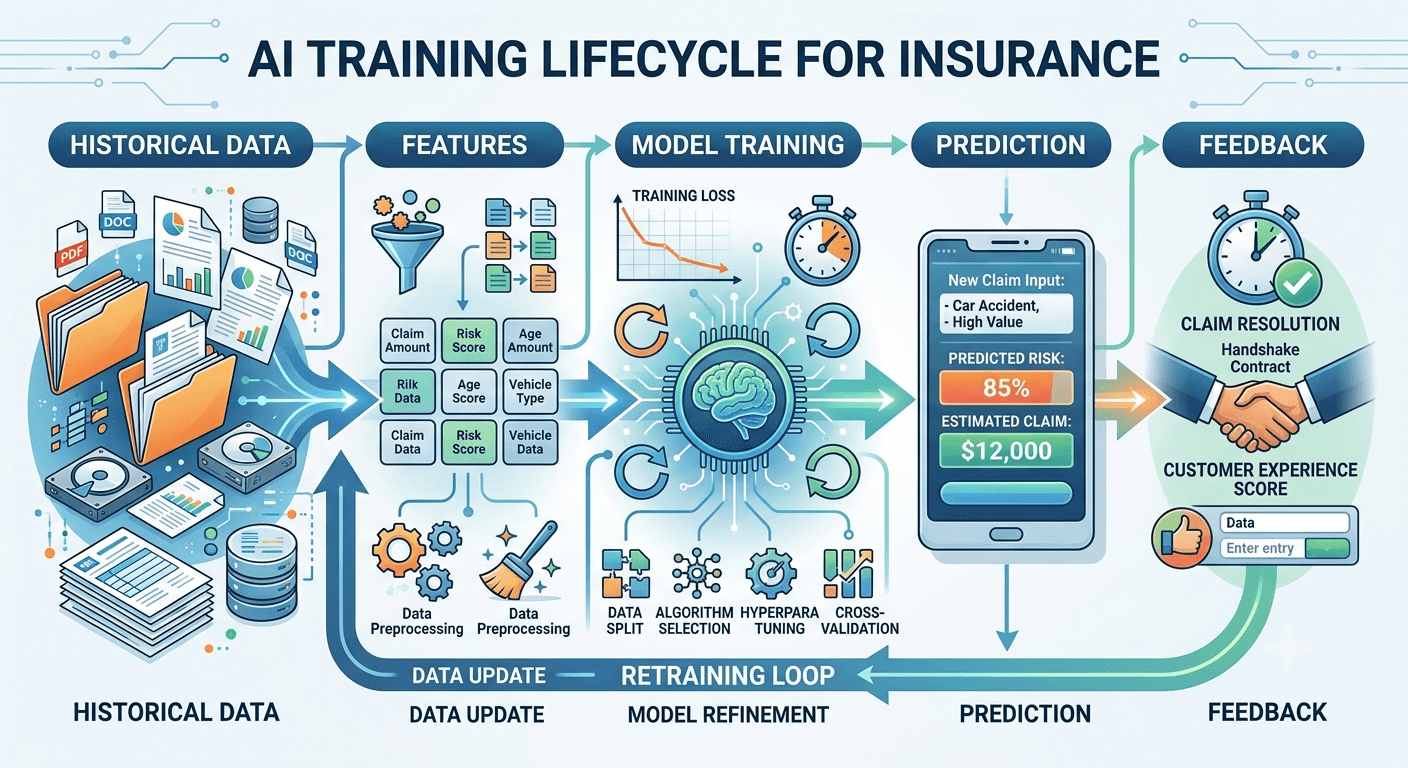
A production machine learning system is a lifecycle, not a one-time modeling exercise. Each stage must be designed around the business decision the insurer is trying to improve.
Define the business problem
Specify the decision, user, timing, current process, action enabled, and measurable outcome. “Predict severity” is incomplete unless the organization defines when the score appears, who reviews it, and what action is possible.
Assemble and govern data
Identify relevant historical data, confirm legal and contractual rights to use it, document lineage, address missing values, and determine whether outcomes reflect past process bias or inconsistent handling.
Create features and labels
Convert raw information into meaningful signals. Features may include claim age, treatment events, jurisdiction, representation status, document-derived indicators, or prior outcomes. Labels must be defined consistently.
Split the data
Separate training, validation, and test data. Time-based splits are often important in insurance because random splits can overstate performance when later information leaks into earlier examples.
Train candidate models
Fit several approaches and compare performance, stability, interpretability, and operational requirements. The most complex model is not always the best production choice.
Validate technically and operationally
Assess discrimination, calibration, precision, recall, subgroup behavior, stability, and whether the output is useful at the point of decision.
Deploy into workflow
Present results in the claim or underwriting environment with explanations, evidence, confidence, and clear ownership.
Monitor and improve
Track data quality, score distributions, outcomes, drift, override patterns, adoption, and business impact. Retrain or recalibrate when evidence supports a controlled change.
Monitor and improve
PRODUCTION PRINCIPLE
A technically accurate model can still fail if it arrives too late, lacks an actionable workflow, produces too many alerts, or is not trusted by the people expected to use it.
Illustrative workflow
| Stage | Insurance example | Control |
|---|---|---|
| Historical data | Closed claims with documents, payments, reserves, litigation events, and outcomes | Lineage, access control, retention, and quality checks |
| Feature creation | Treatment escalation, attorney involvement, injury indicators, claim age, and jurisdiction | Definitions, leakage tests, and documentation |
| Model training | Estimate probability of severe development within a defined period | Repeatable pipeline and version control |
| Validation | Test on later claims not used for training | Performance thresholds and subgroup review |
| Deployment | Display risk score and contributing factors in claim workflow | Role-based access and human review |
| Monitoring | Compare predictions with emerging outcomes | Drift, calibration, override, and impact monitoring |
Types of Machine Learning
Supervised learning
Supervised learning uses historical examples with known outcomes. It is the most common form of machine learning for insurance prediction because the insurer often has a defined target such as litigation, severity band, fraud referral, or incurred loss.
- Classification: predict a category or probability, such as whether a claim is likely to litigate.
- Regression: estimate a continuous value, such as expected loss or treatment cost.
- Ranking: order claims or submissions by urgency, value, or likelihood of a target outcome.
Unsupervised learning
Unsupervised learning identifies structure without a predefined target. It can group similar risks, discover unusual behavior, or reveal patterns that are not represented in an existing label.
- Clustering similar claims or policyholders.
- Anomaly detection for unusual billing or transaction behavior.
- Dimensionality reduction for exploration and visualization.
Semi-supervised learning
Semi-supervised methods combine a smaller amount of labeled data with a larger amount of unlabeled data. This can be useful when expert labeling is expensive or outcomes are available only for part of the portfolio.
Self-supervised learning
Self-supervised learning creates training signals from the data itself. Modern language models often use self-supervised objectives to learn language patterns from large text collections before being adapted to specific tasks.
Reinforcement learning
Reinforcement learning optimizes actions through feedback and rewards. It is less common in core claims and underwriting decisions because insurance outcomes are delayed, constraints are significant, and experimentation must be carefully controlled. It may be useful in limited workflow optimization settings.
Transfer learning
Transfer learning starts with a model trained on a broader problem and adapts it to a more specific task. This can reduce the amount of labeled insurance data required, but the organization must still validate suitability, bias, and performance in its own environment.
Transfer learning
| Method | Best suited for | P&C example | Primary caution |
|---|---|---|---|
| Supervised | Known historical outcomes | Severity, litigation, fraud, or loss prediction | Label quality and leakage |
| Unsupervised | Unknown structure or anomalies | Claim segmentation or unusual billing patterns | Clusters require business interpretation |
| Semi-supervised | Limited expert labels | Document classification with partial labels | Error propagation from pseudo-labels |
| Self-supervised | Learning general representations | Language understanding before task adaptation | Pretraining data may not reflect insurance context |
| Reinforcement | Sequential action optimization | Controlled workflow routing experiments | Delayed rewards and governance complexity |
| Transfer learning | Adapting existing models | Fine-tuning a language model for claim documents | Domain validation and privacy |
Machine Learning Across the P&C Insurance Value Chain
FNOL and triage
Estimate complexity, severity potential, coverage review needs, or specialized handling at intake.
Claims management
Prioritize claims for review, identify changing exposure, and surface emerging risk signals.
Medical review
Recognize treatment patterns, cost escalation, and potential need for clinical or nurse review.
Litigation
Estimate likelihood of attorney involvement, suit, or escalating legal cost based on evolving facts.
Reserving
Support reserve reviews by comparing current development with similar historical claims and expected trajectories.
Fraud and SIU
Detect anomalies and suspicious combinations of behavior for investigator review.
Subrogation
Identify facts suggesting third-party responsibility and prioritize time-sensitive recovery opportunities.
Underwriting
Support risk segmentation, appetite, pricing, submission triage, and portfolio consistency.
Customer experience
Route work, forecast service demand, and personalize communications while preserving fair treatment.
Portfolio management
Identify concentration, trend, emerging exposure, and changing loss patterns across books of business.
Portfolio management
HUMAN ACCOUNTABILITY
For material coverage, claim, pricing, employment, legal, or customer decisions, the machine learning output should inform a qualified professional rather than operate as an unexplained automatic conclusion.
Detailed Case Study: Workers’ Compensation Claim
The following scenario illustrates how machine learning can support a claim team without replacing professional judgment. It is an educational example, not a claim-handling directive.
Day 1: First notice of loss
A warehouse employee reports a lower-back strain after lifting inventory. Initial facts suggest a routine medical-only claim. The claim is assigned through the carrier’s normal rules-based workflow. The model receives the FNOL, job class, employer history, jurisdiction, claimant information, and early clinical description.
The initial score is moderate rather than high. The system explains that the reported mechanism and initial diagnosis are common, while a prior related injury and delayed reporting modestly increase uncertainty. No special action is automatically taken.
Day 12: Treatment expands
New physical therapy records, medication changes, and a specialist referral enter the file. Document intelligence extracts treatment events and converts them into structured features. The model now compares the evolving pattern with historical claims and increases the probability of prolonged disability and higher medical cost.
The adjuster receives an alert that includes the changed score, the new treatment indicators, and links to the source documents. The adjuster reviews the information and contacts the employer and medical provider to clarify work status and treatment planning.
Day 26: Representation event
An attorney letter is received. The litigation model identifies the representation event, jurisdiction, treatment trajectory, and communication history as relevant. The system recommends review by a senior adjuster and notes that comparable claims often experienced reserve development within the next sixty days.
Day 40: Human decision
The senior adjuster reviews the complete file, speaks with the assigned adjuster, and evaluates coverage, compensability, medical evidence, and jurisdictional requirements. Based on professional judgment—not the model score alone—the carrier updates the action plan, secures an independent clinical review, and reassesses reserves.
Day 120: Outcome and learning
The claim stabilizes after modified duty and coordinated treatment. The outcome is captured for model monitoring. Analysts assess whether the earlier score was calibrated, whether the alert resulted in appropriate action, and whether similar claims should be handled differently. The model is not rewarded merely for producing a high score; the program is evaluated on usefulness, accuracy, fairness, and business impact.
Lessons from the scenario
- The model changed as the facts changed.
- Source evidence made the insight reviewable.
- The alert led to investigation and planning, not automatic adjudication.
- The professional retained authority for coverage, reserve, and handling decisions.
- Outcome feedback supported monitoring and future improvement.
Comparison Guide
Machine learning vs. rules engines
| Dimension | Rules engine | Machine learning |
|---|---|---|
| Logic | Explicit conditions written by people | Patterns estimated from examples |
| Best for | Stable, deterministic requirements | Probability, ranking, and complex interactions |
| Transparency | Usually direct and easy to trace | Varies by model; requires explanation methods |
| Change process | Edit the rule | Retrain, recalibrate, or change features |
| Primary risk | Rules become brittle or incomplete | Data bias, drift, overfitting, or weak calibration |
| Insurance role | Eligibility checks, routing, compliance steps | Severity, litigation, fraud, and risk prediction |
Machine learning vs. predictive analytics
Predictive analytics is a business category describing the use of data to forecast outcomes. Machine learning is one set of methods that can power predictive analytics. Traditional statistical models may also be used. The distinction matters less than whether the approach is valid, explainable, monitored, and useful for the decision.
Machine learning vs. generative AI
| Machine learning prediction | Generative AI |
|---|---|
| Estimates an outcome, class, probability, or ranking. | Creates or transforms content such as summaries, explanations, or drafts. |
| Often uses structured features plus document-derived signals. | Often uses large language or multimodal foundation models. |
| Example: litigation probability of 0.72. | Example: a sourced summary of why the claim may litigate. |
| Key risk: calibration, bias, drift, leakage. | Key risk: hallucination, unsupported content, privacy, prompt injection. |
| They can work together: a predictive score can be explained using grounded, source-linked generative capabilities. | They can work together: generative AI can organize unstructured data into features or contextual explanations. |
Machine learning vs. large language models
A large language model is a particular type of machine learning model trained on language patterns at very large scale. LLMs are machine learning, but most machine learning systems are not LLMs. A severity model built from claim variables and outcomes may use gradient boosting or another method rather than a language model.
Business Value and Measurement
A machine learning initiative should be justified by an operational or financial outcome, not by model accuracy alone. The evaluation framework should connect model performance to workflow behavior and then to business results.
Measurement chain
| Layer | Example measures |
|---|---|
| Data | Completeness, timeliness, error rate, document availability, label consistency |
| Model | AUC or discrimination, precision, recall, calibration, stability, subgroup performance |
| Workflow | Alert acceptance, review time, override rate, action completion, time to intervention |
| Business | Severity development, litigation rate, reserve timeliness, leakage, recovery, cycle time, productivity |
| Customer and governance | Complaint rate, consistency, fairness, explainability, audit findings, exception resolution |
Illustrative KPI alignment
| Use case | Model metric | Operational metric | Business metric |
|---|---|---|---|
| High-severity triage | Recall at defined review capacity | Time from signal to senior review | Earlier action-plan completion and reserve review |
| Litigation prediction | Calibration by score band | Percentage of high-risk claims reviewed | Change in avoidable escalation or late legal involvement |
| Subrogation | Precision among referred claims | Time to evidence preservation | Recovery rate and dollars recovered |
| Fraud detection | Precision and investigator yield | SIU acceptance and cycle time | Confirmed fraud savings and reduced false referrals |
| Underwriting triage | Ranking quality | Submission review throughput | Hit ratio, loss ratio, and appetite consistency |
Illustrative KPI alignment
AVOID VANITY METRICS
A high technical score does not prove business value. A model can appear accurate while flagging cases too late, overwhelming users, or producing no meaningful action.
Risks, Governance, and Responsible Use
Data quality and representation
Historical data may be incomplete, inconsistent, or shaped by prior operating practices. Governance should document what the data represents and where it may be weak.
Bias and fairness
Protected or sensitive characteristics may be present directly or through proxies. Review subgroup performance and the consequences of both false positives and false negatives.
Model drift
Medical practices, inflation, legal environments, repair technology, fraud behavior, and internal processes change. Monitoring should detect changes in inputs, outputs, calibration, and outcomes.
Explainability
The required explanation depends on use. A low-impact routing recommendation may need less explanation than a high-impact claim or underwriting action.
Privacy and security
Limit data to authorized purposes, protect sensitive information, control access, and assess third-party processing and retention.
Automation bias
Users may over-trust a score because it appears quantitative. Training and workflow design should reinforce that the model can be wrong and must be evaluated with evidence.
Feedback loops
If model outputs influence handling, future data may reflect the model’s own recommendations. Monitoring must distinguish true improvement from self-reinforcing behavior.
Accountability
Name business, technical, data, risk, and operational owners. Establish who can approve deployment, pause use, and authorize retraining.
Implementation and Operating Model
Phase 1: Define value and decision rights
- Select a specific decision and user population.
- Document current baseline performance and pain points.
- Define permissible model use and prohibited automated actions.
- Set outcome measures and review capacity.
Phase 2: Build and validate
- Establish data rights, lineage, quality, and labeling standards.
- Use time-aware and leakage-resistant validation.
- Compare simple and complex models.
- Test calibration, subgroup behavior, and operational thresholds.
- Conduct business-user review of explanations and evidence.
Phase 3: Deploy into workflow
- Integrate into the system where work occurs.
- Provide evidence and reason codes, not just a score.
- Define alert ownership, service levels, and escalation.
- Train users on capabilities, limits, and override expectations.
Phase 4: Monitor and improve
- Monitor input data, output distributions, accuracy, calibration, and drift.
- Review false positives, false negatives, overrides, and user feedback.
- Measure action taken and business impact.
- Use controlled change management for retraining and model replacement.
Minimum production roles
| Role | Primary responsibility |
|---|---|
| Executive sponsor | Business outcome, funding, risk appetite, and accountability |
| Business owner | Workflow design, adoption, action definitions, and KPI ownership |
| Model owner | Technical performance, documentation, monitoring, and change control |
| Data owner | Data quality, definitions, lineage, access, and retention |
| Risk or governance | Independent review, policy alignment, fairness, and auditability |
| Frontline professional | Evidence review, decision-making, feedback, and exception identification |
| Technology owner | Integration, reliability, security, incident response, and observability |
Executive Decision Guide
Readiness questions
- Is there a clearly defined decision that can improve when insight arrives earlier?
- Are historical outcomes sufficiently consistent and available?
- Can the organization act on the output within the workflow?
- Is there capacity to review alerts without creating noise?
- Are decision rights and human oversight explicit?
- Can performance and business impact be measured over time?
- Is there an owner for monitoring, retraining, incidents, and retirement?
Vendor evaluation questions
What exact business outcome is the model designed to improve?
Which data sources and time periods were used for training and validation?
How do you prevent target leakage and test performance on later data?
How are scores calibrated and how should thresholds be selected?
What explanations and source evidence are provided to users?
How is performance measured across relevant business and demographic segments?
What monitoring detects drift, data failure, and operational misuse?
How are customer data, model data, and derived insights isolated and protected?
What is the process for retraining, approving changes, and rolling back a model?
How do you measure adoption, action taken, and realized business value?
Go / no-go decision
| Proceed when | Pause or redesign when |
|---|---|
| The use case is specific, actionable, measurable, and governed. | The objective is vague or defined only as “use AI.” |
| Data rights, quality, labels, and validation are understood. | Historical outcomes are inconsistent or unavailable. |
| The output arrives before a meaningful intervention point. | The score appears after the decision has effectively been made. |
| Users receive explanations and retain decision authority. | The workflow encourages automatic acceptance of an unexplained score. |
| Monitoring and accountable ownership are funded. | The project ends at deployment with no production operating model. |
Charlee.ai Perspective
Insurance machine learning creates value when it watches the changing facts of a claim or portfolio and turns those changes into timely, explainable insight. The objective is not merely to predict a final outcome. It is to help claims and underwriting professionals recognize a developing pattern early enough to investigate, plan, communicate, and intervene.
For claims, this means combining transaction history with the substance of documents and notes. A model should be able to recognize that a new attorney letter, surgery recommendation, diagnostic change, demand package, reserve movement, or treatment pattern materially changes the exposure. The user should see not only the updated prediction but also the events and evidence that contributed to it.
For leadership, machine learning should support a portfolio view as well as an individual-file view. Leaders need to understand where risk is concentrating, which claims are changing, whether reserves and action plans remain aligned with exposure, and how teams are responding to insight.
PEOPLE PLUS AI
Charlee.ai’s guiding principle is that AI should amplify human judgment. Claims professionals retain responsibility for decisions; AI contributes scale, consistency, early warning, and evidence-based context.
Key Takeaways
- Machine learning learns patterns from historical data and applies them to new insurance situations.
- Its highest-value role is early, consistent decision support—not automatic replacement of professional judgment.
- Production success requires clear use cases, governed data, valid testing, workflow integration, explainability, and continuous monitoring.
- Technical performance should be connected to actions, business outcomes, customer impact, and governance.
- Machine learning and generative AI are complementary: one predicts and ranks; the other can summarize and explain when properly grounded.
- The insurer remains accountable for the decision, the workflow, and the effects of using the model.
Machine learning enables insurers to learn patterns from historical data and apply those patterns to new claims, submissions, policies, and portfolios. It is especially valuable when the business needs to estimate probability, classify risk, prioritize work, or identify unusual behavior at a scale that manual review alone cannot match.
Frequently Asked Questions
Machine learning is a major branch of artificial intelligence. AI is the broader concept of systems performing tasks associated with human intelligence; machine learning specifically learns patterns from data.
Not exactly. Predictive analytics describes the business use of data to forecast outcomes. Machine learning is one family of methods that can support predictive analytics.
There is no universal number. The requirement depends on the complexity of the outcome, class imbalance, data quality, variability, and the level of performance required. A smaller, well-defined dataset can be more useful than a large inconsistent one.
Yes. Natural language processing and document intelligence can extract signals from notes, medical reports, police reports, demand packages, and submissions. Those signals may be combined with structured data.
Often, yes, but explanation quality varies. Insurers should require reason codes, contributing factors, source evidence where possible, and clear documentation of limitations.
It should not. It supports prioritization and analysis. Qualified professionals remain responsible for material decisions and for evaluating facts not captured by the model.
Retraining should be evidence-based rather than purely calendar-based. Triggers may include drift, calibration deterioration, process change, new data, or changed business objectives. Each retraining should follow controlled validation and approval.
Model drift occurs when relationships learned from historical data become less reliable because the data, environment, behavior, or process changes.
A false positive occurs when the model flags a condition that is not actually present—for example, a claim identified as high litigation risk that does not litigate. False positives consume review capacity and must be managed.
A false negative occurs when the model fails to identify a true condition. In high-severity triage, that could mean missing a claim that later develops significantly. The balance between false positives and negatives should reflect the business consequence.
Calibration indicates whether predicted probabilities match observed outcomes. If claims scored at 70% risk develop the outcome only 30% of the time, the score may rank cases but is not a trustworthy probability.
Yes. Bias can arise from historical data, labels, proxies, missing information, sampling, and deployment. Fairness review should examine both performance and business consequences across relevant groups.
No. The appropriate model balances accuracy, stability, explanation, cost, speed, maintainability, and risk. A simpler model may be the better production choice.
Potentially, but the insurer should assess permission, relevance, reliability, refresh frequency, privacy, bias, and whether the data can be explained and audited.
ROI connects model performance to actions and outcomes—for example, earlier review, faster recovery, reduced leakage, improved reserve timeliness, greater throughput, or better portfolio results—net of implementation and operating costs.
Place the executive definition within the first 150 words. Use a scannable table of contents with anchor links. Mark up the FAQ section with valid FAQPage schema only when the questions and answers are visible on the page. Link to Artificial Intelligence, Predictive AI, Generative AI, Deep Learning, Neural Networks, Explainable AI, and Human-in-the-Loop. Use original diagrams with descriptive alt text and captions.