Feature Engineering
Feature engineering is the disciplined process of converting raw insurance data into meaningful, model-ready variables that represent risk, behavior, exposure, chronology, and context for analysis, prediction, prioritization, and decision support.
Executive Snapshot
In One Sentence Feature engineering is the disciplined process of converting raw insurance data into meaningful, model-ready variables that represent risk, behavior, exposure, chronology, and context.
| Dimension | What Executives Should Know |
|---|---|
| Primary purpose | Make raw data more useful to analytics and AI by expressing insurance-relevant patterns in a consistent, model-ready form. |
| Insurance value | Translate claims, policy, underwriting, billing, document, geospatial, and external data into signals that support better prediction and professional review. |
| Common applications | Claim severity, litigation propensity, fraud investigation support, underwriting risk selection, loss-cost modeling, triage, retention, and operational forecasting. |
| Key limitation | A feature is not a fact, explanation, or decision. Its usefulness depends on definition quality, data provenance, timing, representativeness, and validation. |
| Governance priority | Prevent leakage, document lineage, control proxies for protected characteristics, monitor drift, and preserve human authority over consequential decisions. |
| Executive takeaway | Strong feature engineering often creates more business value than changing algorithms because it determines what information the model can actually use. |
Executive Summary
Property & casualty insurers hold large volumes of raw data across claim systems, policy administration platforms, underwriting submissions, billing records, inspections, medical and legal documents, repair estimates, telematics, weather feeds, and operational logs. Much of this information cannot be used directly by a model. Dates, narratives, transactions, codes, images, and event histories must first be translated into variables that represent the business concept being analyzed.
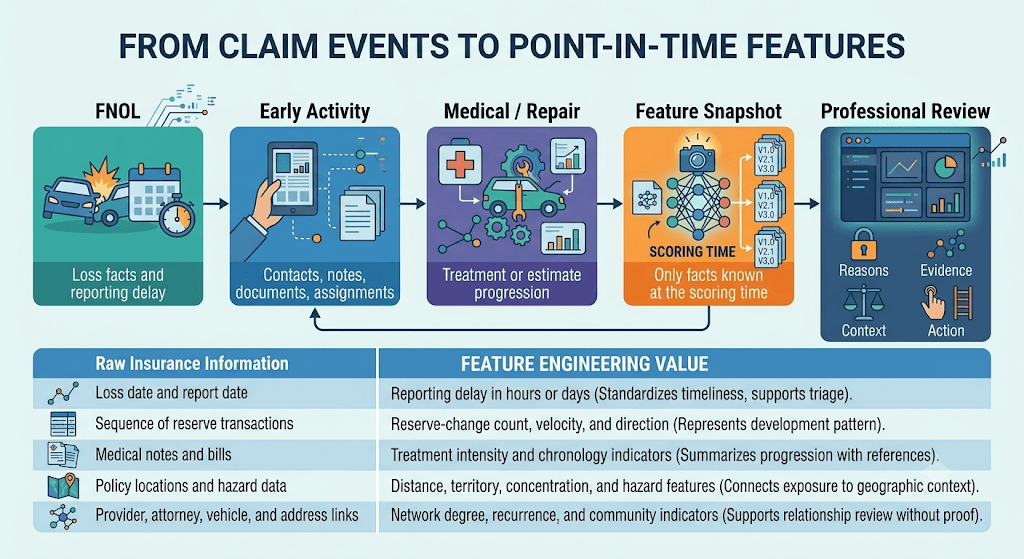
Feature engineering performs that translation. A raw loss date can become claim age, reporting delay, season, weekday, catastrophe proximity, or time since policy inception. A sequence of reserve transactions can become development velocity, volatility, reopening count, or the time between major changes. A medical chronology can produce treatment duration, provider count, diagnostic complexity, and gaps in care. These engineered features allow predictive and analytical systems to recognize patterns that are not explicit in any single source field.
For insurers, the value comes from encoding domain knowledge in a repeatable way. Experienced claims and underwriting professionals understand that timing, combinations, thresholds, and trajectories often matter more than isolated values. Feature engineering turns that knowledge into governed variables that models can evaluate consistently across portfolios and workflows.
Poorly designed features can also create material risk. They may leak future information into training, encode historical bias, act as proxies for protected characteristics, lose important context, or drift as products and operations change. Production use therefore requires clear definitions, source lineage, point-in-time correctness, segmented testing, explainability, monitoring, and professional oversight.
Quick Facts
| Question | Answer |
|---|---|
| What is a feature? | A measurable input used by an analytical or machine-learning system, such as claim age, vehicle age, prior-loss count, treatment duration, or policy tenure. |
| What is feature engineering? | The process of creating, transforming, combining, selecting, and validating features from raw data. |
| Are features always numeric? | Models usually consume numeric or encoded inputs, but features may originate from categories, text, images, dates, sequences, graphs, or external data. |
| Who designs features? | Data scientists, data engineers, actuaries, claims experts, underwriters, fraud specialists, compliance teams, and product owners. |
| Can AI generate features automatically? | Yes. Representation learning, embeddings, automated feature synthesis, and deep learning can generate features, but they still require governance and task-level validation. |
| What is data leakage? | Using information during training that would not have been available at the actual prediction time. |
| Do more features always improve performance? | No. Irrelevant, redundant, unstable, biased, or poorly timed features can reduce accuracy and increase risk. |
| How are features managed in production? | Through documented pipelines, version control, feature stores or governed repositories, monitoring, access controls, and change management. |
Executive Definition
Feature engineering is the business and technical discipline of transforming raw data into model inputs that express meaningful patterns. In insurance, it converts policy, claim, exposure, transaction, document, behavioral, and external information into governed variables that support analysis, prediction, prioritization, and decision support.
Technical Definition
Feature engineering is the process of deriving a feature vector from source data through operations such as cleaning, encoding, aggregation, normalization, interaction creation, temporal alignment, dimensionality reduction, extraction, and selection. A valid feature must have a reproducible definition, known data lineage, point-in-time availability, and demonstrated utility for the intended task.
Insurance Definition
In P&C insurance, feature engineering translates insurance events and records into indicators of exposure, behavior, chronology, complexity, and change. Examples include policy tenure, loss frequency, reporting delay, reserve-development rate, attorney involvement, treatment intensity, property characteristics, catastrophe proximity, vehicle usage, prior-insurance continuity, and claim-network relationships.
Important Distinction Feature engineering represents information for a model. It does not independently determine coverage, liability, compensability, reserve adequacy, fraud, settlement value, or underwriting acceptability. Those conclusions require governed logic, evidence, professional judgment, and often additional models or rules.
Why Feature Engineering Matters in P&C Insurance
Insurance outcomes are rarely driven by one field. Severity, litigation, fraud risk, retention, and underwriting performance often depend on combinations of timing, exposure, history, behavior, geography, documentation, and operational context. Raw systems typically store these elements separately and at different levels of granularity. Feature engineering connects them in a form that analytics and AI can use.
| Insurance Challenge | Feature-Engineering Response | Business Impact |
|---|---|---|
| Raw data is fragmented across systems | Join and align policy, claim, billing, document, and external sources at the correct point in time | More complete and consistent analysis |
| Important patterns are temporal | Create durations, recency measures, event counts, trends, and development velocities | Earlier recognition of changing exposure |
| Categories are inconsistent or high-cardinality | Normalize codes and apply governed encodings or grouped taxonomies | More stable model inputs |
| Narratives contain material context | Extract controlled indicators, topics, entities, or embeddings from text | Use of information previously trapped in documents |
| Risk depends on interactions | Combine related variables such as limit, exposure, geography, and prior-loss history | Better representation of real insurance conditions |
| Data availability changes over the claim or policy lifecycle | Enforce point-in-time feature computation and prediction-time cutoffs | Reduced leakage and more credible validation |
| Models must be explainable and monitored | Maintain definitions, lineage, owner, version, and business interpretation for each feature | Improved governance and professional trust |
How Feature Engineering Works
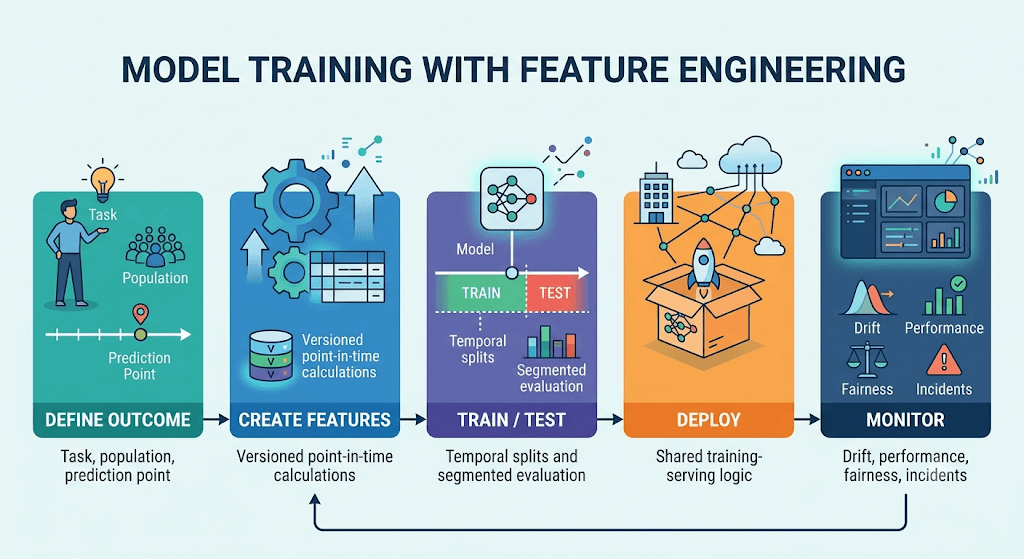
Define the business question
Specify the prediction or analytical task, the user, the decision boundary, the prediction time, and what information would legitimately be available at that moment.
Identify and govern source data
Select relevant systems and documents; confirm ownership, permissions, quality, retention, and lineage. Establish the unit of analysis, such as claim, exposure, policy, account, transaction, or document.
Establish point-in-time logic
Create a cutoff that prevents future events from influencing historical training examples. This is essential for reserve, litigation, fraud, underwriting, and retention models.
Clean and standardize inputs
Resolve missing values, inconsistent codes, duplicate records, units, date formats, category definitions, and anomalous values without erasing legitimate insurance exceptions.
Derive candidate features
Create aggregations, ratios, durations, counts, trends, interactions, encodings, text-derived indicators, geospatial measures, and sequence-based variables that reflect domain knowledge.
Validate usefulness and risk
Test predictive contribution, stability, leakage, bias, explainability, redundancy, and segmented performance. Domain experts review whether the feature has a credible business interpretation.
Operationalize and monitor
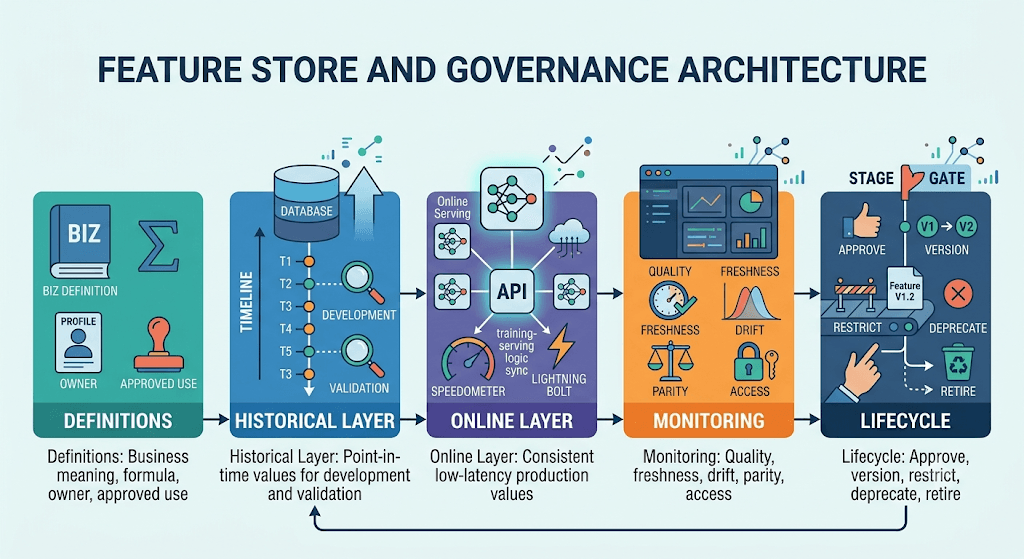
Implement reproducible pipelines, version definitions, serve the same logic in training and production, monitor drift and availability, and control changes through governance.
Operationalize and monitor
Conceptual Workflow Insurance source data → point-in-time alignment → cleaning and standardization → domain transformations and aggregations → candidate feature set → validation and selection → governed feature pipeline → model or decision-support workflow → monitoring and professional review.
Feature Design Principles
| Principle | Practical Meaning |
|---|---|
| Business relevance | The feature represents a plausible insurance concept tied to the intended task rather than a coincidental pattern. |
| Point-in-time correctness | The value can be reproduced using only information available when the prediction or review would occur. |
| Consistency | Training, testing, and production systems calculate the feature using the same definition and source logic. |
| Interpretability | The feature has a documented meaning, owner, units, expected range, and known limitations. |
| Stability | The feature remains sufficiently reliable across time, products, jurisdictions, channels, and operating conditions. |
| Governability | Lineage, permissions, version history, monitoring thresholds, and change controls are defined before production use. |
Core Concepts
| Concept | Plain-Language Meaning | Insurance Example |
|---|---|---|
| Feature | A measurable model input created directly or indirectly from source data. | Days from loss to report, prior-loss count, building age, or claim age. |
| Raw variable | A field as recorded in a source system before transformation. | Loss date, ZIP code, reserve transaction, coverage code, or vehicle year. |
| Target variable | The outcome a supervised model is designed to estimate. | Ultimate loss, litigation occurrence, renewal, fraud referral, or claim closure time. |
| Unit of analysis | The entity or event represented by one model row. | Claim, exposure, policy, account, claimant, transaction, document, or property. |
| Observation window | The historical period used to calculate a feature. | Number of reserve changes during the first 30 days after FNOL. |
| Prediction point | The moment at which a feature set is calculated and a model is used. | At FNOL, after 14 days, at renewal, or before underwriting bind. |
| Point-in-time feature | A value computed only from information available at the prediction point. | Attorney involvement known by day 30, excluding later representation. |
| Feature vector | The complete set of feature values supplied for one observation. | All governed inputs used to score one claim for litigation propensity. |
| Feature lineage | The traceable path from feature value to source, logic, version, and owner. | Reserve velocity derived from dated transaction records and a versioned calculation. |
| Feature drift | A meaningful change in feature distribution or relationship to the target. | Reporting delay changes after a new digital FNOL process is introduced. |
| Proxy variable | A feature that indirectly represents another characteristic. | Geography or occupation acting as a proxy for protected or sensitive attributes. |
| Feature store | A governed system or pattern for defining, calculating, serving, and reusing features. | A shared repository for policy tenure and prior-loss features used by multiple models. |
Common Feature Transformations
| Transformation | What It Does | P&C Example |
|---|---|---|
| Aggregation | Combines many records into a summary value. | Count of reserve changes, total paid-to-date, or prior claims in five years. |
| Duration | Measures elapsed time between events. | Reporting delay, treatment duration, policy tenure, or days since last contact. |
| Ratio | Expresses one value relative to another. | Paid-to-incurred ratio, loss-to-limit ratio, or payroll per employee. |
| Trend or velocity | Measures direction and rate of change. | Reserve-development slope or monthly premium growth. |
| Recency | Measures how recently an event occurred. | Days since prior loss or days since latest adjuster activity. |
| Interaction | Combines variables whose joint effect may matter. | High policy limit combined with severe venue and attorney representation. |
| Encoding | Converts categories into model-readable values. | One-hot, ordinal, frequency, or target-safe encoding of class or territory. |
| Binning | Groups continuous values into ranges. | Building age bands or claim-age intervals. |
| Normalization | Places values on a comparable scale. | Standardizing repair amounts across currencies or exposure units. |
| Text extraction | Derives structured indicators from language. | Presence of surgery, disputed liability, or demand-limit language. |
| Geospatial derivation | Measures location-based relationships. | Distance to coast, wildfire zone, hail footprint, or repair facility. |
| Sequence feature | Represents order, timing, or pattern of events. | Repeated reopening, rapid reserve escalation, or treatment gaps. |
Design Principle The strongest insurance features usually combine a defensible business meaning with point-in-time correctness. A statistically useful variable that cannot be explained, reproduced, or calculated at the actual prediction moment is not production-ready.
Types of Features
| Feature Type | Description | Representative Insurance Uses |
|---|---|---|
| Numeric features | Continuous or discrete quantities used directly or after scaling. | Premium, limits, deductibles, paid loss, square footage, mileage, or claim count. |
| Categorical features | Labels or classes converted into governed model inputs. | Line of business, coverage, cause of loss, class code, jurisdiction, or repair type. |
| Temporal features | Dates, durations, recency, seasonality, and event timing. | Reporting lag, policy tenure, claim age, weekday, renewal month, or treatment gap. |
| Aggregated features | Summaries across transactions, exposures, documents, or prior events. | Prior-loss frequency, reserve-change count, provider count, or location-level exposure. |
| Behavioral features | Patterns of action or interaction over time. | Payment behavior, contact frequency, portal usage, inspection response, or policy changes. |
| Trajectory features | Measures of change, acceleration, volatility, and sequence. | Reserve velocity, incurred volatility, closure probability trend, or estimate revisions. |
| Text-derived features | Structured indicators or representations extracted from documents and notes. | Attorney representation, surgery, disputed liability, sentiment, topics, or embeddings. |
| Image-derived features | Structured or learned characteristics from photographs and scans. | Damage area, roof condition, duplicate image detection, or document quality. |
| Geospatial features | Location attributes and spatial relationships. | Distance to coast, crime index, wildfire score, hail proximity, or territory density. |
| Network features | Relationships among entities represented as graph measures. | Shared providers, attorneys, addresses, vehicles, claimants, or payment destinations. |
| External-data features | Variables joined from governed third-party or public sources. | Weather, catastrophe footprints, economic indices, building data, or vehicle attributes. |
| Learned features | Representations generated automatically by machine-learning models. | Embeddings, latent factors, deep image features, or sequence-model representations. |
Features Across the P&C Value Chain
| Function | Representative Features and Applications |
|---|---|
| Marketing and distribution | Quote behavior, channel, prior-product mix, geographic reach, response timing, and agent-book characteristics for acquisition and segmentation. |
| Underwriting intake | Submission completeness, class-code consistency, exposure trends, loss-history recency, document-derived operations, and appetite indicators. |
| Risk selection and pricing | Property, vehicle, payroll, revenue, geography, protection, prior-loss, catastrophe, and exposure interaction features. |
| Policy service | Endorsement frequency, payment behavior, service interactions, coverage changes, and lapse or reinstatement history. |
| FNOL and triage | Reporting delay, injury indicators, damage type, claimant count, policy-limit context, weather proximity, and early complexity signals. |
| Claim investigation | Entity relationships, repeated narratives, document similarity, provider patterns, event chronology, and inconsistent fact indicators. |
| Severity and reserving | Paid and incurred development, treatment intensity, litigation status, venue, policy limits, wage exposure, and comparable-claim signals. |
| Fraud investigation support | Network centrality, duplicate content, unusual timing, billing patterns, shared addresses, and cross-claim relationships. |
| Subrogation | Third-party indicators, liability facts, recovery potential, responsible-party coverage, and evidence completeness. |
| Litigation management | Attorney involvement, venue, demand characteristics, procedural milestones, expert activity, and case-duration trajectory. |
| Retention and renewal | Tenure, claims experience, payment history, premium change, service interactions, exposure change, and channel behavior. |
| Portfolio management | Concentration, accumulation, loss emergence, claim-development, geographic clustering, and operational workload features. |
Case Study 1: Early Claim Severity and Complexity Triage
Business problem
A claims organization wants to identify newly reported bodily injury claims that may require early senior review. At FNOL, only limited information is available, and the organization must avoid using later reserve, treatment, or litigation events that would create leakage.
Feature-engineering approach
Define the prediction point as the end of the FNOL intake process and restrict every training feature to information available by that moment.
Create exposure features from policy limits, coverage type, vehicle or premises characteristics, claimant count, and loss jurisdiction.
Derive chronology features such as reporting delay, time of day, day of week, policy tenure at loss, and proximity to policy inception or expiration.
Extract governed indicators from the initial narrative, including injury mechanism, emergency transport, multiple vehicles, pedestrian involvement, and disputed liability.
Join weather or catastrophe context only when the external source is historically reproducible and available for the loss time and location.
Validate feature distributions and model performance separately by line, jurisdiction, claim channel, injury category, and represented versus unrepresented claimants.
Potential value
- Earlier assignment of experienced adjusters or nurse resources.
- More consistent identification of claims that need immediate fact development.
- Reduced dependence on a single reserve or cause-of-loss code.
- Improved documentation of why a claim was prioritized.
Required controls
- Do not use future reserve, treatment, attorney, or settlement information in FNOL features.
- Treat the score as a prioritization aid, not a settlement or reserve decision.
- Review sensitive and proxy features for unfair or legally impermissible effects.
- Provide professionals with understandable feature-level reasons and source context.
Case Study 2: Commercial Underwriting Risk Characterization
Business problem
Commercial submissions contain structured schedules, loss runs, narrative descriptions, inspection materials, and external exposure data. The underwriter needs a consistent view of risk while preserving explicit appetite rules and professional authority.
Feature-engineering approach
Normalize operations, class codes, locations, payroll, revenue, vehicle counts, protection features, and prior-loss information across submission formats.
Calculate exposure-adjusted loss frequency and severity using consistent historical periods, inflation treatment, and credibility rules.
Derive concentration and trend features, such as revenue growth, location concentration, fleet-age distribution, and changes in operations.
Extract controlled indicators from narratives and inspection reports, including hazardous operations, subcontracting, maintenance practices, and risk controls.
Add geospatial and catastrophe variables with documented source dates, resolution, and territory logic.
Keep mandatory appetite restrictions, authority limits, and prohibited classes as explicit rules rather than allowing model features to replace them.
Potential value
- Faster preparation of a consistent underwriting risk summary.
- Improved comparison across submissions with different formats.
- More reliable use of loss history and exposure changes.
- Better documentation of the information supporting underwriter review.
Required controls
- Underwriters retain authority over selection, pricing, terms, and exceptions.
- Feature definitions must account for policy period, exposure basis, inflation, and missing schedules.
- External data must be licensed, current, and appropriate for the intended jurisdiction and use.
- Sensitive or potentially discriminatory proxies require legal, compliance, and fairness review.
Case Study 3: Fraud Investigation and Entity-Network Features
Business problem
An insurer wants to help a special investigations unit identify claims that share unusual entities, documents, or transaction patterns. Individual fields may look ordinary, but relationships across claims can reveal patterns worthy of professional investigation.
Feature-engineering approach
Standardize and resolve entities such as providers, attorneys, repair facilities, addresses, phone numbers, vehicles, payment destinations, and claim participants.
Create network features including degree, repeated co-occurrence, shared-entity counts, community membership, and time-bounded relationship strength.
Derive duplicate and near-duplicate indicators for invoices, photographs, narratives, estimates, and supporting documents.
Build timing features for claim reporting, service dates, billing sequences, policy inception, and payment activity.
Use point-in-time graph snapshots so historical training examples do not include relationships discovered only after the investigation date.
Present linked claims and source evidence to investigators rather than exposing only a risk score.
Potential value
- Faster discovery of cross-claim relationships and repeated patterns.
- More focused use of investigator time.
- Improved visibility into organized or networked activity.
- Stronger documentation of the evidence behind a referral.
Required controls
- A relationship or anomaly is not proof of fraud.
- Entity-resolution errors must be measured and reversible.
- Access to sensitive claim and personal data must follow least-privilege controls.
- Investigators must verify source records and document independent professional judgment.
Manual vs. Automated Feature Engineering
| Dimension | Manual / Domain-Designed | Automated / Learned |
|---|---|---|
| How features are created | Experts define transformations based on insurance knowledge and business hypotheses. | Algorithms generate combinations, encodings, latent representations, or transformations from data. |
| Strength | High interpretability and alignment with operational concepts. | Can discover complex nonlinear or high-dimensional patterns at scale. |
| Weakness | May be slow, narrow, or dependent on individual expertise. | May create unstable, opaque, redundant, or leakage-prone features. |
| Typical examples | Reporting delay, policy tenure, loss frequency, reserve velocity, treatment gap. | Embeddings, deep image features, graph representations, automated interaction terms. |
| Governance need | Document assumptions, formulas, units, ownership, and exceptions. | Add reproducibility, explainability, search-space controls, validation, and model-risk review. |
| Best use | When business meaning, auditability, and explicit timing are critical. | When the data is complex and candidate patterns are difficult to specify manually. |
| Recommended approach | Use as the transparent foundation and benchmark. | Use selectively to complement—not erase—domain-designed features and rules. |
Recommended Operating Model Combine domain-designed features with carefully validated automated or learned representations. Explicit insurance concepts, mandatory rules, and point-in-time logic should remain visible. Automated methods should expand the evidence available to the model, not obscure how consequential decisions are made.
Data and Model Requirements
Representative, task-aligned data
Feature design should reflect the actual insurance workflow, prediction point, lines of business, jurisdictions, channels, operating practices, and populations in scope. A feature that is useful for personal auto FNOL may be inappropriate for commercial property underwriting or long-tail casualty reserve review. Development data should include ordinary cases, severe cases, operational exceptions, missing-data patterns, and changes in business practice.
Point-in-time correctness
Every historical feature value must be reproducible using only information that would have been available at the applicable prediction point. Transaction effective dates, posting dates, document receipt times, corrections, reopened claims, and late-arriving external data must be handled explicitly. Point-in-time testing is one of the strongest defenses against data leakage and inflated validation results.
Source quality and lineage
Each feature should identify its source systems, fields, joins, transformation logic, owner, refresh schedule, units, and known limitations. Lineage must allow reviewers to trace a model input back to the underlying claim, policy, exposure, document, event, or external source. Without this connection, errors cannot be investigated and feature behavior cannot be governed.
Consistent training and production logic
The same definition should be used when creating historical training data and when serving live model inputs. Differences in code, timing, missing-value treatment, categorical mappings, or external-data versions create training-serving skew. Shared libraries, tested pipelines, feature stores, and contract-based data validation can reduce this risk.
Versioning and reproducibility
Feature definitions, source snapshots, reference tables, code, parameters, and dependency versions should be controlled. A change in territory mapping, inflation adjustment, entity resolution, text model, or aggregation window may materially change a feature even when its name remains the same.
Versioning and reproducibility
| Requirement | Questions to Resolve | Illustrative Evidence |
|---|---|---|
| Business definition | What insurance concept does the feature represent, for whom, and at what decision point? | Approved feature specification and use-case charter. |
| Unit of analysis | Is the row a claim, exposure, claimant, policy, account, transaction, or document? | Data model and join-key documentation. |
| Time logic | Which events are available at the cutoff, and how are corrections or late records handled? | Point-in-time test cases and leakage review. |
| Data quality | Are completeness, validity, duplication, and exception patterns understood? | Profiling results and quality thresholds. |
| Lineage | Can each value be traced to its source and transformation? | Lineage map, code reference, and source identifiers. |
| Serving consistency | Does production calculate the feature exactly as training did? | Training-serving parity tests. |
| Security | Are access, retention, encryption, and purpose limitations enforced? | Control assessment and audit logs. |
| Change control | Who approves definition or source changes, and how is rollback handled? | Version history, impact analysis, and release record. |
Evaluation Framework
| Evaluation Layer | Questions to Test | Example Measures |
|---|---|---|
| Business validity | Does the feature represent a credible insurance concept and support the intended workflow? | Domain review, hypothesis acceptance, exception analysis. |
| Data quality | Is the feature sufficiently complete, valid, timely, and consistent? | Missing rate, invalid rate, freshness, duplicate rate. |
| Point-in-time integrity | Could the feature contain future information or post-decision corrections? | Leakage tests, cutoff reconciliation, temporal backtesting. |
| Predictive usefulness | Does it add stable signal beyond existing variables? | Incremental lift, permutation importance, ablation results. |
| Stability | Does the distribution remain usable across time and operating changes? | Population stability index, drift statistics, out-of-range rate. |
| Fairness and proxy risk | Does performance or feature behavior differ materially across relevant groups? | Segmented distributions, error rates, disparity analysis. |
| Explainability | Can users understand the feature and its effect in context? | Reason-code clarity, reviewer comprehension, challenge rate. |
| Operational reliability | Can the feature be calculated at the required latency and availability? | Latency, failure rate, stale-value rate, service uptime. |
| Downstream value | Does the complete feature set improve business outcomes without unacceptable harm? | Workflow time, intervention yield, quality, escalation, financial impact. |
Feature Quality Metrics
| Metric | Meaning | Insurance Interpretation |
|---|---|---|
| Missing rate | Share of observations without a usable feature value. | Is a loss-run feature absent for certain agents, products, or policy types? |
| Coverage rate | Share of the intended population for which the feature can be produced. | Can the property characteristic be calculated across the full book? |
| Freshness | Age of the source information at scoring time. | Is catastrophe, vehicle, or claim-activity information current enough? |
| Cardinality | Number of distinct values or categories. | Does a provider or class-code feature create sparse, unstable categories? |
| Out-of-range rate | Share of values outside approved limits. | Are negative durations, impossible building ages, or invalid ratios appearing? |
| Population Stability Index | Summary of distribution change between periods. | Did a new FNOL channel alter reporting-delay patterns? |
| Information value / association | Strength of relationship between a feature and an outcome. | Does early treatment intensity distinguish later complexity? |
| Incremental lift | Improvement when the feature is added to a baseline. | Does geospatial enrichment improve risk ranking beyond internal data? |
| Redundancy | Degree to which features duplicate one another. | Are multiple paid-to-incurred measures adding complexity without value? |
| Availability latency | Time needed to calculate and serve the value. | Can an FNOL feature arrive before assignment decisions are made? |
| Parity failure rate | Frequency with which training and production calculations disagree. | Does reserve velocity match across offline and live pipelines? |
Evaluation Principle A feature should not be retained merely because it improves an offline model metric. It must also be temporally valid, operationally available, explainable at the required level, appropriately governed, and useful within the real insurance workflow.
Risks and Governance
| Risk | Why It Matters | Control |
|---|---|---|
| Target leakage | Future outcomes or post-decision events can make a model appear far more accurate than it will be in production. | Prediction-time definition, temporal joins, leakage tests, backtesting. |
| Proxy discrimination | Geography, occupation, credit-related, behavioral, or network variables may indirectly encode sensitive characteristics. | Legal review, fairness testing, feature restrictions, documented necessity. |
| Historical bias | Features may reproduce prior handling, access, referral, or settlement patterns rather than objective risk. | Outcome review, alternative targets, segmented testing, human oversight. |
| Incorrect aggregation | Mixed units, exposure periods, claim levels, or duplicate records can distort counts, ratios, and trends. | Data contracts, reconciliation, unit tests, exception handling. |
| Training-serving skew | Live feature logic may differ from historical logic. | Shared computation, parity checks, feature-store controls, monitoring. |
| Feature drift | Operational, legal, product, economic, or behavioral changes can alter distributions and meaning. | Drift monitoring, thresholds, revalidation, controlled retirement. |
| Context loss | A simplified variable may omit chronology, uncertainty, or exceptions visible in the source. | Source display, companion metadata, professional review. |
| Unstable external data | Vendor coverage, methods, identifiers, or refresh timing may change without notice. | Contracts, source versioning, fallback logic, vendor monitoring. |
| Privacy and purpose creep | A feature may expose sensitive derived information or be reused beyond the approved purpose. | Purpose limitation, access control, retention, inventory, approval gates. |
| Opaque learned features | Automated representations may be difficult to explain or challenge. | Model cards, interpretability tests, use limitations, human evidence review. |
| Feature proliferation | Large unmanaged feature sets increase cost, redundancy, attack surface, and change risk. | Catalog ownership, usage review, deprecation, reuse standards. |
Feature Governance Record
| Field | What Should Be Documented |
|---|---|
| Feature name and description | Clear business meaning, unit, and expected direction or interpretation. |
| Approved use | Models, workflows, decisions, users, and prohibited uses. |
| Source and lineage | Systems, fields, documents, external vendors, joins, and trace identifiers. |
| Time definition | Observation window, prediction point, cutoff logic, and update schedule. |
| Calculation | Formula, code version, reference tables, imputation, normalization, and exceptions. |
| Ownership | Business owner, technical owner, data steward, and risk approver. |
| Quality controls | Expected range, missing rules, thresholds, and reconciliation tests. |
| Risk classification | Sensitivity, proxy concerns, explainability, privacy, and regulatory considerations. |
| Validation evidence | Usefulness, stability, fairness, leakage, parity, and operational testing. |
| Lifecycle status | Draft, approved, active, restricted, deprecated, or retired; plus effective dates. |
Human-in-the-Loop Operating Model
| Stage | AI / Data Role | Professional Role |
|---|---|---|
| Problem definition | Profile data and suggest candidate patterns. | Define the business question, prediction point, permissible inputs, and decision boundary. |
| Feature design | Generate transformations, encodings, interactions, or representations. | Assess insurance meaning, plausibility, timing, and operational relevance. |
| Validation | Measure quality, leakage, drift, contribution, and segmented behavior. | Review exceptions, challenge proxy effects, and judge workflow usefulness. |
| Deployment | Calculate and serve versioned feature values. | Approve release, confirm user presentation, escalation, and fallback procedures. |
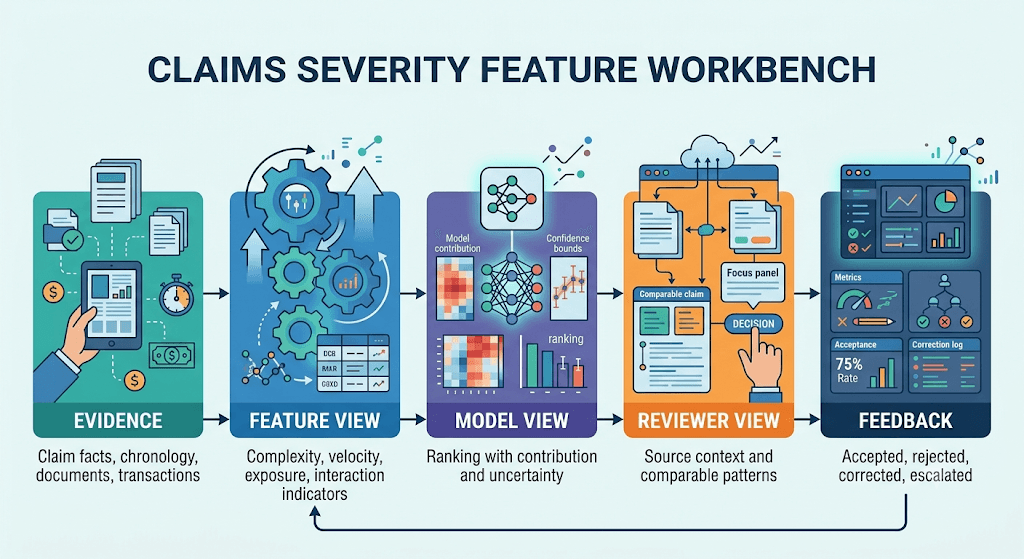
| Decision support | Provide feature-based reasons, rankings, or evidence. | Interpret results with claim, policy, legal, medical, and underwriting context. |
| Monitoring | Detect distribution shifts, failures, and parity problems. | Investigate causes, approve remediation, and decide whether use should pause. |
| Feedback | Capture corrections, overrides, and outcomes. | Explain why the feature or model was misleading and identify new exceptions. |
| Change control | Propose updates or retirement based on evidence. | Authorize changes after impact analysis and validation. |
Best Practices
- Start with a precisely defined business question, user, prediction point, and decision boundary.
- Design features around insurance meaning and chronology rather than generating transformations without a hypothesis.
- Use point-in-time datasets and temporal joins for every historical training example.
- Preserve feature lineage to source records, transformation logic, version, and owner.
- Keep mandatory policy, legal, appetite, authority, and eligibility rules explicit and separate from statistical features.
- Test feature quality and usefulness across lines, jurisdictions, channels, products, vendors, and relevant populations.
- Use simple, interpretable features as baselines before adding complex learned representations.
- Monitor missingness, freshness, range, drift, parity, and downstream performance in production.
- Document imputation, category handling, scaling, external enrichment, and exceptions.
- Review proxy and sensitive features before use; do not assume removal of protected fields eliminates unfair effects.
- Present source context and understandable reasons to professionals when features influence prioritization or review.
- Retire unused, redundant, unstable, or no-longer-justified features through controlled lifecycle management.
Common Mistakes
- Calculating historical features with the latest available record instead of the value known at the prediction time.
- Using reserve changes, attorney status, treatment outcomes, or investigation results that occurred after an early-claim score.
- Creating ratios without consistent exposure bases, time periods, units, or denominator safeguards.
- Treating missing values as neutral without understanding why the information is missing.
- Using ZIP code, occupation, language, credit-related, or network variables without proxy and fairness review.
- Allowing automated feature generation to create thousands of variables without ownership or business interpretation.
- Applying the same feature definition across lines of business with materially different processes or exposure structures.
- Changing source mappings, text models, territory files, or entity resolution without versioning and impact testing.
- Measuring only model accuracy while ignoring availability, latency, interpretability, drift, and workflow impact.
- Exposing a feature-based score without the source facts, limitations, or opportunity for professional challenge.
- Keeping obsolete features active because other systems depend on them, without a formal deprecation plan.
Implementation Blueprint
| Phase | Objectives | Key Deliverables |
|---|---|---|
| 1. Define | Specify the task, users, unit of analysis, prediction point, decision boundary, and risk level. | Use-case charter, target definition, approved data boundary, success measures. |
| 2. Inventory | Identify source systems, documents, external data, quality issues, permissions, and owners. | Source inventory, lineage map, data-quality profile, access assessment. |
| 3. Design | Create candidate features with formulas, windows, timing, imputation, and expected meaning. | Feature specifications, hypotheses, point-in-time design, governance classification. |
| 4. Build | Implement reproducible historical and live calculations with tests. | Versioned code, test data, data contracts, training-serving pipeline. |
| 5. Validate | Assess quality, leakage, stability, contribution, fairness, explainability, and workflow fit. | Validation report, segmented scorecard, professional review, risk findings. |
| 6. Integrate | Serve features in the target system with reasons, evidence, logging, and fallback behavior. | Production interface, feature service, source display, audit logs, runbook. |
| 7. Govern | Assign ownership, approvals, monitoring, incidents, changes, and retirement. | Feature registry, monitoring thresholds, review cadence, change and deprecation process. |
| 8. Scale | Reuse proven definitions and expand only after measured value and control effectiveness. | Shared feature catalog, reuse standards, capacity plan, portfolio rollout. |
Build, Buy, or Combine?
| Decision Area | Questions for Insurers |
|---|---|
| Feature platform | Does the organization need a dedicated feature store, or can governed pipelines and a catalog meet the requirement? |
| External enrichment | Are data rights, coverage, refresh, methodology, historical reproducibility, and permitted uses clear? |
| Text and image features | Can models run in the required environment, and can versions, inputs, outputs, and limitations be governed? |
| Point-in-time support | Can the platform reproduce historical feature values without leakage or retrospective corrections? |
| Integration | Can features be served into claim, underwriting, policy, and analytical systems at the required latency? |
| Security and privacy | Are tenant isolation, encryption, access control, deletion, audit, and purpose limitations supported? |
| Portability | Can definitions, code, metadata, historical values, and monitoring records be exported? |
| Operations | Who owns uptime, freshness, incident response, vendor changes, and feature retirement? |
| Economics | What are the costs of data licensing, storage, computation, serving, backfills, and ongoing validation? |
Executive Decision Guide
| Question | Green Light | Caution |
|---|---|---|
| Is the business question clear? | The user, prediction point, action, and decision boundary are explicit. | The project begins with available data or a desired score rather than a defined workflow. |
| Can features be reproduced in time? | Historical values use information available at the actual decision point. | Training uses latest records, corrected data, or outcomes unavailable in production. |
| Are definitions governed? | Features have owners, lineage, versions, quality tests, and approved uses. | Variables are informal columns with unclear source or meaning. |
| Is usefulness measurable? | Incremental value and workflow outcomes can be evaluated on representative data. | Success is limited to model accuracy or a promising demonstration. |
| Are fairness and privacy addressed? | Sensitive and proxy risks are reviewed and segmented performance is tested. | Risk review is deferred until after deployment. |
| Will professionals see context? | Users receive understandable reasons, relevant source evidence, and escalation options. | Only a score or unexplained feature importance is shown. |
| Can change be controlled? | Source, logic, and model changes are versioned, monitored, and reversible. | Features can change silently through vendor or pipeline updates. |
| Is the operating model sustainable? | Ownership, monitoring, incidents, retraining, and retirement are funded and assigned. | The project depends on one analyst or an unmaintained prototype. |
Executive Recommendation
Invest in feature engineering when the insurance problem depends on patterns that are not captured by raw fields alone. Require every material feature to have a clear business meaning, point-in-time definition, source lineage, validation record, owner, and approved use. Favor transparent domain-designed features as the foundation; add automated or learned features where they provide measurable value and can be governed appropriately. Treat feature engineering as durable model infrastructure—not an informal preprocessing step—and preserve professional authority over consequential insurance decisions.
Business Benefits
| Benefit | How It Is Created | Illustrative Measures |
|---|---|---|
| Earlier insight | Chronology, velocity, interaction, and enrichment features expose patterns before raw outcomes are obvious. | Time to useful signal, earlier intervention rate, escalation lead time. |
| More consistent prioritization | Governed features apply the same definitions across claims, submissions, policies, and portfolios. | Queue consistency, reviewer agreement, override patterns. |
| Improved model performance | Well-designed variables convert raw records into stable signals aligned with the insurance task. | Incremental lift, ranking quality, calibration, error reduction. |
| Faster professional review | Summaries, counts, trends, and document-derived indicators reduce manual reconstruction. | Review time, touches per file, evidence-finding time. |
| Better explainability | Domain-designed features translate model behavior into recognizable insurance concepts. | Reason-code acceptance, challenge resolution, reviewer comprehension. |
| Reusable data assets | Versioned feature definitions can support multiple approved models and analytical workflows. | Reuse rate, duplicated logic retired, development cycle time. |
| Improved governance | Lineage, ownership, quality tests, and lifecycle status make model inputs auditable. | Traceability rate, control exceptions, remediation time. |
| Portfolio insight | Aggregated features support segmentation, trend detection, and operational monitoring. | Emerging-pattern detection, segment stability, management action rate. |
Value Principle The business value of feature engineering is realized only when engineered variables improve a real insurance task, remain valid at the decision point, can be traced to evidence, and support rather than obscure professional judgment.
Charlee.ai Perspective
Feature engineering is where insurance knowledge becomes operational model context. Raw claim, policy, medical, legal, repair, and underwriting data rarely arrives in a form that directly represents complexity, trajectory, timing, or interaction. The design of features determines which patterns an AI system can recognize and which distinctions it may overlook.
For claims intelligence, the most useful features often preserve chronology and connect multiple evidence sources. A single field such as total paid or attorney involvement is less informative than a governed set of point-in-time features showing reporting delay, reserve movement, treatment progression, document activity, participant relationships, and changes in exposure. The system should also retain the source facts behind those features so professionals can understand and challenge the result.
Charlee.ai views feature engineering as a controlled bridge between unstructured insurance evidence and model-supported workflow. The objective is not to create the largest possible feature library. It is to create a smaller set of meaningful, reproducible, monitored, and explainable signals that improve attention, consistency, and insight while preserving human authority over coverage, liability, reserves, settlement, underwriting, and other consequential decisions.
Practical Design Principle A strong feature should answer five questions: What insurance concept does it represent? What information was available at the time? How was it calculated? What source evidence supports it? Under what approved use may it influence a workflow?
Key Takeaways
- Feature engineering converts raw insurance data into model-ready representations of timing, development, complexity, interaction, exposure, and context.
- The strongest features are aligned with a defined business task, user, unit of analysis, prediction point, and decision boundary.
- Point-in-time correctness is essential; future information and retrospective corrections can create target leakage and misleading validation results.
- Feature lineage, ownership, versioning, quality tests, approved use, and lifecycle status are core governance requirements.
- Domain-designed features provide interpretability, while learned representations can add value when their behavior and limitations are appropriately controlled.
- More features are not necessarily better; unused, redundant, unstable, risky, or unjustified variables should be removed or retired.
- Production monitoring should cover freshness, missingness, range, drift, training-serving parity, reliability, fairness, and downstream model impact.
- Engineered features should support evidence-based professional review, not independently determine consequential insurance outcomes.
- Business value should be measured through real workflow improvement, earlier and more consistent insight, stronger explanations, and better-supported decisions.
Feature engineering is the disciplined process of converting raw insurance data into meaningful, model-ready variables that represent risk, behavior, exposure, chronology, and context for analysis, prediction, prioritization, and decision support.
Frequently Asked Questions
Feature engineering is the process of transforming raw data into variables that make relevant patterns easier for a model or analytical workflow to use. It includes selecting, combining, aggregating, encoding, normalizing, enriching, and representing information.
Insurance data is fragmented across transactions, documents, timelines, parties, policies, exposures, and external sources. Feature engineering converts these records into consistent representations of concepts such as reporting delay, claim development, treatment progression, risk concentration, or account stability.
Not always. A raw field may be used directly as a feature, but many features are derived from multiple fields or events. For example, reporting delay is calculated from the loss date and report date; reserve velocity requires a sequence of reserve transactions.
Preprocessing focuses on making data usable, such as correcting formats, handling missing values, or standardizing units. Feature engineering goes further by creating task-relevant representations. In practice, the activities often overlap and should be governed together.
Feature engineering creates or transforms candidate variables. Feature selection determines which variables should be retained for a particular model or use case based on usefulness, stability, redundancy, risk, and operational considerations.
Feature extraction derives informative representations from raw inputs, often reducing complexity. Text embeddings, image descriptors, document classifications, or learned latent representations are examples. It is commonly treated as one form of feature engineering.
Yes. Language models can classify text, extract entities, identify events, summarize chronology, or generate embeddings that become model inputs. Their outputs require versioning, validation, privacy controls, and review for hallucination, inconsistency, bias, and drift.
Target leakage occurs when a feature contains information that would not have been available at the actual prediction point or directly reveals the outcome. Examples include later reserve changes in an FNOL model or final litigation status in an early-claim score.
Historical training values must reflect only the information known at the original decision time. Otherwise validation results can be unrealistically strong and production performance can fail.
Training-serving skew is a difference between the feature logic used to build historical training data and the logic used in production. Differences in code, timing, mappings, missing-value treatment, or vendor data can cause it.
A feature store is infrastructure for defining, computing, storing, discovering, and serving reusable features. A mature implementation supports historical point-in-time values, online serving, lineage, permissions, versioning, monitoring, and ownership.
Not always. A governed pipeline, catalog, and shared calculation library may be sufficient for a smaller environment. A feature store becomes more valuable when many teams and models need consistent definitions, historical reproducibility, and reliable online serving.
The method depends on why the value is missing and how the feature is used. Teams may impute a value, create a missingness indicator, use a model that handles missing values, or exclude the feature. The choice should preserve meaning and be documented.
Yes. Features can reproduce historical bias or act as proxies for sensitive characteristics. Geography, occupation, language, credit-related, behavioral, and network variables require particular care. Segmented testing, legal and governance review, purpose limitation, and human oversight are important.
No. Large feature sets can increase overfitting, redundancy, cost, instability, privacy risk, and explanation difficulty. Features should be retained because they add measurable and governed value.
Evaluation should include business validity, data quality, point-in-time integrity, predictive contribution, stability, fairness, explainability, operational availability, and downstream workflow value.
Feature drift is a change in a feature’s distribution, availability, or meaning over time. It may result from new products, regulations, claims practices, economic conditions, channels, vendor methods, or source-system changes.
Teams should monitor distribution statistics, missingness, range, freshness, category changes, parity, and model impact. Alerts should be segmented and connected to investigation, approval, rollback, and retirement procedures.
When features influence prioritization or decision support, users should receive understandable reasons and relevant source context. Raw internal model variables need not all be displayed, but the workflow should support meaningful explanation and challenge.
A feature is an input, not a decision. Consequential conclusions about coverage, liability, reserves, settlement, compensability, fraud, pricing, or risk selection require governed models, explicit rules, evidence, professional judgment, and applicable legal and regulatory controls.
Review frequency should reflect risk, source volatility, model importance, and operating change. High-impact or rapidly changing features may require continuous monitoring and formal periodic revalidation; lower-risk analytical features may be reviewed less frequently.
A feature should be restricted or retired when it is unused, redundant, unstable, no longer available, no longer legally or operationally justified, difficult to reproduce, or unable to meet quality and governance requirements.