Executive Snapshot
IN TWO MINUTES
A large language model is an AI model trained on very large collections of text so it can interpret language, generate responses, summarize documents, answer questions, classify information, and support knowledge work. In insurance, an LLM is not a decision maker. It is a language interface and reasoning-support component that must be grounded in approved information, governed, monitored, and paired with human review.
What executives should know
- LLMs are exceptionally strong at interpreting and generating language, but they do not inherently know whether a statement is accurate, current, authorized, or appropriate for a particular claim or policy.
- The business value comes from embedding LLMs into controlled workflows such as claim-file review, medical chronology, underwriting submission analysis, policy research, correspondence drafting, and management reporting.
- Production quality depends on more than model selection. Data access, retrieval, security, source citation, prompt design, testing, workflow integration, and human approval are equally important.
- The right success measures are business outcomes: review time saved, consistency improved, rework reduced, earlier risk detection, and better decisions—not merely fluent output.
Business value chain
| Insurance content | Grounded LLM | Structured output | Professional review | Business outcome |
|---|---|---|---|---|
| EXECUTIVE DECISION POINT Do not ask only, “Which model are we using?” Ask, “What information can it access, how is the answer grounded, how is evidence shown, who approves the output, and how will we measure business value?” |
Executive Summary
Large Language Models (LLMs) are a class of foundation model designed to process and generate human language. They learn statistical relationships among words, phrases, concepts, and documents from extremely large text collections. When prompted, an LLM predicts and assembles a response that reflects those learned patterns and the context supplied at the time of use.
For Property & Casualty insurers, LLMs can make complex information easier to use. They can summarize claim files, organize medical records, explain policy language, draft correspondence, extract facts from submissions, answer questions over approved knowledge sources, and convert unstructured documents into structured data for downstream workflows.
Fluency should not be confused with authority. An LLM can produce a polished answer that is incomplete, unsupported, or wrong. Insurance deployments therefore require grounding, retrieval, citations, access controls, testing, human oversight, and clear limits on what the system may recommend or decide.
Quick Facts
| TOPIC | DETAIL |
|---|---|
| Full name | Large Language Model |
| Primary capability | Interpret and generate language |
| Model family | Foundation model / generative AI |
| Typical insurance inputs | Claim notes, medical records, policies, demand packages, submissions, emails, manuals, procedures |
| Typical outputs | Summaries, extracted facts, classifications, answers, drafts, explanations, structured data |
| Key control | Ground outputs in approved sources and require human review |
| Primary risks | Hallucination, unsupported conclusions, data leakage, bias, overreliance, prompt injection |
| Related technologies | NLP, transformers, embeddings, vector databases, RAG, AI agents, predictive AI |
Definitions
Executive definition
A Large Language Model is an AI system that can read, interpret, organize, and generate language at scale. In insurance, it is best understood as a governed language and knowledge assistant that helps professionals work with complex information more efficiently.
Technical definition
An LLM is a neural network—typically based on the transformer architecture—trained on large text corpora using self-supervised learning. The model represents language as tokens, converts tokens into numerical embeddings, processes relationships among them through attention mechanisms, and predicts the next token or sequence of tokens based on the prompt and available context.
Insurance definition
In P&C insurance, an LLM can interpret unstructured content and produce useful outputs such as a medical chronology, claim summary, policy explanation, underwriting risk synopsis, litigation update, reserve-review narrative, or draft communication. It should support—not replace—the professional judgment of adjusters, underwriters, managers, counsel, clinicians, and other subject-matter experts.
Insurance definition
CHARLEE.AI INSIGHT
The most valuable insurance use of an LLM is rarely “chat.” It is the controlled conversion of high-volume, unstructured information into explainable, workflow-ready intelligence.
Why Large Language Models Matter in Insurance
Insurance is a language-intensive business. Critical information is distributed across policy forms, endorsements, claim notes, medical records, police reports, legal filings, emails, repair estimates, underwriting submissions, inspection reports, loss-control documents, and operating procedures. The challenge is not merely storing that content. It is understanding it quickly, consistently, and in context.
The operational problem
- Professionals spend substantial time locating facts, reconstructing chronology, comparing documents, and drafting routine summaries.
- Important signals may be buried in hundreds or thousands of pages and may appear in different terminology across documents.
- Rule-based systems struggle with variation in language, document structure, and context.
- Knowledge is often fragmented across systems, teams, and repositories.
- Work quality can vary because time pressure and workload affect how thoroughly information is reviewed.
What LLMs change
LLMs make language itself computable. They allow users and applications to interact with documents through questions, instructions, and structured prompts. When combined with retrieval and insurance-specific controls, they can identify relevant passages, synthesize information, preserve source references, and create outputs tailored to a workflow.
Where value appears first
| Workflow | LLM contribution | Business value |
|---|---|---|
| Claim-file review | Summarize events, identify changes, organize chronology | Faster review and earlier issue recognition |
| Medical review | Extract diagnoses, procedures, restrictions, treatment progression | More consistent medical understanding |
| Underwriting submission | Condense narrative and document sets into a risk synopsis | Shorter cycle time and more consistent intake |
| Policy research | Retrieve and explain relevant forms and endorsements | Quicker access to approved language |
| Management reporting | Synthesize activity across claims or portfolios | Improved visibility and communication |
How Large Language Models Work
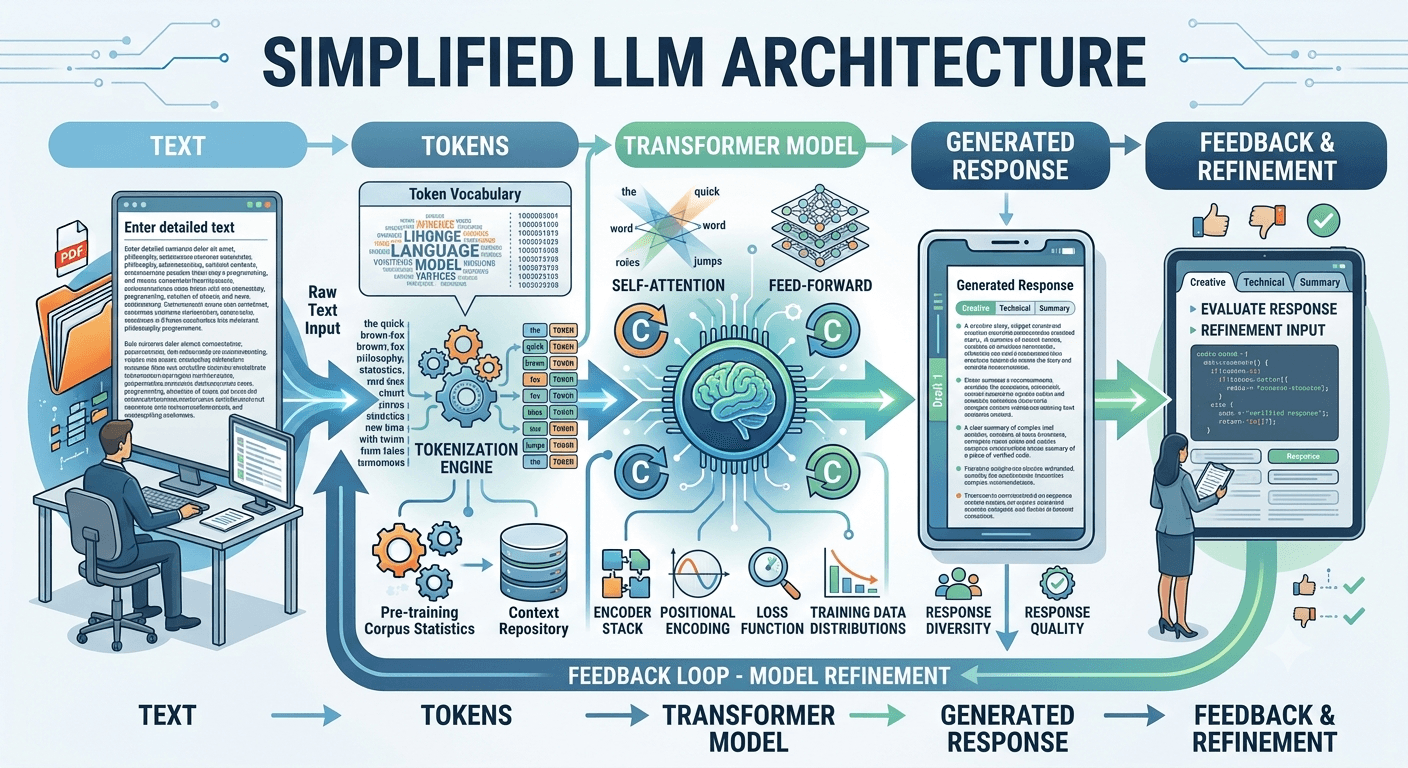
Tokenization
The model breaks text into tokens. A token may be a whole word, part of a word, punctuation, or another small unit. Tokenization allows language to be represented in a form the model can process mathematically.
Embeddings
Each token is converted into a numerical vector called an embedding. Embeddings capture relationships among words and concepts, allowing the model to recognize that different phrases may express similar meaning.
Transformer attention
Transformers use attention mechanisms to evaluate how parts of the input relate to one another. This helps the model connect a pronoun to the correct subject, associate a diagnosis with a later procedure, or recognize that an endorsement changes the effect of a base policy provision.
Pretraining
During pretraining, the model learns broad language patterns from very large datasets. It is not memorizing a traditional database of facts. It is learning statistical relationships that help it predict likely continuations and generate coherent responses.
Instruction tuning and alignment
Additional training and feedback help the model follow instructions, avoid certain harmful behaviors, and provide more useful responses. Enterprise systems may also apply policy controls, safety filters, and domain-specific tuning.
Inference
When the model receives a prompt, it uses the prompt, conversation context, and any retrieved information to generate a response token by token. This production-time process is called inference.
Grounding and retrieval
Because the base model may not contain current or organization-specific knowledge, production systems often retrieve relevant content from approved repositories and place it in the model context. This is the foundation of Retrieval-Augmented Generation (RAG).
Human review and feedback
Insurance professionals validate the output, consult the underlying source material, and make the business decision. Feedback can improve prompts, retrieval, evaluation rules, and workflow design over time.
Human review and feedback
IMPORTANT DISTINCTION
The model does not “look up” every answer in its training data. It generates language based on probabilities. Grounding and citations are therefore essential when the answer must be accurate, current, and defensible.
Core Components of an Enterprise LLM Solution
| Component | Role |
|---|---|
| Foundation model | Provides general language capability. |
| Prompt and orchestration layer | Defines instructions, business rules, context, and workflow steps. |
| Document processing | Extracts text, structure, tables, and metadata from source files. |
| Embeddings and vector search | Finds semantically relevant passages, not merely exact keyword matches. |
| Retrieval layer | Selects approved information to provide to the model. |
| Security and access control | Limits data and actions according to user and role. |
| Evaluation and monitoring | Tests accuracy, relevance, citation quality, consistency, latency, and risk. |
| Human review interface | Shows output, evidence, confidence indicators, and approval steps. |
| Audit trail | Records inputs, retrieved sources, model version, output, and user actions. |
A practical insurance architecture
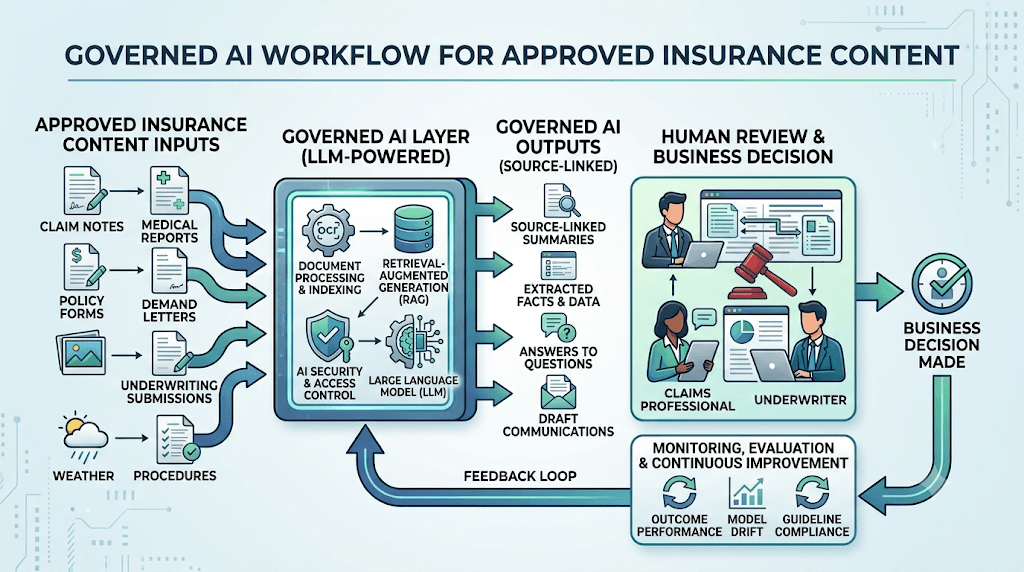
Approved insurance content and transaction data
Document processing + retrieval + access controls
Large Language Model
Structured output with source evidence
Professional review, action, and audit trail
LLMs, Generative AI, NLP, and Predictive AI
These terms are related but not interchangeable. Understanding the differences helps organizations select the right capability for the right problem.
| Capability | Primary purpose | Typical insurance output | Best suited for |
|---|---|---|---|
| NLP | Process and analyze language | Entity extraction, classification, sentiment, document tagging | Focused language tasks |
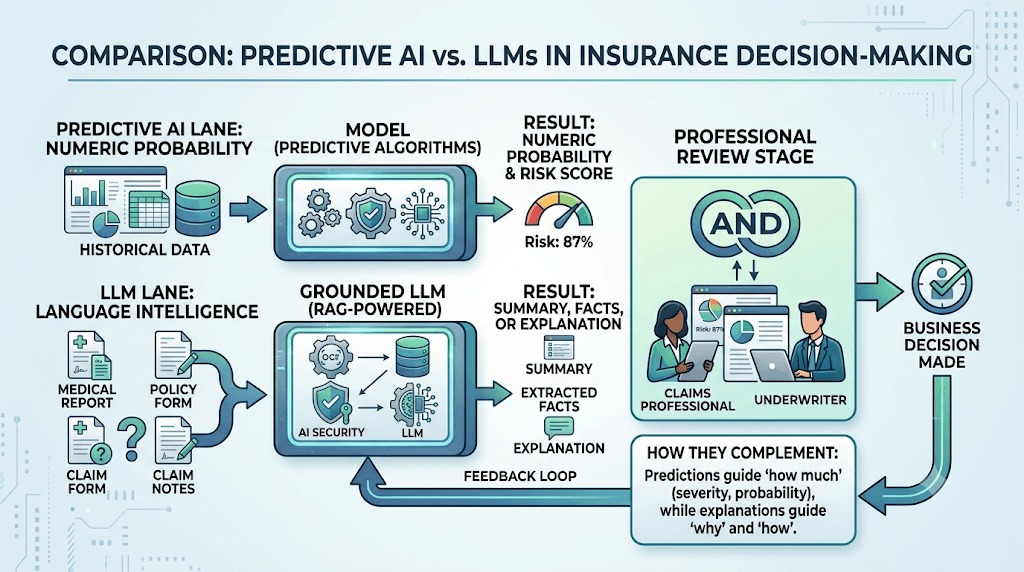
| Large Language Model | Interpret and generate language | Summary, answer, explanation, draft, structured extraction | Broad language and knowledge workflows |
| Generative AI | Create new content across modalities | Text, images, code, audio, synthetic content | Content creation and transformation |
| Predictive AI | Estimate future outcomes | Severity score, litigation likelihood, fraud risk | Forecasting and prioritization |
| Rules engine | Apply explicit business logic | Eligibility result, routing decision, validation flag | Stable, deterministic rules |
| COMPLEMENTARY, NOT COMPETING An insurer may use NLP to extract facts, an LLM to summarize the file, predictive AI to estimate severity, and a rules engine to route the claim. The strongest solutions combine capabilities around a well-defined workflow. |
Model Types and Deployment Choices
There is no universally best model. Selection should consider task quality, security, context length, latency, cost, deployment environment, data residency, explainability, vendor support, and the organization’s ability to test and operate the system.
- General-purpose public models offer broad capability and rapid innovation but require careful enterprise controls.
- Enterprise-hosted models can provide stronger data, identity, and governance integration.
- Open-weight models may offer greater control and customization but require more internal operational capability.
- Domain-adapted models may improve insurance terminology and task performance when supported by appropriate data and evaluation.
- Smaller language models can be faster and less expensive for narrow tasks, especially when deployed close to the data.
Large Language Models Across the P&C Insurance Value Chain
| Function | Illustrative LLM contribution |
|---|---|
| FNOL and intake | Summarize initial reports, normalize descriptions, identify missing information, suggest routing for review. |
| Claims handling | Create claim summaries, chronologies, action lists, and change reports across the life of the claim. |
| Medical review | Organize diagnoses, procedures, restrictions, medications, and treatment progression with source references. |
| Litigation | Summarize pleadings, legal correspondence, depositions, demands, and important changes in representation or posture. |
| Reserving | Prepare a reserve-review narrative by consolidating relevant facts and explaining material changes; final reserve decisions remain with authorized professionals. |
| Fraud and SIU | Organize inconsistencies and suspicious indicators for investigator review; an LLM should not make unsupported fraud accusations. |
| Subrogation | Identify potential responsible parties, evidence references, and recovery facts for specialist review. |
| Underwriting | Summarize submissions, compare information across documents, identify missing items, and draft a risk synopsis. |
| Policy service | Retrieve and explain approved policy and procedure content while linking to the controlling source. |
| Customer communications | Draft clear, audience-appropriate responses for professional approval. |
| Management | Generate consistent portfolio narratives and operational summaries from approved data and analytics. |
Case Study: Complex Claim Review
SCENARIO
A commercial auto bodily injury claim has been open for eighteen months. The file includes adjuster notes, medical records, invoices, a police report, recorded-statement transcripts, defense reports, legal correspondence, and a new settlement demand. The claims manager needs a defensible, current understanding of exposure before a reserve and strategy review.
Step 1 — Controlled ingestion
The system processes the relevant claim documents and preserves metadata such as source document, date, page, author, and document type. Access is limited to authorized users assigned to the claim.
Step 2 — Retrieval
The user requests a current claim summary, medical chronology, treatment changes, liability issues, litigation posture, demand analysis, and unresolved questions. The retrieval layer identifies the most relevant passages from the approved claim file.
Step 3 — LLM synthesis
The LLM produces a structured output that separates established facts, reported allegations, medical findings, disputed issues, and open questions. Each material statement links to supporting evidence.
Step 4 — Professional review
The claims manager reviews the source passages, corrects any misinterpretation, and adds contextual knowledge that is not contained in the documents. Counsel and medical resources are consulted where necessary.
Step 5 — Business decision
Authorized professionals determine reserve, negotiation strategy, additional investigation, and next actions. The LLM output serves as an organized evidence package—not as the decision itself.
Step 6 — Monitoring
As new documents arrive, the system highlights changes from the prior review: new diagnoses, procedures, wage-loss information, experts, demands, legal deadlines, or contradictions.
Outcome measures
- Time required to prepare the review
- Percentage of material statements linked to source evidence
- Number of corrections required
- Consistency across reviewers
- Earlier identification of changed exposure
- Reduction in duplicated document review
Outcome measures
LESSON
The greatest value does not come from generating a longer summary. It comes from producing a structured, source-linked view of what changed, why it matters, and what still requires human judgment.
Case Study: Underwriting Submission Review
A middle-market commercial package submission includes applications, loss runs, schedules, inspection reports, narratives, and broker correspondence. The underwriter must determine whether the submission is complete, identify material risk characteristics, and prepare for pricing and appetite review.
LLM-supported workflow
Ingest and classify the submission documents.
Extract named insured, locations, operations, exposures, limits, loss history, safety controls, and missing information.
Create a concise risk synopsis organized by underwriting criteria.
Identify inconsistencies across application forms, schedules, and narratives.
Generate questions for the broker based on missing or conflicting information.
Present source references for each material fact.
Allow the underwriter to validate, revise, and use the output in the authorized underwriting process.
What the model should not do
- Invent missing exposure information
- Treat a broker statement as verified fact without attribution
- Make a final appetite or pricing decision outside approved rules and authority
- Use confidential information outside the permitted submission context
- Hide uncertainty or omit source references
What the model should not do
BUSINESS VALUE SNAPSHOT
Business problem: document-heavy intake. LLM capability: extraction, comparison, summarization, and question generation. Human role: assess risk and apply judgment. Outcome: faster, more consistent submission review with clearer evidence.
Benefits and Measures of Success
Production deployments should be judged by measurable business and quality outcomes. A fluent demonstration is not evidence of operational value.
| Benefit | Example measure | Why it matters |
|---|---|---|
| Productivity | Minutes or hours saved per review | Creates capacity for higher-value professional work |
| Consistency | Variation in output across users and teams | Reduces uneven review quality |
| Accuracy | Material-fact accuracy and citation precision | Supports defensibility and trust |
| Cycle time | Time from document receipt to actionable review | Improves responsiveness |
| Coverage | Percentage of relevant documents and issues reviewed | Reduces overlooked information |
| Rework | Corrections, repeat reviews, or reopened tasks | Measures operational quality |
| Decision support | Earlier interventions or identified changes | Connects the tool to business outcomes |
| Adoption | Sustained use by intended professionals | Shows workflow fit and usefulness |
Cost considerations
LLM economics depend on model size, token volume, context length, document processing, retrieval, storage, latency requirements, hosting, evaluation, support, and human review. A lower model price does not necessarily produce a lower total cost if output quality causes rework or if the solution requires extensive custom engineering.
Value calculation
A practical business case compares the current workflow with the future workflow. It estimates labor time, cycle time, quality, missed opportunities, implementation cost, operating cost, change management, and the value of earlier or more consistent decisions. Benefits should be validated through pilots using representative insurance work—not idealized demonstration files.
Risks, Limitations, and Governance
| Risk | Required response |
|---|---|
| Hallucination | The model may generate plausible but unsupported content. Require grounding, citations, validation, and task-specific testing. |
| Incomplete context | The answer may omit information that was not retrieved or did not fit within the context. Monitor retrieval coverage and expose source scope. |
| Overreliance | Users may accept fluent output without checking evidence. Design explicit review and approval steps. |
| Data leakage | Prompts or documents may be exposed outside authorized boundaries. Use contractual, technical, identity, encryption, and retention controls. |
| Prompt injection | Malicious or misleading instructions embedded in content may attempt to alter behavior. Separate system instructions, sanitize inputs, restrict tools, and test adversarial cases. |
| Bias and unfairness | Training data and workflow design may reproduce inequities. Evaluate by use case, population, and decision impact. |
| Model drift and change | Provider updates or business changes may alter results. Version, test, monitor, and control releases. |
| Lack of explainability | A generated response may not reveal why it was produced. Require evidence, attribution, uncertainty handling, and clear user communication. |
| Legal and regulatory risk | Use may affect privacy, recordkeeping, consumer communication, claims practices, and model governance obligations. Involve legal, compliance, security, and business owners. |
| Intellectual property | Outputs and source use may create licensing or ownership issues. Establish approved use policies and contractual protections. |
Responsible AI Control Framework
Purpose
Define the business problem, intended users, permitted outputs, and prohibited uses.
Data
Approve sources, permissions, retention, privacy handling, and data-quality expectations.
Model
Document model selection, version, hosting, limitations, and evaluation results.
Grounding
Retrieve from approved content, preserve source metadata, and show supporting evidence.
Prompting
Control system instructions, templates, user inputs, and prompt changes.
Human oversight
Assign review, approval, escalation, and accountability responsibilities.
Security
Apply authentication, authorization, encryption, logging, segmentation, and incident response.
Testing
Evaluate normal, edge, adversarial, biased, and high-risk scenarios before release.
Monitoring
Track quality, usage, failures, changes, drift, cost, latency, and user feedback.
Change management
Train users, define workflow, manage adoption, and communicate limitations.
Auditability
Retain appropriate records of source, prompt, model, output, reviewer, and action.
Auditability
GOVERNANCE PRINCIPLE
Control the complete system—not only the model. Most operational risk arises from how data, retrieval, prompts, interfaces, users, and workflows interact.
Best Practices
- Start with a narrow, high-value, document-intensive workflow where output can be evaluated objectively.
- Use representative insurance files, including difficult and incomplete examples, during testing.
- Ground responses in approved sources and make evidence visible at the point of use.
- Separate facts, allegations, model inference, and professional conclusions in the output structure.
- Design the human review step before designing the model prompt.
- Measure quality by material-fact accuracy, citation accuracy, completeness, consistency, and business outcomes.
- Use reusable prompt templates and controlled output schemas instead of relying on free-form chat alone.
- Apply role-based access and least-privilege data permissions.
- Monitor model and retrieval performance after deployment and after every material change.
- Provide user training that explains strengths, limitations, escalation, and prohibited use.
Common Mistakes
- Choosing a model before defining the workflow and success criteria.
- Assuming a fluent answer is accurate.
- Allowing unsupported outputs to enter claim or underwriting records without review.
- Using a public consumer tool with confidential insurance data.
- Ignoring retrieval quality and focusing only on prompt wording.
- Treating all documents as equally reliable or authoritative.
- Failing to distinguish generated summaries from controlling policy, legal, medical, or regulatory sources.
- Launching without a monitoring, rollback, and incident process.
- Measuring adoption instead of actual business value.
- Attempting broad enterprise deployment before proving a narrow use case.
Common Myths and Misconceptions
“An LLM is a database.”
It is a generative model. It can use databases and document repositories through retrieval, but its internal knowledge is not a controlled system of record.
“A larger model is always better.”
Larger models may provide broader capability, but a smaller or specialized model may be faster, cheaper, easier to control, and better suited to a narrow task.
“RAG eliminates hallucinations.”
RAG can reduce unsupported answers and improve currency, but retrieval can miss content and the model can still misinterpret or overstate it.
“Fine-tuning teaches the model our documents.”
Fine-tuning changes behavior and patterns. Frequently updated enterprise knowledge is usually better supplied through retrieval.
“LLMs replace adjusters and underwriters.”
LLMs can reduce information-processing effort. Authority, accountability, negotiation, empathy, judgment, and complex decision-making remain human responsibilities.
“If the model cites a source, the answer must be correct.”
A citation may be irrelevant, incomplete, or misinterpreted. Citation quality must be tested and users must be able to inspect the source.
“One prompt works for every workflow.”
Production workflows need task-specific prompts, output schemas, evidence rules, and evaluation.
“Private hosting automatically makes the solution safe.”
Hosting is only one control. Access, data flow, logging, retention, prompts, tools, users, and operations also matter.
Executive Decision Guide
Questions to ask before approval
- What exact business workflow and user population are in scope?
- Which documents and systems can the solution access?
- How are source passages selected, displayed, and validated?
- What outputs are advisory, and what actions are prohibited?
- Who reviews and approves the output?
- How were accuracy, completeness, bias, security, and adversarial behavior tested?
- How will model, prompt, and retrieval changes be governed?
- What is the fallback when the model is unavailable or uncertain?
- What records are retained for audit and dispute resolution?
- How will value be measured against the current workflow?
Vendor evaluation checklist
| Area | Evidence requested | Status |
|---|---|---|
| Insurance fit | Demonstrated performance on representative insurance content and workflows | ☐ |
| Security | Architecture, access model, encryption, retention, incident process, certifications | ☐ |
| Data rights | Contract terms for use, training, retention, ownership, and deletion | ☐ |
| Grounding | Source controls, retrieval quality, citations, authority ranking | ☐ |
| Quality | Task-specific evaluation results and error analysis | ☐ |
| Governance | Model/version control, approvals, change management, monitoring | ☐ |
| Integration | APIs, identity, core-system workflow, document repositories, audit logs | ☐ |
| Operations | Availability, latency, cost controls, support, fallback, portability | ☐ |
Readiness indicators
- A clear business owner and measurable problem
- Representative data and approved access
- Defined human review and authority
- Security, legal, compliance, and AI governance participation
- A controlled pilot population
- Evaluation criteria and baseline performance
- Operational support and change-management capacity
Charlee.ai Perspective
Large Language Models are powerful because they make insurance information easier to understand and use. Their role, however, should be carefully defined. A model that writes fluent text without evidence can increase risk. A governed system that connects language understanding with approved data, predictive intelligence, workflow context, and human expertise can materially improve how professionals work.
Charlee.ai’s perspective is that the insurance decision remains with the authorized professional. AI should continuously organize information, surface signals, explain why an issue may matter, and help users focus their attention. The strongest architecture combines document intelligence, natural language processing, predictive models, retrieval, and LLM-based interaction rather than treating the LLM as a standalone answer engine.
CHARLEE.AI INSIGHT
Human judgment is not a control added after AI. It is a core component of the operating model. The system should be designed around the professional’s responsibility to review evidence, apply context, and make the decision.
Practical design principles
- Evidence before eloquence
- Workflow before chatbot
- Purpose-limited access
- Facts separated from inference
- Prediction separated from generation
- Human authority made explicit
- Continuous monitoring and improvement
Key Takeaways
- Large Language Models are foundation models designed to interpret and generate language.
- In insurance, their highest-value uses involve document understanding, knowledge access, summarization, structured extraction, and professional decision support.
- An LLM is not an authoritative database or an independent decision maker.
- Grounding, retrieval, source evidence, access control, testing, and human review are essential for production use.
- LLMs complement predictive AI, NLP, rules engines, and core insurance systems.
- Success should be measured through accuracy, citation quality, workflow improvement, user adoption, and business outcomes.
- The complete operating system—data, retrieval, prompts, model, interface, users, and governance—must be controlled and monitored.
- Human expertise remains responsible for material insurance decisions.
IN TWO MINUTES
A large language model is an AI model trained on very large collections of text so it can interpret language, generate responses, summarize documents, answer questions, classify information, and support knowledge work. In insurance, an LLM is not a decision maker. It is a language interface and reasoning-support component that must be grounded in approved information, governed, monitored, and paired with human review.
Frequently Asked Questions
An LLM is a type of generative AI focused on language. Generative AI is broader and can include image, audio, video, code, and multimodal models.
No. NLP is the broader field of computing with language. LLMs are one modern approach within NLP and can perform many language tasks through prompting.
It can process and synthesize large amounts of content, but practical limits remain. Documents must be extracted correctly, relevant content must be retrieved, and users must know what was included or omitted.
They generate likely language rather than verifying every statement against an authoritative source. Grounding, retrieval, constraints, citations, testing, and human review reduce but do not eliminate this risk.
Context length is the amount of text and other information the model can consider during a single interaction. A longer context can help with larger document sets but does not guarantee that every detail will be used correctly.
Retrieval-Augmented Generation retrieves relevant information from approved sources and supplies it to the model when answering. This improves currency, relevance, and evidence linkage.
Sometimes. Fine-tuning may improve specialized behavior or output format, but retrieval is generally more appropriate for frequently changing enterprise knowledge. The decision should be driven by testing and total operating cost.
An LLM can support analysis, but material claim decisions should remain with authorized professionals and approved decision processes. The system must respect authority, regulation, policy, and governance requirements.
Use approved enterprise environments, contractual restrictions, encryption, identity and access controls, data minimization, retention controls, logging, monitoring, and clear prohibitions on provider training where required.
Not automatically. They may provide more control, but safety depends on hosting, configuration, access, data handling, patching, evaluation, and operations.
Use task-specific measures such as material-fact accuracy, completeness, citation precision, consistency, relevance, prohibited-content rate, latency, cost, reviewer corrections, and business outcomes.
Only if the system can accurately extract or visually interpret them. Document processing quality is often a major determinant of final performance.
Prompt injection occurs when untrusted content attempts to manipulate the model or override instructions. Controls include content isolation, instruction hierarchy, tool restrictions, access controls, testing, and monitoring.
They are more likely to change how professionals spend their time. Routine information processing can be reduced, while judgment, accountability, negotiation, empathy, strategy, and exception handling remain essential.
A narrow, high-volume, document-intensive workflow with measurable quality and time baselines, accessible source evidence, and a clearly defined human review step.