Executive Snapshot
In one sentence A vector database is a specialized data platform designed to store high-dimensional embeddings and quickly retrieve the most semantically similar records, passages, images, claims, policies, or other objects for use in AI applications.
| Dimension | What Executives Should Know |
|---|---|
| Primary role | Enable fast similarity search over embeddings rather than relying only on exact keyword or relational lookups. |
| Insurance value | Help users and AI systems find relevant claim notes, medical reports, policy language, submissions, prior cases, and supporting evidence. |
| Common applications | Semantic search, RAG, document retrieval, duplicate detection, portfolio similarity, image matching, and knowledge assistants. |
| Core dependency | High-quality embeddings, disciplined chunking, reliable metadata, access controls, and governed source content. |
| Primary risk | Retrieving plausible but irrelevant, stale, unauthorized, incomplete, or insufficiently traceable information. |
| Operating principle | Use vector retrieval to improve access to evidence while preserving professional judgment, source verification, and decision authority. |
Vector databases are not replacements for core policy, billing, claims, document management, or data warehouse platforms. They are a specialized retrieval layer that complements those systems by making semantically similar content easier to find and use.
Executive Summary
Insurance organizations generate and retain vast amounts of unstructured information: claim notes, correspondence, medical records, demand packages, repair estimates, underwriting submissions, inspections, policy forms, legal documents, photographs, and emails. Traditional databases and enterprise search systems remain essential, but exact matching alone often fails when the same concept appears in different words or formats.
Vector databases address this problem by storing embeddings—numeric representations that capture aspects of meaning, context, structure, or visual similarity. When a user or application submits a query, the query is converted into an embedding and compared with stored vectors. The database returns the nearest or most similar items, often combined with keyword search, metadata filters, and business rules.
For insurers, the strategic importance of vector databases lies in their ability to connect people and AI systems with relevant evidence. They can support a claims assistant that retrieves similar injury patterns, an underwriting workbench that locates comparable risks, a policy assistant that finds relevant coverage language, or a RAG application that grounds generated answers in approved enterprise sources.
Executive takeaway The business outcome depends less on the database brand than on the quality of the entire retrieval system: source selection, document preparation, embedding model, chunking method, metadata, permissions, ranking, evaluation, monitoring, and professional review.
Quick Facts
| Question | Answer |
|---|---|
| What is stored? | Vectors, source identifiers, metadata, text or object references, and often selected payload content. |
| What is searched? | The nearest neighbors to a query vector, usually subject to filters and ranking logic. |
| What makes it different? | It is optimized for approximate nearest-neighbor search across high-dimensional representations. |
| Does it replace SQL? | No. Relational and vector retrieval frequently work together. |
| Does it guarantee correct answers? | No. It retrieves candidates; application logic and professional review determine how those candidates are used. |
| Is it only for text? | No. Embeddings can represent images, audio, structured entities, events, and multimodal content. |
| Is metadata important? | Yes. Metadata enables filtering, permissions, lineage, time boundaries, jurisdiction, line of business, and other controls. |
| What should be measured? | Recall, precision, ranking quality, latency, freshness, authorization integrity, citation quality, and downstream business impact. |
Definitions
Executive Definition
A vector database is an AI-oriented retrieval system that helps people and applications locate semantically similar information across large collections of documents, records, images, or other content.
Technical Definition
A vector database is a data management platform optimized to persist high-dimensional vectors, build specialized indexes, execute exact or approximate nearest-neighbor searches, apply metadata constraints, and return ranked results with low latency at operational scale.
Insurance Definition
In Property & Casualty insurance, a vector database is a governed retrieval layer that can connect claims, underwriting, legal, medical, policy, inspection, and portfolio workflows with relevant enterprise content based on semantic or multimodal similarity.
Plain-Language Definition
Instead of searching only for the same words, a vector database can search for information that means something similar.
Why Vector Databases Matter in Insurance
The value is not merely faster search. The larger opportunity is improved access to evidence at the point of decision—while maintaining traceability, permissions, and accountability.
- Insurance records often describe the same exposure, injury, condition, event, or coverage issue using different terminology.
- Critical evidence may be buried across thousands of pages and multiple systems.
- Claims and underwriting professionals need context, not just isolated matches.
- Generative AI systems need relevant, approved source material to produce grounded responses.
- Portfolio analytics benefit from identifying similar risks, claims, documents, or patterns.
- Human review becomes more efficient when the system can narrow a large evidence set to a smaller, relevant candidate set.
How Vector Databases Work
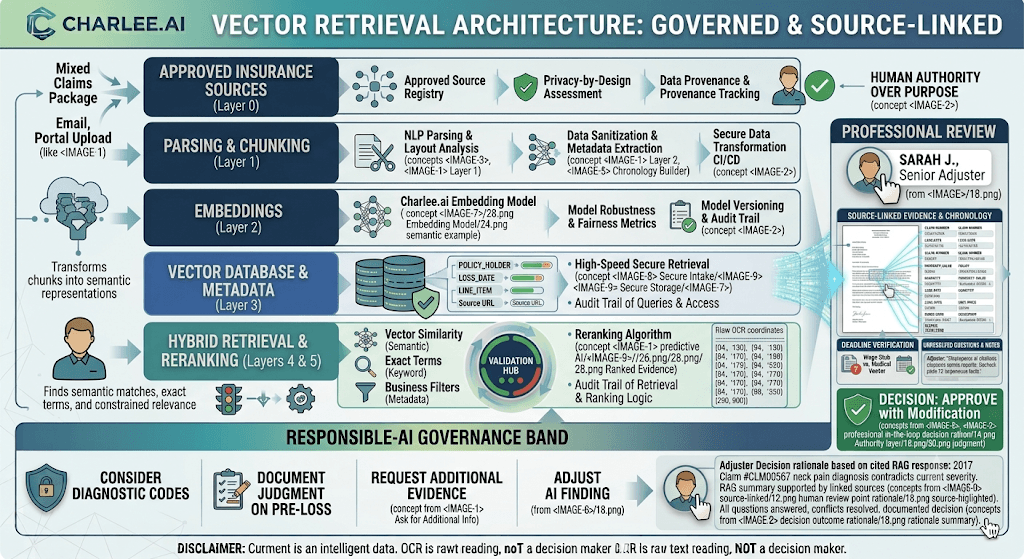
Source content is collected from approved systems such as claims platforms, document repositories, policy systems, underwriting workbenches, and knowledge bases.
Content is cleaned, parsed, segmented, and enriched with metadata.
An embedding model converts each segment or object into a numeric vector.
The vector database stores the vector together with source references, metadata, and optional payload content.
An index is built to make nearest-neighbor retrieval efficient.
A user query or application request is converted into a query vector.
The database retrieves semantically similar candidates, often with filters for permissions, line of business, jurisdiction, date, policy, claim, or document type.
A ranking or reranking layer orders the candidates.
The application presents the results, uses them as context for RAG, or passes them to another governed workflow.
Feedback and monitoring are used to improve retrieval quality over time.
Important distinction The vector database does not inherently understand insurance obligations, determine coverage, establish liability, set reserves, or approve underwriting terms. It retrieves potentially relevant content for use by governed applications and qualified professionals.
Core Components
| Component | Purpose | Insurance Example |
|---|---|---|
| Embedding model | Converts content and queries into vectors. | Representing medical reports, claim notes, policy provisions, or loss-control narratives. |
| Vector store | Persists vectors and associated payloads. | Storing document chunks linked to a claim, policy, submission, or legal matter. |
| Index | Supports efficient similarity search. | Finding relevant passages across millions of pages within operational response times. |
| Metadata layer | Supports filters, lineage, scope, and permissions. | Restricting results by claim, jurisdiction, line, document type, user role, or effective date. |
| Retriever | Defines how candidates are selected. | Combining semantic similarity with keyword matching and business filters. |
| Reranker | Improves result ordering. | Prioritizing passages that best answer a coverage or medical-summary question. |
| Application layer | Uses retrieved content in a workflow. | Claims assistant, underwriting workbench, litigation monitor, or enterprise search experience. |
| Evaluation layer | Measures quality and operational performance. | Tracking relevant-result recall, citation support, latency, and access-control integrity. |
Vector Indexing and Similarity Search
Exact vs. Approximate Search
Exact nearest-neighbor search compares a query vector with every stored vector. It can provide precise results but may become computationally expensive at scale. Approximate nearest-neighbor methods trade a small amount of theoretical exactness for major improvements in speed and scalability.
Common Index Families
| Index Approach | Strengths | Trade-Offs | Insurance Consideration |
|---|---|---|---|
| Flat / brute-force | Simple and exact. | Slow at large scale. | Useful for small collections, testing, or high-precision benchmarks. |
| HNSW graph | High recall and low-latency retrieval. | Can require substantial memory. | Strong fit for interactive claim and underwriting search. |
| IVF-based indexes | Efficient for large datasets. | Requires tuning and can reduce recall. | Useful where cost and scale are significant concerns. |
| Product quantization | Reduces storage and memory. | May reduce fidelity. | May be appropriate for very large historical corpora with careful validation. |
| Disk-based ANN | Supports large indexes beyond memory. | Potentially higher latency. | Useful for archives or broad enterprise retrieval where speed targets permit. |
Similarity Measures
- Cosine similarity compares vector direction and is common for text embeddings.
- Dot product may be used when the embedding model is trained for that scoring method.
- Euclidean distance measures geometric distance between vectors.
- The correct measure should match the embedding model and evaluation design.
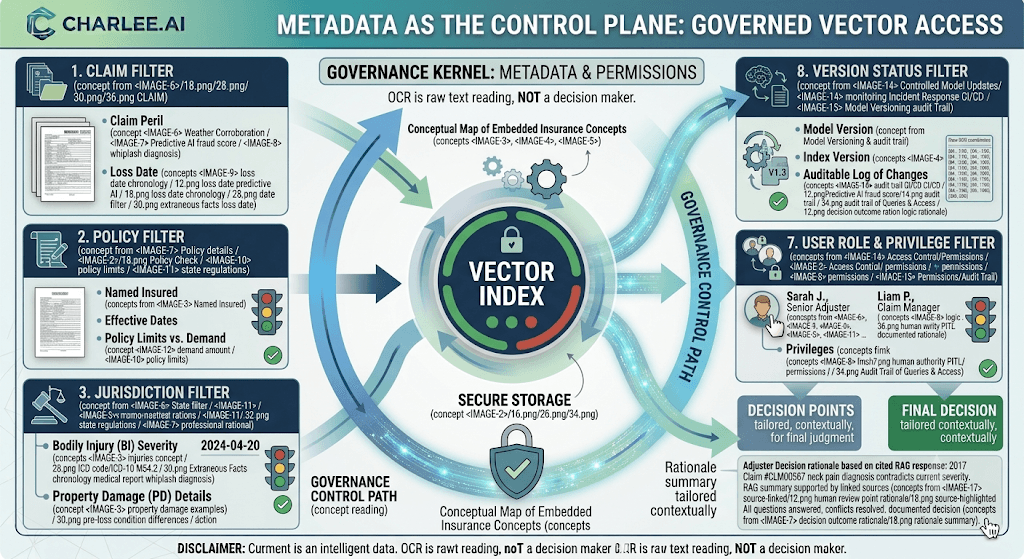
Metadata: The Control Plane of Retrieval
Similarity alone is rarely sufficient for an enterprise insurance application. Metadata provides the control plane that limits, narrows, and explains retrieval.
| Metadata Category | Examples | Why It Matters |
|---|---|---|
| Identity | Claim number, policy number, submission ID, account ID. | Prevents cross-record leakage and supports record-specific retrieval. |
| Business context | Line of business, jurisdiction, coverage, cause of loss. | Improves relevance and permits business-specific retrieval strategies. |
| Document context | Document type, author, date, page, section, source system. | Supports citation, lineage, freshness, and result interpretation. |
| Security | User role, legal privilege, confidentiality class, tenant, region. | Protects restricted or privileged information. |
| Lifecycle | Effective date, expiration date, superseded flag, retention status. | Prevents stale or obsolete content from being treated as current. |
| Quality | OCR confidence, extraction confidence, review status. | Allows low-quality content to be filtered or handled differently. |
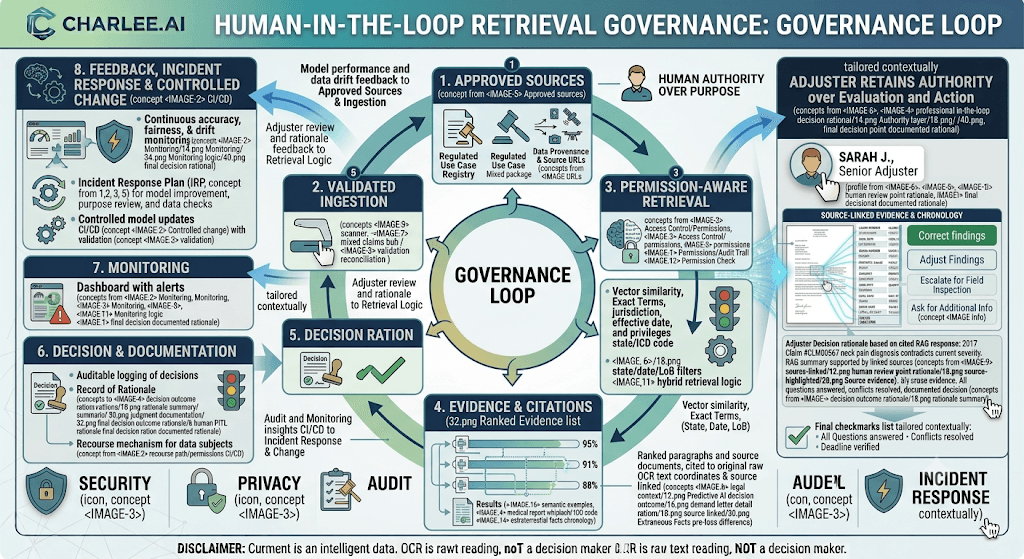
Governance principle A strong vector retrieval solution should fail closed on permissions. Users and applications should never retrieve content they are not authorized to access, even when that content is semantically similar.
Hybrid Search and Reranking
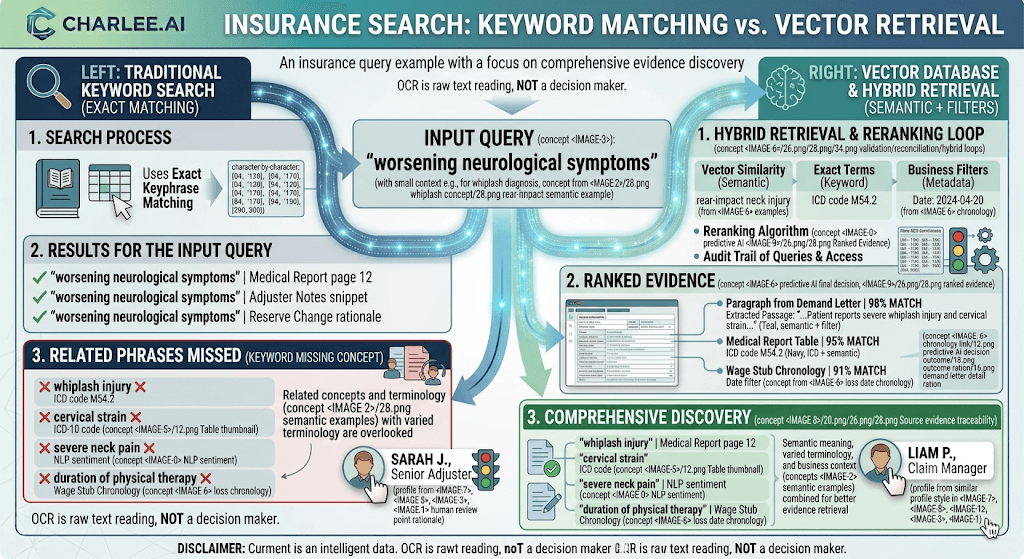
Insurance retrieval often performs best when semantic search is combined with exact keyword matching, metadata filtering, and domain-specific ranking.
| Technique | Role | Illustrative Use |
|---|---|---|
| Vector search | Find conceptually related content. | Find reports discussing escalating neurological symptoms even when terminology varies. |
| Keyword search | Find exact names, codes, provisions, or phrases. | Locate a specific policy endorsement, statute, procedure code, or attorney name. |
| Metadata filtering | Restrict the candidate set. | Search only within a claim, jurisdiction, policy period, or approved knowledge collection. |
| Business rules | Apply domain constraints. | Prioritize current policy forms or exclude superseded guidance. |
| Reranking | Reorder candidates for the question. | Move the most directly supporting passage above broadly related material. |
Hybrid retrieval reduces the risk that a semantically related result will outrank a more authoritative exact match. It also helps insurers preserve terminology, identifiers, and regulatory precision.
Applications Across the P&C Value Chain
| Workflow | Vector Database Application | Potential Value |
|---|---|---|
| FNOL and intake | Retrieve similar losses, prior reports, and relevant guidance. | Faster triage and more complete initial context. |
| Claims investigation | Search notes, statements, reports, and evidence by meaning. | Reduced review time and improved issue identification. |
| Medical review | Locate similar injury patterns, treatments, and escalation indicators. | Better access to relevant medical context. |
| Litigation monitoring | Retrieve pleadings, demands, legal themes, and comparable matters. | Earlier visibility into litigation complexity. |
| Property claims | Match damage descriptions, estimates, photographs, and repair patterns. | Improved document and image retrieval. |
| Underwriting intake | Find comparable submissions, appetite guidance, and prior decisions. | Faster submission review and consistent context. |
| Policy research | Retrieve relevant forms, endorsements, and guidance. | More efficient access to approved coverage sources. |
| Subrogation | Identify similar recovery scenarios and supporting evidence. | Earlier recognition of recovery opportunities. |
| Fraud investigation | Find similar documents, narratives, images, or network patterns. | Additional leads for professional investigation. |
| Knowledge management | Create semantic access to approved enterprise guidance. | Improved reuse of institutional knowledge. |
Claims Case Study: Complex Bodily Injury Review
Business Situation
A claims organization manages a large bodily injury inventory. Relevant information is distributed across adjuster notes, medical records, demand packages, reserve history, legal correspondence, and prior claim files. Keyword searches frequently miss conceptually similar developments because terminology varies across providers, attorneys, and adjusters.
Vector Retrieval Design
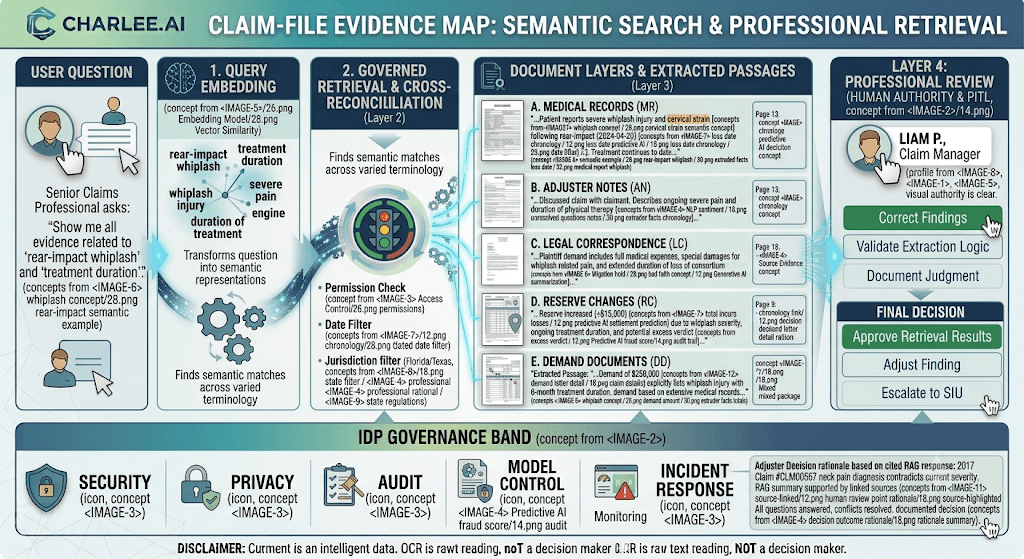
Approved claim documents and notes are parsed into source-linked segments.
Each segment receives metadata for claim, document type, date, author, jurisdiction, injury category, and access classification.
Embeddings are generated and stored in a vector database.
An adjuster or claims manager submits a question such as, “What evidence suggests the injury trajectory is worsening?”
The retriever combines semantic search, claim-level filters, keyword constraints, and date weighting.
A reranker prioritizes passages directly supporting the question.
The application presents source-linked evidence for professional review and documentation.
Potential Benefits
- Reduced manual review of large claim files.
- Faster identification of relevant medical and legal developments.
- Improved consistency in management reviews.
- Stronger traceability because each result links back to the source.
Required Controls
- Claim-level and role-based access controls.
- Protection of health, legal, and personally identifiable information.
- Freshness and version controls.
- Evaluation against representative claim questions.
- Clear separation between retrieved evidence and final claim decisions.
Underwriting Case Study: Commercial Submission Workbench
Business Situation
A commercial underwriting team receives submissions containing applications, schedules, loss runs, financial statements, inspection reports, broker narratives, and attachments. Underwriters need to find comparable accounts, prior decisions, appetite guidance, and relevant policy considerations without manually searching across disconnected systems.
Vector Retrieval Design
Submission content is segmented and embedded. Metadata identifies account, industry, geography, coverage, document type, source, confidentiality level, and effective period. A retrieval service supports questions such as, “Find comparable accounts with similar operations, loss patterns, and construction characteristics,” or “Show the current appetite guidance relevant to this risk.”
Operating Model
| Stage | System Role | Underwriter Role |
|---|---|---|
| Intake | Extract, classify, embed, and index approved content. | Confirm submission completeness and material facts. |
| Retrieval | Find comparable risks, guidance, and supporting documents. | Assess relevance and differences. |
| Analysis | Summarize retrieved evidence and highlight gaps. | Apply underwriting judgment and request clarification. |
| Decision support | Present source-linked context. | Retain authority over selection, terms, pricing, and referral. |
| Documentation | Capture sources and rationale. | Approve the final record and disposition. |
Policy and Coverage Research Scenario
A coverage professional asks a system to locate relevant policy language for a scenario involving water intrusion, ensuing loss, and concurrent causes. The retriever should not simply return semantically similar text. It should apply filters for product, jurisdiction, edition, effective date, policy form, endorsement set, and approved guidance. Results should include source identifiers and page-level citations so the professional can verify the controlling language.
Coverage caution Vector similarity is not legal interpretation. Coverage analysis requires the actual policy, endorsements, applicable law, facts, and qualified professional judgment.
Deployment Patterns
| Pattern | Description | Advantages | Considerations |
|---|---|---|---|
| Managed cloud service | Vendor operates the platform. | Rapid deployment and lower operational burden. | Data residency, security, cost, portability, and vendor controls. |
| Cloud-native database extension | Vector search added to an existing cloud database. | Integration with existing data and controls. | May have limits on scale, indexing, or search features. |
| Search platform with vector support | Semantic and keyword search in one service. | Strong hybrid retrieval. | Architecture and licensing complexity. |
| Self-managed open source | Organization operates the database. | Control and customization. | Requires engineering, security, scaling, backup, and monitoring expertise. |
| Embedded / local index | Vector retrieval within an application or local environment. | Useful for smaller or constrained workloads. | Limited scale and enterprise governance capabilities. |
Architecture for an Insurance Retrieval Platform
Systems of record remain authoritative for policies, claims, billing, submissions, and documents.
A secure integration layer extracts only approved content.
Parsing and document intelligence create structured text, page references, tables, and metadata.
Chunking logic preserves meaningful insurance context.
Embedding services generate vectors under version control.
The vector database stores vectors, metadata, and source references.
Hybrid retrieval applies semantic search, lexical search, metadata filtering, permissions, and reranking.
Applications present evidence or pass it to a governed RAG workflow.
Logging, evaluation, feedback, and change control monitor the complete system.
Data Preparation and Chunking
A vector database can only retrieve what has been represented and indexed. Poor parsing or chunking can separate a coverage condition from its exception, disconnect a medical finding from its date, or mix unrelated sections of a document.
| Design Choice | Good Practice | Failure Mode |
|---|---|---|
| Chunk size | Use enough context to preserve meaning without burying relevance. | Chunks too small lose context; chunks too large dilute retrieval. |
| Overlap | Use selective overlap where continuity matters. | Excessive overlap creates duplicates and increases cost. |
| Structure awareness | Respect headings, sections, tables, page boundaries, and document types. | Arbitrary splits break logical units. |
| Source linkage | Preserve page, section, paragraph, and record identifiers. | Results cannot be verified or cited. |
| Metadata | Capture business and security context at ingestion. | Filtering and governance become unreliable. |
| Versioning | Track document and embedding versions. | Stale or superseded content remains active. |
Evaluation and Performance Metrics
Retrieval Quality
| Metric | Meaning | Insurance Interpretation |
|---|---|---|
| Recall@K | Share of relevant items found in the top K results. | Whether important claim, policy, medical, or underwriting evidence is surfaced. |
| Precision@K | Share of top K results that are relevant. | Whether professionals must sift through excessive noise. |
| Mean reciprocal rank | How high the first relevant item appears. | Whether the most useful source appears early. |
| nDCG | Measures ranking quality with graded relevance. | Whether highly relevant evidence is ordered above loosely related content. |
| Citation support rate | Share of outputs adequately supported by retrieved sources. | Whether downstream answers are grounded in evidence. |
| Authorization integrity | Whether unauthorized content is ever returned. | A non-negotiable security requirement. |
| Freshness | Whether current, effective, and non-superseded sources are retrieved. | Critical for policy, regulatory, and operational guidance. |
| Latency | Time to return useful results. | Affects adoption in live claims and underwriting workflows. |
Business Outcome Measures
- Reduction in document review time.
- Improvement in time to locate supporting evidence.
- Increase in source-linked responses.
- Reduction in duplicate research.
- Improvement in workflow completion time.
- User adoption and professional satisfaction.
- Reduction in retrieval-related errors or escalations.
Risks and Governance
| Risk | Why It Matters | Control |
|---|---|---|
| Unauthorized retrieval | Sensitive claim, health, legal, or customer information could be exposed. | Enforce permissions before and during retrieval; test fail-closed behavior. |
| Stale content | Superseded policy or guidance may be treated as current. | Use effective dates, version metadata, lifecycle rules, and reindexing. |
| Irrelevant similarity | Semantically related content may not be legally or operationally applicable. | Use filters, reranking, source labels, and professional review. |
| Embedding drift | Model changes can alter retrieval behavior. | Version embedding models and revalidate before migration. |
| Data leakage | Vectors or payloads may reveal sensitive information. | Encryption, tenant isolation, retention controls, and careful payload design. |
| Poor lineage | Users cannot verify where a result came from. | Preserve source identifiers, page references, and ingestion history. |
| Index inconsistency | Source changes may not be reflected promptly. | Use synchronization, deletion handling, reconciliation, and monitoring. |
| Vendor dependency | Proprietary features may complicate portability. | Define export, backup, abstraction, and migration requirements. |
| Cost growth | Storage, ingestion, query, and reranking costs can expand quickly. | Measure unit economics and apply lifecycle policies. |
| Overreliance | Users may treat retrieval as a decision. | Maintain clear human authority, review, and documentation requirements. |
Security, Privacy, and Regulatory Considerations
- Apply encryption in transit and at rest.
- Use tenant, account, claim, document, and role-level authorization where appropriate.
- Classify protected health information, personally identifiable information, legal privilege, and confidential business content.
- Keep source systems authoritative and synchronize deletions, corrections, and retention actions.
- Log queries, retrievals, administrative changes, and access-control decisions.
- Conduct privacy and security reviews of embedding models, hosted services, and cross-region processing.
- Limit payload content when a reference to the authoritative source is sufficient.
- Test for cross-claim, cross-customer, and cross-tenant leakage.
- Maintain incident response and controlled change procedures.
Implementation Blueprint
Define a narrow business problem and representative user questions.
Identify authoritative source systems and approved content scope.
Design security, privacy, retention, and data residency requirements before ingestion.
Choose parsing, chunking, metadata, and citation standards.
Select and benchmark embedding models using insurance-specific content.
Compare vector database options against scale, latency, filtering, operations, and governance needs.
Build a hybrid retrieval baseline rather than testing vector search in isolation.
Create a labeled evaluation set with subject-matter experts.
Measure retrieval quality, authorization integrity, freshness, latency, and business outcomes.
Pilot inside a human-reviewed workflow.
Add monitoring, feedback, versioning, and rollback capabilities.
Scale only after quality and control thresholds are met.
Build, Buy, or Extend an Existing Platform
| Decision Area | Questions |
|---|---|
| Strategic fit | Is vector retrieval a core differentiator or enabling infrastructure? |
| Scale | How many vectors, documents, tenants, and queries are expected? |
| Performance | What latency, recall, and availability targets are required? |
| Hybrid search | Are lexical search, filters, faceting, and reranking first-class requirements? |
| Security | Can the platform enforce required permissions and isolation? |
| Operations | Who will manage indexing, backup, disaster recovery, upgrades, and monitoring? |
| Portability | Can vectors, metadata, and source mappings be exported and migrated? |
| Economics | What are ingestion, storage, query, compute, and support costs at scale? |
| Ecosystem | Does the platform integrate with existing cloud, data, AI, and observability services? |
| Governance | Can the organization document, evaluate, and control changes across the retrieval system? |
Best Practices
- Start with an evidence-retrieval problem, not a technology purchase.
- Use authoritative and curated source collections.
- Preserve document structure, lineage, and page-level references.
- Combine semantic retrieval with keyword search, filters, and reranking.
- Keep permissions in the retrieval path rather than applying them after results are returned.
- Benchmark with real insurance questions and difficult edge cases.
- Version embeddings, indexes, metadata schemas, and evaluation sets.
- Design deletion, correction, and reindexing processes from the beginning.
- Monitor both technical quality and business outcomes.
- Keep insurance professionals responsible for interpretation and decisions.
Common Mistakes
| Mistake | Consequence | Better Approach |
|---|---|---|
| Indexing everything immediately | Noise, security exposure, and high cost. | Begin with a governed, high-value collection. |
| Ignoring metadata | Weak filtering, poor lineage, and access risk. | Treat metadata as a core design asset. |
| Using one chunking method for all documents | Loss of context and inconsistent quality. | Use structure-aware, document-specific strategies. |
| Evaluating only demo queries | Inflated confidence. | Use representative, adversarial, and failure-oriented tests. |
| Assuming vector search replaces exact search | Missed names, codes, and legal phrases. | Use hybrid retrieval. |
| Changing embedding models without migration planning | Inconsistent search behavior. | Version, re-embed, compare, and roll back if needed. |
| Failing to synchronize deletions | Retained or obsolete content remains retrievable. | Implement lifecycle and reconciliation controls. |
| Treating retrieved passages as conclusions | Potentially unsupported decisions. | Require source review and professional judgment. |
Executive Decision Guide
| Question | Green Light | Caution |
|---|---|---|
| Is there a high-value semantic retrieval problem? | Users repeatedly search large, unstructured collections. | The need is mainly exact structured reporting. |
| Are sources authoritative and governed? | Ownership, versions, permissions, and retention are defined. | Content is inconsistent, obsolete, or unowned. |
| Can quality be measured? | Representative questions and relevance judgments are available. | Success is defined only by a polished demo. |
| Can access be enforced? | Security filters are integrated and tested. | Permissions are applied only in the user interface. |
| Will professionals verify sources? | Workflow includes evidence review and documentation. | Outputs may be accepted without review. |
| Is lifecycle management funded? | Reindexing, deletion, monitoring, and change control are planned. | The project assumes a one-time ingestion. |
| Is the architecture composable? | The system can evolve across models, databases, and ranking layers. | The design creates unnecessary lock-in. |
Charlee.ai Perspective
For P&C insurers, vector databases are most valuable when they are embedded inside governed, insurance-specific workflows rather than exposed as a generic search utility. The database should help connect professionals with the right claim evidence, medical information, litigation developments, policy language, underwriting context, and enterprise guidance at the moment it is needed.
Charlee.ai’s responsible-AI philosophy emphasizes that retrieval is an evidence service—not a substitute for professional authority. The strongest solutions combine high-quality data preparation, insurance-aware metadata, semantic and keyword retrieval, source-level explainability, human review, documented decisions, monitoring, and controlled change.
People-plus-AI principle Vector retrieval should reduce the effort required to find and organize evidence so claims, underwriting, legal, medical, and management professionals can apply their expertise more effectively.
Key Takeaways
- Vector databases make embeddings operational by storing, indexing, and retrieving semantically similar content.
- Their insurance value comes from connecting professionals and AI systems with relevant evidence across large unstructured collections.
- Hybrid retrieval, metadata, permissions, reranking, and source lineage are as important as vector similarity.
- Vector databases complement—not replace—claims systems, policy systems, data platforms, document repositories, and enterprise search.
- Retrieval quality must be evaluated with insurance-specific questions, expert judgments, security tests, and business outcomes.
- Human review and professional authority remain essential for coverage, liability, reserve, underwriting, settlement, and other decisions.
- Governance must cover the full lifecycle: ingestion, embeddings, indexing, access, retrieval, monitoring, deletion, and controlled change.
In one sentence A vector database is a specialized data platform designed to store high-dimensional embeddings and quickly retrieve the most semantically similar records, passages, images, claims, policies, or other objects for use in AI applications.
Frequently Asked Questions
No. Traditional databases are optimized for structured queries, transactions, and exact relationships. Vector databases are optimized for similarity search across high-dimensional representations. They are commonly used together.
It can store text or payloads, but many enterprise designs store only selected content and source references while the authoritative document remains in the system of record.
Keyword search is essential for exact names, identifiers, codes, and phrases, but it may miss conceptually related content expressed in different language. Hybrid search combines both approaches.
It is a family of indexing methods that retrieves highly similar vectors efficiently without comparing the query to every vector in the database.
They depend on the use case, but common fields include source ID, record ID, document type, date, jurisdiction, line of business, user-access classification, version, and page or section reference.
Yes. Image embeddings can support visually similar damage, document, or scene retrieval. Multimodal models can also connect text and images.
No. It can improve grounding by retrieving source material, but poor retrieval, weak prompts, model behavior, or misuse can still produce unsupported output.
Use representative insurance questions, expert relevance judgments, recall and ranking metrics, source-support testing, permission tests, freshness checks, and workflow outcome measures.
Vectors may need to be regenerated because embedding spaces are not generally interchangeable. The migration should be versioned, benchmarked, and reversible.
Potentially. Vectors and associated payloads should be treated as sensitive data and protected with encryption, access controls, isolation, retention rules, and testing.
The ingestion pipeline should propagate deletions and corrections to the vector index, verify completion, and reconcile the index against the source system.
Hybrid search combines vector similarity with lexical search, metadata filters, business rules, and often reranking.
Reranking uses an additional model or scoring layer to reorder retrieved candidates based on how well they answer the specific question.
No. Content should be selected based on business value, authority, quality, permissions, retention, and risk.
No. A document management system remains responsible for authoritative storage, versioning, retention, and workflow. The vector database provides a retrieval index.
They retrieve relevant source passages that are supplied as context to a generative model, usually together with citations and instructions.
Treating the database as the solution by itself. Retrieval quality depends on the complete system, including data preparation, embeddings, metadata, permissions, ranking, evaluation, and workflow design.
Qualified insurance professionals and the organization remain accountable. A vector database supports evidence retrieval; it does not assume decision authority.