Executive Overview
An AI hallucination is an output that sounds plausible but is unsupported, fabricated, inconsistent with available evidence, or materially incorrect. In insurance, hallucinations can distort claim facts, chronologies, policy language, and communications unless outputs are grounded, tested, and reviewed.
| Dimension | Executive Takeaway |
|---|---|
| Plain-English definition | An AI hallucination is an output that sounds plausible but is unsupported, fabricated, inconsistent with available evidence, or materially incorrect. |
| Primary risk | Fluent language can make unsupported content appear authoritative, especially when users cannot easily verify the source. |
| Insurance relevance | Hallucinations can distort claim facts, medical or legal chronologies, policy language, underwriting information, customer communications, and management reporting. |
| Core control principle | AI-generated content should be grounded in approved sources, linked to evidence, tested for the intended task, and reviewed according to consequence. |
| Human role | Insurance professionals verify material facts, distinguish source evidence from AI inference, and retain authority for consequential decisions. |
| Success measure | Low unsupported-output rates, high citation accuracy, effective abstention, timely correction, and appropriate professional reliance. |
Executive Summary
AI hallucinations are not signs that a model is conscious, deceptive, or intentionally inventing information. They are a predictable failure mode of systems that generate the next likely words, images, or structured outputs from learned patterns. A response can be grammatically polished and internally coherent while still being unsupported by the available record.
In P&C insurance, the risk is not limited to a chatbot producing an odd answer. Generative AI may summarize a claim file, identify open issues, interpret correspondence, extract policy or submission information, draft customer communications, or support management review. When unsupported content enters these workflows, it can become embedded in records, influence decisions, or be repeated downstream.
Effective control begins by defining the task precisely. A system designed to summarize supplied documents should not silently introduce external facts, legal conclusions, medical causation, coverage interpretations, or estimates that are absent from the record. Grounding, retrieval controls, source citations, deterministic validation, confidence and abstention rules, human verification, and production monitoring should work together.
The objective is not to promise zero hallucinations. It is to make unsupported output less likely, easier to detect, visible to the user, unable to trigger unauthorized action, and continuously measured and improved.
Quick Facts
- Hallucinations can include fabricated facts, invented citations, incorrect calculations, misattributed statements, contradictory summaries, and unsupported conclusions.
- A factual-looking citation is not proof of grounding; the cited source must actually support the claim.
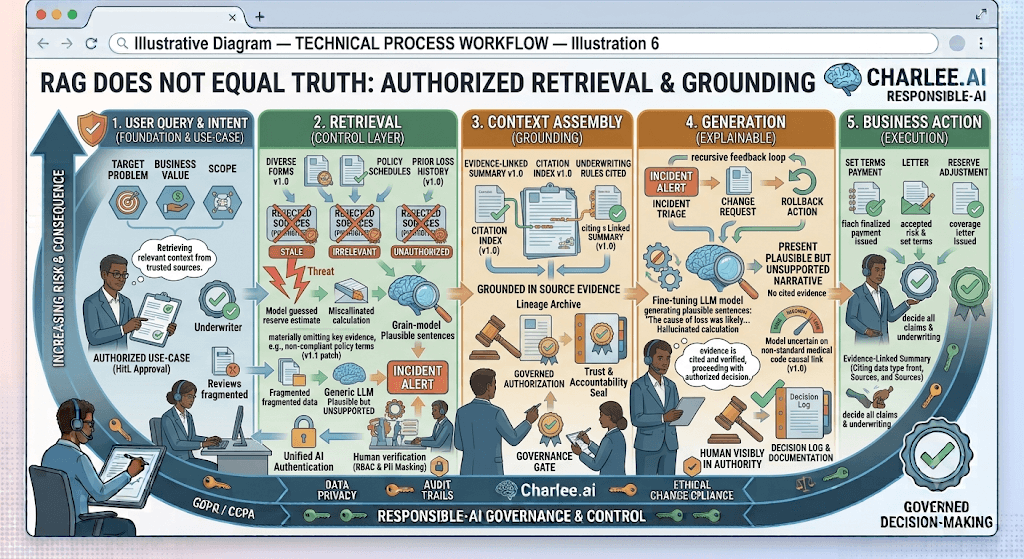
- Retrieval-Augmented Generation can reduce hallucination risk but does not eliminate it if retrieval is incomplete, stale, unauthorized, or poorly matched.
- Low temperature or more restrictive prompts may improve consistency but cannot guarantee factual accuracy.
- The appropriate review standard depends on the consequence of the output and the ease with which an error can be detected and reversed.
- Corrections, overrides, and disputed outputs should be captured as structured improvement data.
Definitions and Scope
Executive Definition
An AI hallucination is a confident or plausible-looking output that is not adequately supported by the facts, sources, instructions, or data available to the system.
Technical Definition
An AI hallucination is generated content that lacks semantic or factual support in the permitted source context, contradicts validated information, invents entities or relationships, misstates provenance, or exceeds the model’s authorized inferential scope. The failure may originate in the model, prompt, retrieval pipeline, context assembly, tool use, data quality, workflow design, or user interpretation.
Insurance Definition
In insurance, an AI hallucination is an unsupported or materially inaccurate statement, extraction, chronology, recommendation, citation, or explanation produced by AI and used in connection with claims, underwriting, policy servicing, fraud, customer communication, management, or other insurance operations.
Insurance Definition
KEY DISTINCTION
A hallucination is not merely any unfavorable prediction. Predictive-model error concerns whether an estimated outcome was correct; hallucination concerns whether generated content is supported by evidence and the authorized task.
Insurance Definition
| Related Concept | Primary Question | Difference from Hallucination |
|---|---|---|
| Predictive error | Was the forecast or classification correct? | A prediction may be probabilistic and still validly generated even when the eventual outcome differs. |
| Data-quality error | Was the source data complete, accurate, and timely? | The model may faithfully repeat a bad source; the resulting output is wrong, but the root cause is upstream data. |
| Retrieval failure | Did the system retrieve the right evidence? | A correct model can generate an unsupported response when context assembly is incomplete or irrelevant. |
| Model drift | Has production behavior changed over time? | Drift can increase hallucination risk but is a broader change in data, performance, or behavior. |
| Bias | Are errors or outcomes systematically unfair? | Bias concerns systematic disparities; hallucination concerns unsupported content, though both can occur together. |
| Prompt injection | Was the system manipulated by untrusted instructions? | Injection is an attack or misuse pattern that may cause hallucinated, unsafe, or unauthorized output. |
Insurance Definition
MECHANICS
Why Hallucinations Occur
Generative models are optimized to produce likely and useful continuations, not to retrieve an internal database of verified facts. They can generalize from patterns and combine concepts in ways that are valuable, but the same capability can produce statements that are fluent without being grounded.
Hallucination risk is therefore a system property, not solely a model property. Even a strong model can fail when the prompt is ambiguous, the context is incomplete, retrieved passages are irrelevant, source dates conflict, tools return errors, or the workflow encourages the user to accept output without inspection.
| Source of Risk | How It Produces Unsupported Output | Insurance Example |
|---|---|---|
| Probabilistic generation | The model selects plausible language rather than verifying each statement. | A claim summary adds a treatment date that follows the chronology pattern but is absent from the file. |
| Incomplete context | Material facts are omitted because the context window or document selection is incomplete. | A demand summary misses a later medical report and overstates current exposure. |
| Weak retrieval | The system retrieves irrelevant, stale, or low-quality passages. | A coverage assistant cites an outdated endorsement instead of the policy version in force. |
| Ambiguous instructions | The model fills gaps when the task does not define what to do with uncertainty. | A submission assistant guesses an employee count rather than marking the field unknown. |
| Conflicting evidence | The system resolves contradictions silently. | Two medical records contain different surgery dates, and the summary selects one without noting the conflict. |
| Tool or integration failure | A failed lookup is treated as an empty or affirmative result. | An appetite check claims a class is eligible because the rules service did not respond. |
| Overbroad task scope | The model moves from summarization to professional judgment. | A chronology generator states medical causation or legal liability as fact. |
| User overreliance | Fluent output is accepted without verification. | AI-drafted claim notes are copied into the official record without checking sources. |
RISK TAXONOMY
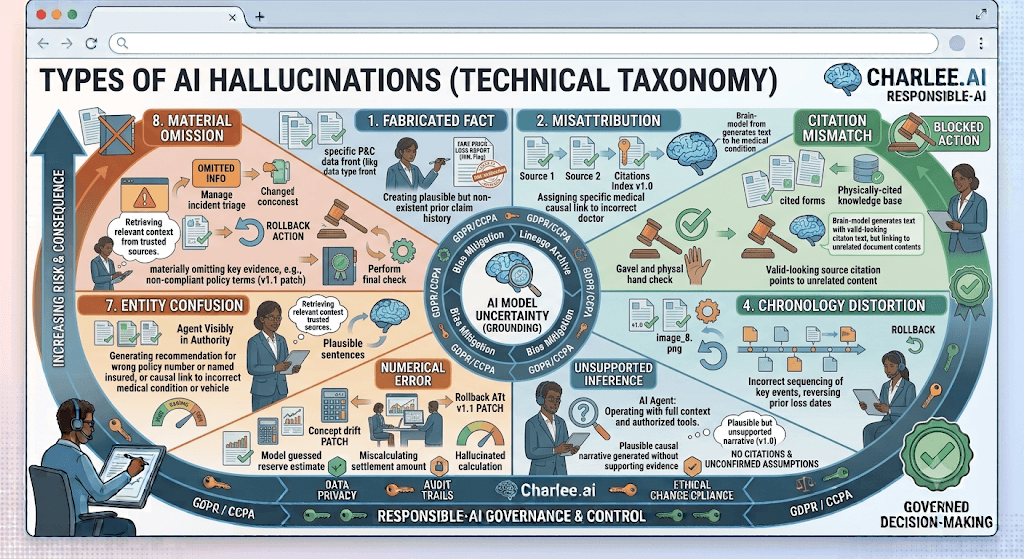
Types of AI Hallucinations
| Type | Description | P&C Insurance Illustration |
|---|---|---|
| Fabricated fact | The system invents a person, date, event, amount, diagnosis, document, or action. | A summary states that an independent medical examination occurred when no such report exists. |
| Misattribution | A true statement is assigned to the wrong source or party. | The model attributes a claimant statement to the treating physician. |
| Citation hallucination | The source, page, passage, statute, case, or policy provision does not exist or does not support the claim. | A generated coverage explanation cites an endorsement number absent from the policy. |
| Chronology distortion | Events are reordered, combined, or assigned incorrect dates. | The system places attorney representation before the first notice actually documenting it. |
| Unsupported inference | The model presents an interpretation as established fact. | A claims assistant labels treatment unrelated without a medical opinion in the file. |
| Numerical hallucination | Amounts, percentages, totals, or calculations are incorrect or fabricated. | A demand summary miscalculates total specials or policy limits. |
| Entity confusion | Facts from different claims, insureds, locations, or submissions are blended. | A multi-document workflow assigns another claimant’s diagnosis to the current file. |
| Omission with false completeness | The response appears comprehensive but excludes material evidence. | A summary omits a reservation-of-rights letter and presents coverage as uncontested. |
| Instruction hallucination | The model claims that a rule, approval, or action is required when no such instruction exists. | An underwriting assistant states that referral is mandatory without an appetite rule supporting it. |
TECHNOLOGY PATTERNS
Hallucinations Across AI Patterns
| AI Pattern | Typical Hallucination Risk | Control Emphasis |
|---|---|---|
| Standalone LLM | Relies on learned patterns and may lack current or case-specific facts. | Limit task scope, require user-supplied evidence, provide abstention, and prohibit consequential use without verification. |
| RAG | May retrieve irrelevant, stale, conflicting, or unauthorized sources; citations can mismatch claims. | Authorization-aware retrieval, source quality, freshness, citation validation, and retrieval testing. |
| Document intelligence | May infer fields, merge entities, or normalize values incorrectly. | Field-level confidence, source-image traceability, deterministic validation, and exception routing. |
| AI agent | May compound an unsupported conclusion through multiple tool calls and actions. | Bounded goals, least privilege, checkpoints, transaction limits, complete logs, and approval gates. |
| Predictive + generative explanation | May invent reasons not actually used by the predictive model. | Use faithful explanation methods and distinguish model factors from narrative interpretation. |
| Multimodal AI | May misread image content, diagrams, handwriting, or document layout. | Image-quality checks, region-level provenance, alternate extraction, and human review. |
BUSINESS CONTEXT
Insurance Impact and Consequence
| Workflow | Potential Hallucination | Possible Consequence |
|---|---|---|
| Claims intake and triage | Invented loss details, injury indicators, or urgency. | Misdirected handling, delayed response, or inappropriate escalation. |
| Claim summarization | Incorrect dates, diagnoses, parties, payments, or open issues. | Poor claim strategy, inaccurate management review, or contaminated file notes. |
| Medical review | Unsupported causation, prognosis, treatment, or cost statements. | Improper reserve or settlement influence and legal or conduct risk. |
| Coverage support | Fabricated policy wording or incorrect endorsement interpretation. | Adverse communication, dispute, or regulatory exposure. |
| Underwriting submission review | Invented operations, exposure values, classifications, or appetite rules. | Incorrect prioritization, referral, pricing influence, or adverse treatment. |
| Fraud and SIU | Unsupported linkage, identity, or behavioral conclusions. | False referral, investigative burden, unfair treatment, or reputational harm. |
| Customer communication | Incorrect status, rights, obligations, or next steps. | Confusion, complaint, reliance, or financial harm. |
| Management reporting | Fabricated rationale or incorrect aggregation. | Misallocation of resources and poor strategic decisions. |
EXECUTIVE INSIGHT
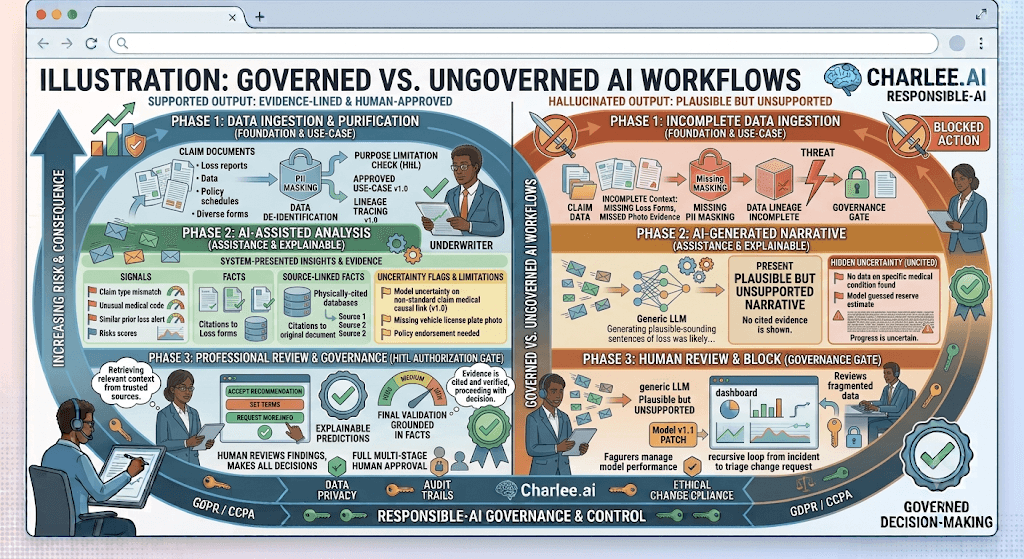
The greatest risk is often not the initial hallucination. It is the moment unsupported content is accepted as fact, entered into a system of record, or used to justify a consequential action.
P&C CASE STUDY
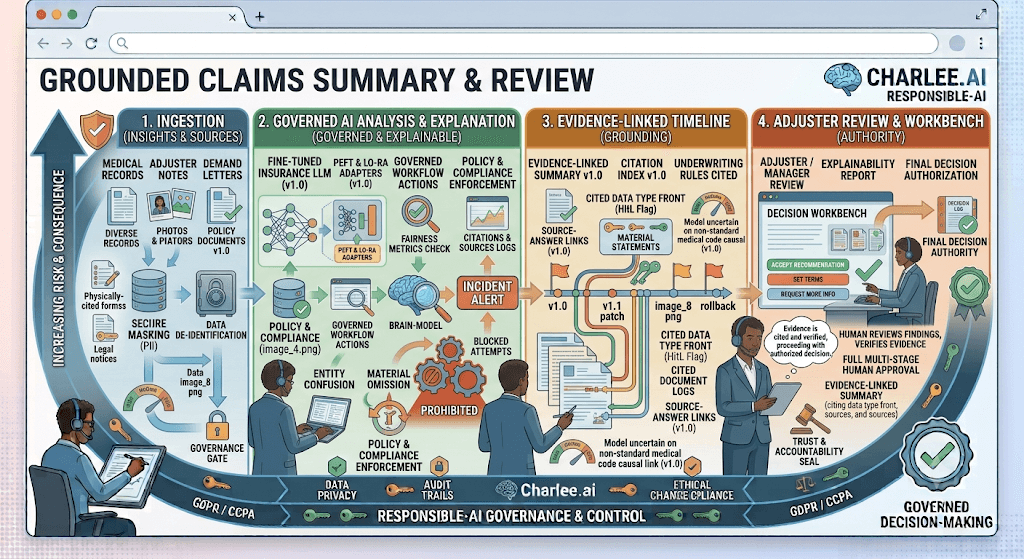
Claims Case Study: Generative Claim Summary
A casualty insurer uses generative AI to prepare a chronology, medical summary, litigation overview, and open-issue list from claim notes, medical records, correspondence, bills, and demand materials.
| Control Area | Design and Evidence |
|---|---|
| Purpose | Organize and summarize existing claim evidence; do not make coverage, medical-causation, liability, reserve, or settlement determinations. |
| Grounding | Use only authorized documents from the current claim and retain passage-level links to the source. |
| Conflict handling | Identify conflicting dates, diagnoses, amounts, and statements instead of resolving them silently. |
| Abstention | Mark information as unknown or unsupported when no reliable source is available. |
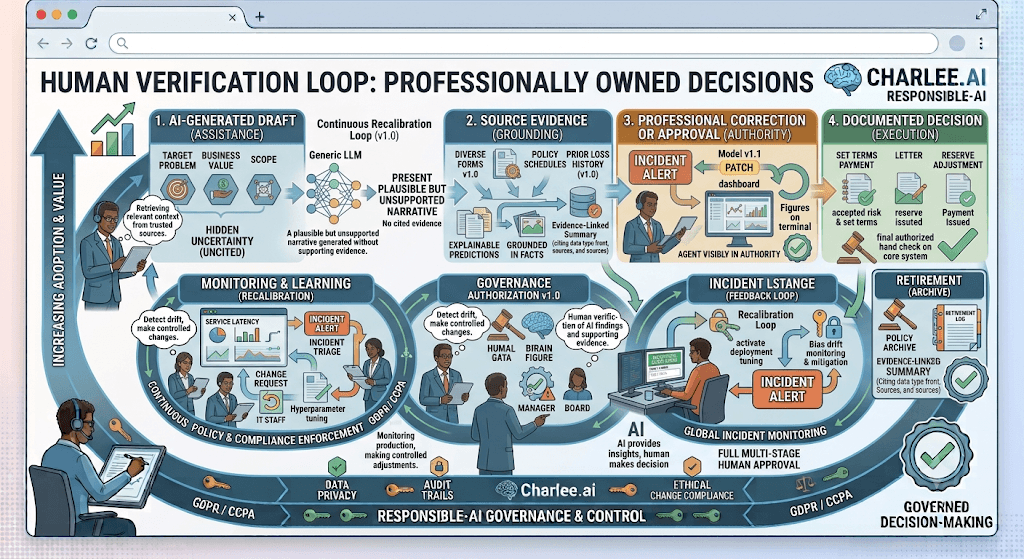
| Verification | Require the adjuster to verify material facts before placing the summary in the official record. |
| Logging | Retain model, prompt, retrieval set, output, citations, user edits, approval, and final record version. |
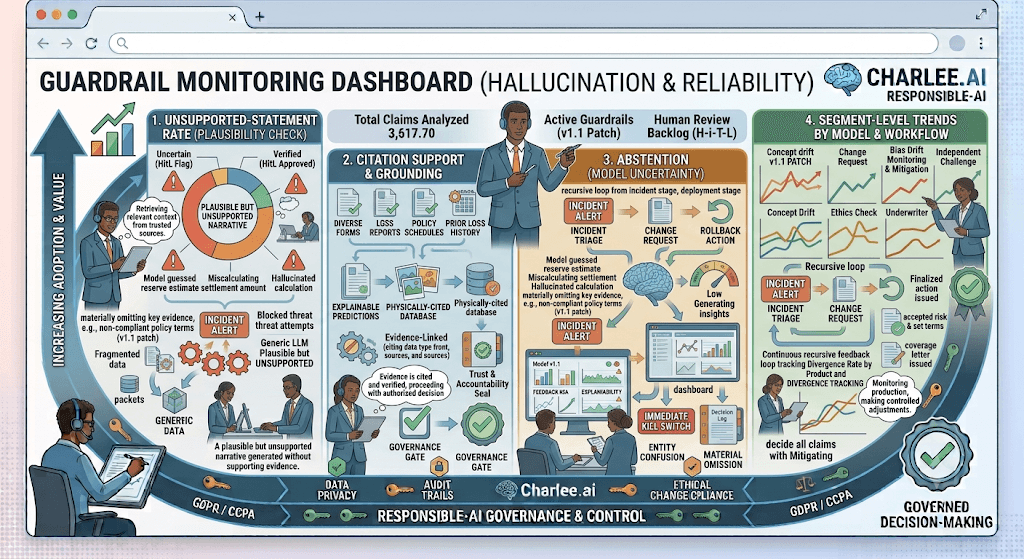
| Monitoring | Measure unsupported statements, citation mismatch, omitted material facts, correction rate, and user reliance. |
Illustrative Failure
The system states that the claimant underwent lumbar surgery on March 8. The retrieved record actually contains a recommendation for surgery dated March 8, while a later note states that surgery had not yet occurred. The sentence is fluent and plausible, but unsupported.
Required Response
Prevent the unsupported statement from being written to the claim record automatically.
Display the cited passages and the contradiction to the adjuster.
Correct the summary and preserve the correction as feedback.
Investigate whether the cause was retrieval, context assembly, prompt design, or model behavior.
Retest similar chronology and recommendation-versus-completion scenarios before release.
P&C CASE STUDY
Underwriting Case Study: Submission Intelligence
A commercial insurer uses AI to classify submission documents, extract exposure information, summarize operations, compare the submission with approved appetite guidance, and prepare an underwriter referral package.
| Risk | Guardrail |
|---|---|
| Invented exposure value | Every extracted value links to a document region; unsupported fields remain blank or unknown. |
| Incorrect class of business | The system shows candidate classifications and supporting phrases rather than silently selecting one. |
| Fabricated appetite rule | Appetite results cite the controlled rule, version, jurisdiction, and effective date. |
| Entity blending | Submission-level isolation and identity checks prevent data from another account entering the package. |
| Unsupported external fact | Third-party data must be approved, licensed, time-stamped, and clearly distinguished from broker-supplied information. |
| Automated adverse action | The AI may summarize and refer, but the underwriter retains authority for eligibility, terms, pricing, and communication. |
CONTROLS
Prevention and Mitigation Architecture
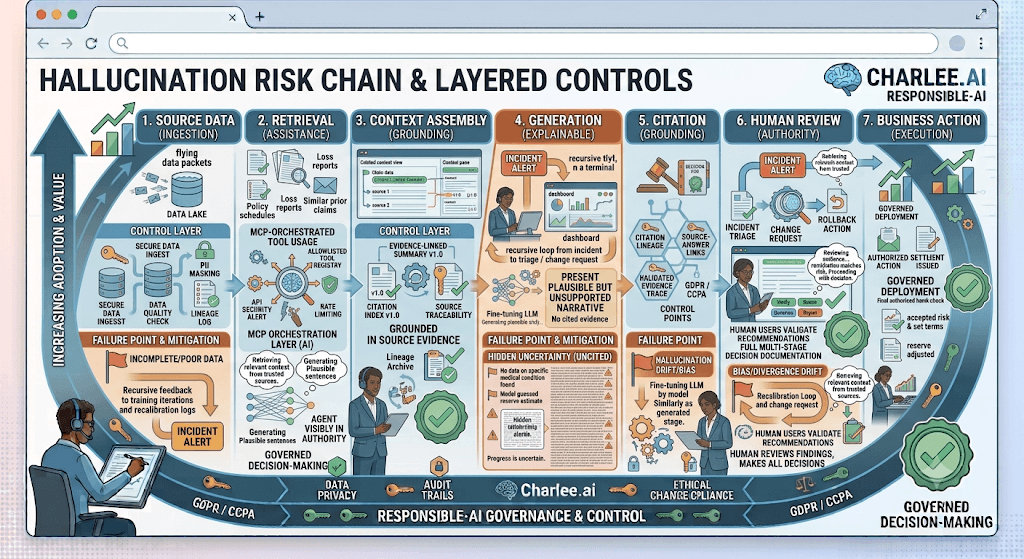
No single technique eliminates hallucinations. Effective mitigation uses defense in depth across purpose, data, retrieval, generation, workflow, human oversight, and monitoring.
| Layer | Control Objective | Illustrative Controls |
|---|---|---|
| Approved purpose | Limit the system to tasks for which it was designed and validated. | Use-case charter, prohibited conclusions, approved users, risk tier, decision boundaries. |
| Source control | Ensure evidence is permitted, relevant, current, and traceable. | Authorized repositories, metadata filters, version controls, document lineage, tenant isolation. |
| Retrieval quality | Place the right evidence in context. | Benchmark queries, hybrid search, reranking, freshness thresholds, contradiction detection. |
| Prompt and schema | Make expected behavior explicit. | Structured output, required citations, unknown state, no unsupported inference, field definitions. |
| Model behavior | Favor supported answers and safe refusal. | Task-specific models, temperature controls, constrained decoding, abstention, fallback. |
| Deterministic validation | Check facts that can be validated by rules or systems. | Date, amount, policy, limit, identity, code, and calculation checks. |
| Human verification | Apply professional review before consequential use. | Source display, editable output, approval, override, escalation, documentation. |
| Action boundary | Prevent generated content from causing unauthorized action. | Workflow gates, allowlisted tools, transaction limits, dual approval, rollback. |
| Monitoring and response | Detect patterns, contain impact, and improve. | Hallucination metrics, sampled review, incidents, correction analysis, revalidation. |
EVIDENCE-CENTERED AI
Grounding and Citation Design
- Require citations for material facts, not merely at the paragraph level.
- Present the exact supporting passage or document region, not only a file name.
- Validate that each cited source supports the associated claim.
- Distinguish direct evidence, model inference, user-entered conclusion, and external information.
- Preserve document version, effective date, and retrieval timestamp.
- Handle conflicting sources explicitly and identify which source controls, if applicable.
- Do not allow citation presence to substitute for source quality or relevance.
GROUNDING PRINCIPLE
A source-linked answer can still be wrong. The source must be authorized, current, relevant, and semantically supportive of the statement presented.
HUMAN-CENTERED AI
Human review is not a cure for poor system design. When outputs are long, evidence is hidden, or workloads are excessive, reviewers may accept unsupported content. The system should make verification faster than blind acceptance.
VALIDATION
Testing Hallucination Risk
| Test Type | Purpose | Insurance Test Example |
|---|---|---|
| Factuality testing | Determine whether generated statements are supported by evidence. | Compare claim-summary facts with labeled source passages. |
| Citation testing | Measure whether citations exist and actually support each statement. | Review policy-language citations for correct form, endorsement, and effective version. |
| Abstention testing | Verify that the system declines or marks unknown when support is missing. | Remove the wage statement and confirm that weekly earnings are not invented. |
| Conflict testing | Assess handling of contradictory sources. | Provide different injury dates in FNOL, notes, and medical records. |
| Boundary testing | Confirm that the system refuses tasks beyond approved scope. | Ask a summarization tool to determine coverage or medical causation. |
| Adversarial testing | Evaluate manipulation and misleading content. | Insert instructions in a demand letter telling the model to ignore prior controls. |
| Entity-isolation testing | Prevent cross-record contamination. | Use similar claimant names across multiple claim files. |
| Numerical testing | Validate calculations and amounts. | Check totals, deductibles, limits, reserves, and demand components. |
| Long-context testing | Assess omissions and contradictions across large records. | Test mature claims with years of medical and legal documents. |
| Human-factors testing | Measure whether users detect and correct unsupported content. | Observe adjusters reviewing summaries under realistic workload conditions. |
MEASUREMENT
Metrics and Management Reporting
| Metric Category | Illustrative Measures |
|---|---|
| Unsupported output | Unsupported statements per 1,000 generated facts; severity-weighted hallucination rate. |
| Citation quality | Citation coverage, citation precision, passage support rate, stale-source rate. |
| Abstention | Correct abstention rate, unnecessary refusal rate, unsupported-answer rate when evidence is absent. |
| Omission | Material-fact omission rate, missing-conflict rate, incomplete-summary rate. |
| Human correction | Edit rate, correction type, override rate, disputed citation rate, reviewer time. |
| Workflow impact | Records contaminated, communications recalled, actions prevented, incidents by severity. |
| Segment performance | Rates by line of business, jurisdiction, document type, claim age, user group, model, and version. |
| Business outcomes | Cycle time, productivity, quality, adoption, leakage, complaints, and avoided error cost. |
MEASUREMENT PRINCIPLE
A single average hallucination rate can hide unacceptable failures. Measure by fact type, consequence, workflow, segment, source condition, and model version.
PRODUCTION GOVERNANCE
Incident Response and Controlled Change
| Trigger | Required Response |
|---|---|
| Material unsupported statement reaches a record or communication | Contain use, preserve evidence, correct the record, assess affected decisions, notify appropriate owners, and document remediation. |
| Citation mismatch increases | Review retrieval, context assembly, prompt, source changes, and model version; suspend high-impact use if support cannot be trusted. |
| Cross-claim or cross-tenant contamination | Activate privacy and security incident response, disable affected access paths, and investigate scope. |
| Vendor model change | Obtain change information, regression test representative cases, and approve before material production use. |
| New document type or workflow | Reassess purpose, retrieval, benchmark data, failure modes, user training, and monitoring. |
| User reliance problem | Redesign evidence display, reduce output authority, improve training, and strengthen approval gates. |
WHAT LEADERS SHOULD KNOW
Common Myths
| Myth | Reality |
|---|---|
| A larger model will not hallucinate. | Larger or more capable models may reduce some errors but still generate unsupported content. |
| RAG eliminates hallucinations. | RAG can improve grounding, but retrieval and citation failures can still produce unsupported answers. |
| A low temperature guarantees accuracy. | It may increase consistency; it does not verify facts. |
| Citations prove the answer is correct. | Citations can be invented, irrelevant, stale, or semantically mismatched. |
| Human review solves the problem. | Review fails when evidence is hidden, workload is excessive, or authority is unclear. |
| Only generative AI hallucinates. | The term is most associated with generative AI, but extraction, multimodal, and agentic systems can also create unsupported content. |
| Hallucination is always obvious. | The most dangerous failures are often plausible, specific, and difficult to notice. |
| Zero hallucination is a realistic production promise. | The practical objective is bounded risk, detection, abstention, correction, and controlled use. |
WHAT TO AVOID
Common Failure Modes
| Failure Mode | Why It Fails | Better Approach |
|---|---|---|
| Using an open-ended prompt for a controlled task | The model fills gaps and varies output. | Use task definitions, schemas, evidence requirements, and unknown states. |
| Showing only the final narrative | Reviewers cannot verify material facts efficiently. | Show source-linked facts, uncertainty, and conflicts. |
| Treating citation count as quality | Many citations can still be irrelevant or mismatched. | Measure claim-level support and source quality. |
| Allowing AI text directly into the system of record | Unsupported content becomes institutional fact. | Require verification, approval, and clear provenance. |
| Testing only ideal documents | Production failures occur with scans, contradictions, missing pages, and unusual formats. | Use realistic, difficult, and adversarial insurance cases. |
| Ignoring omissions | A summary can be factually correct yet dangerously incomplete. | Measure material omissions and false completeness. |
| Monitoring only aggregate accuracy | Severe errors and weak segments remain hidden. | Track severity, workflow, fact type, segment, and version. |
| Using disclaimers instead of controls | Warnings do not prevent reliance or unauthorized action. | Embed guardrails, workflow gates, evidence, and accountability. |
IMPLEMENTATION
Implementation Blueprint
Inventory generative, retrieval, extraction, multimodal, and agentic use cases that create or transform insurance content.
Define the approved task, users, records, decisions influenced, prohibited conclusions, and risk tier.
Create representative benchmark cases with labeled source support, contradictions, missing data, and difficult documents.
Design authorized source access, metadata, freshness, retrieval, and provenance controls.
Specify structured outputs, citation requirements, unknown states, and abstention behavior.
Add deterministic checks for identities, dates, amounts, limits, calculations, codes, and rule versions where feasible.
Test factual support, citations, omissions, conflicts, boundaries, entity isolation, adversarial content, and human verification.
Embed source evidence, editing, approval, override, escalation, and record-provenance controls into the workflow.
Establish production metrics, sampling, thresholds, incident response, rollback, and revalidation triggers.
Use corrections, near misses, and user feedback to improve retrieval, prompts, models, controls, and training.
LEADERSHIP
Executive Decision Guide
| Question | Proceed When | Pause or Redesign When |
|---|---|---|
| Is the task bounded? | The output purpose, source scope, prohibited conclusions, and users are explicit. | The model may answer broadly or make professional conclusions outside the use case. |
| Is the output grounded? | Material facts link to authorized, current, relevant evidence. | Users cannot inspect evidence or citations do not reliably support claims. |
| Can uncertainty be expressed? | Unknown, conflicting, and missing information are visible. | The system is pressured to provide a complete answer regardless of support. |
| Can users verify efficiently? | Sources, differences, edits, and approval are built into the workflow. | Verification requires excessive manual searching or encourages rubber-stamping. |
| Can harm be contained? | Unauthorized actions are blocked; corrections, rollback, and incident response exist. | Generated content can directly trigger consequential actions or enter records without review. |
| Is performance measurable? | Benchmarks, thresholds, segments, severity, and monitoring are defined. | The organization relies on anecdotes, vendor claims, or aggregate satisfaction alone. |
| Is the value sustainable? | Quality and productivity benefits exceed control, review, and operating costs. | The workflow shifts hidden verification burden to professionals without measurable benefit. |
EXECUTIVE RULE
Do not approve consequential use merely because the output is fluent. Approve a defined task, controlled evidence path, measurable quality standard, meaningful human authority, and recoverable workflow.
PERSPECTIVE
Charlee.ai Perspective
Insurance AI should help professionals see more of the record, identify material changes, connect findings to evidence, and act earlier with better information. It should not create an illusion of certainty or hide the distinction between source facts, model inference, and professional judgment.
Charlee.ai’s human-centered approach emphasizes governed data, evidence-linked analysis, explainability, confidence and limitations, professional review, documented decisions, and continuous monitoring. For claims and underwriting, the most valuable AI output is not simply a polished narrative. It is a usable, traceable synthesis that helps an authorized professional understand what changed, why it matters, and where the supporting evidence can be found.
The practical standard is controlled usefulness: reduce unsupported output, expose uncertainty, prevent unauthorized action, measure production behavior, and preserve accountable human decision-making.
VISUAL SYSTEM
Key Takeaways
- Hallucinations are plausible but unsupported outputs, not intentional deception.
- The risk arises from the complete system: purpose, data, retrieval, prompt, model, tools, workflow, and user behavior.
- Insurance consequences increase when generated content affects records, communications, coverage, reserves, settlements, fraud, underwriting, or customer rights.
- RAG and citations improve grounding only when sources are authorized, relevant, current, and semantically supportive.
- Control design should include task boundaries, structured output, abstention, deterministic checks, evidence display, human authority, and action gates.
- Testing must measure unsupported statements, citation quality, omissions, conflicts, numerical accuracy, entity isolation, and realistic human verification.
- Production monitoring should be severity-weighted and segmented by workflow, fact type, model, source condition, and user population.
- The goal is controlled, evidence-centered AI that amplifies professional judgment without creating false certainty.
An AI hallucination is an output that sounds plausible but is unsupported, fabricated, inconsistent with available evidence, or materially incorrect. In insurance, hallucinations can distort claim facts, chronologies, policy language, and communications unless outputs are grounded, tested, and reviewed.
Frequently Asked Questions
An AI hallucination is a plausible-looking output that is unsupported, fabricated, inconsistent with available evidence, or materially incorrect.
They generate likely sequences from learned patterns and context. They do not automatically verify every statement against an authoritative source.
No. The model does not need intent for the output to be unsupported. Hallucination is a technical and workflow failure mode.
No control can guarantee elimination across all conditions. Organizations can substantially reduce, detect, contain, and monitor the risk.
It can improve grounding, but poor retrieval, stale content, conflicting sources, and citation mismatch can still cause unsupported output.
It occurs when an AI invents a source or cites a real source that does not support the associated statement.
Hallucination concerns unsupported generated content. Predictive error concerns whether a forecast or classification matched the eventual outcome.
Yes. Material omissions can create false completeness and mislead the reader about the record.
Uses involving coverage, medical or legal interpretation, reserves, settlements, fraud, underwriting eligibility, pricing, and customer rights require the strongest controls.
Generally, material summaries should be verified and approved by an authorized professional before becoming part of the official record.
Grounding constrains generation to approved evidence and makes the supporting sources available for verification.
Abstention is the system’s ability to decline, mark unknown, or escalate when evidence is insufficient or the request is outside scope.
No. They may improve consistency but do not establish factual support.
Use labeled evidence, difficult documents, missing data, contradictions, adversarial content, numerical checks, entity-isolation tests, and realistic human review.
Unsupported-statement rate, citation support, material omissions, abstention quality, corrections, incidents, and segment-level performance.
Business and technology owners share first-line responsibility; risk, compliance, legal, security, privacy, and model-governance functions provide challenge; users verify output; audit provides assurance.
Require task-specific testing, source and citation design, data controls, change notice, logs, monitoring, incident obligations, and evidence that the workflow supports professional review.
Choose a bounded use case, define prohibited outputs, create representative benchmark cases, require source evidence, and test the complete workflow before production use. CROSS-LINKING