Executive Snapshot
In one sentence An AI agent is a software system that can interpret a goal, plan and execute permitted actions with tools and data, evaluate progress, and involve a person when judgment, approval, or an exception is required.
| Business problem | Agent capability | Insurance workflow | Potential outcome |
|---|---|---|---|
| Work is fragmented across documents, systems, queues, and follow-ups. | Coordinates multi-step tasks using approved tools. | Claims, underwriting, service, compliance, and operations. | Faster cycle time and fewer handoff failures. |
| Professionals spend time gathering context before making decisions. | Retrieves, organizes, and summarizes relevant information. | Claim review, submission triage, portfolio monitoring. | More time for judgment and customer engagement. |
| Important events can be missed between periodic reviews. | Monitors defined triggers and escalates exceptions. | Reserve changes, litigation developments, documentation gaps. | Earlier intervention and stronger control. |
| Automation can become opaque or overextended. | Operates within permissions, evidence requirements, and approval gates. | Governed enterprise deployment. | Traceable actions and controlled risk. |
Executive decision point Treat AI agents as governed digital workflow participants, not independent decision makers. Start with bounded tasks, explicit authority, complete audit trails, and human approval for consequential insurance decisions.
Executive Summary
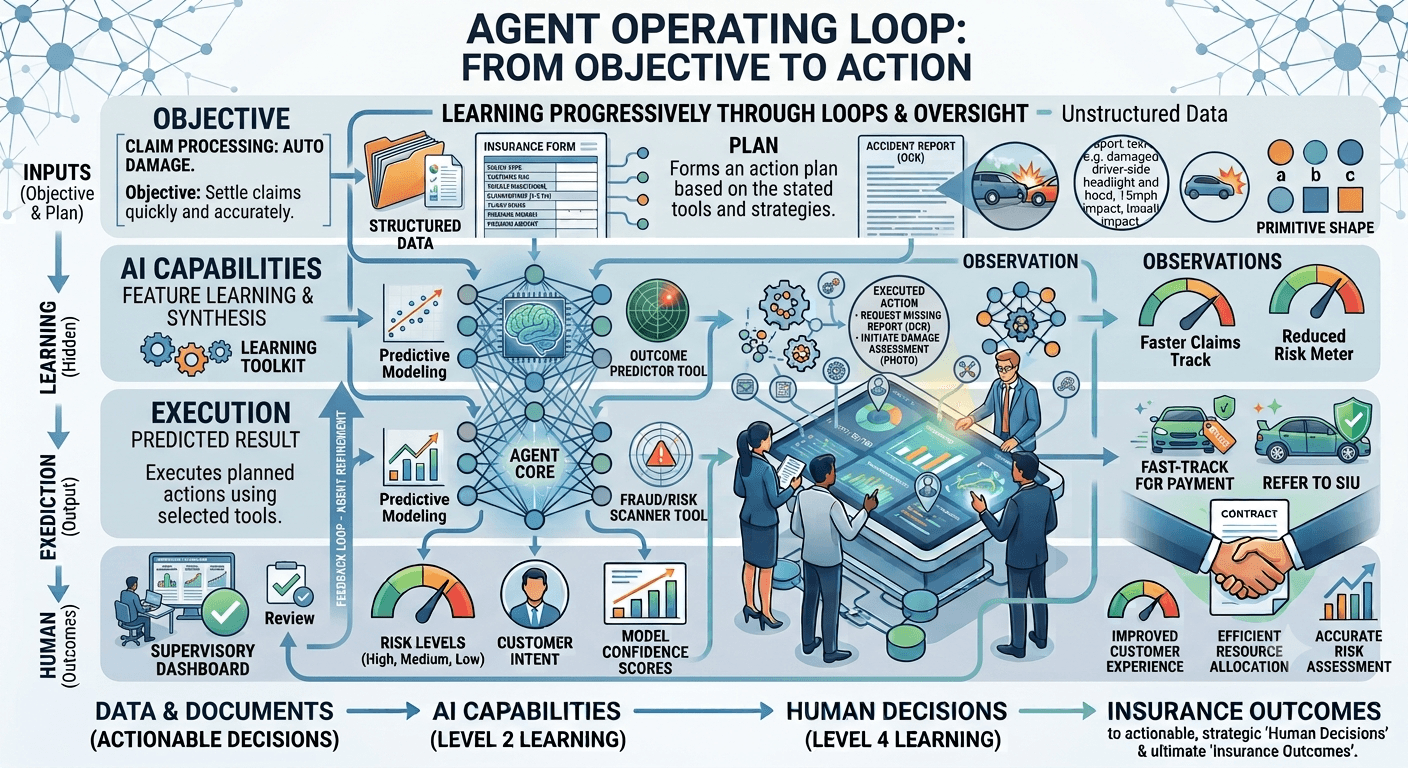
AI agents represent an important evolution in enterprise artificial intelligence. Instead of only producing a prediction or answering a prompt, an agent can work toward a defined goal by gathering information, selecting from approved tools, completing a sequence of actions, checking results, and escalating when conditions fall outside its authority.
For Property & Casualty insurers, this capability can reduce friction in document-intensive and coordination-heavy workflows. An agent may assemble a claim review package, identify missing information, draft a chronology, schedule a follow-up task, update an approved work queue, or notify a supervisor when a threshold is crossed. In underwriting, an agent may gather submission materials, validate completeness, summarize exposures, compare information with appetite guidance, and prepare a referral package for an underwriter.
The value is not autonomy for its own sake. The value is disciplined orchestration: connecting data, models, documents, rules, and people so work progresses reliably. Production deployment requires clearly defined permissions, source evidence, security controls, monitoring, exception handling, and human authority over material decisions.
Quick Facts
| Topic | Summary |
|---|---|
| Category | Applied artificial intelligence and workflow orchestration |
| Primary purpose | Pursue a defined goal through a controlled sequence of reasoning and actions |
| Typical components | Model, instructions, memory or state, tools, permissions, evaluation, monitoring |
| Common insurance uses | Claim preparation, underwriting intake, document follow-up, workflow monitoring, service support |
| Human oversight | Required for material, regulated, financial, or customer-impacting decisions |
| Key risks | Excessive permissions, unreliable tool use, weak evidence, hidden errors, security exposure, uncontrolled loops |
| Best deployment model | Bounded scope with approved tools, explicit controls, escalation rules, and auditability |
Definitions
Executive Definition
An AI agent is a governed digital worker that can interpret an objective, use approved information and tools, complete a sequence of tasks, and report or escalate the result.
Technical Definition
An AI agent is a software architecture in which an AI model operates within an execution loop. The system receives a goal and context, develops or follows a plan, chooses permitted tools or functions, observes the outcome of each action, updates its working state, and continues until it reaches a completion condition, a control threshold, or a human-approval gate.
Insurance Definition
In insurance, an AI agent coordinates bounded work across policy, claim, underwriting, document, communication, and workflow systems. It may gather evidence, prepare summaries, validate requirements, create tasks, or recommend next steps. It should not independently make consequential coverage, liability, settlement, reserve, pricing, or eligibility decisions unless the insurer has explicitly authorized an appropriately controlled automated process.
Why AI Agents Matter in Insurance
Insurance operations are built around complex cases rather than simple transactions. A claim or submission may involve dozens of documents, multiple systems, external parties, time-sensitive obligations, and professional judgment. Traditional automation works well when each step is predictable. It becomes brittle when the next action depends on new documents, changing facts, exceptions, or context.
AI agents can help bridge this gap by combining language understanding, retrieval, predictive models, rules, and workflow actions. Their role is to reduce coordination burden while preserving the expertise and accountability of claims professionals, underwriters, managers, and compliance teams.
Where the value comes from
- Context assembly: gathering the most relevant documents, notes, policy provisions, and model outputs for a professional review.
- Multi-step coordination: moving a case through approved tasks rather than requiring manual navigation across systems.
- Exception detection: identifying incomplete, inconsistent, or overdue items and routing them to the right person.
- Continuity: maintaining state across a workflow so the next action reflects what has already occurred.
- Operational discipline: applying documented processes consistently while retaining human authority for judgment.
How an AI Agent Works
Goal and scope: The agent receives a defined objective, such as preparing a claim review packet or validating submission completeness.
Context retrieval: It obtains authorized information from systems, documents, policies, procedures, and prior workflow events.
Planning: It selects or constructs a sequence of permitted tasks based on instructions and current context.
Tool selection: It calls approved functions, such as document search, data extraction, calendar creation, workflow updates, or notifications.
Observation: It evaluates the result returned by each tool and determines whether the task succeeded, failed, or requires another step.
Control evaluation: It checks confidence, permissions, business rules, and approval requirements before proceeding.
Completion or escalation: It produces a result, creates an auditable record, or routes the case to a person with supporting evidence.
Core principle The model proposes and coordinates; enterprise controls determine what it is allowed to see, do, approve, and record.
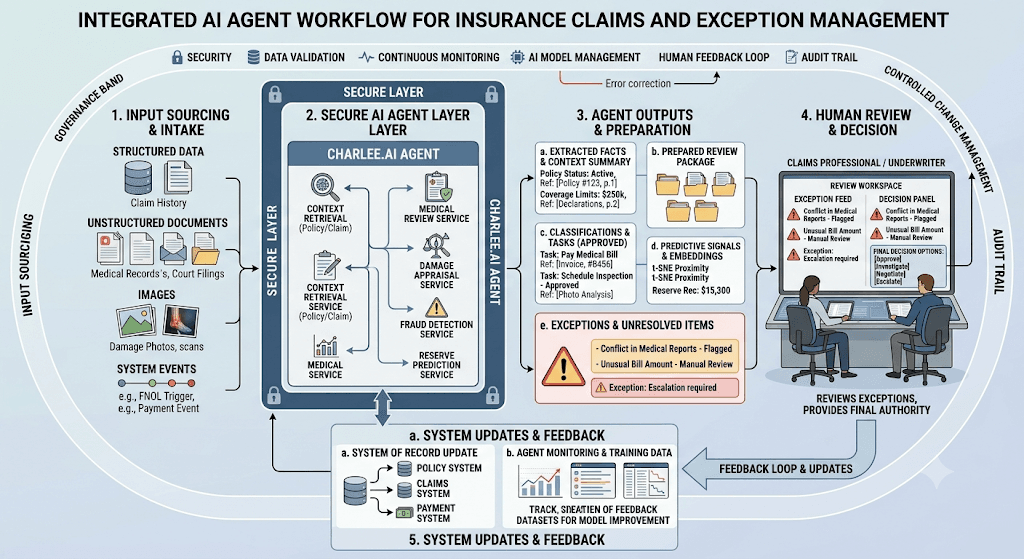
Reference architecture
| Layer | Purpose | Insurance example |
|---|---|---|
| Objective and instructions | Defines the mission, limits, and completion criteria. | Prepare a litigation review package; do not alter reserves. |
| Reasoning model | Interprets context and selects next steps. | Determine which records and events are relevant. |
| Knowledge and retrieval | Provides grounded enterprise information. | Policy forms, claim notes, medical records, procedures. |
| Tools and integrations | Performs approved actions in connected systems. | Search, extract, create task, draft email, update queue. |
| Memory and state | Tracks what has occurred during the workflow. | Documents reviewed, missing items, pending approvals. |
| Policy and permission layer | Restricts data and action authority. | Read-only access; supervisor approval before communication. |
| Monitoring and audit | Records actions, evidence, outcomes, and exceptions. | Tool calls, source citations, approval identity, timestamps. |
Types of AI Agents
| Agent type | Description | Insurance example |
|---|---|---|
| Assistive agent | Prepares information and drafts outputs for human review. | Build a claim chronology and suggested follow-up list. |
| Workflow agent | Executes a bounded sequence across approved systems. | Check document completeness, create tasks, and route exceptions. |
| Monitoring agent | Observes events or conditions and alerts when criteria are met. | Flag material litigation developments or overdue activity. |
| Analytical agent | Combines models, retrieval, and calculations to support analysis. | Assemble a reserve review with evidence and scenario ranges. |
| Conversational agent | Interacts through dialogue while accessing controlled enterprise tools. | Help an underwriter locate appetite guidance and submission facts. |
| Multi-agent system | Coordinates specialized agents under a supervisory design. | Separate document, policy, medical, and workflow agents contributing to one case review. |
Applications Across the P&C Value Chain
| Function | Potential agent role | Human authority retained |
|---|---|---|
| FNOL and intake | Validate required information, identify missing documents, create follow-up tasks, route exceptions. | Coverage and handling decisions. |
| Claims | Prepare reviews, summarize changes, monitor deadlines, organize evidence, draft communications. | Liability, reserve, settlement, and strategy. |
| Medical review | Build treatment chronologies, identify gaps, retrieve relevant guidelines, prepare review packages. | Clinical and claim judgment. |
| Litigation | Monitor new filings and correspondence, summarize developments, prepare counsel-review packets. | Legal strategy and settlement authority. |
| Subrogation | Collect potential recovery indicators, identify missing evidence, create preservation tasks. | Recovery strategy and pursuit decisions. |
| Underwriting | Check completeness, summarize risk, compare with appetite, prepare referrals. | Risk selection, pricing, terms, and exceptions. |
| Policy service | Gather context, draft responses, complete low-risk approved updates. | Material policy changes and regulated determinations. |
| Management | Monitor portfolio conditions, assemble executive summaries, route exceptions. | Business strategy and accountability. |
Detailed Claims Scenario: Litigation Review Agent
Situation
A commercial auto bodily injury claim has accumulated several hundred pages of notes, medical records, correspondence, reserve history, and legal documents. A new attorney letter and an updated treatment plan arrive on the same day. The assigned adjuster needs to understand what changed and whether management review is warranted.
Agent workflow
Trigger: The document-management system records the new attorney correspondence and medical report.
Access check: The agent confirms that it has read access to the claim and permission to create a review task, but no authority to change financial fields.
Context assembly: It retrieves the new documents, prior attorney status, medical chronology, policy information, reserve history, and applicable review procedures.
Analysis: It extracts new facts, identifies changes in representation and treatment, and compares them with prior claim information.
Evidence package: It produces a concise summary with citations to the supporting documents and clearly distinguishes observed facts from model-generated interpretation.
Control gate: Because specified thresholds are met, the agent creates a supervisor-review task rather than recommending or executing a reserve change.
Human decision: The adjuster and supervisor review the evidence, contact counsel as appropriate, and determine the claim strategy.
Audit: The system records sources, tool calls, outputs, routing, and the human decision.
Agent workflow
Outcome The agent shortens preparation time and improves consistency, but the claims organization retains control over liability assessment, reserve adequacy, litigation strategy, and settlement authority.
Detailed Underwriting Scenario: Submission Preparation Agent
A commercial property submission arrives through email with applications, schedules, loss runs, photographs, and narrative attachments. The agent inventories the package, extracts key exposure information, identifies missing items, retrieves the carrier's approved appetite guidance, and prepares a structured risk summary. It creates a referral task when occupancy, protection class, or catastrophe exposure falls outside defined thresholds.
The underwriter reviews source evidence, resolves inconsistencies, evaluates the risk, and determines whether to quote, decline, or request additional information. The agent improves preparation and workflow discipline; it does not select the risk or set terms.
Business Value and Measurement
The business case for AI agents should be tied to measurable workflow outcomes rather than claims of autonomy. Baseline performance should be established before deployment, and benefits should be evaluated by use case and user group.
| Value area | Illustrative metric | What good measurement requires |
|---|---|---|
| Productivity | Preparation time per review; touches per case. | Comparable workflow scope and quality standards. |
| Cycle time | Time from event to completed review or escalation. | Reliable timestamps and exclusion of unrelated delays. |
| Quality | Completeness, factual accuracy, citation accuracy, rework rate. | Human-reviewed samples and defect taxonomy. |
| Control | Unauthorized action attempts, escalation rate, exception handling. | Complete action logs and policy-rule testing. |
| Adoption | Active use, acceptance rate, override reasons, user satisfaction. | Role-based analysis and feedback loops. |
| Business outcome | Earlier intervention, leakage reduction, improved service. | Causal caution; distinguish agent contribution from broader process changes. |
Risks and Governance
| Risk | Why it matters | Required controls |
|---|---|---|
| Excessive permissions | An agent may access or change more than the use case requires. | Least privilege, role-based access, environment separation, action allowlists. |
| Unsupported reasoning | The agent may infer facts not supported by the record. | Source citations, evidence checks, confidence thresholds, human review. |
| Tool misuse | Correct tools may be called with incorrect parameters or sequence. | Schema validation, pre-execution checks, idempotency, safe defaults. |
| Automation loops | The agent may repeat actions or consume excessive resources. | Step limits, timeouts, budget limits, termination conditions. |
| Prompt injection | Untrusted content may attempt to redirect the agent. | Content isolation, instruction hierarchy, tool authorization outside the model. |
| Privacy and security | Sensitive policyholder, claimant, employee, or health data may be exposed. | Data minimization, encryption, retention rules, logging controls, vendor due diligence. |
| Model or process drift | Performance may degrade as models, data, forms, and workflows change. | Versioning, regression testing, monitoring, controlled change management. |
| Accountability gaps | Users may not know who owns the outcome. | Named business owner, RACI, approval gates, incident response, audit trail. |
Charlee.ai Insight Responsible agent design begins with authority boundaries. Define what the agent may read, what it may prepare, what it may execute, and what it must escalate before selecting a model or building integrations.
Human-in-the-Loop Operating Model
Human oversight should be designed into the workflow, not added as a final disclaimer. The appropriate control depends on the consequence, reversibility, confidence, and regulatory sensitivity of the action.
| Control pattern | When to use | Example |
|---|---|---|
| Human review before action | Material or customer-impacting actions. | Supervisor approves external communication or financial update. |
| Human review by exception | High-volume, low-risk work with clear thresholds. | Complete document intake unless inconsistency is detected. |
| Human sampling and audit | Stable, reversible, low-consequence tasks. | Periodic review of classification or tagging quality. |
| Read-only assistance | Early deployments or high-risk domains. | Prepare evidence and recommendations without changing systems. |
| Dual control | Sensitive actions requiring separation of duties. | One user initiates; another approves. |
Implementation Roadmap
Select a bounded use case with clear volume, pain points, controls, and measurable outcomes.
Document the current workflow, decision rights, systems, data sources, exceptions, and failure modes.
Define the agent contract: objective, inputs, outputs, tools, permissions, completion criteria, and escalation rules.
Build a read-only or preparation-focused pilot before enabling write actions.
Test with representative cases, including difficult, incomplete, adversarial, and out-of-scope examples.
Measure factual accuracy, tool success, citation quality, completion, escalation, security, and user acceptance.
Introduce controlled actions gradually with approval gates and rollback procedures.
Monitor production performance and manage model, prompt, tool, data, and workflow changes through formal governance.
Readiness checklist
- A named business owner and accountable process owner are assigned.
- The use case has a clear start, completion condition, and exception path.
- Authoritative data sources and system-of-record responsibilities are known.
- Permissions can be limited and audited at the action level.
- Human decision rights are explicit.
- Quality and control metrics are defined before deployment.
- Incident response, rollback, and change-management procedures exist.
Executive Decision Guide
Questions for internal teams and vendors
- What exact objective is the agent authorized to pursue, and what is outside scope?
- Which tools can it call, and how is each tool authorized independently of the model?
- What data can it retrieve, retain, or expose?
- How are source evidence and factual claims presented to users?
- Which actions require human approval, and how are exceptions routed?
- How are prompt injection, tool misuse, and unauthorized actions tested?
- How are model, prompt, tool, and workflow versions documented?
- What audit information is retained for every action?
- How are performance, adoption, defects, and business value measured?
- What happens when the agent is uncertain, unavailable, or wrong?
Deployment decision matrix
| Condition | Recommended posture |
|---|---|
| High consequence, weak evidence, or unclear authority | Do not automate; use read-only assistance and redesign controls. |
| Clear task but variable context | Use an assistive agent with mandatory human review. |
| Low-risk, reversible action with strong rules | Consider controlled execution with exception-based review. |
| Stable process, strong monitoring, mature governance | Expand scope gradually after demonstrated performance. |
| No reliable audit trail or permission boundary | Do not deploy production actions. |
Common Myths and Misconceptions
| Myth | Reality |
|---|---|
| An AI agent is simply a chatbot. | A chatbot is an interface. An agent also uses state, tools, permissions, and an execution loop to pursue a goal. |
| Autonomy is the primary measure of value. | Insurance value usually comes from reliable coordination, preparation, and exception handling. |
| An agent can replace process design. | Poorly defined workflows become more dangerous when automated. |
| Human-in-the-loop means someone reads every output. | Oversight can include approval gates, exception review, sampling, audit, and dual control. |
| More tools make an agent more capable. | Every tool increases complexity and risk; access should be minimal and purpose-specific. |
| A strong model eliminates the need for governance. | Model quality does not replace security, permissions, auditability, or accountability. |
Best Practices
- Design around a business process and authority model, not a technology demonstration.
- Prefer small, specialized agents over one broadly empowered agent.
- Keep consequential decisions and approvals with qualified professionals.
- Require evidence for factual outputs and distinguish fact, inference, and recommendation.
- Use least-privilege access and authorize every tool outside the language model.
- Make actions observable, reversible where possible, and fully auditable.
- Test failure modes, edge cases, and adversarial content before production.
- Measure workflow quality and business outcomes, not only model response quality.
- Manage agent changes as controlled production changes across models, prompts, tools, and data.
Common Mistakes to Avoid
- Beginning with a vague goal such as “handle the claim” or “underwrite the risk.”
- Allowing write access before proving read-only preparation quality.
- Using the model itself as the only permission or policy control.
- Failing to preserve the source evidence behind summaries and actions.
- Ignoring exceptions, unavailable systems, duplicate actions, and partial failures.
- Measuring speed without measuring factual accuracy, completeness, and rework.
- Assuming users will trust or adopt the system without workflow integration and training.
- Expanding scope before governance, monitoring, and incident response are mature.
Charlee.ai Perspective
AI agents should amplify professional judgment by ensuring that the right information, evidence, and workflow actions are available at the right time. In claims and underwriting, the strongest opportunity is not an unconstrained autonomous system. It is a governed orchestration layer that combines document intelligence, predictive signals, enterprise knowledge, workflow controls, and human expertise.
This approach supports earlier awareness, better preparation, more consistent execution, and stronger management visibility. The professional remains responsible for interpretation and decision-making, while the agent reduces the friction required to reach an informed decision.
Guiding principle Human judgment - amplified. AI coordinates information and action; insurance professionals retain authority, accountability, and context.
Key Takeaways
- AI agents move beyond isolated predictions and generated text by coordinating a controlled sequence of actions toward a defined goal.
- The most valuable insurance use cases are bounded, evidence-based, workflow-integrated, and designed around professional decision rights.
- An agent is an architecture, not only a model: it requires data, tools, state, permissions, monitoring, and governance.
- Human oversight must be built into the operating model according to consequence, reversibility, and uncertainty.
- Least-privilege access, independent tool authorization, auditability, and source evidence are essential production controls.
- Success should be measured through workflow quality, business value, adoption, and control performance - not autonomy alone.
- The goal is human judgment amplified by disciplined AI orchestration.
In one sentence An AI agent is a software system that can interpret a goal, plan and execute permitted actions with tools and data, evaluate progress, and involve a person when judgment, approval, or an exception is required.
Frequently Asked Questions
An AI agent is a software system that works toward a defined goal by interpreting context, selecting permitted tools, taking actions, checking results, and escalating when necessary.
A chatbot primarily exchanges messages. An agent may maintain state, retrieve enterprise information, call tools, and coordinate a sequence of workflow actions.
They can operate with different levels of autonomy, but insurance deployments should use bounded authority and human oversight based on risk and consequence.
An agent can prepare information and recommendations. Material coverage, liability, reserve, settlement, and strategy decisions should remain subject to the insurer's documented decision rights and controls.
An LLM may interpret instructions, reason over context, generate a plan, and select tools. The complete agent also requires integrations, permissions, state, monitoring, and governance.
RAG grounds the agent in approved enterprise sources. It helps the agent retrieve relevant policy, claim, procedural, and reference information before generating or acting.
Memory is the stored working state or approved historical context used across steps or sessions. It should be limited, secured, governed, and appropriate to the use case.
Tool calling allows the model to request an approved function, such as searching documents, extracting data, creating a task, or checking a system. The application, not the model, should enforce authorization.
It is an architecture in which specialized agents perform different roles under coordination. It can improve modularity but also increases orchestration, security, and monitoring complexity.
Production systems should record inputs, sources, model and prompt versions, tool calls, outputs, permissions, approvals, errors, and timestamps.
Use least privilege, independent tool authorization, allowlists, approval gates, parameter validation, and monitoring rather than relying on natural-language instructions alone.
Prompt injection occurs when untrusted content attempts to manipulate the agent's instructions or tool use. Controls include content isolation, instruction hierarchy, restricted tools, and external authorization.
A bounded, high-volume preparation task with clear sources, measurable effort, low-consequence actions, and an obvious human review point is usually a strong starting point.
Measure preparation time, cycle time, factual and citation accuracy, completion, rework, exceptions, unauthorized-action attempts, adoption, and business outcomes.
Yes, through APIs, workflow services, messaging, document interfaces, or controlled automation. Integration reliability and permission controls are critical.
The intended enterprise role is augmentation. Agents reduce coordination and preparation work while professionals retain judgment, relationships, authority, and accountability.
Requirements depend on jurisdiction and use case. Insurers should involve legal, compliance, privacy, security, model risk, and business owners when designing and approving deployments.
Monitoring should be continuous, with formal reviews after material changes to models, prompts, tools, data, workflows, regulations, or business conditions.