SYNTHETIC DATA
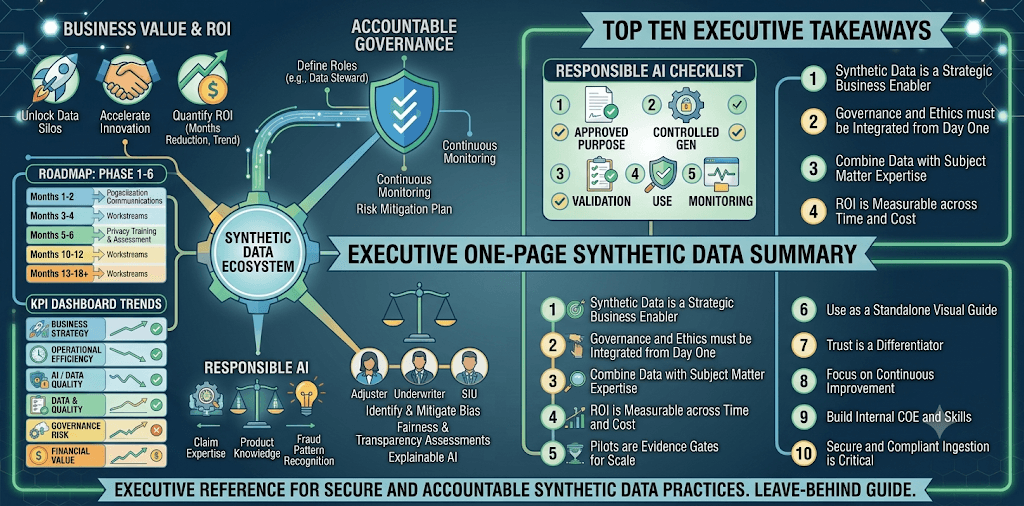
Synthetic data is artificially generated information designed to reflect the statistical patterns, relationships, and business behaviors found in real data without reproducing actual policyholder, claimant, employee, or partner records.
How insurers can use artificially generated information to accelerate AI development, strengthen testing, improve collaboration, and support responsible innovation.
Publication Overview
Synthetic data is artificially generated information designed to reflect the statistical patterns, relationships, and business behaviors found in real data without reproducing actual policyholder, claimant, employee, or partner records. For Property & Casualty insurers, it can support model development, software testing, training, demonstrations, vendor collaboration, privacy-preserving research, and rare-event simulation.
EXECUTIVE PREMISE
Synthetic data creates value when it solves a defined business or development problem, is validated against the intended use, and is governed as a controlled enterprise asset. It complements production data; it does not eliminate the need for representative real-world evidence, professional judgment, privacy controls, or ongoing monitoring.
Executive Snapshot
- Business definition: Artificially generated data reflecting real insurance patterns and relationships.
- Why it matters: Supports responsible AI development while reducing unnecessary exposure of sensitive records.
- Primary benefits: Privacy, faster development, broader testing, safer collaboration, and improved scenario coverage.
- Insurance applications: Claims, underwriting, fraud, document intelligence, catastrophe analytics, testing, and training.
- Executive takeaway: Synthetic data complements—not replaces—production data.
Executive Summary
Insurance organizations depend on large volumes of sensitive and fragmented information to build and test AI systems. Access is frequently constrained by privacy requirements, contractual limitations, security controls, data scarcity, inconsistent quality, and the practical difficulty of assembling representative examples. Synthetic data can reduce these barriers by generating controlled datasets that reflect important business patterns without directly exposing real customer records.
The capability is not inherently safe or accurate. A synthetic dataset may reproduce bias, omit critical edge cases, exaggerate relationships, create unrealistic combinations, or leak information from its source data. For that reason, synthetic data requires the same enterprise discipline applied to other important data and AI assets: approved purpose, accountable ownership, source authorization, lineage, validation, security, privacy assessment, version control, monitoring, and retirement.
This guide provides an executive and implementation reference for P&C insurers. It explains core concepts, generation methods, quality and privacy validation, applications across claims and underwriting, risks, governance, implementation practices, business measurement, and practical case studies. Throughout the guide, insurance professionals retain authority for consequential decisions.
How to Use This Guide
| Reader | Recommended Focus |
|---|---|
| Executive leadership | Chapters 1–4, 18–21, 26–27 |
| Claims and underwriting leaders | Chapters 8–10, 15–17, 20 |
| Data, AI, and technology teams | Chapters 5–7, 11–14, 19–20 |
| Legal, privacy, security, and audit | Chapters 6–7, 12–13, 27, 30 |
| Editors and designers | Chapters 24–31 |
What Synthetic Data Is
Definitions, boundaries, and executive context
EXECUTIVE INSIGHT
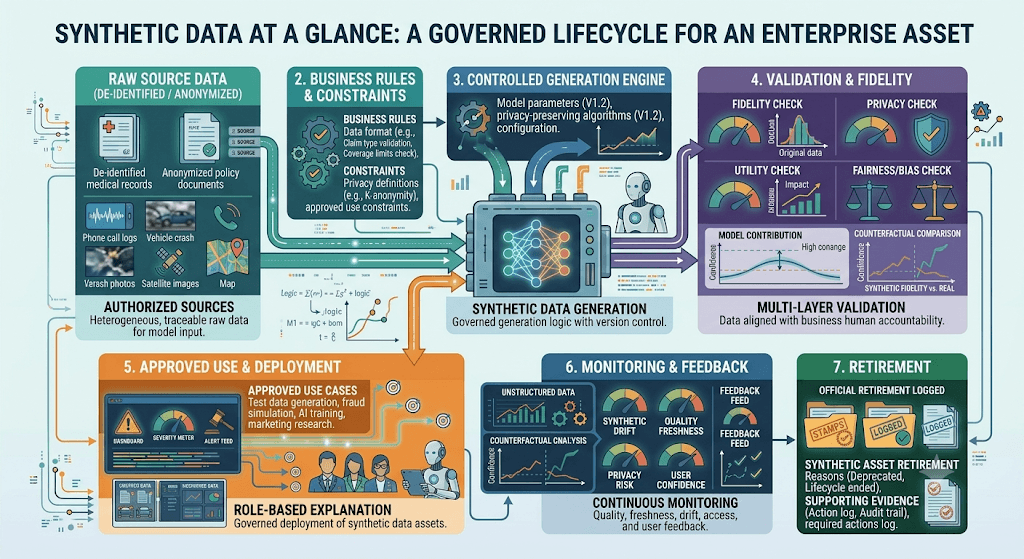
Synthetic data is useful because it can recreate important patterns without requiring every user or system to work directly with identifiable production records. Its value depends on fitness for purpose—not on how realistic it appears at first glance.
Business Definition
Synthetic data is information created by software, simulation, statistical models, generative models, rules, or combinations of these methods. It is designed to resemble selected characteristics of real data while representing artificial records, events, documents, images, or relationships.
Technical Definition
Technically, a generator learns or encodes distributions, correlations, sequences, constraints, and domain rules, then produces new observations sampled from that learned or specified representation. The output may be tabular, textual, visual, temporal, relational, or multimodal.
Insurance Definition
In P&C insurance, synthetic data may represent claims, policies, insureds, claimants, submissions, exposures, documents, transactions, providers, attorneys, repair facilities, catastrophe events, or networks. The records are not intended to represent actual individuals or claims, even when their structures and patterns resemble production information.
What Synthetic Data Is Not
| Concept | Difference |
|---|---|
| Masked data | Real records remain underneath transformed identifiers or values. |
| Anonymized data | Real records are modified to reduce identifiability; re-identification risk may remain. |
| Augmented data | Existing examples are altered or expanded through transformations. |
| Test fixtures | Hand-built examples may validate software logic but may not reflect production distributions. |
| Simulation output | A form of synthetic data generated from explicit process or physical models. |
| Fabricated examples | Invented examples without statistical or business validation may not qualify as useful synthetic data. |
Core Principle
A dataset should be called synthetic only when its artificial origin, intended purpose, generation method, validation status, and limitations are documented. The term should not be used as a blanket assurance that data is private, unbiased, or production-ready.
Why Synthetic Data Matters to P&C Insurance
Business drivers, strategic value, and appropriate expectations
EXECUTIVE INSIGHT
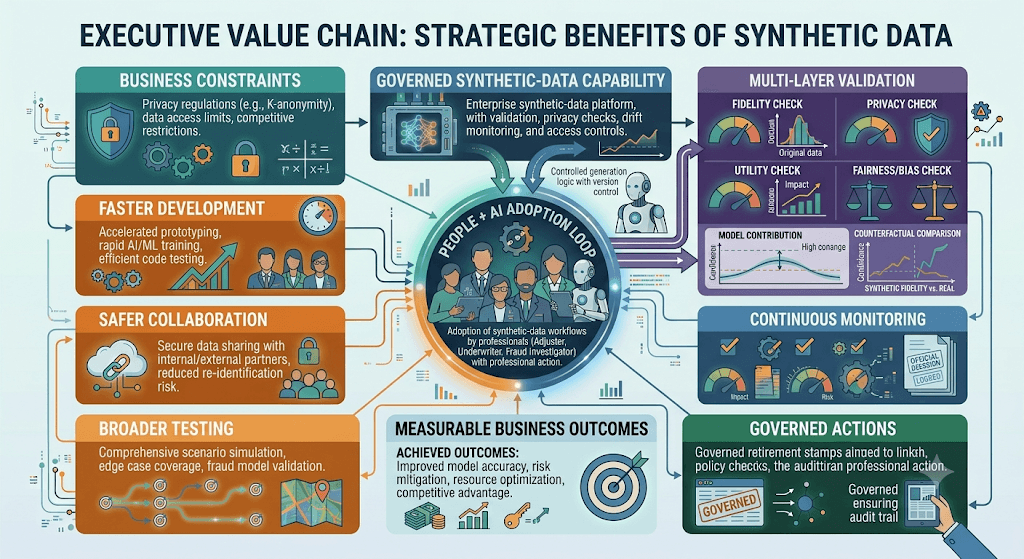
The strongest use cases are not “create synthetic data.” They are business and technology problems—such as restricted data access, rare-event testing, or safe vendor collaboration—for which synthetic data is one controlled solution.
Insurance Data Challenges
- Sensitive policyholder, claimant, medical, financial, legal, and employee information.
- Rare but material events such as nuclear verdicts, catastrophic losses, organized fraud, and unusual coverage combinations.
- Fragmented data across core systems, documents, notes, images, vendor feeds, and historical platforms.
- Limited access for development, testing, training, demonstrations, and third-party collaboration.
- Changing products, jurisdictions, litigation patterns, medical practices, repair costs, and catastrophe conditions.
Business Value
| Value Area | Potential Contribution |
|---|---|
| Development speed | Reduce delays in obtaining approved datasets for model and software work. |
| Privacy and security | Limit unnecessary sharing of identifiable production records. |
| Scenario coverage | Create controlled examples of rare, emerging, or adverse conditions. |
| Testing | Exercise integrations, workflows, rules, models, and user interfaces at scale. |
| Collaboration | Support vendors, partners, and distributed teams with governed datasets. |
| Training | Provide realistic practice environments without exposing customer records. |
| Innovation | Enable experimentation while maintaining approval boundaries and documentation. |
When Synthetic Data Adds Less Value
Synthetic data may be unnecessary when approved, representative, well-governed production data is readily available; when the use case depends on precise reconstruction of real claim evidence; when validation cannot establish fidelity; or when the generator would be more complex and costly than controlled access to existing data.
Executive Questions
- What exact constraint is synthetic data intended to solve?
- Which real-world behaviors must be preserved?
- Which attributes must not be reproduced?
- How will usefulness, privacy, and bias be validated?
- What decisions or activities are permitted with the dataset?
- What evidence will support scale, correction, or retirement?
Types of Synthetic Data
Fully synthetic, partially synthetic, hybrid, simulated, and multimodal data
Fully Synthetic Data
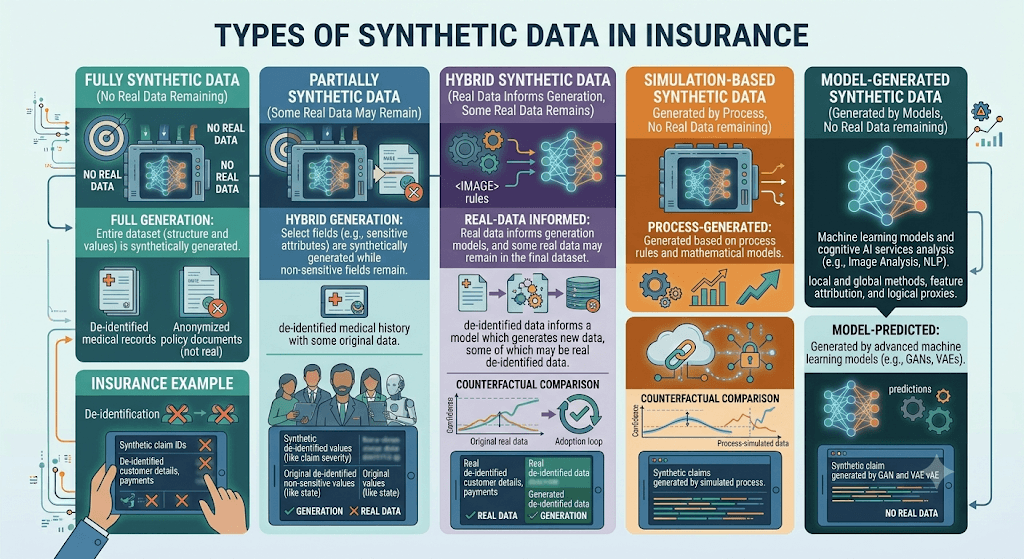
Every record and value is generated. No row is intended to correspond to a real policy, claim, or person. Fully synthetic datasets can reduce direct exposure of source records, but they may lose important detail or utility if the generator does not preserve complex relationships.
Partially Synthetic Data
Selected fields, documents, or observations are generated or replaced while other elements remain real. This can preserve operational realism, but the retained data must still be protected and evaluated for re-identification risk.
Hybrid Data
Real and synthetic records are combined. Hybrid datasets are often useful when rare classes need augmentation or when production examples provide the baseline and synthetic observations broaden coverage. Clear labels and provenance are essential.
Rule-Based and Simulation Data
Rules, process models, actuarial assumptions, engineering models, catastrophe simulations, and workflow emulators can generate controlled scenarios. These methods are especially useful when physical, contractual, or business constraints are explicit.
Model-Generated Data
Statistical, machine-learning, generative, and foundation models can learn patterns from data and produce new rows, sequences, text, images, or relationships. These methods may capture complexity but require testing for memorization, implausible outputs, and hidden bias.
Insurance Examples
| Data Type | Example | Primary Use |
|---|---|---|
| Tabular | Artificial claim, policy, reserve, payment, and exposure records. | Model development and system testing. |
| Text | Synthetic adjuster notes, demand letters, medical summaries, or submission narratives. | Document intelligence and workflow evaluation. |
| Images | Generated property damage, vehicle damage, or document scans. | Computer vision and quality testing. |
| Time series | Artificial claim development, reserve changes, or telematics sequences. | Forecasting and monitoring tests. |
| Relational | Artificial networks of claimants, providers, attorneys, vehicles, and claims. | Fraud and network analysis. |
| Multimodal | Coordinated structured records, documents, images, and events. | End-to-end workflow simulation. |
How Synthetic Data Is Generated
Generation methods, constraints, and lifecycle
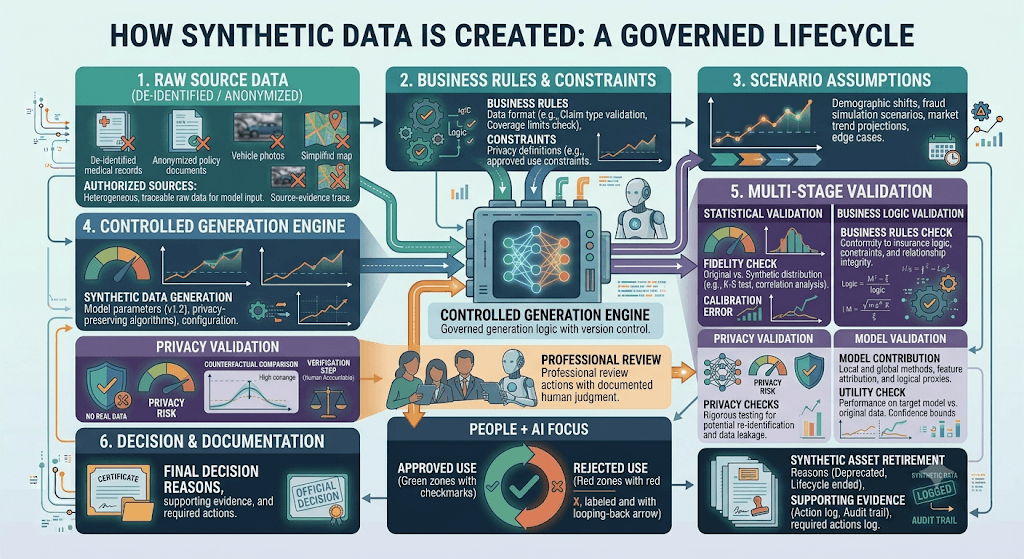
Generation Lifecycle
Define the business purpose and permitted use.
Identify authorized source data, rules, and constraints.
Select a generation method appropriate to the data type and risk.
Create candidate synthetic datasets.
Validate statistical, business, privacy, and model utility.
Approve and version the dataset.
Deploy within defined environments and workflows.
Monitor outcomes, changes, and incidents.
Refresh or retire when conditions change.
Common Generation Methods
| Method | Strength | Limitation |
|---|---|---|
| Rule-based generation | Transparent and easy to constrain. | May not reflect complex real-world distributions. |
| Parametric statistical models | Interpretable and efficient. | May oversimplify nonlinear relationships. |
| Bayesian networks | Represent dependencies and uncertainty. | Model design can be demanding. |
| Copulas | Preserve multivariate dependence. | Complex mixed data may be difficult. |
| Generative adversarial networks | Can model complex distributions. | Training instability and privacy risk require attention. |
| Variational autoencoders | Useful latent representations and controlled sampling. | Outputs may be overly smooth or lose rare detail. |
| Diffusion and foundation models | Strong for text, image, and multimodal generation. | Hallucination, memorization, provenance, and cost concerns. |
| Agent or process simulation | Represents workflows and interactions. | Assumptions may dominate the output. |
Constraints and Business Rules
Insurance generators should enforce logical and regulatory constraints where appropriate. Examples include valid policy periods, consistent dates, permitted coverage combinations, plausible reserve and payment development, geographic relationships, claim-event chronology, and document-to-record consistency.
Rare Events
Synthetic data can intentionally oversample rare but important events. The resulting dataset must clearly distinguish scenario prevalence from real-world prevalence so that model calibration and executive interpretation are not distorted.
Source Data and Data Readiness
Fitness, authorization, representativeness, and lineage
MANAGEMENT PRINCIPLE
A generator cannot reliably create patterns that are absent, misunderstood, unauthorized, or materially defective in the source environment.
Source Data Requirements
- Authorized use and documented purpose.
- Representative populations, products, jurisdictions, time periods, channels, and edge cases.
- Clear definitions and business semantics.
- Known quality limitations and missingness patterns.
- Reliable linkage across structured and unstructured information.
- Documented lineage, transformations, and retention obligations.
Observed, Verified, Inferred, and Synthetic
Datasets should preserve distinctions among observed facts, verified facts, inferred values, estimates, labels, and synthetic values. Blurring these categories creates false certainty and weakens explainability.
Data Readiness Assessment
| Dimension | Key Question |
|---|---|
| Authority | May the organization use the data for generation and evaluation? |
| Coverage | Does the source represent intended business conditions? |
| Quality | Are critical fields, documents, and links dependable? |
| Bias | Which groups or workflows may be underrepresented or historically distorted? |
| Lineage | Can teams trace inputs, transformations, versions, and approvals? |
| Timeliness | Does the source reflect current products, costs, practices, and behavior? |
| Security | Are access, encryption, logging, and environment controls sufficient? |
Preparation Practices
- Profile distributions and dependencies before generation.
- Separate training, validation, privacy testing, and final evaluation data.
- Remove direct identifiers not needed for generation.
- Document exclusions, assumptions, and known limitations.
- Engage claims, underwriting, actuarial, SIU, legal, and data owners in review.
Privacy, Security, and Confidentiality
Reducing exposure without assuming zero risk
EXECUTIVE INSIGHT
Synthetic data may reduce privacy risk, but “synthetic” is not a security classification or legal conclusion. Privacy must be tested, documented, and monitored.
Privacy Risks
- Memorization of source records or distinctive passages.
- Re-identification through rare combinations or external linkage.
- Attribute disclosure about groups or individuals.
- Retention of sensitive information in prompts, logs, embeddings, or model artifacts.
- Unapproved secondary use of source or synthetic datasets.
Privacy Evaluation
| Test or Control | Purpose |
|---|---|
| Nearest-neighbor analysis | Identify synthetic records unusually close to real records. |
| Membership-inference testing | Assess whether an attacker can infer source-set participation. |
| Attribute-inference testing | Evaluate whether hidden sensitive attributes can be predicted. |
| Uniqueness and k-anonymity-style checks | Identify rare or linkable combinations. |
| Differential privacy | Bound information contribution under a formal privacy model. |
| Red-team review | Test realistic misuse and disclosure scenarios. |
| Data minimization | Exclude fields and details not required for the approved purpose. |
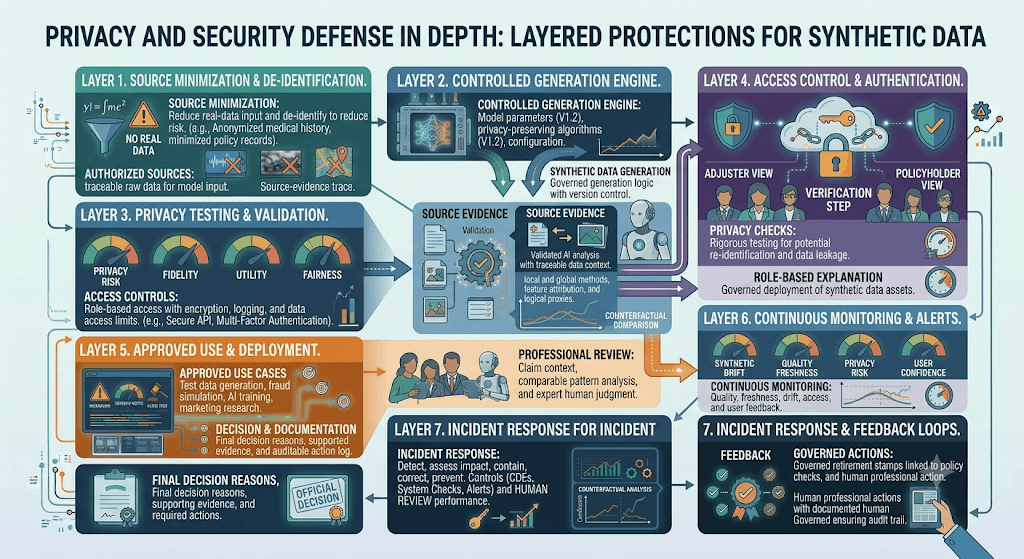
Security Controls
- Least-privilege access to source data, generators, outputs, prompts, and logs.
- Separate development, test, demonstration, and production environments.
- Encryption in transit and at rest.
- Dataset registration, classification, watermarking or labeling where appropriate.
- Monitoring for downloads, exports, unusual queries, and unauthorized reuse.
- Contractual controls for vendors and partners.
- Incident response and revocation procedures.
Confidential Business Information
Synthetic records can still reveal proprietary underwriting rules, pricing logic, claim strategies, portfolio characteristics, fraud indicators, or operational practices. Governance should protect both personal information and enterprise intellectual property.
Validation and Quality Assurance
Proving utility, realism, privacy, and fitness for purpose
VALIDATION PRINCIPLE
A synthetic dataset is not valid in the abstract. It is valid—or invalid—for a defined use, population, period, workflow, and risk level.
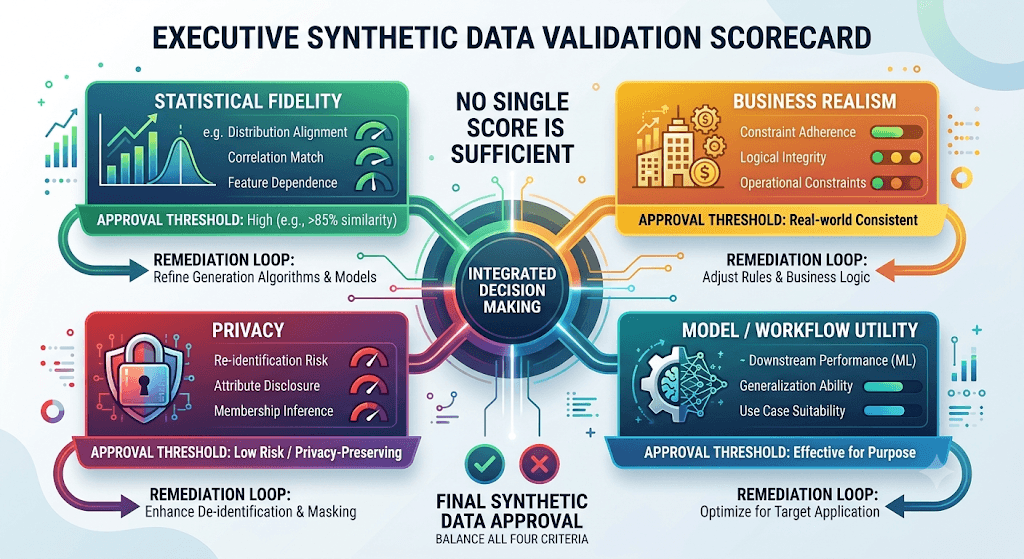
Four Validation Dimensions
| Dimension | What It Tests |
|---|---|
| Statistical fidelity | Distributions, correlations, dependencies, sequences, and rare-event behavior. |
| Business realism | Insurance logic, chronology, document consistency, and professional plausibility. |
| Privacy | Memorization, re-identification, attribute disclosure, and leakage. |
| Model and workflow utility | Whether systems trained or tested with the data perform acceptably on representative real-world evaluation sets. |
Statistical Evaluation
- Univariate distributions and missingness.
- Pairwise and multivariate relationships.
- Conditional distributions across products, jurisdictions, and segments.
- Temporal development and event sequences.
- Tail behavior and rare classes.
- Distance, divergence, and propensity-to-distinguish measures.
Business Validation
Subject-matter experts should review sampled records, scenarios, and exceptions. Claims leaders may evaluate chronology, medical and litigation development, reserve progression, and document relationships. Underwriters may assess appetite, exposure, classification, and portfolio realism. SIU professionals may review network structures and investigative plausibility.
Utility Evaluation
A common approach is to train on synthetic data and test on a protected real-world holdout set, then compare performance with models trained on real or hybrid data. The evaluation should include calibration, subgroup performance, robustness, explainability, and workflow outcomes—not accuracy alone.
Validation Report
- Purpose, owner, dataset version, and approved users.
- Source scope and generation method.
- Statistical, business, privacy, and utility results.
- Known limitations and prohibited uses.
- Approval decision, conditions, and review date.
Claims Applications
Using synthetic data across the claim lifecycle
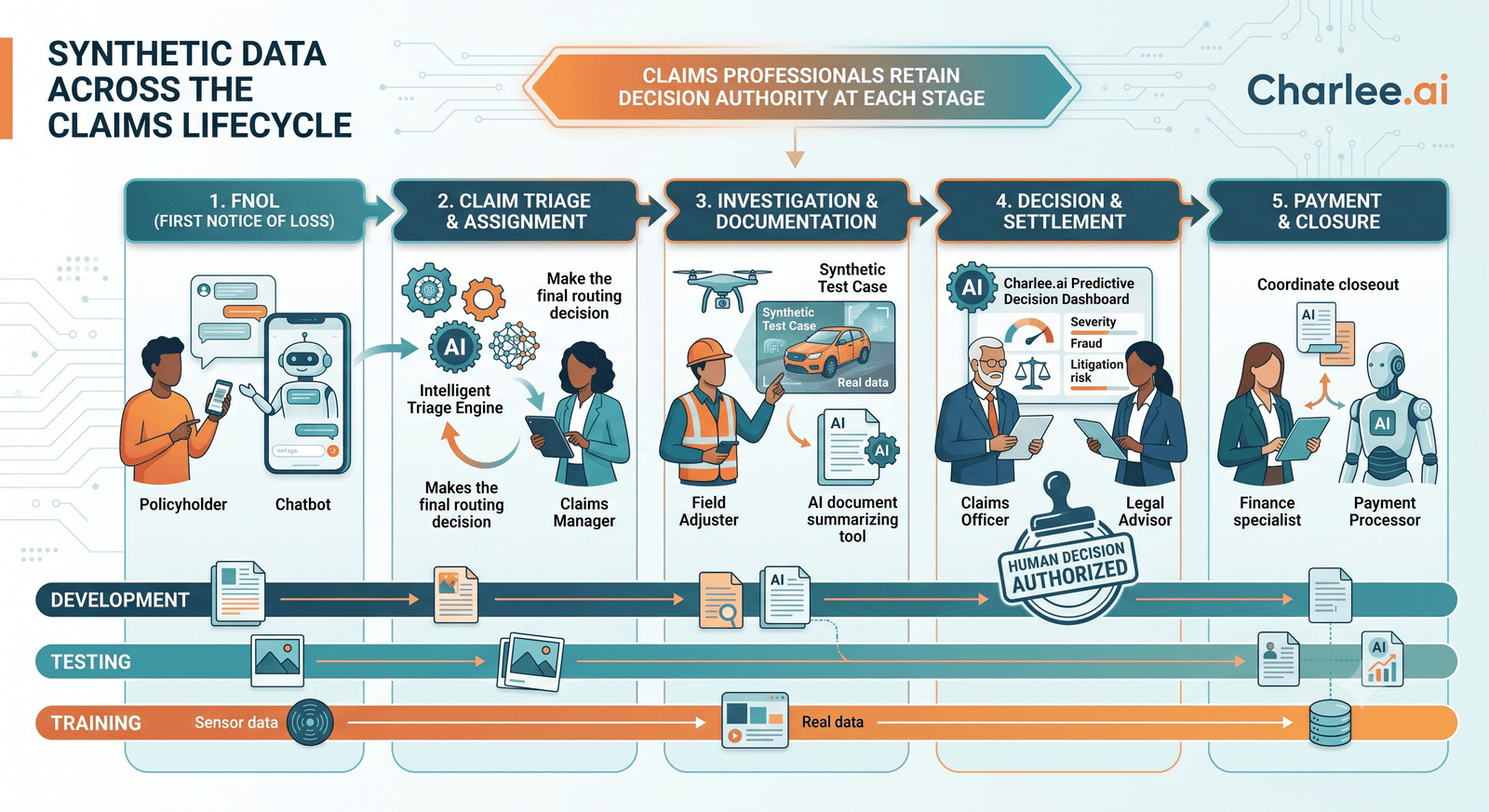
First Notice of Loss and Triage
Synthetic claim records, narratives, images, and documents can help test intake classification, routing, severity indicators, missing-information detection, and catastrophe surge workflows. Scenarios should include normal, ambiguous, incomplete, and adversarial inputs.
Severity and Reserve Monitoring
Synthetic development paths can supplement rare high-severity examples, test reserve-change alerts, and evaluate sensitivity to new medical, legal, repair, or exposure information. Calibration must reflect real prevalence and development patterns.
Litigation Prediction
Artificial chronologies may represent attorney involvement, demand activity, venue, treatment escalation, communication patterns, and procedural events. The data should support earlier review—not determinations about legal strategy or claim value without professional assessment.
Medical Review
Synthetic medical narratives and billing sequences can support extraction, chronology, summarization, and escalation testing. Generated content should never be represented as clinical truth or used to replace qualified medical review.
Subrogation and Recovery
Synthetic scenarios can test early identification of third parties, contractors, defective products, comparative negligence, evidence preservation, and recovery workflows.
Adjuster and Manager Training
Controlled claim simulations allow professionals to practice investigation, escalation, documentation, and management response without exposing real customers. Training outcomes should be reviewed separately from model-development outcomes.
Claims Use-Case Matrix
| Use Case | Synthetic Contribution | Human Authority |
|---|---|---|
| FNOL triage | Broader scenario testing and rare-event coverage. | Assignment, contact, and investigation decisions. |
| Severity prediction | Supplement tail examples and stress tests. | Reserve and handling strategy. |
| Litigation prediction | Test changing signals and escalation logic. | Legal referral, negotiation, and settlement. |
| Document intelligence | Generate varied formats and content patterns. | Interpretation and claim decisions. |
| Fraud leads | Simulate suspicious patterns and networks. | Investigation and fraud determination. |
| Training | Safe, repeatable claim scenarios. | Coaching, judgment, and performance management. |
Underwriting Applications
Submission intelligence, appetite, risk assessment, and portfolio simulation
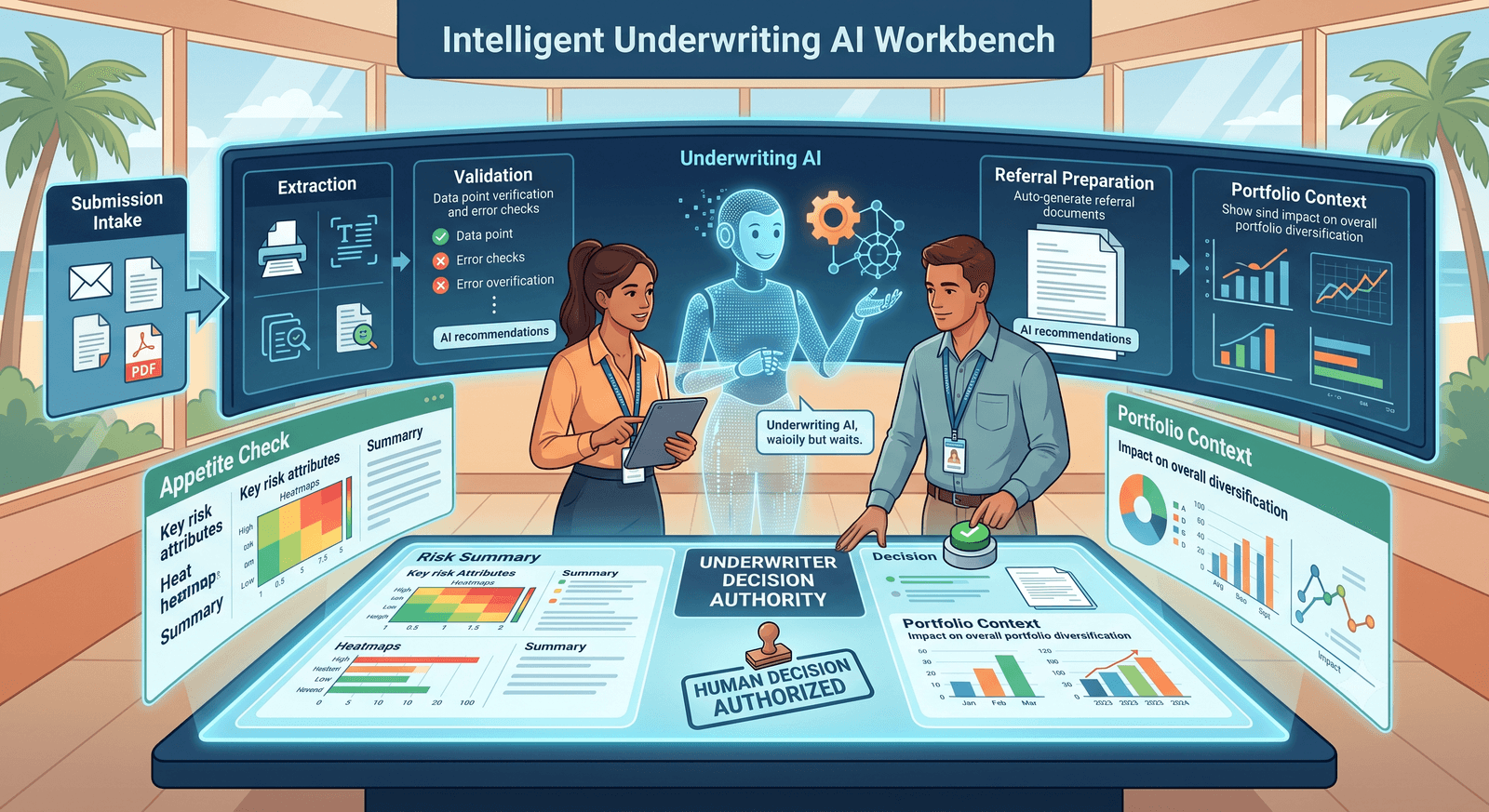
Submission Intake
Synthetic submissions can help test document classification, extraction, completeness checks, duplicate detection, normalization, and routing across varied formats and lines of business.
Appetite Evaluation
Artificial risks can exercise appetite rules and AI recommendations across industry, geography, construction, occupancy, limits, loss history, and exposure combinations. The test set should include boundary cases and conflicting evidence.
Risk Summarization
Synthetic narratives and documents can evaluate whether AI summaries remain grounded, distinguish missing from negative information, and surface material contradictions.
Portfolio Simulation
Synthetic portfolios can support concentration analysis, stress testing, emerging-risk exploration, and scenario planning. They should not be mistaken for actuarial estimates without appropriate actuarial methods and validation.
Underwriter Training
Controlled cases can improve consistency in referral preparation, documentation, and escalation while preserving underwriting authority over risk selection, terms, pricing, and adverse decisions.
Use-Case Matrix
| Use Case | Synthetic Contribution | Professional Responsibility |
|---|---|---|
| Submission processing | Document and field variation. | Confirm material facts and completeness. |
| Appetite check | Boundary and exception testing. | Apply approved appetite and judgment. |
| Risk summary | Grounding and omission tests. | Interpret evidence and decide next steps. |
| Portfolio analytics | Scenario and concentration modeling. | Actuarial and underwriting interpretation. |
| Training | Repeatable decision cases. | Coaching and authority development. |
Fraud, SIU, and Network Analysis
Synthetic scenarios for detection, prioritization, and investigation
Why Synthetic Data Is Useful
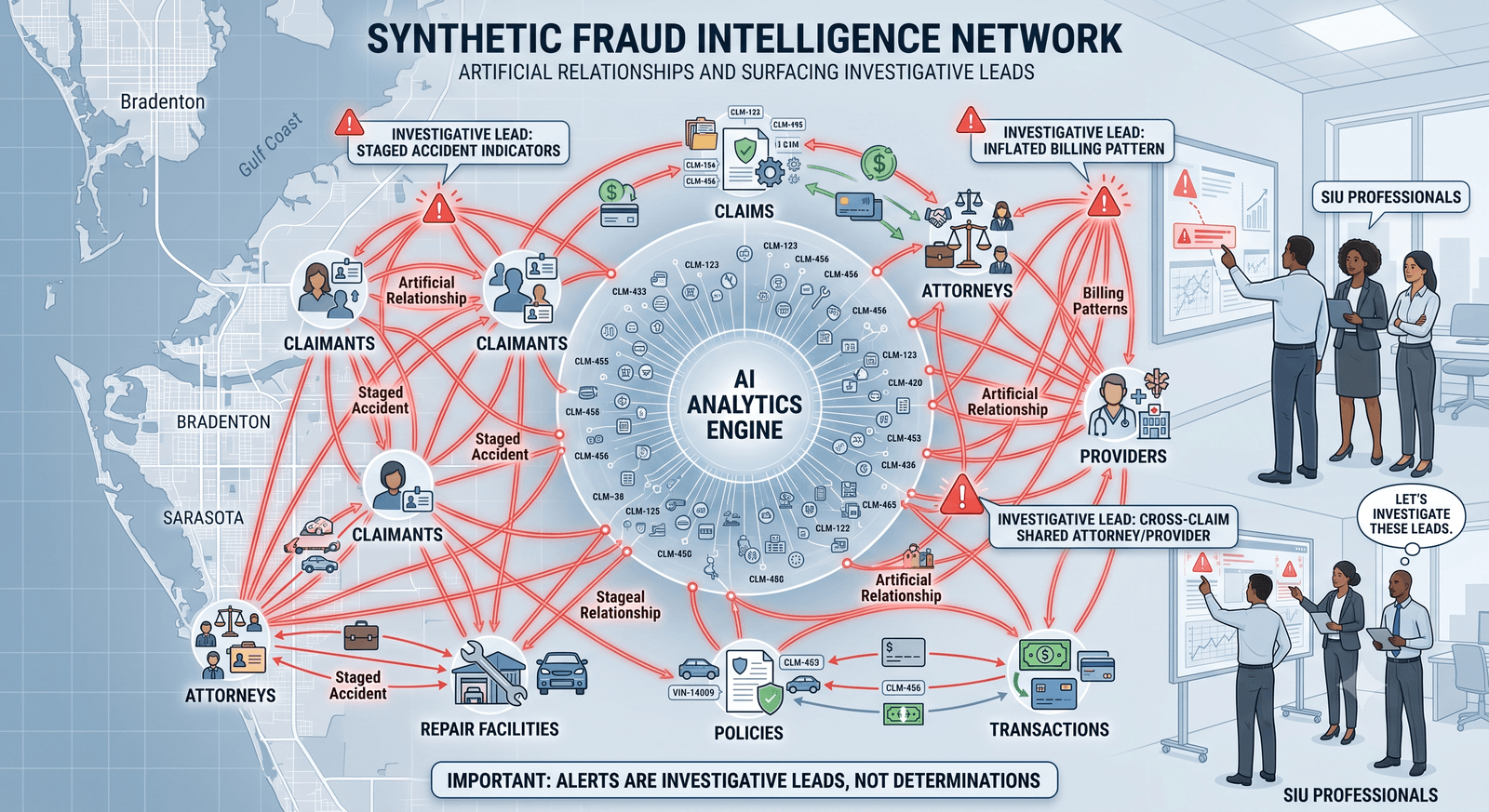
Confirmed fraud examples are relatively scarce, sensitive, and often heterogeneous. Synthetic data can broaden scenario coverage, create controlled networks, and test system behavior against evolving patterns without distributing real investigative records.
Applications
- Fraud model development and class-balance experiments.
- Network analysis involving claims, people, providers, attorneys, vehicles, devices, and addresses.
- SIU referral prioritization and workflow testing.
- Investigator training and case simulation.
- Adversarial testing of identity, document, and transaction controls.
Critical Safeguards
- Do not treat synthetic prevalence as real fraud prevalence.
- Avoid encoding stereotypes or protected-class proxies.
- Separate suspicious indicators from fraud conclusions.
- Validate against representative real-world holdouts.
- Retain investigator review, documentation, and escalation authority.
Illustrative Network Scenario
A generator creates a set of artificial claims connected through shared providers, addresses, telephone numbers, repair facilities, attorneys, and vehicles. Some links are benign and others form coordinated patterns. Analysts use the scenario to test entity resolution, graph construction, alert thresholds, explanation, and investigator workflow—not to establish that any comparable real-world relationship proves fraud.
Document Intelligence, Generative AI, and RAG
Generating and testing unstructured and multimodal insurance information
Synthetic Documents
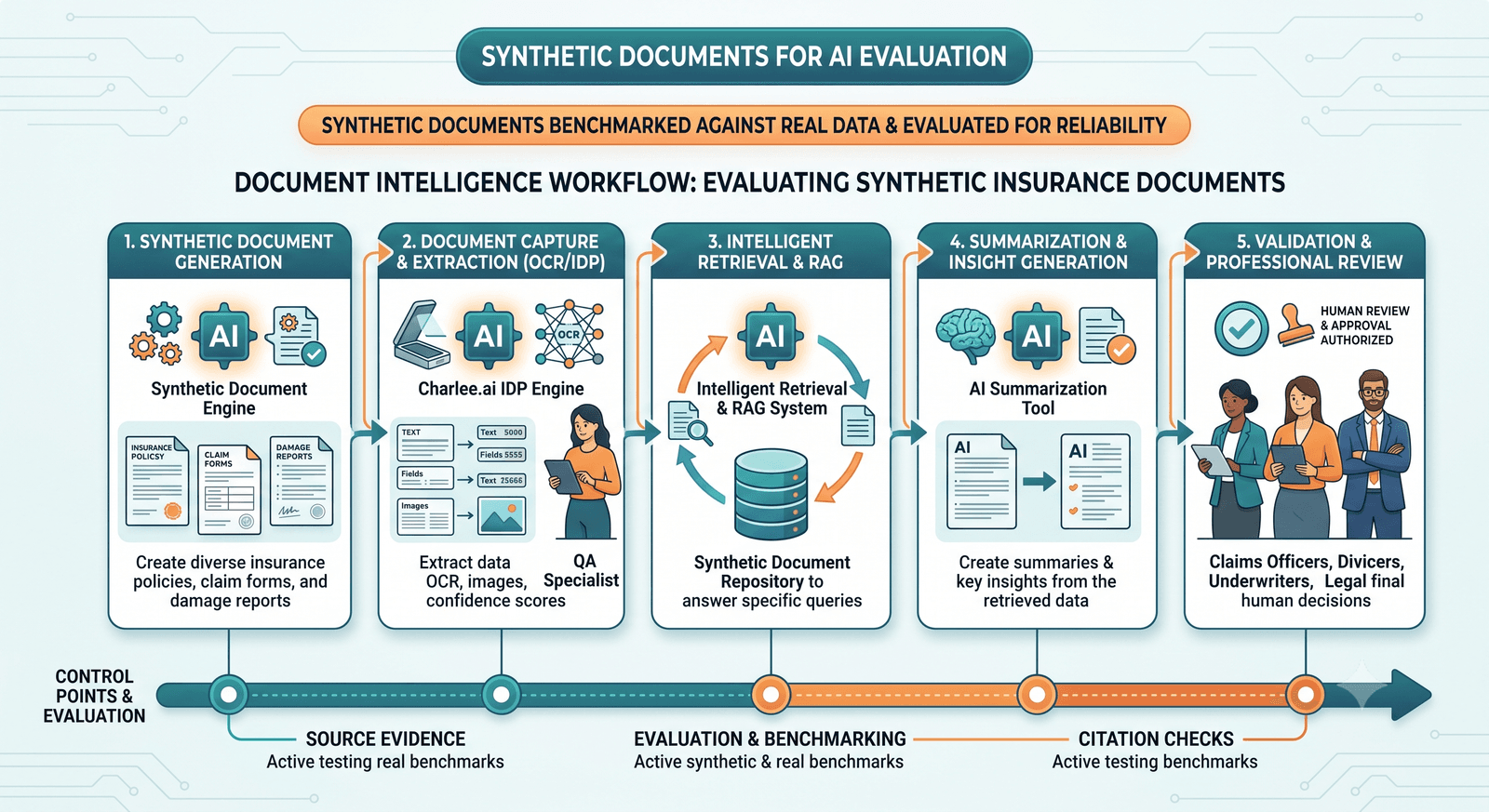
Insurers can generate artificial forms, letters, notes, estimates, invoices, medical narratives, demand packages, engineering reports, submissions, and policy-related content to test classification, extraction, summarization, retrieval, and workflow routing.
Document Variation
- Layouts, fonts, handwriting, scanning artifacts, page order, missing pages, and duplicates.
- Language, terminology, abbreviations, tables, and embedded images.
- Conflicting versions, amendments, and superseded information.
- Low-quality images, rotated pages, and mixed document packages.
Generative AI Evaluation
Synthetic prompt-and-document sets can test groundedness, citation accuracy, omission, contradiction handling, refusal, uncertainty, output structure, prompt injection, and data leakage. Evaluation sets should include realistic failures and adversarial examples.
RAG and Enterprise Search
Artificial corpora can support repeatable retrieval benchmarks, permission tests, metadata filtering, deletion tests, and citation checks. Final validation should still use authorized representative enterprise content because synthetic text may not capture the full ambiguity and vocabulary of production documents.
Key Control
EVIDENCE RULE
A generated answer should remain traceable to approved evidence. Synthetic evaluation content can test the mechanism, but it should not weaken requirements for source access, citations, uncertainty, and human review.
Risks, Limitations, and Common Failure Modes
What executives and implementation teams must control
Principal Risks
| Risk | Consequence | Control Response |
|---|---|---|
| Low fidelity | Models learn unrealistic patterns. | Business and statistical validation. |
| Memorization | Sensitive source details may leak. | Privacy testing, minimization, differential privacy where appropriate. |
| Bias reproduction | Historical inequities or proxies persist. | Segmented testing, fairness review, and source analysis. |
| Rare-event distortion | Synthetic prevalence changes calibration. | Weighting, prevalence documentation, and real-world evaluation. |
| Mode collapse or limited diversity | Important scenarios disappear. | Coverage metrics, targeted generation, and failure analysis. |
| Impossible combinations | Records violate insurance logic. | Constraints, rules, and expert review. |
| Stale assumptions | Data no longer reflects products or conditions. | Monitoring, refresh, and controlled retirement. |
| Unapproved reuse | Dataset is used outside validated scope. | Registration, labeling, access control, and enforcement. |
| Automation bias | Users trust synthetic-derived outputs too readily. | Visible limitations, professional review, and training. |
Common Mistakes
- Starting with a generator rather than a business problem.
- Assuming synthetic means anonymous or risk-free.
- Using only aggregate similarity measures.
- Skipping business subject-matter review.
- Training and testing on data produced by the same generator without protected holdouts.
- Failing to label synthetic records and versions.
- Using synthetic data to hide poor source quality.
- Scaling before workflow, ownership, and monitoring are ready.
Limitation Statement
Synthetic data cannot recreate unknown future events with certainty, substitute for real-world evidence in claim or underwriting decisions, or guarantee privacy and fairness. It is a controlled approximation whose value depends on disciplined use.
Governance and Responsible AI
Ownership, approval, documentation, monitoring, and controlled change
EXECUTIVE PREMISE
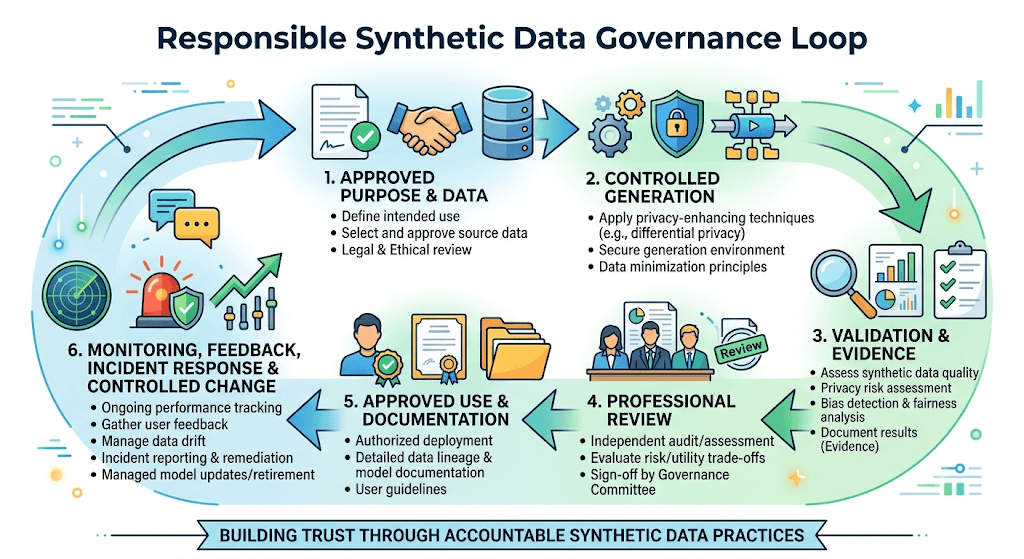
Governance should make responsible synthetic-data use repeatable and scalable. It should define who may create, approve, use, change, share, and retire datasets—and what evidence is required at each decision point.
Governance Lifecycle
Approve the business purpose, scope, users, and authority boundaries.
Confirm lawful and authorized source-data use.
Define generation, validation, security, privacy, and documentation standards.
Review dataset and model performance before use.
Record approvals, versions, limitations, and permitted environments.
Monitor quality, privacy, adoption, incidents, and business outcomes.
Control refresh, expansion, sharing, and retirement.
Roles
| Role | Primary Accountability |
|---|---|
| Executive sponsor | Business objective, funding, risk tolerance, and value realization. |
| Business owner | Use-case definition, realism, workflow, and acceptance. |
| Data owner/steward | Source authority, quality, definitions, and lineage. |
| Data science/engineering | Generation, testing, documentation, and operations. |
| Privacy and security | Risk assessment, controls, monitoring, and incidents. |
| Legal and compliance | Requirements, contracts, policy, and permitted use. |
| Model risk or AI governance | Independent challenge, approval, monitoring, and change control. |
| Internal audit | Independent assurance over design and operation. |
Dataset Card
- Dataset name, version, owner, purpose, and status.
- Source scope, date range, generation method, and assumptions.
- Validation results and thresholds.
- Privacy and security classification.
- Approved users, environments, and prohibited uses.
- Known limitations, refresh date, and retirement criteria.
Human-in-the-Loop
Synthetic data may support models and workflows, but consequential insurance decisions remain with authorized professionals. Human review should be defined by decision materiality, uncertainty, customer impact, and applicable requirements.
Technology Architecture and Operating Model
Platforms, integration, environments, MLOps, and reusable services
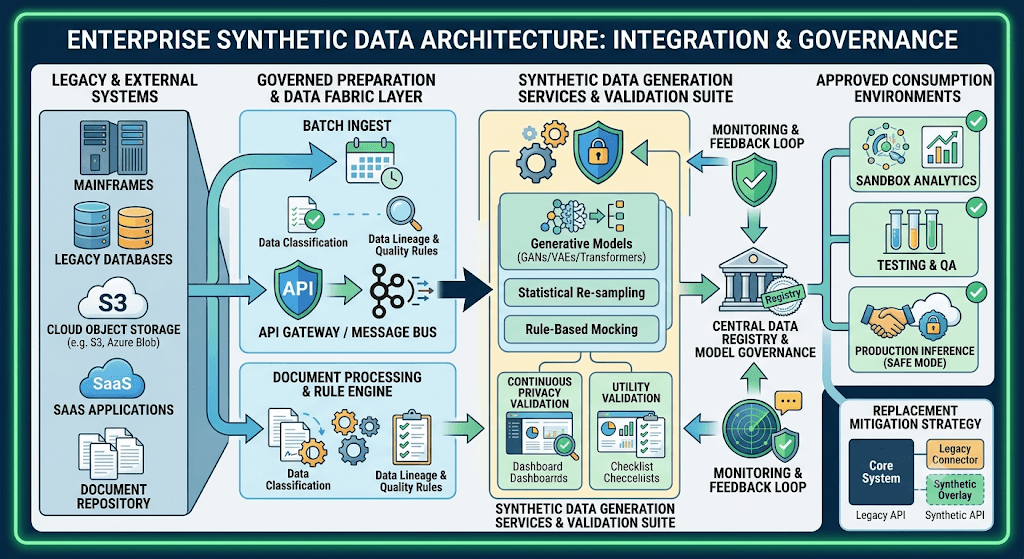
Reference Architecture
| Layer | Capabilities |
|---|---|
| Source and metadata | Approved data stores, catalogs, lineage, classifications, and schemas. |
| Preparation | Profiling, quality controls, minimization, transformations, and feature pipelines. |
| Generation | Rule-based, statistical, simulation, and generative engines. |
| Validation | Statistical, business, privacy, fairness, security, and utility testing. |
| Registry and storage | Versioned datasets, dataset cards, approvals, access, and retention. |
| Consumption | Model development, testing, training, demos, analytics, and partner use. |
| Monitoring | Usage, drift, incidents, refresh, outcomes, and audit evidence. |
Build, Buy, or Partner
| Decision Area | Build May Fit | Buy or Partner May Fit |
|---|---|---|
| Differentiation | Synthetic capability is strategically unique. | Use case is common and speed matters. |
| Talent | Strong data science, privacy, and MLOps teams exist. | Specialized expertise is limited. |
| Data types | Highly proprietary or complex relationships. | Standard tabular or document-generation needs. |
| Governance | Organization can operate full lifecycle controls. | Vendor provides transparent methods and evidence. |
| Economics | Scale and reuse justify sustained investment. | Managed service lowers execution risk. |
Integration Patterns
- Batch generation for model-development datasets.
- APIs for controlled on-demand scenarios.
- Event-driven test environments.
- Document and image generation pipelines.
- Secure partner workspaces.
- CI/CD integration for software and model testing.
Operational Requirements
- Reproducible generation with seeds, versions, and configuration.
- Environment isolation and secrets management.
- Automated validation gates and approval workflows.
- Dataset registry and searchable metadata.
- Cost, performance, and capacity monitoring.
- Rollback, revocation, and deletion procedures.
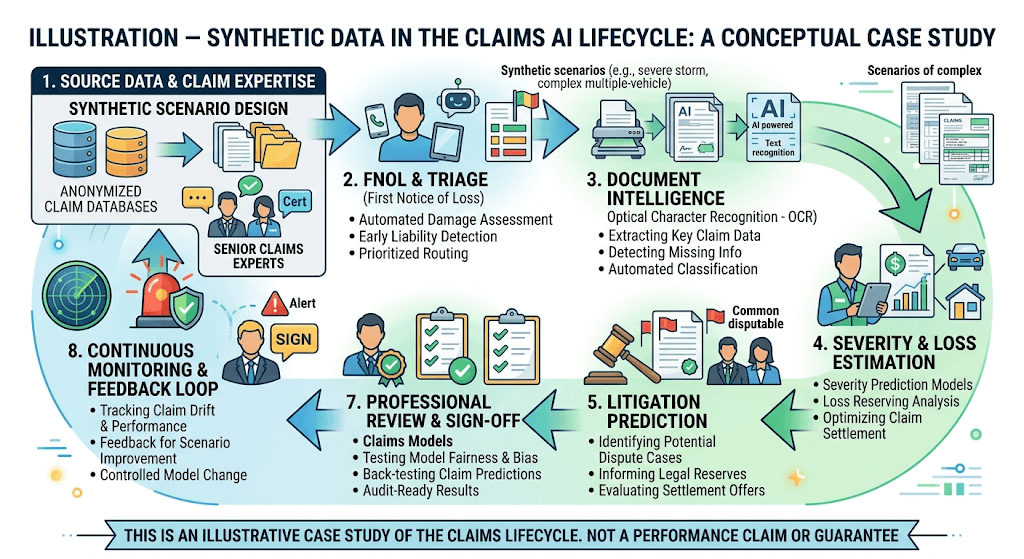
Case Study: Using Synthetic Data to Transform Claims AI
Illustrative enterprise implementation
Executive Insight
A national P&C insurer used synthetic data to expand claims-AI development while reducing direct exposure of sensitive claim records. The program succeeded because it began with defined claim decisions, embedded business validation, and scaled through evidence-based governance gates.
Business Background
The insurer operated across personal auto, commercial auto, property, and workers’ compensation. Its AI teams faced slow access to development data, uneven representation of severe and litigated claims, and restrictions on sharing records with vendors and distributed teams.
Business Objectives
- Accelerate model and workflow development.
- Expand rare-event and adverse-scenario coverage.
- Reduce unnecessary use of identifiable claim records.
- Improve repeatability of testing across FNOL, documents, severity, and litigation use cases.
Initial Assessment
The team inventoried source systems, documents, decisions, data rights, quality gaps, and existing controls. It selected bodily injury claim triage as the first pilot because the workflow had measurable outcomes, experienced reviewers, and clear escalation points.
Governance Framework
- Executive claims sponsor and accountable product owner.
- Dataset cards, versioning, access, and use restrictions.
- Privacy, legal, security, model-risk, and claims review.
- Protected real-world holdout data for final evaluation.
Synthetic Data Generation
The program combined de-identified structured claim features, constrained statistical generation, synthetic narratives, and scenario rules for attorney involvement, treatment escalation, reserve movement, and demand activity. Rare scenarios were deliberately oversampled and labeled so model calibration would not treat them as natural prevalence.
FNOL Triage
Generated loss descriptions and intake combinations tested routing, missing information, and escalation.
Document Intelligence
Synthetic medical and legal documents tested classification, extraction, chronology, and summarization.
Litigation Prediction
Artificial claim timelines broadened coverage of changing attorney, venue, treatment, and demand signals.
Severity Prediction
Synthetic development paths supplemented limited tail examples and supported stress testing.
Validation
- Statistical: distributions, dependencies, time sequences, and tail behavior.
- Business: claim chronology, plausibility, and handling relevance.
- Privacy: nearest-neighbor, membership, and rare-combination testing.
- Utility: train-on-synthetic/test-on-real comparisons and workflow pilots.
Business Results
The insurer reduced data-provisioning delays, improved repeatability of model and integration tests, expanded rare-scenario coverage, and created reusable claims datasets. Production approval still depended on performance against real-world holdout data and human-reviewed pilot outcomes.
Lessons Learned
- Synthetic data did not repair weak source definitions.
- Claims experts were essential to validation.
- Rare-event oversampling required careful calibration.
- Reusable datasets produced more value than one-off extracts.
- Governance accelerated scale by making approval expectations predictable.
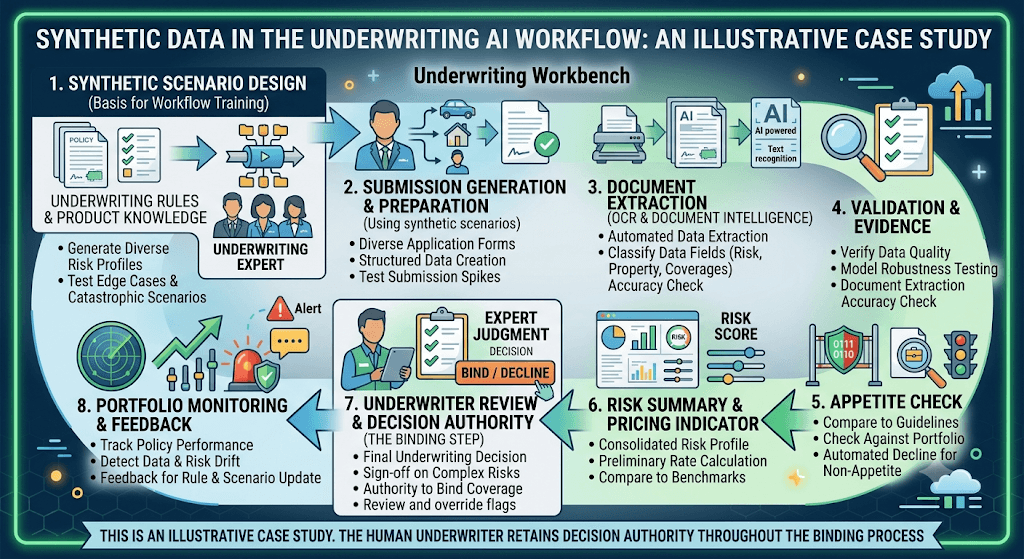
Case Study: Using Synthetic Data to Transform Underwriting AI
Illustrative submission and portfolio implementation
Executive Insight
A commercial insurer used synthetic submissions and portfolios to improve underwriting-AI testing without distributing real applicant files. The program focused on evidence organization and appetite support while retaining underwriter authority over selection, terms, and pricing.
Business Background
Submissions arrived through brokers in inconsistent formats and included applications, schedules, loss runs, engineering reports, financial information, emails, and supplemental forms. Access constraints slowed document-intelligence testing and vendor collaboration.
Strategic Objectives
- Improve submission intake and document extraction.
- Test appetite logic across boundary cases.
- Create safe training and demonstration environments.
- Support portfolio stress scenarios.
Synthetic Underwriting Environment
The team generated coordinated artificial submissions containing structured records and linked documents. Business rules enforced consistent dates, classifications, locations, limits, and loss histories. Scenarios included missing information, conflicting versions, borderline appetite, and concentration changes.
Submission Intake and Triage
Varied document packages tested classification, extraction, completeness, and routing.
Document Intelligence
Generated schedules and reports tested tables, terminology, versions, and contradictions.
Appetite Evaluation
Artificial risks exercised in-appetite, out-of-appetite, and referral conditions.
Portfolio Simulation
Synthetic books supported concentration and emerging-risk exploration.
Validation and Results
Underwriters reviewed realism and decision usefulness; data teams measured distributions and consistency; privacy teams assessed leakage; and model teams tested on protected real submissions. The program improved testing coverage and reduced the need to copy sensitive submission files into development and demonstration environments.
Lessons Learned
- Document realism mattered as much as tabular fidelity.
- Appetite rules needed version control and jurisdictional context.
- Portfolio scenarios required actuarial and underwriting interpretation.
- Human review remained necessary for material facts and adverse decisions.
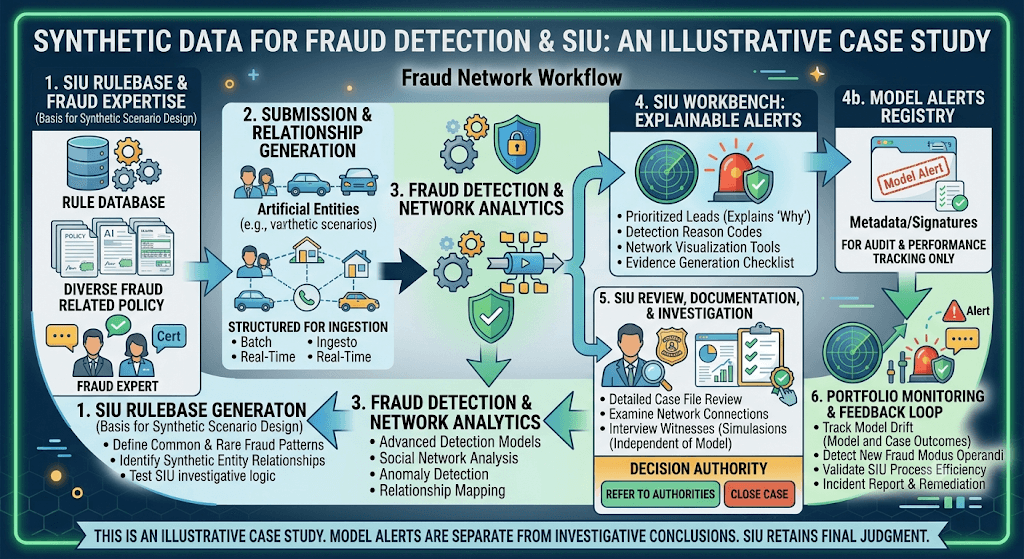
Case Study: Using Synthetic Data to Strengthen Fraud Detection and SIU Operations
Illustrative network and investigator implementation
Executive Insight
An insurer expanded fraud-model and SIU workflow testing by creating artificial claim networks with controlled suspicious and benign patterns. The primary value was broader scenario coverage and repeatable investigator training—not automatic fraud determination.
Business Background
Confirmed fraud cases were limited, highly sensitive, and difficult to share. Existing models performed well on known patterns but had limited testing against coordinated networks and emerging behaviors.
Strategic Objectives
- Broaden fraud pattern coverage.
- Test entity resolution and graph analytics.
- Improve SIU referral prioritization.
- Create safe investigator training scenarios.
Synthetic Fraud Environment
The generator created artificial claims, identities, addresses, devices, providers, attorneys, repair facilities, payments, and vehicles. It inserted both legitimate shared relationships and suspicious clusters so that systems had to distinguish common links from coordinated patterns.
Fraud Detection
Evaluate features, thresholds, and class imbalance.
Network Analysis
Test graph construction, link explanations, and cluster behavior.
SIU Prioritization
Assess referral queues, evidence summaries, and workload balancing.
Investigator Training
Practice evidence review, documentation, escalation, and disposition.
Validation and Results
SIU experts reviewed plausibility and investigative value. Technical teams measured detection, false positives, network coverage, and explanation quality on synthetic scenarios, then tested final models against authorized real-world holdouts. The program created a reusable test library and improved consistency of workflow validation.
Lessons Learned
- Synthetic networks must include benign shared relationships.
- Fraud prevalence and scenario difficulty must be labeled.
- Bias review is essential because proxy patterns can be amplified.
- Alerts remain leads requiring authorized investigation.
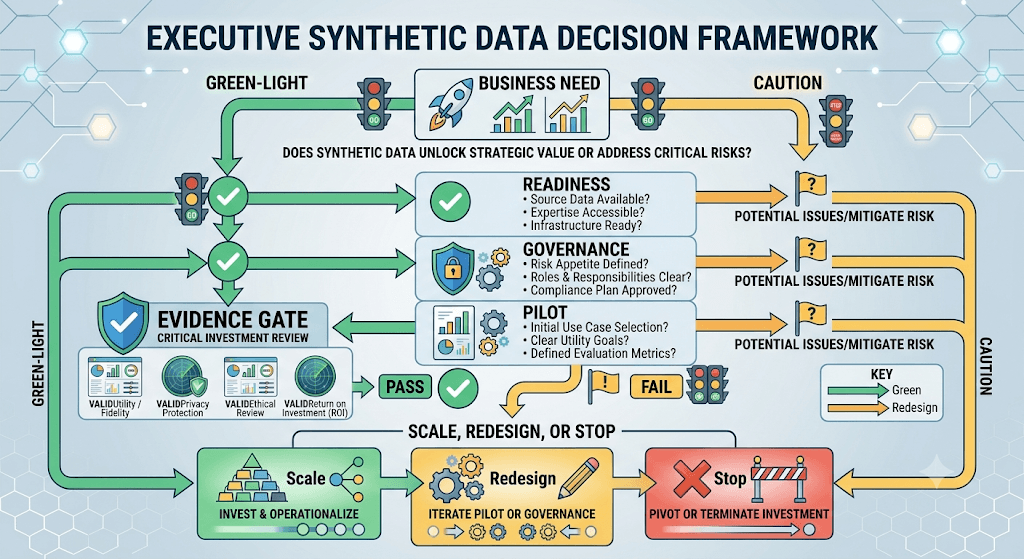
Executive Decision Guide
When to invest, pilot, scale, or defer
When Synthetic Data Creates Value
- Sensitive production data cannot be broadly shared.
- Rare scenarios materially affect model or workflow risk.
- Testing requires repeatable and scalable data.
- Vendors or partners need controlled access.
- Training and demonstrations require realistic but non-customer examples.
- The organization can validate utility and privacy against representative evidence.
When It May Not Be Necessary
- Approved production data is already accessible and sufficient.
- The task requires exact reconstruction of real evidence.
- The organization lacks business ownership or validation capability.
- Generation cost exceeds the practical value.
- The intended use is too broad or undefined.
Executive Readiness Scorecard
| Dimension | Green Light | Caution |
|---|---|---|
| Business purpose | Defined problem, user, action, and outcome. | General interest in synthetic data. |
| Data readiness | Authorized, representative, understood sources. | Unknown rights or weak definitions. |
| Governance | Named owners and approval path. | Controls planned after the pilot. |
| Validation | Protected holdouts and expert reviewers. | Similarity metrics only. |
| Workflow | Clear consumption and response. | No operational action path. |
| Measurement | Baseline and decision criteria. | Activity metrics only. |
Seven-Step Decision Framework
Define the business or development constraint.
Confirm that synthetic data is an appropriate option.
Assess source authority and readiness.
Define permitted use and risk tier.
Establish generation and validation requirements.
Pilot in a controlled environment.
Scale, correct, or retire based on evidence.
Cost-Benefit Considerations
- Platform, compute, data engineering, validation, governance, and operating cost.
- Time avoided in data provisioning and masking.
- Reuse across models, systems, teams, and partners.
- Reduction in exposure of production records.
- Improved test coverage and earlier detection of failure.
- Value of faster deployment and safer experimentation.
Enterprise Implementation Blueprint
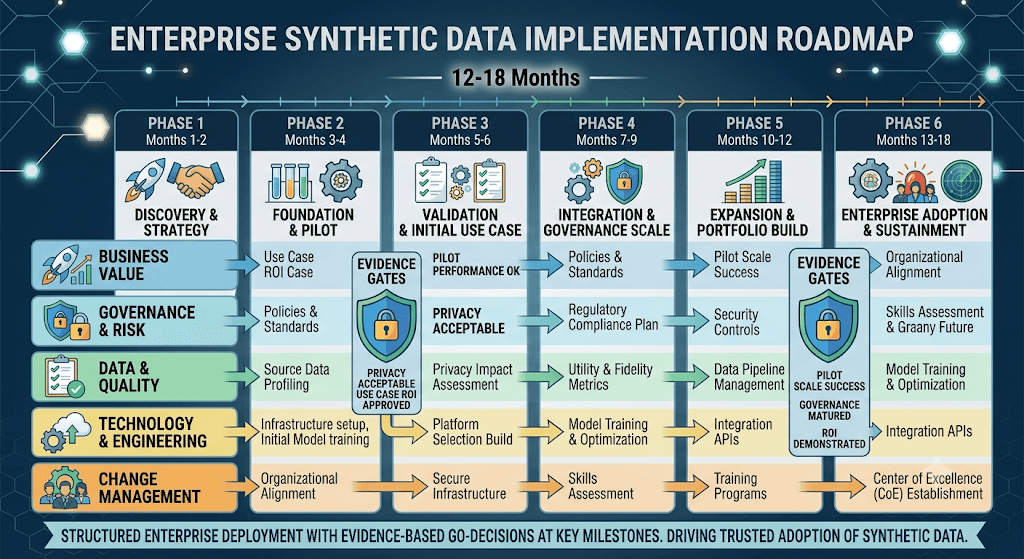
A phased 12–18 month roadmap
IMPLEMENTATION PHILOSOPHY
Begin with a narrow, measurable use case; build reusable governance and technical capabilities; and expand only after utility, privacy, workflow, and operating controls are demonstrated.
Phase 1 - Strategy and Executive Alignment
Define objectives, sponsorship, use-case portfolio, risk appetite, and funding.
Phase 2 - Governance and Data Readiness
Establish ownership, source authorization, standards, environments, and validation plans.
Phase 3 - Pilot Development
Generate, validate, and test one focused dataset in a controlled workflow.
Phase 4 - Controlled Expansion
Add use cases, data types, partners, and reusable services after evidence gates.
Phase 5 - Enterprise Integration
Embed registry, automation, monitoring, and consumption patterns into the operating model.
Phase 6 - Continuous Improvement
Refresh, benchmark, audit, manage incidents, and retire obsolete assets.
Organizational Responsibilities
| Function | Responsibility |
|---|---|
| Executive leadership | Priority, funding, risk tolerance, and outcome accountability. |
| Business teams | Use cases, realism, workflows, and acceptance. |
| Data and AI | Generation, validation, tooling, and monitoring. |
| Technology | Architecture, integration, reliability, and support. |
| Privacy, security, legal | Rights, risk, controls, contracts, and incidents. |
| Governance and audit | Independent review, evidence, and assurance. |
| Change and training | Role design, communication, education, and adoption. |
Success Milestones
| Timeframe | Indicative Milestone |
|---|---|
| First 90 days | Sponsor, use case, governance, source assessment, and validation plan approved. |
| 180 days | Pilot dataset validated; workflow and holdout evaluation completed. |
| 12 months | Reusable platform, registry, standards, and multiple controlled use cases. |
| 18 months | Enterprise operating model, monitoring, audit evidence, and value reporting. |
KPIs and Success Metrics
Measuring business, operational, AI, governance, and financial value
Measurement Principle
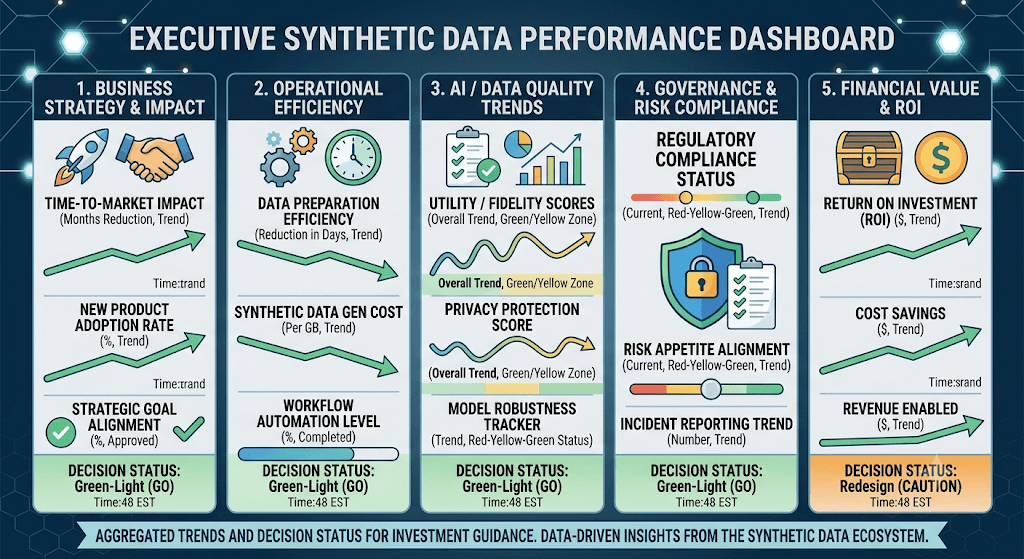
Synthetic-data success should be measured through the chain from dataset quality to development activity, workflow adoption, model behavior, risk control, and business outcome. A realistic dataset that is never used—or a widely used dataset that weakens production performance—is not successful.
KPI Framework
| Dimension | Illustrative KPIs |
|---|---|
| Business outcomes | Cycle time, decision timeliness, adoption, productivity, and outcome improvement. |
| Operations | Time to provision data, generation throughput, validation time, reuse, and platform availability. |
| AI and data quality | Fidelity, coverage, calibration, subgroup performance, real-holdout utility, and drift. |
| Governance and risk | Approval completion, privacy findings, incidents, access exceptions, documentation, and audit issues. |
| Financial value | Cost avoided, development acceleration, reuse value, loss or expense impact, and ROI. |
Executive Dashboard
- Baseline, target, actual, trend, owner, and commentary.
- Leading indicators such as review completion, adoption, and validation failures.
- Lagging outcomes tied to the original business case.
- Segmented results by line, jurisdiction, team, data type, and use case.
- Decision status: scale, continue, correct, pause, or retire.
Maturity Model
| Level | Description |
|---|---|
| 1 - Experimental | Isolated generation with limited standards or reuse. |
| 2 - Controlled Pilot | Defined use, owners, validation, and restricted deployment. |
| 3 - Repeatable | Standard methods, registry, reusable datasets, and monitoring. |
| 4 - Enterprise | Integrated platform, governance, portfolio management, and value reporting. |
| 5 - Adaptive | Continuous benchmarking, automated controls, cross-enterprise reuse, and controlled innovation. |
The Charlee.ai Perspective on Responsible Synthetic Data
Trusted insurance AI through governance, evidence, and human expertise
Executive Perspective
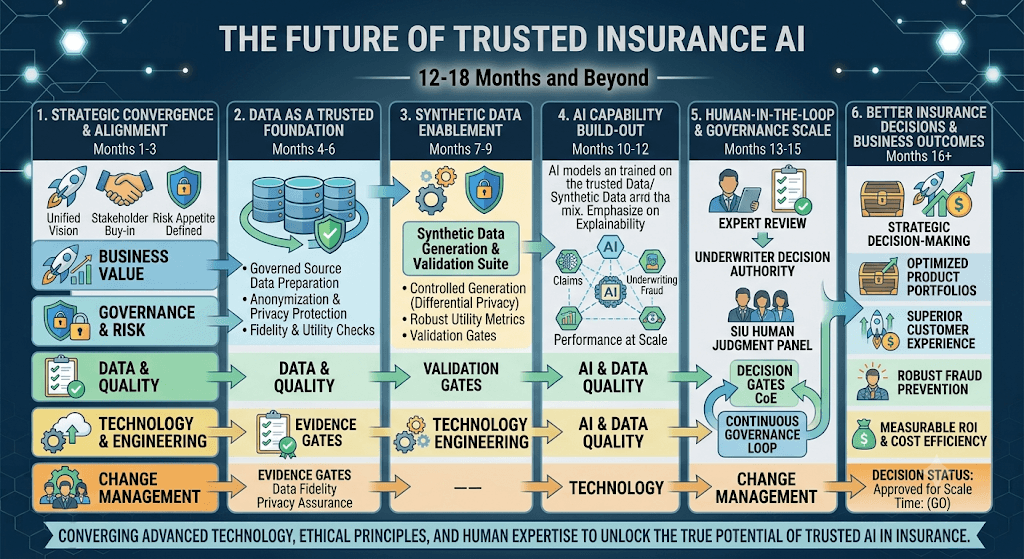
Charlee.ai views synthetic data as one enabling capability within a broader responsible-AI strategy. Its purpose is to help insurers learn, test, and innovate while protecting sensitive information and preserving professional decision authority.
Responsible AI Begins with Responsible Data
Models inherit the strengths and weaknesses of their data. Synthetic generation does not remove the need for source quality, lawful use, clear definitions, provenance, validation, and monitoring.
Human Expertise Remains Essential
Claims professionals, underwriters, investigators, actuaries, legal teams, and executives provide context that statistical similarity cannot establish. They remain responsible for consequential insurance judgments.
Governance Enables Innovation
Predictable standards and evidence requirements reduce uncertainty and make it easier to move successful use cases from experiment to production.
Enterprise Thinking Creates Long-Term Value
Reusable datasets, shared validation services, common controls, and integrated workflows produce more durable value than disconnected pilots.
Five Principles
AI augments human expertise.
Governance enables innovation.
Business outcomes matter most.
Enterprise knowledge creates competitive advantage.
Responsible AI is a long-term commitment.
Comprehensive Glossary of Synthetic Data Terms
Executive and technical reference
AI Governance
The policies, roles, controls, evidence, and oversight used to manage AI throughout its lifecycle.
AI Model
A computational system that transforms inputs into predictions, classifications, generated content, or other outputs.
Algorithm
A defined procedure or set of computational steps.
Anonymization
Modification of real data intended to prevent identification; effectiveness depends on context and attack risk.
Bias
Systematic distortion that may affect representation, performance, or outcomes.
Business Validation
Review by qualified domain professionals to determine whether data and scenarios are plausible and useful.
Continuous Monitoring
Ongoing observation of data, models, use, incidents, and outcomes.
Data Governance
Accountability and controls for data definition, quality, access, lineage, use, retention, and protection.
Data Lineage
Traceable history of data origins, transformations, versions, and movement.
Data Quality
The degree to which data is accurate, complete, consistent, timely, valid, traceable, and fit for purpose.
Differential Privacy
A formal method that limits how much an individual record can influence a released result.
Document Intelligence
AI-assisted classification, extraction, organization, retrieval, and summarization of documents.
Enterprise AI
AI capabilities governed and operated as reusable business assets across an organization.
Explainability
Information that helps users understand the basis, limitations, and appropriate use of an AI output.
Fairness
Assessment and management of performance and outcome differences across relevant groups and contexts.
Fine-Tuning
Further training of a pretrained model on task- or domain-specific data.
Foundation Model
A large pretrained model that can be adapted to many tasks.
Generative AI
AI that creates new text, images, code, audio, data, or other content.
Human-in-the-Loop
A design in which qualified people review, approve, correct, or oversee AI-supported work.
Large Language Model
A model trained on large text corpora to process and generate language.
Machine Learning
Methods that learn patterns from data to perform tasks.
Metadata
Information describing data, such as source, date, owner, schema, rights, and classification.
Model Drift
Change that causes model inputs, relationships, or performance to differ from validated conditions.
Natural Language Processing
Methods for analyzing and generating human language.
Personally Identifiable Information
Information that identifies or can reasonably be linked to an individual.
Predictive Analytics
Methods that estimate future or unknown outcomes from current and historical data.
Production Data
Information generated or used in live business operations.
Quality Assurance
Structured review and testing to confirm that requirements are met.
Retrieval-Augmented Generation
A design that retrieves approved evidence and provides it to a generative model.
Statistical Similarity
The degree to which synthetic and reference data share measured distributions and relationships.
Synthetic Data
Artificially generated information designed to reflect selected characteristics of real data.
Synthetic Dataset
A versioned collection of synthetic records or content prepared for an approved purpose.
Testing Environment
A controlled system used to evaluate software, models, integrations, or workflows.
Training Data
Data used to fit or adapt a model.
Transparency
Clear communication of purpose, data use, methods, limitations, and accountability.
Unstructured Data
Information not organized in a fixed tabular schema, including documents, notes, images, and audio.
Validation
Evidence-based evaluation of fitness, quality, privacy, risk, and performance.
Version Control
Management of identifiable changes to data, code, models, configuration, and documentation.
Explainable AI (XAI)
Methods and practices that help people understand and evaluate AI behavior.
AI Foundations
- Artificial Intelligence
- Machine Learning
- Generative AI
- Large Language Models
- Retrieval-Augmented Generation
AI Governance
- AI Governance
- AI Guardrails
- Responsible AI
- Explainable AI
- Human-in-the-Loop
- AI Risk Management
- AI Model Validation
Claims Intelligence
- AI in Claims
- FNOL
- Claims Severity
- Litigation Prediction
- Medical Cost Escalation
- Reserve Optimization
- Claims Triage
- Claims Document Intelligence
- Claims Analytics
- Adjuster Productivity
Underwriting Intelligence
- AI in Underwriting
- Underwriter Productivity
- Submission Intelligence
- Appetite Management
- Risk Scoring
- Portfolio Analytics
- Document Intelligence
Fraud and Investigation
- Fraud Detection
- SIU Operations
- Network Analytics
- Subrogation
- Litigation Analytics
Enterprise AI
- Document Intelligence
- Intelligent Document Processing
- Knowledge Management
- Enterprise Search
- Legacy System Integration
- Data Modernization
- Workflow Automation
Implementation and ROI
- Organizational Change
- Executive AI Strategy
- AI Program Governance
- AI Roadmaps
- AI ROI
- Measuring Business Value
Recommended Learning Paths
| Audience | Suggested Sequence |
|---|---|
| Executives | AI Strategy → Governance → Synthetic Data → ROI → Operating Model |
| Claims | AI in Claims → Document Intelligence → Severity → Litigation → Synthetic Data |
| Underwriting | AI in Underwriting → Submission Intelligence → Appetite → Synthetic Data |
| Technology | Data Quality → Feature Engineering → Synthetic Data → MLOps → Observability |
| Governance | AI Governance → Guardrails → Bias → Privacy → Model Validation → Synthetic Data |
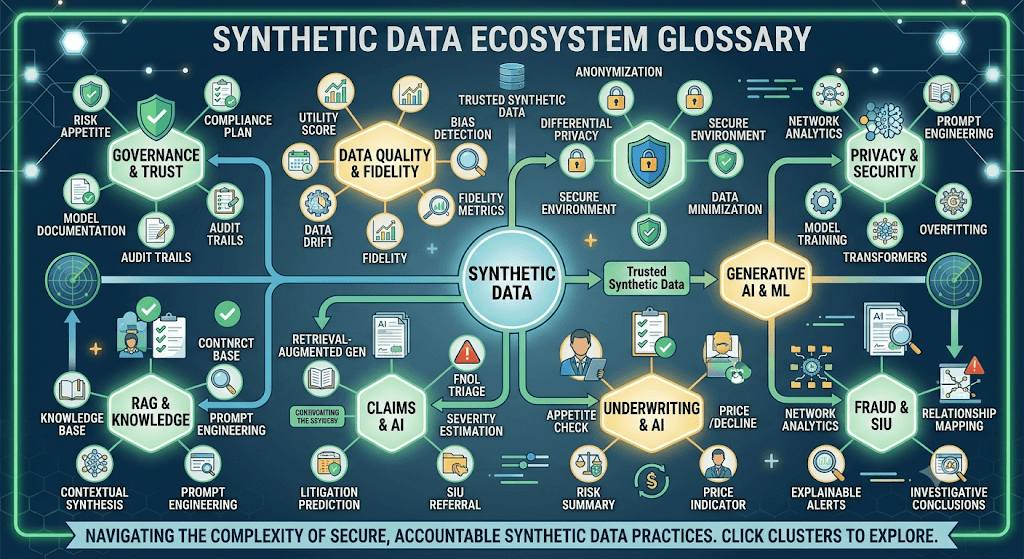
Illustration Brief - Knowledge Center Cross-Reference Map
Recommended illustration: Place Synthetic Data at the center with connected hubs for foundations, governance, claims, underwriting, fraud, enterprise AI, and implementation.
Preferred format: Hub-and-spoke map
Production notes: Use as a navigation aid for web and downloadable editions.
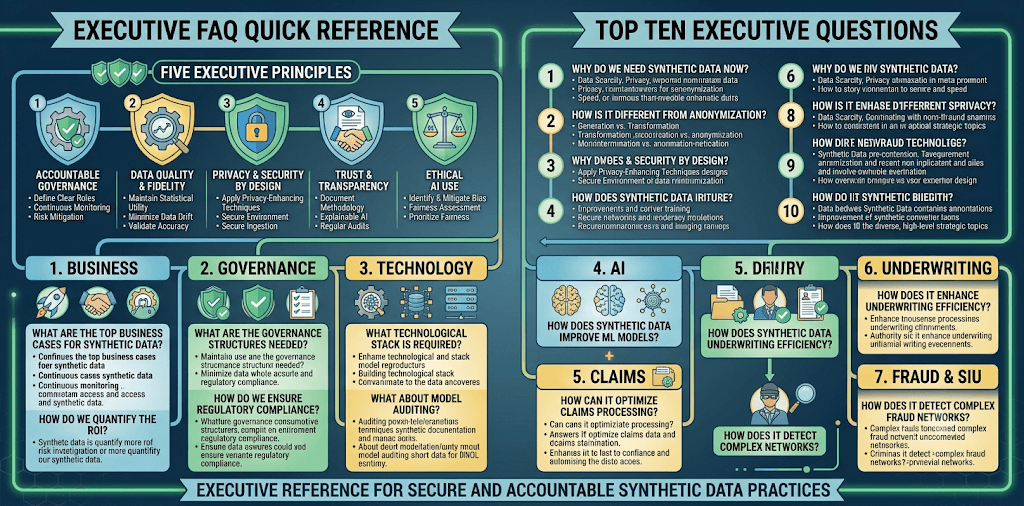
Executive Quick Reference Guide
A boardroom-ready summary
What Is Synthetic Data?
Synthetic data is artificially generated information that reflects selected characteristics and relationships of real data without reproducing actual customer records. It supports AI development, testing, training, demonstrations, and collaboration. It complements production data; it does not replace it.
Where It Creates Value
| Area | Examples |
|---|---|
| Claims | FNOL, severity, litigation, documents, reserves, fraud, training. |
| Underwriting | Submission intake, appetite, risk summaries, portfolios, training. |
| Enterprise AI | Model development, software testing, RAG evaluation, demos, partner use. |
| Governance | Reduced exposure, repeatable validation, controlled scenarios. |
Five Executive Principles
Start with the business problem.
Governance enables innovation.
Human expertise remains central.
Validate statistical fidelity, business realism, privacy, and utility.
Measure business outcomes, not technical activity alone.
Implementation Roadmap
Strategy and alignment → governance and data readiness → pilot → controlled expansion → enterprise integration → continuous improvement.
Common Mistakes
- Assuming synthetic data eliminates privacy risk.
- Skipping expert and real-world validation.
- Training exclusively on synthetic data without justification.
- Failing to label and version datasets.
- Measuring generation volume instead of business value.
Executive Checklist
- Clear objective and sponsor.
- Approved source data and purpose.
- Named dataset and business owners.
- Validation and privacy plan.
- Protected real-world holdout.
- Defined workflow and human authority.
- KPI dashboard and review cadence.
- Monitoring, incident, refresh, and retirement procedures.
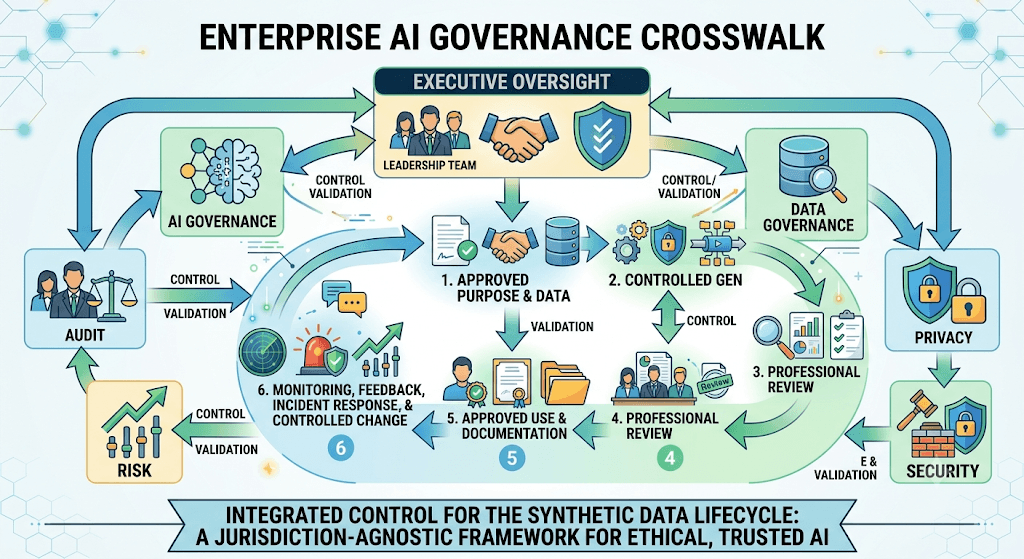
AI Governance and Compliance Crosswalk
Integrating synthetic data with existing enterprise controls
Governance Philosophy
Synthetic data should be incorporated into existing AI, data, privacy, cybersecurity, legal, compliance, enterprise-risk, and audit programs rather than governed through a disconnected parallel structure.
Enterprise Governance Framework
| Governance Domain | Primary Objective |
|---|---|
| Executive oversight | Strategic direction, funding, and accountability. |
| AI governance | Responsible lifecycle management and model oversight. |
| Data governance | Quality, ownership, lineage, and stewardship. |
| Privacy | Minimization, disclosure risk, permitted use, and rights. |
| Information security | Access, protection, monitoring, and incident response. |
| Legal and compliance | Requirements, contracts, policy, and regulatory alignment. |
| Enterprise risk management | Operational and strategic risk oversight. |
| Internal audit | Independent review and assurance. |
Governance Control Matrix
| Control Area | Recommended Control |
|---|---|
| Business purpose | Document intended use, users, decisions, and outcomes. |
| Executive sponsorship | Assign accountable executive owner. |
| Dataset ownership | Designate business and technical owners. |
| Generation method | Document methods, assumptions, code, and configuration. |
| Validation | Complete statistical, business, privacy, and utility evaluation. |
| Documentation | Maintain lineage, metadata, approvals, and versions. |
| Security | Apply access, environment, logging, and sharing controls. |
| Privacy | Assess memorization, linkage, and disclosure risk. |
| Lifecycle | Define creation, review, refresh, and retirement. |
| Monitoring | Evaluate quality, use, incidents, and effectiveness. |
Audit Readiness Checklist
- Business objectives and sponsor documented.
- Dataset ownership and permitted use defined.
- Validation and privacy reports complete.
- Access, security, and sharing controls evidenced.
- Version history and approvals maintained.
- Monitoring and governance reviews performed.
- Issues, corrections, and retirements documented.
Additional Reading and Industry Resources
Continuing education for enterprise AI leaders
Artificial Intelligence Strategy
- Enterprise AI adoption
- AI operating models
- Digital transformation
- Organizational change
- AI ROI
Synthetic Data
- Generation methods
- Statistical validation
- Privacy-preserving data
- Testing methodologies
- Enterprise governance
Machine Learning
- Model evaluation
- MLOps
- Feature engineering
- Monitoring
- Robustness
Generative AI
- LLMs
- Prompt engineering
- RAG
- AI assistants
- Responsible GenAI
AI Governance
- Responsible AI
- Explainability
- Human oversight
- Model validation
- Risk management
Data Management
- Data governance
- Quality
- Metadata
- Lineage
- Architecture
Cybersecurity and Privacy
- Privacy engineering
- Identity and access
- Secure AI development
- Data protection
- Operational resilience
Insurance Technology
- Claims technology
- Underwriting platforms
- Document intelligence
- Fraud detection
- Core modernization
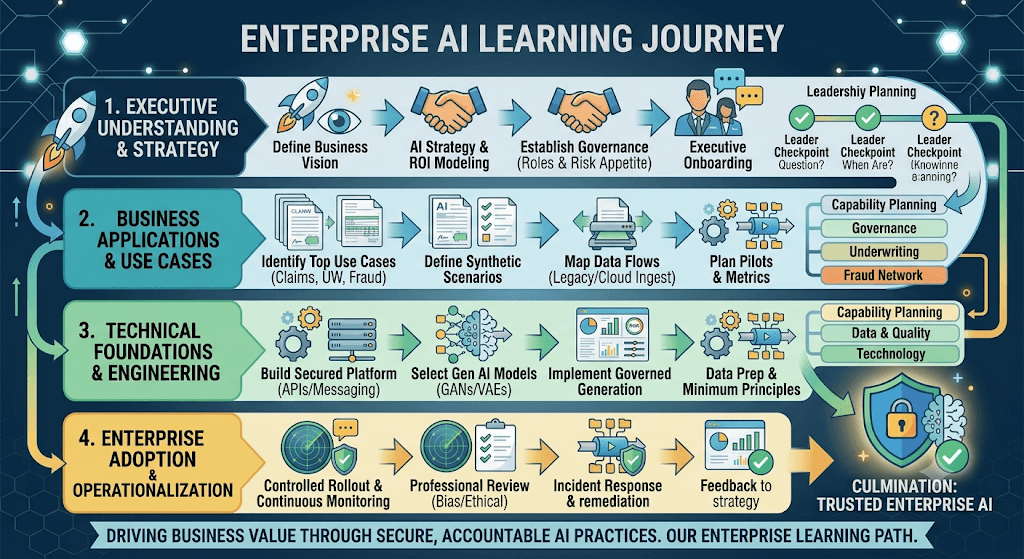
Charlee.ai Recommended Learning Path
| Phase | Focus |
|---|---|
| 1 - Executive Understanding | AI strategy, responsible AI, governance, and business value. |
| 2 - Business Applications | Claims, underwriting, fraud, and document intelligence. |
| 3 - Technical Foundations | Machine learning, generative AI, synthetic data, RAG, and data governance. |
| 4 - Enterprise Adoption | Operating model, change, performance measurement, and continuous improvement. |
References and Bibliography
Authoritative categories for future editions
Purpose
This guide combines insurance practice, enterprise AI governance, data management, privacy, security, synthetic-data methods, and implementation guidance. Future editions should rely on current, authoritative sources and record versions and dates used for material control or policy decisions.
Purpose
| Reference Area | Recommended Coverage |
|---|---|
| Artificial Intelligence | Enterprise AI, machine learning, generative AI, model lifecycle, and responsible AI. |
| Synthetic Data | Generation, fidelity, privacy, utility, benchmarking, and enterprise implementation. |
| AI Governance | Governance frameworks, model risk, explainability, fairness, and human oversight. |
| Data Governance | Quality, metadata, lineage, stewardship, architecture, and retention. |
| Privacy | Privacy engineering, de-identification, disclosure risk, and ethical use. |
| Information Security | Cybersecurity frameworks, secure development, cloud security, and AI security. |
| P&C Insurance | Claims, underwriting, fraud, actuarial, catastrophe, operations, and regulation. |
| Document Intelligence | OCR, NLP, IDP, multimodal AI, retrieval, and enterprise content management. |
| Change Management | Leadership, adoption, workforce design, communications, and transformation. |
| Standards and Best Practices | AI, data, privacy, security, risk, quality, and enterprise architecture standards. |
| Academic Research | Synthetic data, privacy-preserving AI, robustness, explainability, and human-AI collaboration. |
| Industry Research | Insurance, technology, and executive benchmarking studies. |
Citation Guidance for Future Editions
- Confirm current edition and applicability.
- Distinguish regulatory or standards guidance from commercial opinion.
- Record source, publication date, version, and access date.
- Avoid unsupported quantitative claims.
- Use direct references for material legal, regulatory, technical, or market statements.
Illustration Brief - Trusted Sources for Enterprise AI
Recommended illustration: Synthetic Data at the center of AI research, insurance practice, governance, data management, privacy/security, academic research, technology innovation, and the Knowledge Center.
Preferred format: Knowledge ecosystem
Production notes: Keep the graphic evergreen and vendor-neutral.
Closing Perspective
Synthetic data should be viewed as a strategic enterprise capability that supports responsible innovation. Its greatest value lies not simply in creating artificial records, but in enabling organizations to learn and test more safely, collaborate more effectively, build better AI systems, and deliver measurable outcomes while preserving customer trust and professional accountability.
Closing Perspective
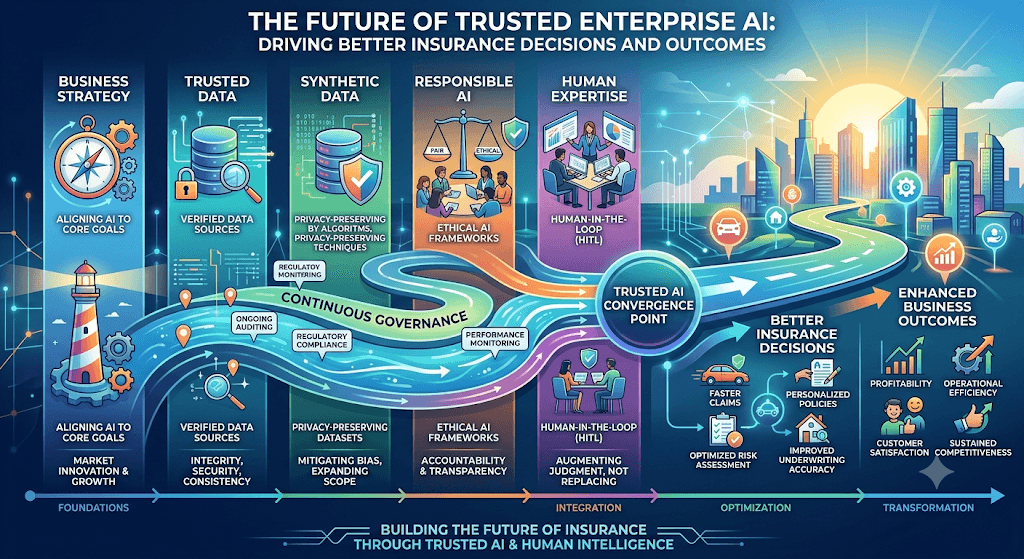
FINAL EXECUTIVE MESSAGE
The future of insurance AI will belong to organizations that combine technology, governance, trusted data, and human expertise into a unified enterprise strategy. Synthetic data can accelerate that journey when it is governed, validated, and used with discipline.
Key Takeaways
- Synthetic data complements production data; it does not replace representative real-world validation.
- Privacy, bias, realism, and leakage risks must be governed throughout generation and use.
- Synthetic data creates value when it improves testing, training, rare-scenario coverage, or collaboration without exposing sensitive records.
- Quality should be measured against fitness for the intended insurance purpose.
- Human accountability remains required for decisions that affect customers, claims, and underwriting outcomes.
Synthetic data is artificially generated information designed to reflect the statistical patterns, relationships, and business behaviors found in real data without reproducing actual policyholder, claimant, employee, or partner records.
How insurers can use artificially generated information to accelerate AI development, strengthen testing, improve collaboration, and support responsible innovation.
Frequently Asked Questions
Artificially generated information designed to reflect selected characteristics of real data without representing actual records.
To support development, testing, training, collaboration, and rare-scenario coverage while reducing unnecessary exposure of sensitive data.
No. It complements production data and still requires representative real-world validation.
No. It may leak information, reproduce bias, omit important patterns, or create unrealistic records.
Yes. Generated outputs may reveal memorized source content or proprietary business patterns.
Sometimes for narrow tasks, but most material insurance use cases should be evaluated against protected real-world evidence and often benefit from hybrid data.
It may improve coverage or robustness when well designed, but it can also degrade performance. Improvement must be measured.
Yes. It can support prompt testing, safety evaluation, structured-output checks, and document scenarios.
Yes, especially text and mixed-content scenarios, but outputs require constraints, privacy review, and business validation.
For FNOL, document intelligence, severity, litigation, reserves, fraud, subrogation, testing, and training.
Yes. Controlled simulations can support repeatable practice without exposing real claimants.
It supports submission processing, appetite tests, risk summaries, portfolio scenarios, and training.
It can generate artificial examples for testing, but they are not professional engineering opinions.
It broadens scenarios and network tests; alerts remain investigative leads.
Yes. Artificial relationships can test graph analytics and SIU workflows.
A named business owner should share accountability with data, technology, privacy, security, legal, and AI-governance functions.
Approved purpose, source authority, validation, documentation, access, monitoring, change control, and retirement.
Through statistical, business, privacy, fairness, security, and real-world utility evaluation.
When products, costs, behaviors, source data, models, or intended uses materially change—not by calendar alone.
Controlled source access, generation tools, validation services, versioned storage, registry, secure environments, and monitoring.
Build, buy, or partner based on strategic fit, talent, data type, transparency, governance, integration, and economics.
Yes. It can populate systems, exercise interfaces, and test failures at scale.
With one high-value, bounded use case and a protected real-world evaluation plan.
Treating synthetic data as inherently safe or valuable without a defined purpose and rigorous validation.
Business ownership, source quality, governance, reusable capabilities, workflow adoption, and measurable outcomes.