Executive Overview
AI bias is a systematic tendency in data, models, or workflows that can produce distorted, inconsistent, or unjustified outcomes. In P&C insurance, it can affect claims prioritization, fraud referrals, underwriting recommendations, and service—and must be managed through fairness testing, governance, and human oversight.
| Dimension | Executive Takeaway |
|---|---|
| Plain-English meaning | AI bias is a systematic tendency in data, models, or workflows that can produce distorted, inconsistent, or unjustified outcomes. |
| Insurance relevance | Bias can affect claims prioritization, fraud referrals, underwriting recommendations, pricing support, service, and customer communications. |
| Core management principle | Evaluate the complete decision system—not only the algorithm—and distinguish legitimate risk differentiation from unfair discrimination. |
| Human role | Professionals must understand evidence, challenge inappropriate outputs, correct errors, document decisions, and escalate concerning patterns. |
| Success measure | Comparable accuracy and treatment across relevant populations, defensible differences, effective correction paths, and stable business outcomes. |
Executive Summary
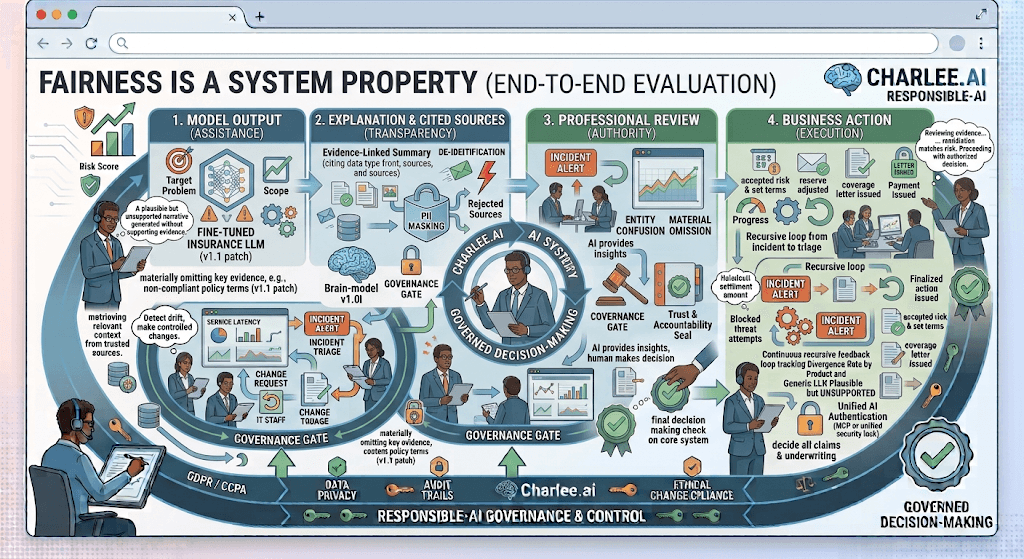
AI bias is not a single technical defect. It can enter through historical data, labels, sampling, feature design, objectives, thresholds, user behavior, vendor services, and the operational process in which an output becomes a decision. A model may perform well on average while producing materially different error rates or burdens for particular groups, regions, claim types, or customer segments.
In Property & Casualty insurance, not every difference is improper. Insurance requires risk classification, professional judgment, and the use of relevant evidence. The governance challenge is to determine whether differences are supported by legitimate business and actuarial considerations, whether prohibited or inappropriate attributes and proxies are being used, whether error and service burdens are distributed reasonably, and whether affected people have practical opportunities for review and correction.
Bias management therefore requires a socio-technical approach. Insurers should examine data provenance and representation, model performance by relevant segments, feature and proxy effects, decision thresholds, explanations, human overrides, downstream actions, customer impact, and production drift. Testing should be tied to the specific use case rather than reduced to a single fairness score.
The objective is not to claim that an AI system is perfectly neutral. It is to identify material risks, make justified tradeoffs explicit, preserve professional accountability, monitor real outcomes, and intervene when the system creates unsupported or unfair patterns.
Quick Facts
- Bias can arise without explicit use of a protected characteristic because other variables may act as proxies.
- Balanced training data does not automatically produce fair outcomes; labels, objectives, thresholds, and workflows also matter.
- Average accuracy can conceal important differences in false-positive, false-negative, calibration, or service outcomes.
- Fairness metrics can conflict, so organizations must choose measures that fit the decision, harm, and legal context.
- Human review can reduce bias only when reviewers have evidence, authority, training, and time to challenge outputs.
- Overrides, complaints, corrections, and downstream outcomes are essential monitoring signals.
Definitions and Scope
Executive Definition
AI bias is a systematic tendency in an AI-enabled process that causes certain people, claims, risks, or situations to be treated differently or less accurately for reasons that may be unsupported, unintended, or inconsistent with approved policy and law.
Technical Definition
AI bias is a persistent distortion in data representation, labels, features, model behavior, evaluation, thresholds, or human-machine interaction that changes error rates, scores, rankings, recommendations, or outcomes across relevant subpopulations or contexts.
Insurance Definition
In insurance, AI bias is an unjustified or insufficiently controlled pattern in AI-supported claims, underwriting, fraud, pricing, servicing, or management workflows that may create unfair discrimination, inconsistent treatment, unequal error burdens, or unsupported differences in customer outcomes.
Insurance Definition
| Concept | Primary Question | Insurance Example |
|---|---|---|
| Statistical bias | Is the estimate systematically off? | Severity predictions consistently understate a type of bodily-injury claim. |
| Social or historical bias | Does past data reflect unequal access, treatment, or institutional practice? | Historical referrals reflect inconsistent investigative practices across offices. |
| Algorithmic bias | Does the model or optimization process amplify a pattern? | A threshold creates more false fraud referrals for a particular segment. |
| Unfair discrimination | Does a difference violate applicable law or lack a legitimate, supported basis? | A rating or underwriting outcome relies on a prohibited factor or unjustified proxy. |
| Fairness | Are relevant people or groups treated consistently under defined criteria? | Comparable claims receive comparable review quality and correction opportunities. |
Insurance Definition
KEY DISTINCTION
AI bias is broader than unlawful discrimination. A system can be statistically biased without violating law, and a system can create legally or operationally problematic outcomes even when a model-level fairness metric appears acceptable.
Insurance Definition
BUSINESS CONTEXT
Why AI Bias Matters in P&C Insurance
| Insurance Reality | Bias Implication |
|---|---|
| Insurance decisions rely on historical data. | Past practices, access patterns, settlement behavior, and reporting differences may be embedded in labels and outcomes. |
| Risk classification is legitimate but constrained. | Differences must be based on relevant, permitted, supportable factors rather than prohibited attributes or unjustified proxies. |
| Claims and underwriting involve professional judgment. | Human decisions can mitigate or amplify model bias depending on evidence, incentives, authority, and workload. |
| Errors have different consequences. | A false negative may miss a severe claim; a false positive may create unnecessary investigation, delay, or customer burden. |
| Vendor and third-party data are common. | Insurers remain responsible for evaluating bias even when models, scores, or data are externally supplied. |
| Consumer impact can emerge downstream. | A prioritization score may influence service levels, reserve attention, referrals, communications, and eventual outcomes. |
EXECUTIVE INSIGHT
The relevant question is not whether every group receives identical outcomes. It is whether differences are explainable, permitted, supported by the business purpose, proportionate to risk, and monitored for unintended harm.
RISK TAXONOMY
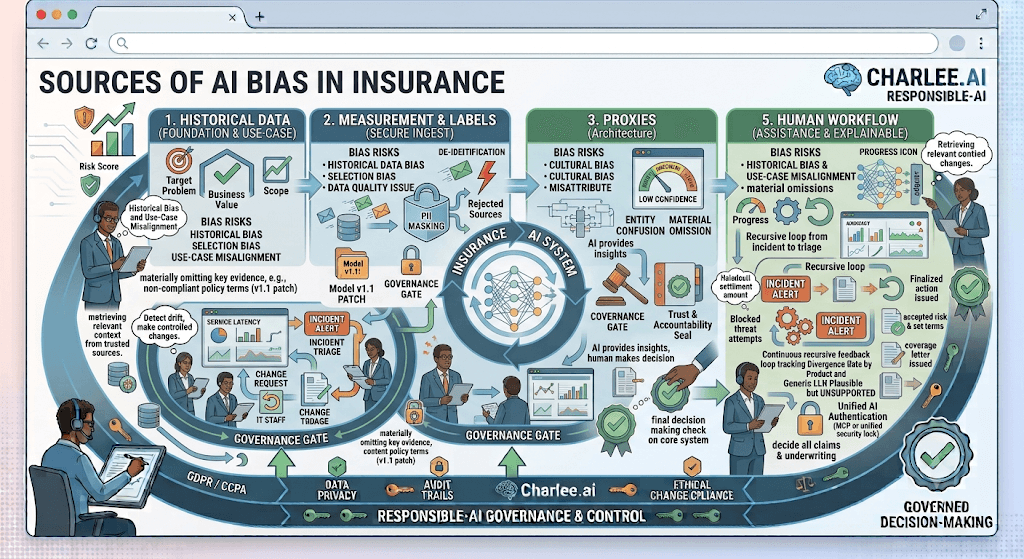
Where AI Bias Comes From
| Source | How Bias Enters | Insurance Illustration |
|---|---|---|
| Problem framing | The objective ignores important harms or stakeholders. | Optimizing only for fraud yield without considering false-referral burden. |
| Sampling | Training data underrepresents key populations or conditions. | Catastrophe claims or small commercial accounts are sparse in training data. |
| Measurement | Inputs are incomplete or measured differently. | Medical documentation quality varies by provider, geography, or claimant access. |
| Labels | Historical outcomes reflect inconsistent judgment. | Litigation or fraud labels depend on prior referral and investigation practices. |
| Features and proxies | Variables indirectly encode sensitive characteristics. | ZIP code, language, occupation, or digital behavior acts as a proxy. |
| Model objective | Optimization rewards the wrong tradeoff. | A model maximizes overall accuracy while missing high-impact minority cases. |
| Thresholds | A single cutoff creates unequal error burdens. | Fraud or underwriting referral thresholds affect segments differently. |
| Interface and workflow | Users see incomplete evidence or follow automation cues. | A score is prominent while uncertainty and contrary evidence are hidden. |
| Feedback loops | Model-influenced actions create future training data. | More investigations in one segment generate more recorded findings there. |
| Production change | Population, process, or data drift alters performance. | New repair practices or legal patterns shift segment-level accuracy. |
FAIRNESS
Fairness Is Context-Specific
There is no universal fairness metric that resolves every use case. Different measures answer different questions, and some cannot be satisfied simultaneously when underlying outcome rates differ. Insurers should begin with the decision, affected parties, potential harm, applicable legal requirements, and the operational meaning of an error.
| Fairness Lens | What It Examines | When It May Matter |
|---|---|---|
| Representation | Whether relevant groups and conditions are adequately present in data. | Training, validation, catastrophe scenarios, jurisdictions, and lines of business. |
| Error-rate parity | Whether false positives or false negatives differ materially. | Fraud referral, litigation prediction, severity escalation, and triage. |
| Calibration | Whether a score has similar meaning across groups or segments. | Risk scores and predicted probabilities used for prioritization. |
| Selection-rate parity | Whether recommendations or referrals occur at similar rates. | Useful as a diagnostic, but differences may require legitimate-risk analysis. |
| Individual consistency | Whether similar cases receive similar treatment. | Claims with comparable evidence or submissions with comparable risk. |
| Process fairness | Whether people receive evidence, review, correction, and appeal. | Customer communications, claim decisions, underwriting referrals. |
| Outcome fairness | Whether downstream service or financial outcomes show unjustified disparities. | Cycle time, settlement support, referral burden, declination, or pricing impact. |
MANAGEMENT PRINCIPLE
Select fairness measures before seeing the preferred result. Document why the measures fit the use case, what tradeoffs are accepted, and who has authority to approve residual risk.
LIFECYCLE
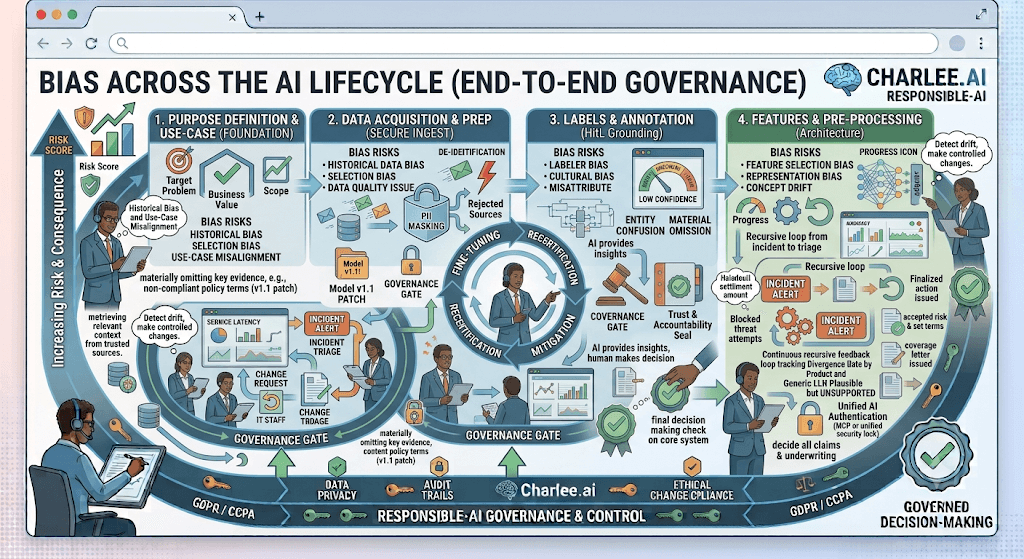
Bias Across the AI Lifecycle
| Lifecycle Stage | Bias Questions | Core Evidence |
|---|---|---|
| Use-case intake | Whose interests, harms, and authority are implicated? | Use-case charter, affected-party analysis, prohibited outcomes. |
| Data preparation | Who is represented, missing, mislabeled, or measured differently? | Data sheet, lineage, segment profile, label review. |
| Design | Could features, objectives, thresholds, or explanations create unequal burdens? | Feature review, causal analysis, proxy tests, workflow design. |
| Validation | How do performance and errors vary by relevant segments and scenarios? | Segment metrics, confidence intervals, scenario tests, independent challenge. |
| Deployment | Do access, training, explanations, and review controls support fair use? | Release checklist, user testing, authority matrix, SOPs. |
| Monitoring | Are error, referral, override, complaint, and outcome patterns changing? | Dashboards, alerts, investigations, corrective actions. |
| Change and retirement | Could a model, data, policy, vendor, or workflow change alter fairness? | Impact assessment, regression testing, approval, archived evidence. |
DATA
Data, Labels, and Representation
Data Quality Is Necessary but Not Sufficient
Accurate, complete, timely, and well-governed data reduces risk, but fairness requires additional analysis. Data can be technically clean while still reflecting historical inequities, inconsistent access, selective observation, or labels created by prior decisions.
Label Bias
Labels often appear objective because they are stored as fields. In practice, labels such as fraud, litigation, severity, claim complexity, or underwriting quality may depend on who was investigated, how a claim was managed, when information became available, and which business rule was in effect.
Missingness as Information and Risk
Missing data can reflect ordinary operational variation, but it can also reflect access, language, provider, broker, technology, or process differences. Treating missingness as a predictive signal without understanding its cause can create problematic proxies.
Missingness as Information and Risk
| Data Control | Practical Requirement |
|---|---|
| Provenance | Identify who created the data, for what purpose, and under which process. |
| Representation | Measure coverage across relevant lines, jurisdictions, claim types, account sizes, and customer segments. |
| Label review | Audit consistency, timing, leakage, subjectivity, and differential observation. |
| Proxy analysis | Test whether variables encode sensitive or prohibited attributes directly or indirectly. |
| Temporal validity | Ensure features and labels were available at the time the historical decision would have been made. |
| Correction rights | Create mechanisms to correct source records and propagate corrections to downstream systems. |
Missingness as Information and Risk
MODEL DESIGN
Features, Objectives, Thresholds, and Explanations
Feature Governance
Feature review should address relevance, permission, stability, interpretability, and proxy risk. Removing a protected attribute does not necessarily remove its influence, while retaining it in a controlled validation environment may be necessary to test outcomes.
Objective Functions
A model optimized for portfolio-wide accuracy may perform poorly on rare but consequential claims. A fraud model optimized only for positive predictive value may impose excessive review burden on a smaller group. Objectives should reflect business value and the cost of different errors.
Threshold Governance
Thresholds translate scores into workflow actions. They should be approved, documented, tested by segment, and monitored. Changing a threshold can alter fairness even when the underlying model is unchanged.
Explainability
Explanations help users identify unsupported factors, missing evidence, and unusual patterns. They do not prove fairness. A clearly explained biased decision remains biased; explanation must be combined with validation and outcome monitoring.
INSURANCE APPLICATIONS
Bias Risks Across Insurance Workflows
| Workflow | Potential Bias Risk | Control Emphasis |
|---|---|---|
| Claims triage | Certain claims receive delayed or lower-priority review because of proxy features. | Comparable service standards, segment error analysis, override monitoring. |
| Severity prediction | Underprediction for underrepresented injury or claim patterns. | Calibration by segment, missing-data controls, specialist escalation. |
| Litigation prediction | Geography, attorney, language, or provider patterns act as unstable proxies. | Feature governance, explanation, temporal validation, professional review. |
| Fraud and SIU | Historical referral practices create feedback loops and unequal scrutiny. | Treat score as referral support, corroboration, false-positive analysis. |
| Underwriting triage | Small, new, or nonstandard businesses are systematically deprioritized. | Representative testing, referral quality, appetite-rule traceability. |
| Pricing support | Data or model effects produce unfairly discriminatory rates. | Actuarial and legal review, approved factors, filing and governance controls. |
| Document intelligence | OCR or extraction accuracy varies by language, format, handwriting, or image quality. | Field-level confidence, segment testing, exception routing. |
| Customer communication | Language generation differs in clarity, tone, or completeness. | Approved content, readability testing, source verification, review. |
CASE STUDY
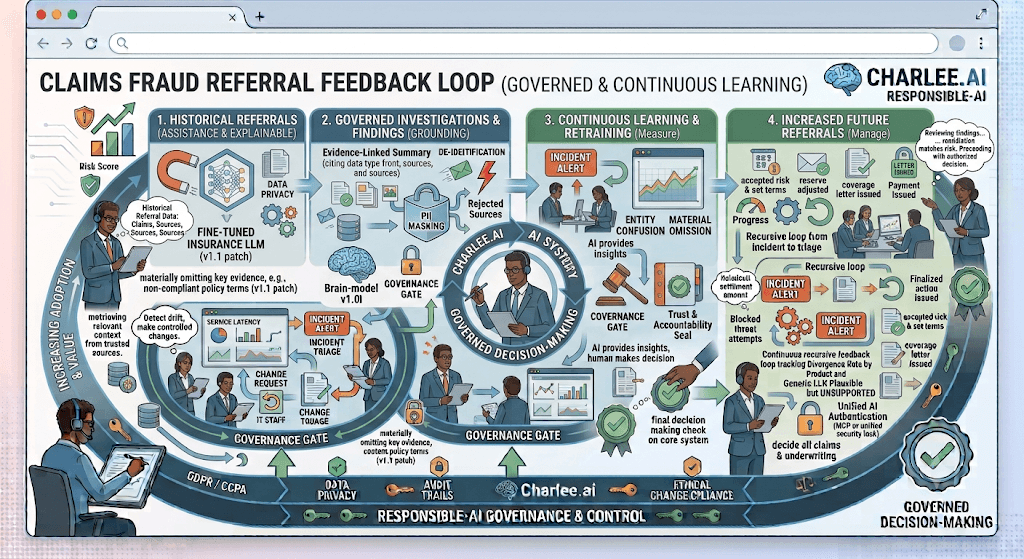
Claims Case Study: Fraud Referral Bias
A carrier uses predictive AI to prioritize casualty claims for potential SIU review. Historical data includes prior referrals, investigative findings, claim notes, provider information, geography, and claim behavior.
Risk
The historical referral label reflects prior investigator capacity and local practices. Geography and provider variables may operate as proxies. Increased scrutiny creates more documented findings, which can reinforce the model in a feedback loop.
Control Design
- Define the model as referral support—not proof of fraud or a basis for adverse action.
- Review label quality and distinguish referral, investigation, substantiation, and final disposition.
- Test false-positive and false-negative rates by relevant segments and jurisdictions.
- Require corroborating claim evidence and trained investigator review before escalation.
- Limit the use of sensitive or high-proxy variables and document their business justification.
- Monitor referral burden, investigation outcomes, overrides, complaints, and repeated feedback effects.
- Provide a correction path when source data or identity matching is wrong.
Outcome
The system remains useful for prioritizing limited investigative resources while reducing the risk that historical scrutiny patterns become self-reinforcing or that a score is treated as an adverse conclusion.
CASE STUDY
Underwriting Case Study: Commercial Submission Triage
A commercial insurer uses AI to extract submission data, summarize operations, identify missing information, compare the submission with appetite guidance, and prioritize underwriter attention.
Risk
Document quality, broker sophistication, language, business age, and digital completeness may influence the recommendation even when those factors are not legitimate measures of risk. Smaller or newer businesses may be routed to slower queues or receive more referrals.
Control Design
- Trace every extracted field and appetite result to the source document or approved rule.
- Test extraction and prioritization performance across account size, class, broker format, language, and submission complexity.
- Distinguish missing information from negative risk evidence.
- Prevent the system from binding, declining, pricing, or changing terms.
- Provide underwriters with uncertainty, conflicts, missing fields, and an exception path.
- Monitor referral, quote, decline, turnaround, and override patterns for unjustified differences.
Outcome
The workflow reduces administrative effort without allowing document format, broker resources, or missingness to become hidden substitutes for underwriting judgment.
HUMAN-CENTERED AI
Human Oversight and Automation Bias
Human review is not automatically fairer than an algorithm. Reviewers may reproduce historical patterns, over-trust a score, selectively investigate certain cases, or apply inconsistent exceptions. Effective oversight must be designed and measured.
| Oversight Element | Required Design |
|---|---|
| Evidence | Show source data, material factors, uncertainty, missing information, and limitations. |
| Authority | Allow reviewers to accept, reject, modify, or escalate without improper pressure. |
| Timing | Place review before the consequential action or communication. |
| Competence | Train users on model purpose, bias risks, proxies, error tradeoffs, and escalation. |
| Structured feedback | Capture overrides, reasons, corrections, and disagreement in analyzable form. |
| Management review | Examine reviewer patterns as well as model patterns. |
| Contestability | Provide practical correction and appeal mechanisms where appropriate. |
HUMAN-CENTERED STANDARD
A human approval click is not a fairness control unless the reviewer can understand the evidence, recognize bias risk, exercise independent authority, and document a reasoned decision.
TESTING
Bias and Fairness Testing
Data profiling
Measure representation, missingness, label frequency, and data quality across relevant groups and operating conditions.
Segment performance
Compare accuracy, calibration, false positives, false negatives, abstentions, and confidence.
Proxy testing
Evaluate correlations, feature importance, causal plausibility, and whether combinations of variables recreate sensitive attributes.
Counterfactual testing
Change a sensitive or suspect attribute while holding legitimate risk factors constant, where methodologically appropriate.
Scenario testing
Test edge cases, catastrophes, unusual documents, language variation, disability access, and process failures.
Workflow testing
Evaluate how users interpret, override, and act on outputs; measure automation bias and unequal service burden.
Outcome testing
Examine downstream referrals, cycle time, communications, corrections, complaints, financial outcomes, and customer impact.
Adversarial review
Ask whether a motivated user or poorly designed workflow could exploit or amplify biased behavior.
Statistical Caution
Small samples can create unstable or misleading comparisons. Testing should report denominators, uncertainty, practical significance, and data limitations—not only point estimates. Aggregated groups can also hide differences within subgroups.
METRICS
Bias Metrics and Management Reporting
| Metric Category | Illustrative Measures |
|---|---|
| Representation | Population coverage, missingness, label rates, sample sufficiency, out-of-scope frequency. |
| Performance | Accuracy, calibration, precision, recall, false-positive and false-negative rates by segment. |
| Workflow | Referral rate, queue placement, review time, override rate, escalation, abstention, exception burden. |
| Customer impact | Cycle time, communication quality, correction time, complaints, adverse outcomes, access to review. |
| Human behavior | Reviewer disagreement, automation bias indicators, variance by team, unsupported overrides. |
| Data and proxy risk | Feature stability, proxy indicators, source quality, identity-match errors. |
| Change | Metric movement after model, threshold, data, policy, vendor, or workflow changes. |
| Remediation | Time to detect, contain, investigate, correct, revalidate, and close findings. |
CONTROLS
Bias Mitigation Strategies
| Control Layer | Examples |
|---|---|
| Purpose and scope | Narrow the use case; prohibit unsupported adverse decisions; identify affected parties. |
| Data | Improve representation, correct labels, remove leakage, document missingness, control sensitive attributes. |
| Features | Remove or constrain inappropriate variables; justify high-proxy features; use robust alternatives. |
| Model | Reweight, resample, regularize, calibrate, or use models that better support the required tradeoff. |
| Thresholds | Use validated thresholds, abstention zones, or differentiated review rules where lawful and justified. |
| Workflow | Require evidence, route uncertainty, add specialist review, prevent automatic adverse action. |
| Human oversight | Train reviewers, monitor overrides, preserve authority, and provide escalation. |
| Monitoring | Track segment metrics, complaints, drift, corrections, and business outcomes. |
| Governance | Assign owners, document tradeoffs, approve residual risk, and revalidate material changes. |
DESIGN PRINCIPLE
Mitigation should address the source of bias. Adjusting a fairness metric at the model layer may not correct biased labels, poor access, unequal workflow burden, or downstream human behavior.
VENDOR OVERSIGHT
Third-Party Models and Data
A vendor may not disclose every model detail, but the insurer still needs enough evidence to evaluate suitability, fairness, data use, change, and control. Contracting and validation should reflect the decision impact of the service.
OPERATIONS
- What populations, jurisdictions, lines of business, and time periods were used for development and validation?
- Which sensitive attributes or likely proxies are used, inferred, or excluded?
- What segment-level performance and fairness evidence is available?
- How are labels defined, and what human or institutional processes created them?
- How are model, feature, threshold, data, and subprocessor changes communicated?
- Can the insurer independently test outputs and retain enough evidence for audit and examination?
- What remediation, suspension, and exit rights apply if unfair or unstable patterns emerge?
Monitoring, Incidents, and Controlled Change
| Trigger | Required Response |
|---|---|
| Material segment performance gap | Investigate data, labels, features, thresholds, workflow, and customer impact; contain if necessary. |
| Unexpected referral or selection pattern | Review legitimate-risk explanation, proxy effects, and operational incentives. |
| Complaint or correction cluster | Preserve evidence, assess affected population, correct records, and evaluate broader impact. |
| Data or vendor change | Run impact assessment and regression testing before or immediately after controlled release. |
| Unacceptable user reliance | Redesign interface and approvals; retrain; increase management review. |
| Drift or population change | Recalibrate, retrain, narrow scope, or suspend use until performance is restored. |
| Potential unfair discrimination | Engage legal, compliance, actuarial, risk, and business owners; pause affected use where appropriate. |
IMPLEMENTATION
Implementation Blueprint
1. Inventory AI use cases and identify decisions, actions, affected parties, data, vendors, and jurisdictions.
2. Define the specific fairness concern, potential harm, and legitimate business purpose for each use case.
3. Identify relevant comparison groups and operational segments with legal, actuarial, compliance, and business input.
4. Profile data representation, labels, missingness, proxies, and temporal validity.
5. Select use-case-appropriate performance and fairness measures before final model selection.
6. Test the complete system: model, thresholds, interface, human review, downstream actions, and correction paths.
7. Document tradeoffs, residual risk, approvals, and prohibited uses.
8. Design evidence-centered human oversight and structured override capture.
9. Deploy segment monitoring, complaint analysis, drift detection, and incident triggers.
10. Revalidate after material model, data, policy, vendor, threshold, jurisdiction, or workflow changes.
11. Use findings, corrections, and near misses to improve both the system and the surrounding process.
WHAT TO AVOID
Common Failure Modes
| Failure Mode | Why It Fails | Better Approach |
|---|---|---|
| Removing protected fields and declaring success | Proxies and historical patterns may remain. | Use controlled attributes for testing where permitted; examine proxies and outcomes. |
| Using one fairness metric | Metrics answer different questions and may conflict. | Choose measures tied to the decision, harm, and legal context. |
| Testing only average accuracy | Important segment errors remain hidden. | Report disaggregated performance, uncertainty, and practical impact. |
| Treating historical labels as truth | Labels may reflect prior access and judgment. | Audit label creation, timing, consistency, and observation bias. |
| Relying on vendor assurances | Local populations and workflows may differ. | Validate independently and contract for evidence and change control. |
| Nominal human review | Reviewers may rubber-stamp or amplify bias. | Provide evidence, authority, training, structured feedback, and monitoring. |
| Fixing the model but not the workflow | Unequal service and downstream actions persist. | Evaluate end-to-end outcomes and customer burden. |
| Ignoring small groups | Rare segments may have high consequence. | Use scenario testing, expert review, pooled analysis, and cautious scope. |
| Assuming identical outcomes equal fairness | Legitimate risk differences may exist. | Evaluate supportable factors, comparable treatment, and error burden. |
LEADERSHIP
Executive Decision Guide
| Question | Proceed When | Pause or Redesign When |
|---|---|---|
| Is the purpose legitimate? | The use, affected parties, benefits, harms, and prohibited outcomes are documented. | The system can influence adverse action without clear authority or value. |
| Is the data suitable? | Representation, labels, lineage, missingness, and permissions are understood. | Material groups are absent or labels are unreliable and uncorrected. |
| Are differences justified? | Relevant factors and tradeoffs are documented and independently challenged. | Proxy effects or unsupported disparities remain unexplained. |
| Can users challenge it? | They see evidence, uncertainty, limitations, and have authority to override. | The workflow encourages automatic acceptance or hides contrary evidence. |
| Can impact be monitored? | Segment metrics, complaints, corrections, drift, and outcomes are tracked. | The organization cannot detect or reconstruct material unfairness. |
| Can the system be stopped? | Pause, rollback, remediation, communication, and restart criteria exist. | Harm cannot be contained or affected records corrected reliably. |
EXECUTIVE RULE
Do not approve an AI-enabled insurance workflow merely because the model is accurate overall. Approve a defined use, an evidence-based fairness standard, a proportionate control package, and a monitoring plan that can detect and correct harmful patterns.
PERSPECTIVE
Charlee.ai Perspective
Insurance AI should help professionals see important information earlier, organize evidence, identify changing risk, and make better-informed decisions. It should not hide the source of a conclusion, convert historical patterns into unquestioned rules, or displace accountable professional judgment.
Charlee.ai’s people-plus-AI approach emphasizes approved purpose and data, validated analysis, source-linked findings, explainability, professional review, documented decisions, and continuous monitoring. Bias management fits naturally within this model because fairness cannot be separated from data quality, evidence, workflow design, human authority, and outcome measurement.
The strongest insurance AI systems make uncertainty and limitations visible, support correction, and learn from overrides and outcomes. They enable insurers to improve consistency and focus while preserving the judgment and accountability required for consequential claims and underwriting decisions.
VISUAL SYSTEM
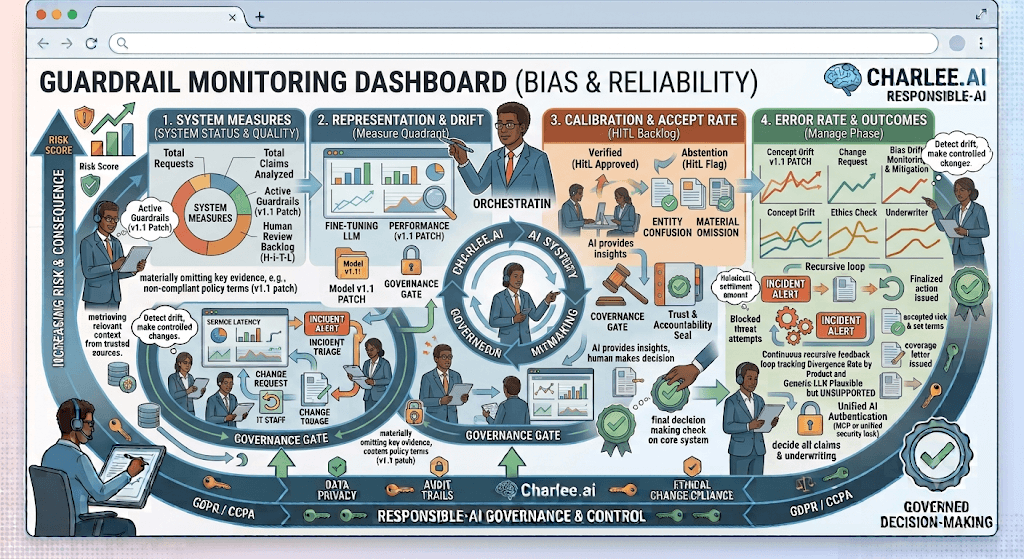
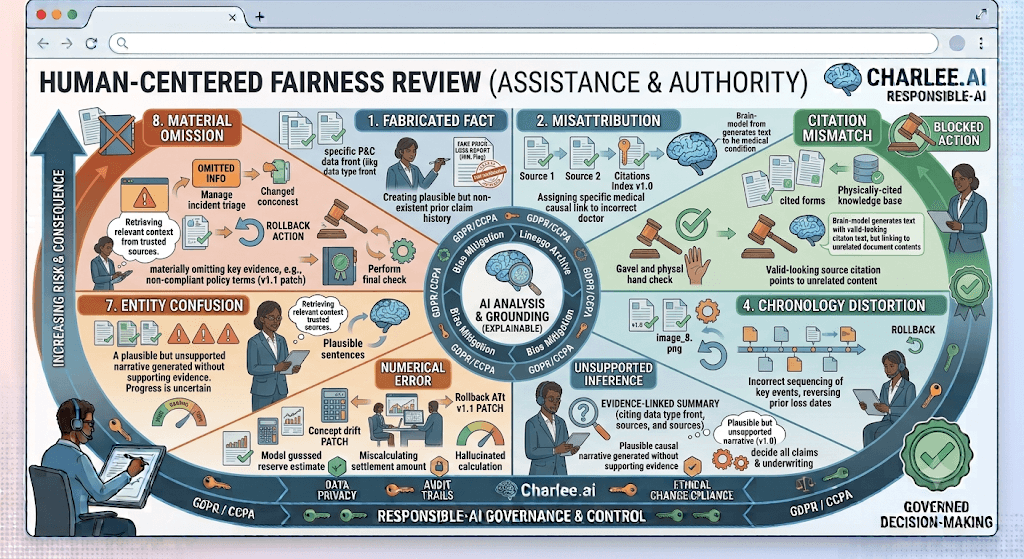
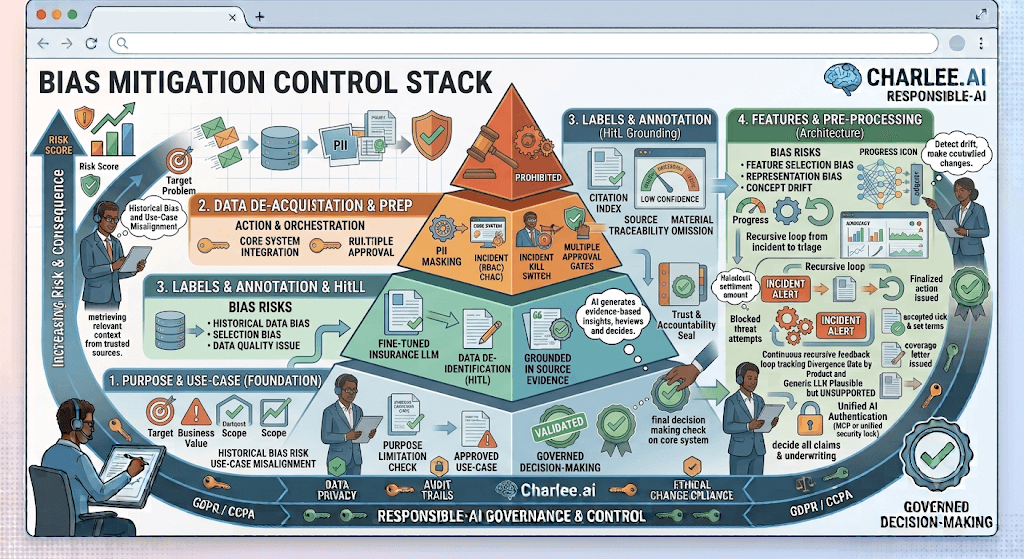
External Framework Alignment
| Framework or Guidance | Relevance |
|---|---|
| NIST AI Risk Management Framework (AI RMF 1.0) | Treats fairness with harmful bias managed as a characteristic of trustworthy AI and emphasizes context, measurement, governance, and risk management. |
| NIST Special Publication 1270 | Provides a socio-technical perspective for identifying and managing bias across the AI lifecycle. |
| NAIC Model Bulletin on the Use of AI Systems by Insurers | Sets expectations for governance and risk management designed to prevent unfair trade practices and unfair discrimination in consumer-impacting decisions. |
| Applicable state insurance laws and guidance | May govern rating, underwriting, claims, privacy, data use, examinations, and unfair discrimination. |
| Internal actuarial, claims, underwriting, compliance, and model-risk standards | Define insurer-specific authority, evidence, testing, and decision controls. |
CURRENT-STATE NOTE
AI laws, regulatory expectations, and technical standards continue to evolve. Before publication or implementation, legal, compliance, actuarial, privacy, security, and model-governance teams should verify current requirements for each jurisdiction and use case.
Key Takeaways
- AI bias can enter through purpose, data, labels, features, objectives, thresholds, interfaces, human behavior, and feedback loops.
- Fairness is context-specific; no single metric or technical fix is sufficient.
- Insurance requires legitimate risk differentiation, but differences must be relevant, permitted, supportable, and monitored.
- Average model performance can conceal important segment-level error and burden.
- Removing protected attributes does not eliminate proxy or historical bias.
- Meaningful human oversight requires evidence, authority, competence, correction, and structured feedback.
- Insurers should validate and monitor the complete decision system, including vendors and downstream outcomes.
- The goal is governed, evidence-centered AI that improves decisions while preserving fairness and professional accountability.
AI bias is a systematic tendency in data, models, or workflows that can produce distorted, inconsistent, or unjustified outcomes. In P&C insurance, it can affect claims prioritization, fraud referrals, underwriting recommendations, and service—and must be managed through fairness testing, governance, and human oversight.
Frequently Asked Questions
AI bias is a systematic tendency in data, models, or workflows that can create distorted, inconsistent, or unjustified outcomes.
No. Insurance legitimately differentiates risk, but differences should be relevant, permitted, supportable, and monitored for unintended or unfair effects.
No. Bias is broader. Unfair discrimination is a legal and regulatory concept that depends on applicable law and the specific insurance practice.
Yes. Strong average accuracy can coexist with materially different errors or burdens for particular groups or contexts.
No. Other variables may act as proxies, and historical labels or workflow effects may remain.
In a controlled and legally reviewed environment, they may be needed to measure disparities that would otherwise remain invisible.
It occurs when a seemingly neutral variable carries information closely related to a sensitive or prohibited attribute.
It arises when the target used for training reflects inconsistent, incomplete, selective, or historically biased decisions.
There is no universal best metric. The choice should match the decision, harm, population, and legal context.
Yes. Some fairness properties cannot all be achieved simultaneously, especially when underlying outcome rates differ.
Use uncertainty estimates, scenario testing, expert review, pooled analysis where appropriate, and cautious scope rather than overconfident conclusions.
Reviewers need evidence, training, authority, time, structured override options, and monitoring of their own decisions.
Yes. Automation bias, inconsistent exceptions, and prior beliefs can amplify unfair patterns.
Generative systems may reproduce stereotypes, omit relevant perspectives, or generate different tone and quality across prompts, languages, or users.
Predictive systems may produce different error rates, calibration, or rankings because of data, labels, features, thresholds, or drift.
Require documentation, representative testing, segment evidence, data-use controls, change notice, auditability, remediation, and exit rights.
Segment performance, referrals, overrides, complaints, correction time, customer outcomes, drift, and material changes.
When material unexplained disparities, unreliable data, legal concerns, or inability to monitor and contain harm are identified. CROSS-LINKING