AI Guardrails
AI guardrails are the policies, technical controls, workflow constraints, monitoring mechanisms, and human oversight practices that keep AI systems operating within approved business, legal, ethical, security, and operational boundaries.
Executive Snapshot
Executive Definition AI guardrails are the policies, technical controls, workflow constraints, monitoring mechanisms, and human oversight practices that keep AI systems operating within approved business, legal, ethical, security, and operational boundaries.
| Dimension | Executive takeaway |
|---|---|
| Primary purpose | Prevent, detect, and respond to unsafe, unauthorized, inaccurate, discriminatory, or noncompliant AI behavior. |
| Core principle | AI should operate only within explicitly approved purposes, data boundaries, actions, users, and escalation paths. |
| Insurance relevance | Guardrails are essential wherever AI influences claims, underwriting, coverage, pricing, fraud, reserves, communications, or customer outcomes. |
| Human role | Professionals retain authority for consequential decisions and exceptions. |
| Success measure | Fewer control failures, better auditability, safer adoption, and more consistent business outcomes. |
Executive Summary
AI guardrails translate governance principles into operational controls. Governance defines who is accountable and what outcomes are acceptable; guardrails determine what an AI system may access, generate, recommend, or execute in practice.
In property and casualty insurance, guardrails must reflect the consequences of the workflow. A summarization assistant may need source citation and privacy controls, while an agent that can change a claim status or draft a coverage communication requires tighter authorization, validation, logging, and human approval.
Effective guardrails are layered. No single prompt, policy, model filter, or approval step is sufficient. Strong programs combine preventive controls, detective controls, corrective controls, and governance evidence across the full AI lifecycle.
Guardrails should be proportionate rather than obstructive. The objective is not to eliminate all model uncertainty. It is to ensure that uncertainty is visible, bounded, and handled through appropriate professional review and escalation.
Quick Facts
- Guardrails apply to data access, model behavior, tool use, outputs, workflow actions, users, vendors, and downstream integrations.
- High-impact insurance decisions require stronger controls than low-risk drafting or research assistance.
- Guardrails should be tested against normal use, edge cases, misuse, adversarial behavior, and changing production conditions.
- Human review is most effective when decision rights, evidence expectations, and escalation triggers are explicit.
- Every blocked, overridden, or escalated event can become valuable monitoring and improvement data.
Definitions
Executive Definition
AI guardrails are the boundaries and controls that keep AI use aligned with approved objectives and prevent the system from exceeding its authority.
Technical Definition
AI guardrails are a layered control architecture consisting of input validation, data-access controls, policy enforcement, model constraints, content filtering, confidence thresholds, tool permissions, workflow gates, monitoring, logging, and response mechanisms.
Insurance Definition
In insurance, AI guardrails are the operational safeguards that ensure AI supports—but does not improperly replace—licensed, accountable, or authorized professionals in consequential decisions involving coverage, claim handling, reserves, settlements, fraud referrals, risk selection, pricing, and policyholder communications.
Why AI Guardrails Matter
| Insurance concern | How guardrails help |
|---|---|
| Incorrect or unsupported output | Require evidence, confidence, and validation before use. |
| Unauthorized data exposure | Restrict retrieval and tools by role, purpose, tenant, and record. |
| Improper automated action | Require approval before consequential workflow changes. |
| Bias or disparate impact | Apply fairness testing, restricted-feature controls, and exception review. |
| Regulatory or litigation exposure | Preserve traceability, approvals, version history, and decision evidence. |
| Prompt injection or tool abuse | Separate instructions from data, validate tool calls, and apply least privilege. |
| Model or workflow drift | Monitor outcomes, overrides, failures, and changing data patterns. |
Key distinction A policy says what should happen. A guardrail makes approved behavior more likely, prohibited behavior harder, and exceptions visible.
The Layered Guardrail Architecture
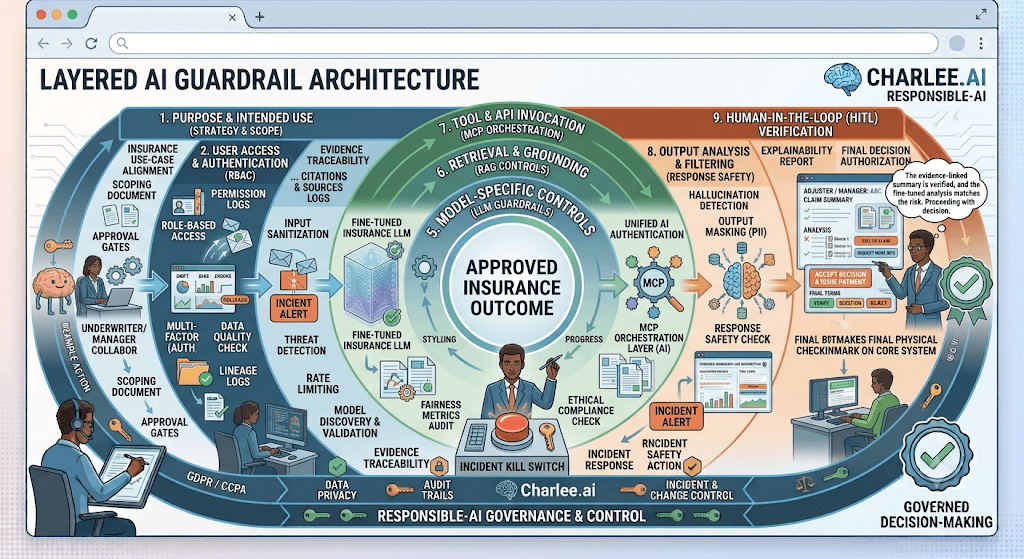
Strong guardrails are defense-in-depth controls. Each layer addresses a different failure mode and compensates for the limitations of the others.
Purpose and policy guardrails
Define approved use cases, prohibited uses, risk tier, decision authority, and required evidence.
Identity and access guardrails
Control who may use the system, what records they may retrieve, and which actions they may invoke.
Data guardrails
Limit sensitive data, enforce minimization, validate provenance, and prevent cross-tenant or cross-claim leakage.
Input guardrails
Detect malformed input, prompt injection, unsafe instructions, missing context, or unsupported requests.
Model guardrails
Constrain output format, confidence, reasoning scope, supported tasks, and fallback behavior.
Retrieval guardrails
Apply authorization-aware retrieval, metadata filtering, source quality thresholds, and citation requirements.
Tool and action guardrails
Use allowlists, parameter validation, transaction limits, approval gates, and rollback controls.
Output guardrails
Screen for unsupported claims, privacy violations, harmful language, policy deviations, and required disclaimers.
Human oversight guardrails
Define review points, escalation triggers, override rights, and documentation requirements.
Monitoring and response guardrails
Log activity, detect drift or abnormal behavior, suspend unsafe functions, and manage incidents.
Monitoring and response guardrails
Design principle The highest-risk control is often not the model itself. It is the point where a model output becomes a business action.
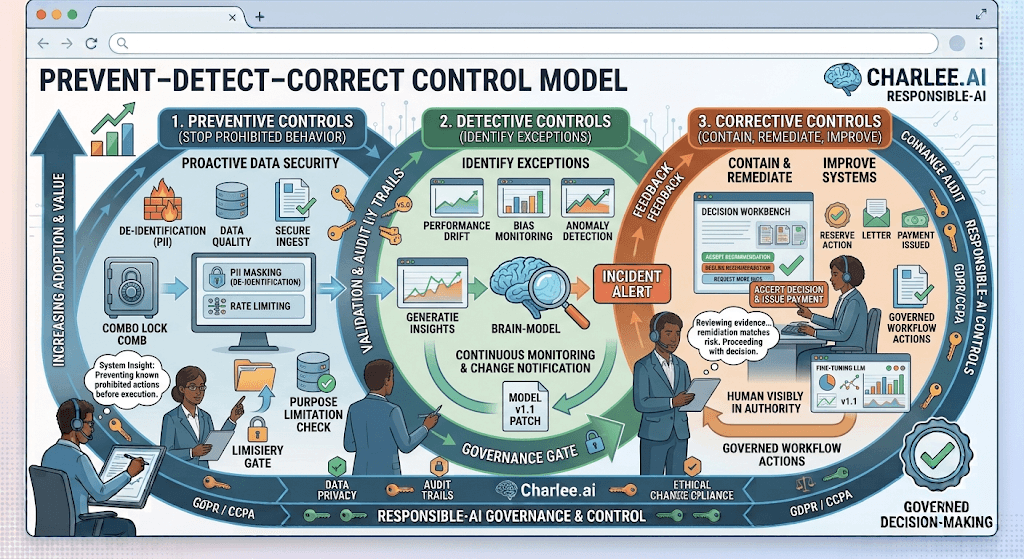
Preventive, Detective, and Corrective Controls
| Control type | Purpose | Insurance examples |
|---|---|---|
| Preventive | Stop inappropriate behavior before it occurs | Role-based access; prohibited-use rules; tool allowlists; approval gates; data minimization. |
| Detective | Identify failures, misuse, or emerging risk | Output validation; anomaly detection; override monitoring; citation checks; fairness testing. |
| Corrective | Contain and remediate problems | Disable a capability; roll back a model; correct records; notify stakeholders; update controls. |
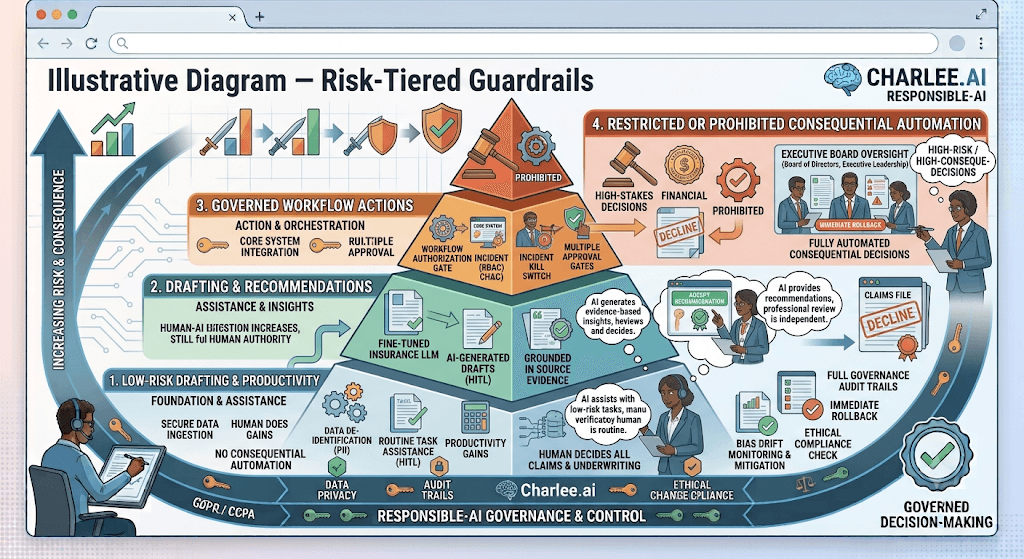
Risk-Tiered Guardrails
| Risk tier | Typical use | Minimum guardrail posture |
|---|---|---|
| Low | Drafting, brainstorming, internal search | Approved data only; user notice; output review; logging. |
| Moderate | Document extraction, summarization, prioritization | Source evidence; confidence thresholds; exception queues; quality monitoring. |
| High | Severity prediction, fraud referral, underwriting recommendation | Independent validation; fairness review; explanations; professional approval; outcome monitoring. |
| Very high | Coverage determination, claim payment, policy cancellation, autonomous settlement | Generally prohibit full autonomy; require explicit authority, legal review, dual controls, and documented human decision. |
Guardrails Across the AI Lifecycle
| Lifecycle phase | Guardrail objective |
|---|---|
| Use-case intake | Confirm purpose, value, stakeholders, affected populations, prohibited outcomes, and risk tier. |
| Data preparation | Validate rights, quality, representativeness, sensitive attributes, retention, and lineage. |
| Design and development | Choose architecture, controls, fallback behavior, explanation method, and workflow boundaries. |
| Testing and validation | Test accuracy, robustness, security, bias, privacy, usability, and control effectiveness. |
| Deployment | Apply access controls, approved configurations, versioning, change controls, and production monitoring. |
| Operation | Monitor performance, drift, exceptions, overrides, incidents, user behavior, and business outcomes. |
| Change and retirement | Revalidate material changes, remove obsolete access, preserve evidence, and manage record retention. |
Guardrail Requirements by AI Pattern
| AI pattern | Distinctive guardrail needs |
|---|---|
| Predictive AI | Threshold governance, feature controls, calibration, fairness testing, explanation, and outcome monitoring. |
| Generative AI | Grounding, citation, hallucination controls, privacy filters, prompt governance, and user verification. |
| RAG | Authorization-aware retrieval, trusted sources, chunk provenance, freshness, and evidence display. |
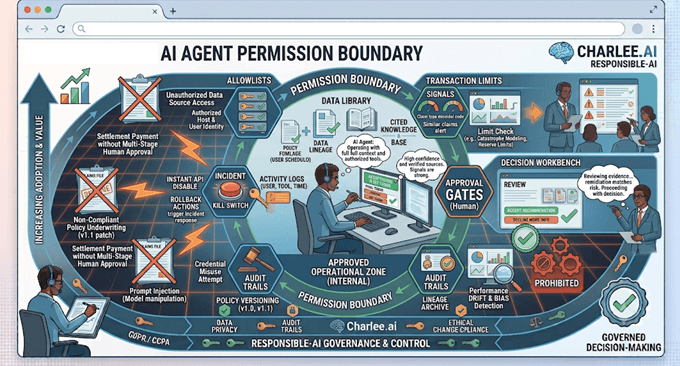
| AI Agents | Tool permissions, action limits, transaction approval, state management, sandboxing, and kill switches. |
| Computer Vision | Image quality rules, confidence thresholds, human review, geolocation/privacy controls, and fraud resistance. |
| IDP/OCR | Document classification, field confidence, business-rule validation, exception routing, and source-image retention. |
Insurance Applications
Claims
- Require source documents for summaries and recommendations.
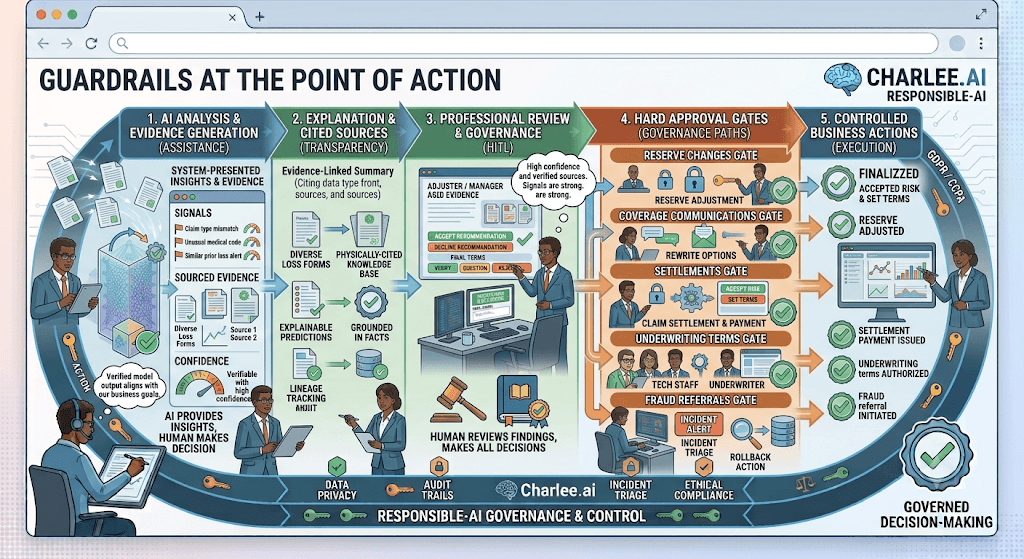
- Prevent AI from changing reserves, coverage status, payments, or settlement authority without approved workflow controls.
- Route low-confidence extraction and contradictory evidence to adjusters.
- Log every model version, input set, recommendation, reviewer, override, and final action.
- Apply additional controls to represented claimants, medical data, litigation, and vulnerable customers.
Underwriting
- Restrict recommendations to approved products, jurisdictions, authority levels, and appetite rules.
- Prevent use of prohibited or unapproved attributes and proxies.
- Require underwriter review of referrals, declinations, terms, and pricing impacts.
- Display material evidence, uncertainty, missing information, and policy exceptions.
- Monitor acceptance, decline, pricing, and portfolio outcomes for unintended patterns.
Fraud and SIU
- Treat models as referral support rather than proof of fraud.
- Require corroborating evidence and trained investigator review.
- Limit sensitive network information and investigative notes by role.
- Monitor false positives and disparate impacts.
- Prohibit adverse action based solely on opaque risk scores.
Customer and Producer Communications
- Use approved language libraries and jurisdictional requirements.
- Identify AI-assisted content where appropriate.
- Block unsupported legal, coverage, or medical conclusions.
- Require review for adverse or consequential communications.
- Preserve the final approved communication and its source evidence.
Case Study 1: Guardrails for Claims Severity and Litigation Prediction
Scenario
A carrier uses predictive AI to identify casualty claims with elevated severity and litigation potential so supervisors can prioritize review.
Primary risks
- Overreliance on a score
- Incorrect escalation caused by poor data
- Bias linked to geography, provider, attorney, or claimant proxies
- Unexplained reserve changes
- Model drift after changes in legal or medical patterns
Guardrail design
Use the model only for prioritization and information support, not autonomous reserve or settlement action.
Display the top contributing signals and source evidence available in the claim file.
Require supervisor approval for material reserve changes or strategy changes.
Suppress recommendations when required data is missing or outside the validated population.
Monitor calibration, false positives, overrides, litigation outcomes, and potential disparate effects.
Revalidate after material model, data, jurisdiction, or claim-process changes.
Guardrail design
Outcome The guardrails preserve the model’s ability to surface early signals while ensuring that trained claims professionals remain accountable for claim strategy and financial decisions.
Case Study 2: Guardrails for Generative Claim Summaries
Scenario
An adjuster workbench generates a chronology, medical summary, and open-issue list from claim notes, medical reports, correspondence, and demand documents.
Guardrail design
- Use retrieval only from records the adjuster is authorized to access.
- Attach source citations to material facts and preserve links to original documents.
- Label uncertain, conflicting, or missing information instead of resolving it silently.
- Block unsupported coverage or medical causation conclusions.
- Require user verification before the summary is placed in the official claim record.
- Log the prompt template, retrieved sources, model version, generated output, edits, and approval.
Case Study 3: Guardrails for an Underwriting AI Agent
Scenario
An AI agent collects submission data, extracts documents, checks appetite, summarizes risk, and prepares a referral package.
Guardrail design
- The agent may read approved submission and policy data but cannot bind, quote, decline, or change terms.
- Tool access is allowlisted and scoped to the current submission.
- Every external data source must be approved, licensed, and documented.
- Appetite results must identify the rule, version, evidence, and exception path.
- Underwriters approve all risk selection, pricing, and coverage decisions.
- A kill switch immediately disables actions if abnormal tool use or cross-record access is detected.
Human-in-the-Loop Guardrails
Human oversight is meaningful only when the reviewer has the authority, information, time, and competence to challenge the AI output. A nominal approval click is not an effective control.
| Oversight element | Required design |
|---|---|
| Decision authority | Identify who may accept, reject, modify, or escalate the recommendation. |
| Evidence | Show source documents, material factors, uncertainty, and known limitations. |
| Timing | Place review before the consequential action, not after it. |
| Competence | Train reviewers on model purpose, limitations, and common failure modes. |
| Override | Permit reasoned override without penalizing appropriate professional judgment. |
| Documentation | Record the recommendation, review, edits, final decision, and rationale. |
Guardrail Testing
- Functional testing: Does the control work as designed?
- Boundary testing: Does the system refuse unsupported or prohibited tasks?
- Adversarial testing: Can prompts, documents, users, or tools bypass restrictions?
- Privacy testing: Can sensitive information be exposed across users, claims, or tenants?
- Fairness testing: Do outcomes or error rates differ materially across relevant groups?
- Robustness testing: Does the system behave appropriately with incomplete, contradictory, or unusual data?
- Workflow testing: Can downstream integrations turn a benign output into an unauthorized action?
- Recovery testing: Can the organization suspend, roll back, correct, and investigate quickly?
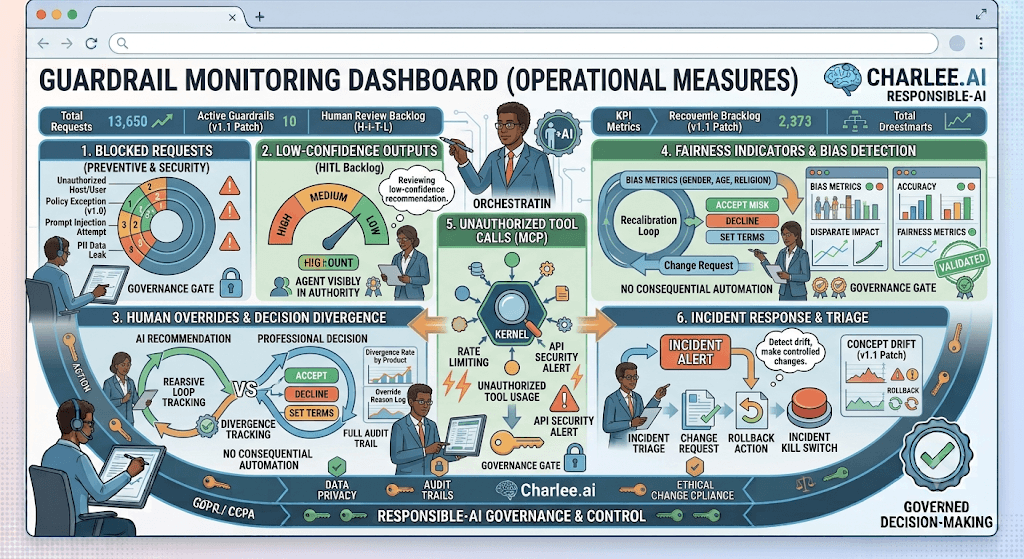
Guardrail Metrics and Management Reporting
| Metric category | Illustrative measures |
|---|---|
| Prevention | Blocked prohibited requests; denied tool calls; prevented data-access violations. |
| Quality | Unsupported-output rate; citation accuracy; extraction exception rate; calibration. |
| Human oversight | Review completion; override rate; override reasons; approval latency. |
| Security | Prompt-injection detections; abnormal tool use; access violations; data-loss events. |
| Fairness | Outcome and error-rate differences; protected-class proxy reviews; exception patterns. |
| Reliability | Availability; latency; fallback use; kill-switch activations; incident recurrence. |
| Business outcome | Cycle time, quality, leakage, customer impact, adoption, and benefit realization. |
Implementation Blueprint
Inventory AI use cases, models, prompts, tools, data sources, vendors, and workflow actions.
Classify each use case by impact, autonomy, data sensitivity, affected parties, and regulatory exposure.
Define prohibited uses and minimum guardrails by risk tier.
Map failure modes from input through downstream action.
Design layered preventive, detective, and corrective controls.
Test control effectiveness, not only model performance.
Assign control owners, evidence requirements, escalation paths, and approval authority.
Deploy monitoring for quality, fairness, security, user behavior, and business outcomes.
Conduct periodic review and revalidation after material changes.
Use incidents, overrides, and near misses to improve controls continuously.
Best Practices
- Design guardrails around the business decision, not merely the model endpoint.
- Use least privilege for data, users, tools, and actions.
- Make the safe path easier than bypassing the control.
- Keep policy, prompt, retrieval, model, and tool versions traceable.
- Show uncertainty and evidence at the moment of professional review.
- Use deterministic business rules where a fixed requirement must always be enforced.
- Separate experimentation from production environments and data.
- Create rapid suspension and rollback capabilities before deployment.
- Treat third-party AI services as part of the controlled system.
- Reassess guardrails as autonomy, scope, data, or user populations expand.
Common Mistakes
| Mistake | Why it fails | Better approach |
|---|---|---|
| Relying on a system prompt | Prompts can be ambiguous, overridden, or bypassed. | Use independent policy enforcement, access, workflow, and monitoring controls. |
| Using one filter for every use case | Risk and context differ widely. | Apply proportionate controls by decision impact and autonomy. |
| Treating human review as a checkbox | Reviewers may lack evidence or authority. | Design meaningful review with clear decision rights. |
| Ignoring downstream actions | A correct output can still trigger an improper action. | Control tools, integrations, transactions, and approvals. |
| Monitoring only accuracy | Security, fairness, misuse, and operational failures remain invisible. | Monitor the full control environment and business outcomes. |
| Allowing unmanaged exceptions | Repeated workarounds erode control effectiveness. | Log, approve, analyze, and remediate exceptions. |
Executive Decision Guide
Before approving an AI-enabled insurance workflow, executives should be able to answer the following questions:
- What business decision or action could the AI influence?
- What outcomes are prohibited, and how are they technically prevented or detected?
- What data, records, tools, and systems may the AI access?
- What can the AI recommend, draft, execute, or change?
- Where is professional approval required?
- What evidence and uncertainty are shown to the reviewer?
- How are fairness, privacy, security, and regulatory obligations addressed?
- How will failures, overrides, incidents, and near misses be monitored?
- Who can suspend the system, and how quickly can the organization recover?
- What documentation proves that the guardrails are operating effectively?
Executive rule The greater the consequence and autonomy, the stronger the guardrails, evidence, validation, and human authority must be.
Charlee.ai Perspective
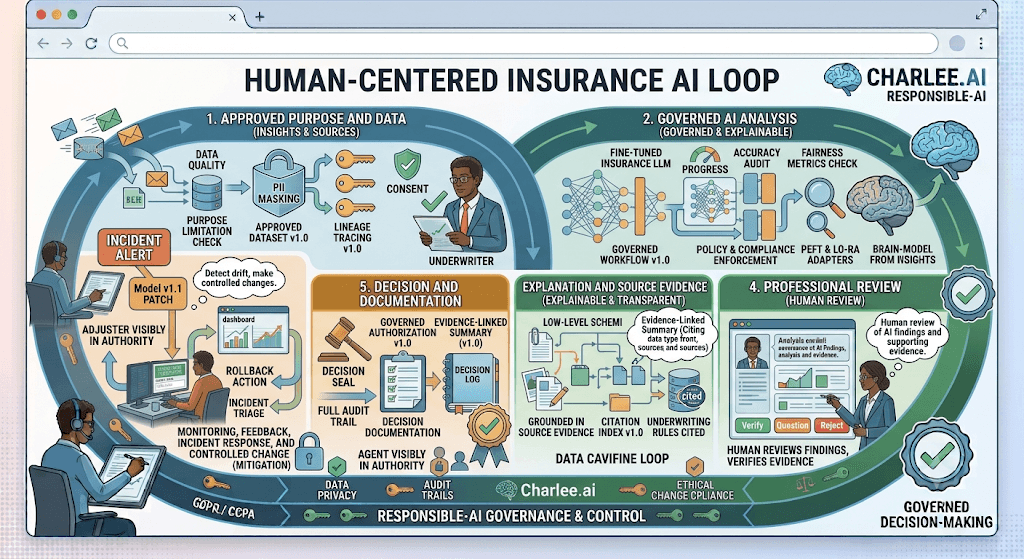
Insurance AI should amplify professional judgment by continuously organizing information, identifying signals, explaining findings, and supporting timely action. It should not obscure the evidence or displace accountable decision-making.
For claims and underwriting, the most effective guardrails are embedded in the workflow: approved data, role-based access, source-linked findings, clear confidence and limitations, professional review, documented decisions, and ongoing monitoring.
Charlee.ai’s human-centered approach emphasizes governed analysis, explainability, evidence, and controlled workflow integration so insurers can gain value from AI while preserving trust, accountability, and operational discipline.
Key Takeaways
- AI guardrails operationalize governance and Responsible AI principles.
- Controls should cover data, inputs, models, retrieval, tools, outputs, users, actions, and monitoring.
- Consequential insurance decisions require stronger validation and human authority.
- Layered controls are more reliable than any single prompt, filter, or approval step.
- Guardrail effectiveness must be tested, monitored, documented, and improved over time.
- The objective is trustworthy, controlled AI that amplifies insurance professionals.
AI guardrails are the policies, technical controls, workflow constraints, monitoring mechanisms, and human oversight practices that keep AI systems operating within approved business, legal, ethical, security, and operational boundaries.
Frequently Asked Questions
No. Governance establishes accountability, policy, oversight, and decision rights. Guardrails are the operational controls that enforce those expectations in systems and workflows.
No. They can reduce unsupported outputs, require grounding and citations, detect likely errors, and route uncertainty to human review.
No. Prompts are useful instructions, but they should be supplemented with independent access controls, validation, workflow gates, monitoring, and human oversight.
A clearly defined professional decision authority supported by evidence, explanation, validation, and documented review before the consequential action occurs.
Use tightly scoped tool permissions, allowlisted actions, parameter validation, transaction limits, approval gates, complete logs, sandboxing, monitoring, and emergency shutdown capabilities.
A mechanism that rapidly disables an AI capability, tool, integration, or workflow when unsafe or abnormal behavior is detected.
Not necessarily. Review intensity should reflect risk. Low-impact internal drafting may use sample review, while consequential decisions require direct professional approval.
They can require source evidence, factor explanations, uncertainty, limitations, and decision documentation before an output is used.
They restrict unapproved features, require representative testing, monitor outcome differences, and route concerning patterns for review and remediation.
Through due diligence, contractual requirements, approved configurations, data restrictions, access controls, testing, monitoring, audit rights, incident obligations, and exit planning.
Controls that determine which sources may be searched, which records a user may retrieve, how freshness and quality are assessed, and how evidence is presented.
Blocked prohibited requests, low unsupported-output rates, effective exception routing, appropriate overrides, reduced incidents, timely response, and stable business outcomes.
The system should provide a safe explanation and an approved exception or escalation path, while logging the event for review.
Yes. They can be misconfigured, bypassed, outdated, overly broad, or inconsistent. Their effectiveness must be tested and monitored.
At least periodically and whenever there is a material change in the model, data, workflow, tools, regulations, autonomy, vendor, or affected population.
Poorly designed controls can create friction. Well-designed guardrails clarify expectations, reduce rework, and enable safer scaling.
Ownership is shared. Business owners define the decision and risk; technology implements controls; legal, compliance, privacy, security, and model-risk functions provide oversight; users operate within the controls.
Guardrails protect and strengthen human judgment by ensuring professionals receive reliable evidence, understand limitations, retain authority, and can challenge or override AI recommendations.