Executive Premise
Premise Medical cost escalation is usually multifactorial. Clinical needs, treatment utilization, provider patterns, claimant circumstances, legal conditions, market pricing, and claims operations can reinforce one another and change the ultimate exposure.
Executive Summary
Understanding the causes of medical cost escalation requires a structured taxonomy rather than a single list of warning signs. Some drivers arise from the injury and recovery process; others result from treatment patterns, provider behavior, geography, economic conditions, legal involvement, or operational delay. Artificial intelligence can help detect combinations of drivers across large claim portfolios, but those patterns require professional interpretation. The goal is not to label legitimate care as excessive. It is to understand why a claim is developing differently from expectation and determine whether a timely, appropriate response is available.
Learning Objectives
After reading this chapter, you should be able to:
- Identify clinical, treatment, provider, economic, legal, social, and operational cost drivers.
- Understand how several drivers can interact and compound over time.
- Distinguish legitimate clinical development from avoidable administrative friction.
- Use a driver taxonomy to support earlier, more consistent claim review.
Executive Framework
A driver taxonomy helps claims leaders separate observable evidence from the underlying explanation. It also supports more targeted interventions because different drivers require different owners and responses.
| Driver category | Examples | Potential impact | Management focus |
|---|---|---|---|
| Clinical | Injury complexity, complications, comorbidities, behavioral health | Longer or more intensive care | Qualified clinical review |
| Treatment | Specialists, imaging, therapy duration, medication changes | Higher utilization and prolonged recovery | Compare progression with expected pathways |
| Provider | Charge variation, referral patterns, coding, network concentration | Different cost and utilization profiles | Benchmark and monitor provider patterns |
| Operational | Delayed contact, authorization, fragmented records, poor coordination | Care disruption and longer claim duration | Remove workflow friction |
| Legal and economic | Representation, disputes, venue, inflation, geography | Higher total claim expense and uncertainty | Proactive communication and updated forecasting |
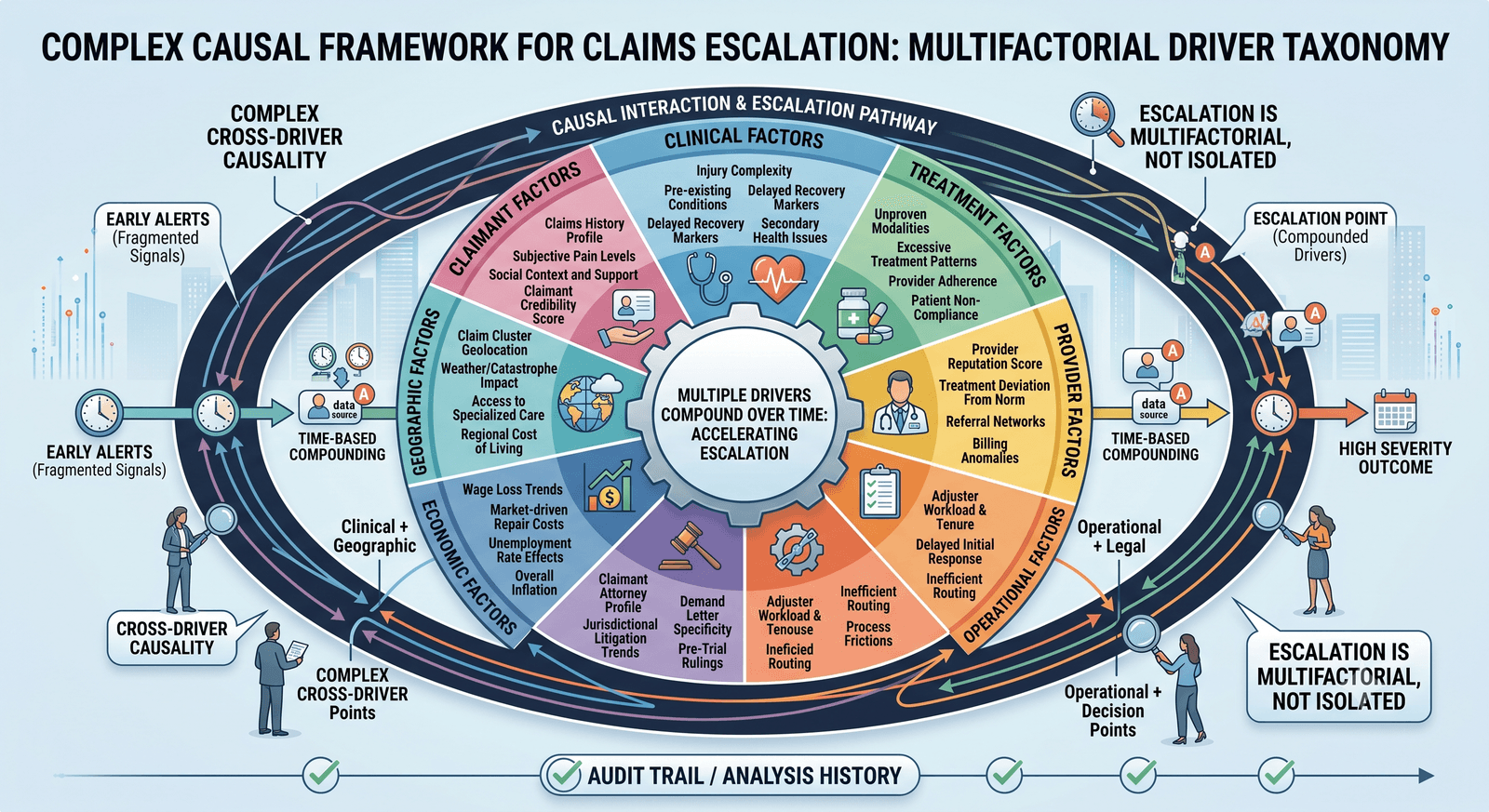
Which clinical factors drive medical cost escalation?
Which clinical factors drive medical cost escalation?
Injury severity, affected body parts, surgery, complications, chronic pain, functional limitation, behavioral health, and comorbidities can all change the expected treatment path. These factors should be interpreted in context because a more complex course may be medically necessary and unrelated to claim handling quality.
How do treatment patterns affect cost?
Frequency, intensity, duration, specialist referrals, repeated diagnostics, therapy progression, prescriptions, and gaps in care all influence the trajectory. The most useful signal is often a change from the expected course rather than the presence of any one service.
Why do provider and geographic patterns matter?
Charges, practice styles, referral networks, access to care, and local market conditions vary. Provider-level analysis can reveal meaningful differences, but organizations should avoid drawing conclusions from small samples or treating variation as proof of poor-quality care.
How can claims operations contribute to escalation?
Slow initial contact, delayed authorization, fragmented records, missed handoffs, and unclear responsibility can extend claim duration or disrupt coordination. Operational reviews should therefore examine whether the insurer’s own process contributed to delay before attributing the change solely to clinical or claimant factors.
How should AI identify combinations of drivers?
AI can combine structured claim fields, medical records, bills, provider information, narratives, and historical outcomes to surface patterns. The system should identify contributing evidence and uncertainty, not simply produce an unexplained risk label. Human reviewers determine which drivers are material and which response is appropriate.
Executive Insight
“Executive Insight Escalation becomes easier to manage when the organization identifies the type of driver involved. A clinical complication, an operational delay, and a provider-utilization change may produce similar cost growth but require entirely different responses.”
— Executive insight
Management Principle
“Classify the cause before selecting the intervention.”
— Management principle
Executive Responsibilities
Executives and accountable owners should:
- Maintain an enterprise taxonomy of medical cost drivers.
- Assign accountable owners to clinical, operational, legal, and data issues.
- Review whether internal process delays contribute to worsening outcomes.
- Monitor AI performance across lines, jurisdictions, and claimant populations.
Executive Checklist
Use this checklist to assess readiness and control:
- Separate clinical, treatment, provider, operational, and legal drivers.
- Look for combinations and compounding effects.
- Use line- and jurisdiction-specific benchmarks.
- Avoid equating higher utilization with inappropriate care.
- Investigate internal process friction as well as external causes.
- Document evidence and rationale for interventions.
Key Takeaways
- Key Takeaway Medical cost escalation results from interacting clinical, treatment, provider, operational, legal, social, and economic forces. A structured driver taxonomy gives insurers a more reliable basis for early review and targeted action.
Applying These Concepts with Charlee.ai
These concepts become most valuable when AI is embedded in daily insurance workflows, uses structured and unstructured information, and gives professionals timely insight without removing their authority or accountability.
Charlee.ai applies document intelligence, predictive analytics, and generative assistance so teams can identify risk earlier and make more informed decisions.
Earlier Risk Identification
Document Intelligence
Predictive Insights
Adjuster Copilot
Premise Medical cost escalation is usually multifactorial. Clinical needs, treatment utilization, provider patterns, claimant circumstances, legal conditions, market pricing, and claims operations can reinforce one another and change the ultimate exposure.
Frequently Asked Questions
Common drivers include injury severity, comorbidities, complications, treatment intensity, surgery, specialist utilization, pharmaceuticals, diagnostics, provider pricing, geography, legal involvement, delayed reporting, care fragmentation, psychosocial barriers, and prolonged disability.
Frequency, sequence, duration, intensity, provider mix, referrals, gaps, and deviations from expected recovery can signal whether a claim is stabilizing or becoming more complex. Patterns should be interpreted with diagnosis, age, comorbidity, jurisdiction, and clinical context.
Conditions such as diabetes, obesity, cardiovascular disease, mental health concerns, or prior injuries may complicate treatment and recovery. Their relevance varies, and they should be used carefully to support appropriate handling rather than unfair assumptions.
Provider networks differ in pricing, utilization, referral patterns, procedure intensity, and outcomes. Provider analytics can reveal variation, but conclusions should account for case mix, specialty, geography, patient complexity, and data completeness.
Attorney involvement may coincide with longer treatment, additional documentation, disputed causation, independent examinations, depositions, or other expenses. The relationship is not necessarily causal, so legal and medical signals should be evaluated separately and together.
Delay can postpone care coordination, evidence collection, early communication, and appropriate assignment. It may also create incomplete treatment histories or missed opportunities to address barriers before the claim becomes more complex.
Insurers may influence assignment, communication, care coordination, specialist referral, network guidance where permitted, reserve review, return-to-work support, and timely decision-making. They generally cannot control underlying injury, lawful treatment choices, or broader medical inflation.
Use it to select interventions, segment claims, allocate expertise, improve forecasting, and identify operational or market changes. Driver analysis should lead to specific workflow actions and measurable outcomes rather than a static dashboard.
Next step
Request a Demonstration
Explore how Charlee.ai can help claims organizations apply timely, explainable intelligence to recognizing the clinical, provider, utilization, geographic, legal, operational, and claimant-specific factors that drive medical cost growth, while keeping claims and clinical professionals responsible for consequential decisions.
Request a Demonstration