Executive Premise
Use predictive analytics to estimate work demand, complexity, strategic value, and skill requirements so submissions are assigned and sequenced more effectively.
Executive Summary
Optimizing Underwriter Workloads with Predictive Analytics addresses a central challenge for property and casualty insurers: increasing underwriting capacity and responsiveness without weakening risk selection, pricing discipline, portfolio management, or broker relationships. The strongest operating models treat productivity as a combination of better information, simpler work, clear decision rights, well-timed automation, and accountable professional judgment.
A production approach begins with a defined business problem and baseline. It then connects trusted submission, policy, claims, exposure, pricing, and external data to the underwriting workflow; sets human-review and exception rules; and measures whether the change improves capacity, quality, profitability, service, and workforce sustainability. Technology is valuable only when it changes the work in a controlled and measurable way.
Quick Answer
Use predictive analytics to estimate work demand, complexity, strategic value, and skill requirements so submissions are assigned and sequenced more effectively.
Learning Objectives
After reading this chapter, you should be able to:
- Explain the business importance of predictive analytics underwriting workload.
- Identify the data, workflow, technology, and professional-judgment requirements.
- Recognize implementation risks, governance controls, and decision boundaries.
- Apply practical metrics and executive actions that support measurable value.
Executive Framework
The framework below connects the operating question, enabling practice, expected value, primary measure, and accountable owner.
| Dimension | Executive Question | Enabling Practice | Primary Measure | Owner |
|---|---|---|---|---|
| Demand forecast | Where is work delayed or duplicated? | Map and simplify the workflow | Cycle time | Operations |
| Complexity scoring | What evidence improves the decision? | Use trusted, traceable information | Data quality | Data and technology |
| Priority scoring | Which actions require judgment? | Define authority and exceptions | Override quality | Underwriting leadership |
| Skill matching | How is performance controlled? | Monitor quality and risk | Exception rate | Risk and compliance |
| Capacity balancing | What outcome proves value? | Measure balanced outcomes | Net business benefit | Finance and business |
| Outcome feedback | How will learning continue? | Refine through feedback | Improvement realized | Executive sponsor |
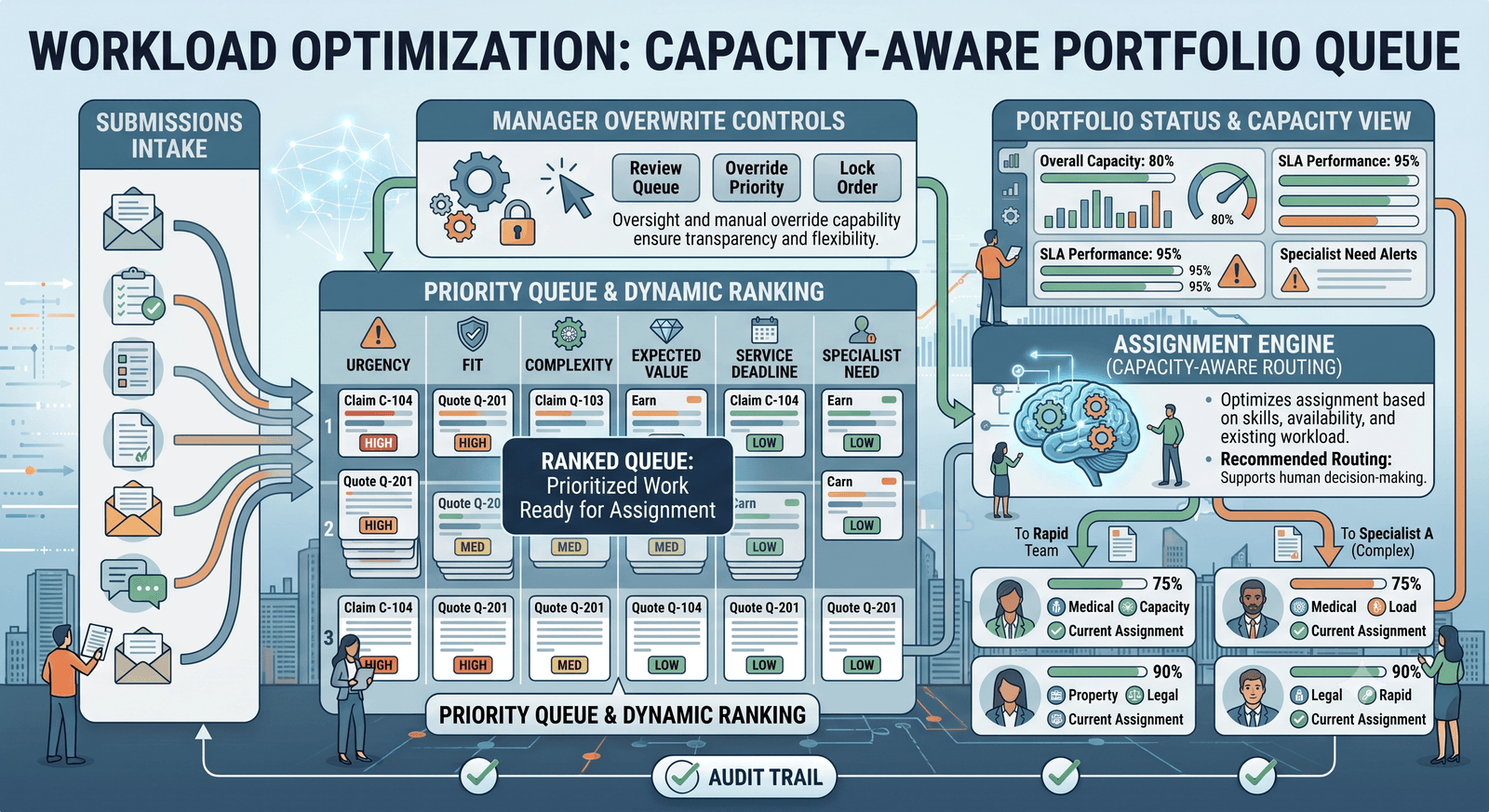
Why workload volume is not workload effort
Why workload volume is not workload effort
Two submissions can differ dramatically in document volume, exposure complexity, referral needs, negotiation effort, and strategic importance. Workload models should estimate expected effort and uncertainty rather than count items equally.
For implementation, define the user, decision, timing, required evidence, permitted action, exception path, and accountable owner. Establish a baseline before changing the process, test with representative submissions and users, and review results by product, complexity, channel, geography, and experience level. This prevents local improvements from being mistaken for enterprise value and helps leaders identify where operating assumptions need to change.
Forecasting demand and complexity
Predictive analytics can estimate incoming volume, seasonal patterns, product mix, catastrophe effects, and likely complexity. Forecasts should provide ranges and be refreshed as actual conditions change; they are planning aids, not guarantees.
For implementation, define the user, decision, timing, required evidence, permitted action, exception path, and accountable owner. Establish a baseline before changing the process, test with representative submissions and users, and review results by product, complexity, channel, geography, and experience level. This prevents local improvements from being mistaken for enterprise value and helps leaders identify where operating assumptions need to change.
Prioritizing submissions by value and urgency
Priority models can combine appetite fit, broker commitment, renewal timing, premium opportunity, service obligations, risk complexity, and portfolio need. The criteria should be transparent and reviewed to prevent bias toward easily measured or historically favored segments.
For implementation, define the user, decision, timing, required evidence, permitted action, exception path, and accountable owner. Establish a baseline before changing the process, test with representative submissions and users, and review results by product, complexity, channel, geography, and experience level. This prevents local improvements from being mistaken for enterprise value and helps leaders identify where operating assumptions need to change.
Managing fairness, transparency, and overrides
Work-allocation models affect opportunity, workload, and performance visibility. Leaders should test for uneven burdens, disclose key assignment factors, document overrides, and avoid using opaque scores as the sole basis for employment decisions.
For implementation, define the user, decision, timing, required evidence, permitted action, exception path, and accountable owner. Establish a baseline before changing the process, test with representative submissions and users, and review results by product, complexity, channel, geography, and experience level. This prevents local improvements from being mistaken for enterprise value and helps leaders identify where operating assumptions need to change.
Measuring allocation quality and business outcomes
Evaluate whether routing improves time to first review, service attainment, workload balance, reassignments, quality, hit ratio, and employee sustainability. Closed-loop feedback should update assumptions when actual effort differs from predicted effort.
For implementation, define the user, decision, timing, required evidence, permitted action, exception path, and accountable owner. Establish a baseline before changing the process, test with representative submissions and users, and review results by product, complexity, channel, geography, and experience level. This prevents local improvements from being mistaken for enterprise value and helps leaders identify where operating assumptions need to change.
Practical Insurance Example
A commercial insurer applies the principles in this article to a segment with growing submission volume and inconsistent service. The team maps intake through bind, identifies repeated document review and referral delays, and introduces targeted workflow and decision support with clear human review. Leadership compares the pilot with a matched baseline using cycle time, rework, referral quality, quote rate, pricing consistency, broker service, workload, and downstream portfolio indicators. The capability is expanded only after the carrier confirms that faster handling did not weaken underwriting discipline.
Common Misconceptions
EXECUTIVE INSIGHT
: Use predictive analytics to estimate work demand, complexity, strategic value, and skill requirements so submissions are assigned and sequenced more effectively. The executive objective is not maximum automation; it is better deployment of scarce underwriting judgment.
MANAGEMENT PRINCIPLE
: Redesign the work, preserve clear human accountability, and measure balanced outcomes before scaling technology.
Productivity means processing more submissions.
productive underwriting balances speed with quality, profitability, service, and sustainable workload.
Automation eliminates the need for professional judgment.
it should remove routine work and strengthen the evidence available for consequential decisions.
A technically accurate model guarantees business value.
integration, timing, adoption, controls, and management follow-through determine whether value is realized.
Executive Responsibilities
Executives and accountable owners should:
- Approve the business objective, decision boundaries, accountable owners, and success measures.
- Fund workflow redesign, data, integration, security, training, and operational support—not technology alone.
- Preserve underwriter authority, source evidence, system-of-record integrity, and business continuity.
- Review adoption, exceptions, quality, workforce effects, portfolio outcomes, incidents, and realized value.
Executive Checklist
Use this checklist to assess readiness and control:
- Define the business problem and baseline.
- Map the end-to-end underwriting workflow and decision rights.
- Validate data quality, lineage, security, and permitted use.
- Set human-review, override, escalation, and fallback procedures.
- Test with representative products, users, and complexity levels.
- Measure speed, quality, service, workforce, and portfolio outcomes together.
- Assign ongoing monitoring, change control, and benefit ownership.
Key Takeaways
- Optimizing Underwriter Workloads with Predictive Analytics should be treated as an operating-model capability. Sustainable value comes from combining trusted information, simpler workflows, responsible automation and AI, professional judgment, governance, and continuous measurement.
Applying These Concepts with Charlee.ai
These concepts become most valuable when AI is embedded in daily insurance workflows, uses structured and unstructured information, and gives professionals timely insight without removing their authority or accountability.
Charlee.ai applies document intelligence, predictive analytics, and generative assistance so teams can identify risk earlier and make more informed decisions.
Earlier Risk Identification
Document Intelligence
Predictive Insights
Adjuster Copilot
Use predictive analytics to estimate work demand, complexity, strategic value, and skill requirements so submissions are assigned and sequenced more effectively.
Frequently Asked Questions
Predictive analytics can estimate complexity, urgency, appetite fit, likelihood to bind, expected value, and need for specialist review, helping leaders route work to the right underwriter at the right time.
Models should use relevant business factors, be tested for bias and drift, account for skill and capacity, allow managerial override, and be monitored for effects on service, quality, and employee development.
It improves productivity by using predictive insight to match work to expertise, urgency, complexity, and expected business value. The goal is to create better decisions and usable capacity, not merely to accelerate activity.
Use authoritative sources, documented definitions, lineage, role-based access, privacy and security review, validation, monitoring, change control, audit trails, retention rules, and human oversight proportionate to the decision impact.
Deliver relevant evidence, explanations, priorities, recommended next steps, ownership, and due dates inside the systems and queues underwriters already use. Capture disposition and rationale for learning and accountability.
Use a balanced scorecard covering time saved, capacity, adoption, response time, decision quality, broker experience, portfolio outcomes, employee experience, risk, and realized financial value.
Executives should define outcomes and decision boundaries, assign ownership, fund shared foundations, protect professional judgment, monitor workforce and portfolio effects, and require evidence before scaling.
Common risks include poor data quality, disconnected workflows, unclear ownership, weak explainability, excessive alerts, low adoption, untested assumptions, and measuring activity without confirming business value.
Next step
Request a Demonstration
Explore how Charlee.ai helps property and casualty insurers give underwriters earlier insight, less administrative burden, stronger prioritization, and more time for the judgment, portfolio stewardship, and broker relationships that drive profitable growth.
Request a Demonstration