Executive Summary
AI-enabled FNOL combines conversational intake, speech and language processing, document and image intelligence, predictive models, data enrichment, and workflow orchestration. These capabilities help capture information across channels, identify missing or contradictory facts, estimate early risk and complexity, recommend routing, and initiate downstream actions. The transformation is most valuable when outputs are embedded in the core claims workflow, grounded in source evidence, and governed by clear authority limits.
Learning Objectives
After reading this chapter, you should be able to:
- Identify the AI capabilities used in modern FNOL.
- Understand the end-to-end AI-enabled intake workflow.
- Recognize the difference between automation and intelligent claim initiation.
- Define controls for confidence, source grounding, exceptions, and human review.
Executive Framework
AI adds value across the entire intake sequence. The framework below shows how individual capabilities combine to create an intelligent claim initiation process.
| FNOL Stage | AI Capability | Decision Support | Control Requirement | Business Value |
|---|---|---|---|---|
| Report intake | Conversational AI, speech transcription, OCR | Capture facts across voice, web, mobile, email, and documents | Authentication, accessibility, consent | Lower friction and broader access |
| Validation | Rules, entity matching, anomaly detection | Identify missing, inconsistent, or implausible information | Source traceability and confidence | Higher data quality |
| Enrichment | Policy, geospatial, weather, vehicle, property, and external data | Add trusted context without repeated customer questions | Approved data sources and lineage | More complete claim record |
| Risk assessment | Predictive analytics and multimodal models | Estimate severity, complexity, fraud, litigation, and recovery potential | Calibrated thresholds and human review | Earlier prioritization |
| Routing | Optimization and business rules | Recommend adjuster, specialist, vendor, or fast-track path | Authority, licensing, capacity, exceptions | Better first assignment |
| Workflow launch | Orchestration and generative assistance | Create tasks, summaries, acknowledgment, and next-step guidance | Approved content, audit trail, fallback | Faster first action |
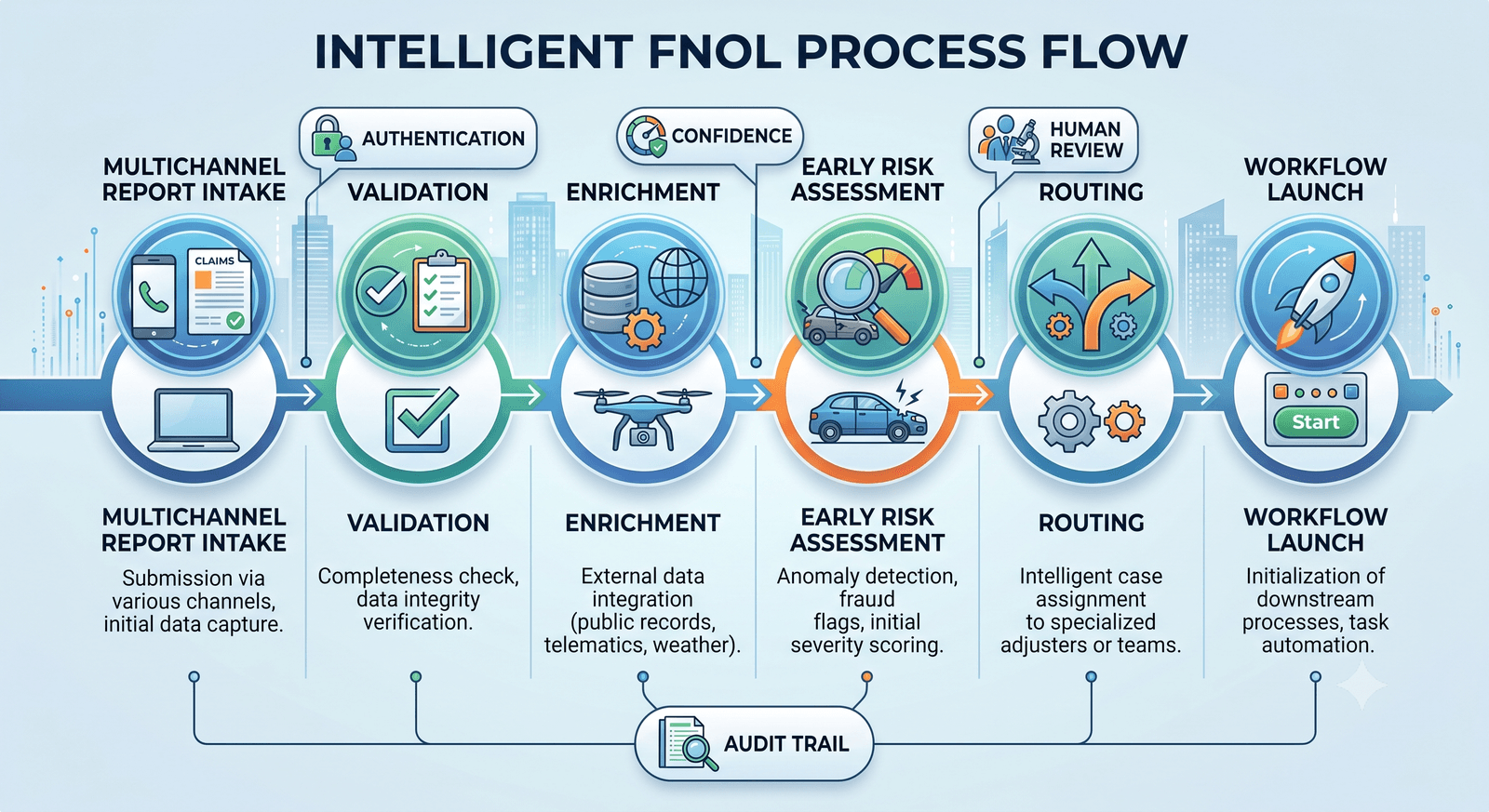
How does an AI-enabled FNOL process work?
How does an AI-enabled FNOL process work?
An AI-enabled process receives the report, authenticates the party, locates the policy, captures structured and unstructured information, validates and enriches the facts, estimates urgency and complexity, recommends routing, and initiates controlled actions. Each step should preserve the source data and identify uncertainty rather than presenting inferred information as verified fact.
What role does conversational AI play?
Conversational AI can guide customers through reporting by voice or digital channels, ask conditional questions, clarify ambiguous responses, support multiple languages, and summarize the interaction. It should offer a clear transfer to a person when the customer is distressed, the facts are complex, accessibility needs arise, or confidence is low.
How do document and image intelligence improve intake?
Document intelligence can classify and extract facts from police reports, estimates, medical information, forms, and correspondence. Computer vision can help describe damage or identify image-quality issues. These tools should not make unsupported conclusions; outputs require confidence scores, source links, and validation where the consequence of error is significant.
How does predictive AI support first decisions?
Predictive models can estimate likely severity, complexity, litigation, fraud, subrogation, and handling effort using the limited information available. Because early data is sparse, predictions should be expressed as risk ranges or priorities, not certainty. The recommended action should reflect both the score and the cost of a false positive or false negative.
What is the role of generative AI at FNOL?
Generative AI can draft summaries, create customer-friendly explanations, and suggest next questions or actions. It should be grounded in approved claim and policy information, prevented from inventing coverage or payment commitments, and subject to templates, retrieval controls, testing, and human review for consequential communications.
What makes AI transformation operationally successful?
Success depends on integration with the core claims platform, secure data flows, clear ownership, exception handling, user training, monitoring, and measurable outcomes. A technically accurate model that creates a separate screen, excessive alerts, or unclear responsibility will not produce sustained value.
EXECUTIVE INSIGHT
The transformation is not the substitution of a chatbot for an intake representative. It is the creation of a connected decision-support process that improves what the organization knows and does from the first interaction.
MANAGEMENT PRINCIPLE
Automate routine capture, augment judgment, and escalate uncertainty.
Executive Responsibilities
Executives and accountable owners should:
- Define approved FNOL use cases and prohibited autonomous actions.
- Require source-grounded outputs, confidence measures, and exception handling.
- Integrate AI recommendations and evidence into the core claim file.
- Establish testing for accuracy, accessibility, privacy, and customer impact.
- Measure both adoption and downstream business outcomes.
Executive Checklist
Use this checklist to assess readiness and control:
- Map the full intake-to-action workflow before selecting technology.
- Support voice, digital, document, and image inputs as appropriate.
- Ground generative outputs in approved sources.
- Use calibrated thresholds for early risk recommendations.
- Provide immediate human transfer for complex or sensitive situations.
- Monitor data quality, routing, customer effort, and outcomes.
Applying These Concepts with Charlee.ai
These concepts become most valuable when AI is embedded in daily insurance workflows, uses structured and unstructured information, and gives professionals timely insight without removing their authority or accountability.
Charlee.ai applies document intelligence, predictive analytics, and generative assistance so teams can identify risk earlier and make more informed decisions.
Earlier Risk Identification
Document Intelligence
Predictive Insights
Adjuster Copilot
AI-enabled FNOL combines conversational intake, speech and language processing, document and image intelligence, predictive models, data enrichment, and workflow orchestration. These capabilities help capture information across channels, identify missing or contradictory facts, estimate early risk and complexity, recommend routing, and initiate downstream actions. The transformation is most valuable when outputs are embedded in the core claims workflow, grounded in source evidence, and governed by clear authority limits.
Frequently Asked Questions
The primary objective is how AI converts intake into a validated, actionable claim record. The capability should produce timely, decision-relevant information that improves the next professional action while preserving uncertainty, source evidence, and human accountability.
AI can combine structured claim and policy fields with narratives, conversations, documents, images, historical outcomes, and approved external context. It can extract facts, validate information, identify patterns, estimate risk, summarize evidence, recommend workflow actions, and update insights as the record changes.
Useful inputs may include policy and coverage data, claimant and insured information, loss circumstances, injuries, property or vehicle details, notes, recordings, documents, images, prior claims, operational events, and approved external data. Quality, timeliness, lineage, missingness, and permissible use should be assessed before production use.
The system should distinguish confirmed, reported, inferred, and unknown information; show confidence or missing-information indicators; preserve contradictory versions; and route low-confidence or consequential cases for review. It should never fabricate missing facts or convert an estimate into an authoritative claim conclusion.
Authorized professionals remain responsible for coverage, liability, reserving, investigation, assignment, payment, customer treatment, and other material decisions. AI should organize evidence and recommend action within approved boundaries, with clear override, correction, and escalation paths.
Measures should connect technical performance and workflow adoption to operational, customer, risk, and financial outcomes. Depending on the use case, these may include completeness, cycle time, recontact, assignment accuracy, intervention timing, customer effort, false-positive burden, downstream correction, loss outcomes, and realized benefit.
Leaders should manage poor data, unstable models, weak explanations, bias or proxy effects, privacy and security exposure, brittle integration, alert fatigue, unclear ownership, unsupported automation, vendor dependency, service failures, and measurement designs that overstate value.
Start with a defined decision, user, intervention, claim population, baseline, and benefit owner. Co-design the workflow with users, validate on representative data, integrate into the authoritative system, pilot with explicit success and risk criteria, monitor production performance, and scale only after value and control are demonstrated.
Next step
Request a Demonstration
Explore how Charlee.ai can help claims organizations apply timely, explainable intelligence to how AI converts intake into a validated, actionable claim record, while keeping claims professionals responsible for consequential decisions.
Request a Demonstration