Executive Premise
Premise: Creating an AI Implementation Roadmap creates sustainable value only when leaders connect a clearly defined business objective to trusted data, integrated workflows, accountable human judgment, proportionate governance, and measurable outcomes.
Executive Summary
Creating an AI Implementation Roadmap is a core management discipline for property and casualty insurers seeking to move artificial intelligence from isolated experimentation into dependable business operations. The central challenge is not simply selecting technology. It is aligning strategy, people, process, data, integration, controls, funding, and measurement around a defined insurance decision or workflow.
Effective programs establish ownership before deployment, design the future-state operating model, test assumptions with representative data and users, and use explicit stage gates to decide whether an initiative should advance, change, pause, or stop. Human professionals remain accountable for material insurance decisions, while AI supports visibility, prioritization, analysis, and consistency.
Executives should evaluate progress through a balanced view of technical performance, adoption, operational behavior, customer and workforce effects, financial outcomes, risk, and total cost. This approach converts AI from a technology activity into a governed enterprise capability that can improve over time.
Quick Answer
Creating an AI Implementation Roadmap succeeds when the insurer defines the business decision, assigns accountable owners, prepares data and workflows, embeds human oversight, validates performance in realistic conditions, and measures attributable value after full lifecycle cost.
Learning Objectives
After reading this chapter, you should be able to:
- Understand the executive decisions required for this capability.
- Connect business outcomes with data, workflow, technology, and governance.
- Identify common failure modes and production-readiness requirements.
- Apply measurable criteria for investment, scaling, correction, or retirement.
Executive Framework
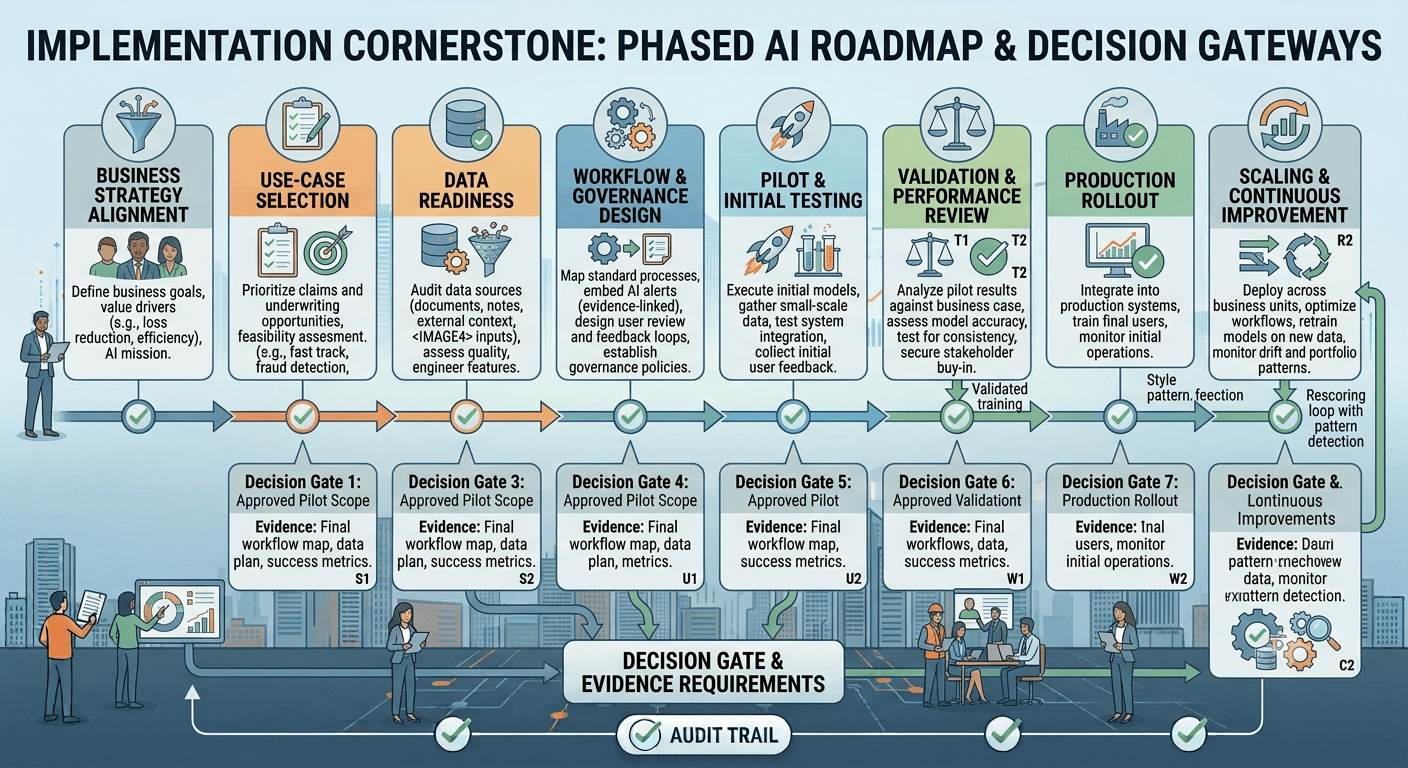
The framework below translates the topic into a small set of executive questions, evidence requirements, and risks that should be managed throughout implementation and operation.
| Dimension | Executive Question | Evidence Required | Primary Risk |
|---|---|---|---|
| Strategy | What outcomes matter most? | Prioritized business agenda | Disconnected projects |
| Use cases | Where can AI create measurable value? | Ranked portfolio with owners | Too many simultaneous initiatives |
| Foundations | What must exist first? | Data, integration, security, support | Pilots that cannot scale |
| Adoption | How will work change? | Future-state workflow and training | Low use and weak trust |
| Value & scale | What evidence permits expansion? | Stage gates and benefit tracking | Premature scaling |
Begin with enterprise strategy
Begin with enterprise strategy
Begin with enterprise strategy is essential to AI implementation roadmap insurance. Leaders should begin by defining the business objective, the decision or workflow to improve, the responsible owner, the required timing, and the outcome that will demonstrate value. The design should make evidence, confidence, limitations, action expectations, and escalation paths visible to the people responsible for the result. Implementation should be tested with representative lines of business, jurisdictions, claim or policy segments, and users. The organization should document assumptions, exceptions, overrides, dependencies, and fallback procedures. Management should review adoption, performance, business behavior, customer impact, workforce effects, financial value, and risk together rather than relying on a single model metric.
Prioritize a balanced use-case portfolio
Prioritize a balanced use-case portfolio is essential to AI implementation roadmap insurance. Leaders should begin by defining the business objective, the decision or workflow to improve, the responsible owner, the required timing, and the outcome that will demonstrate value. The design should make evidence, confidence, limitations, action expectations, and escalation paths visible to the people responsible for the result. Implementation should be tested with representative lines of business, jurisdictions, claim or policy segments, and users. The organization should document assumptions, exceptions, overrides, dependencies, and fallback procedures. Management should review adoption, performance, business behavior, customer impact, workforce effects, financial value, and risk together rather than relying on a single model metric.
Executive practice: Define the decision, evidence, owner, timing, action threshold, escalation path, and outcome measure before deployment. Use stage gates and documented evidence before expanding scope.
Assess readiness by use case
Assess readiness by use case is essential to AI implementation roadmap insurance. Leaders should begin by defining the business objective, the decision or workflow to improve, the responsible owner, the required timing, and the outcome that will demonstrate value. The design should make evidence, confidence, limitations, action expectations, and escalation paths visible to the people responsible for the result. Implementation should be tested with representative lines of business, jurisdictions, claim or policy segments, and users. The organization should document assumptions, exceptions, overrides, dependencies, and fallback procedures. Management should review adoption, performance, business behavior, customer impact, workforce effects, financial value, and risk together rather than relying on a single model metric.
Sequence delivery through stage gates
Sequence delivery through stage gates is essential to AI implementation roadmap insurance. Leaders should begin by defining the business objective, the decision or workflow to improve, the responsible owner, the required timing, and the outcome that will demonstrate value. The design should make evidence, confidence, limitations, action expectations, and escalation paths visible to the people responsible for the result. Implementation should be tested with representative lines of business, jurisdictions, claim or policy segments, and users. The organization should document assumptions, exceptions, overrides, dependencies, and fallback procedures. Management should review adoption, performance, business behavior, customer impact, workforce effects, financial value, and risk together rather than relying on a single model metric.
Integrate governance and adoption
Integrate governance and adoption is essential to AI implementation roadmap insurance. Leaders should begin by defining the business objective, the decision or workflow to improve, the responsible owner, the required timing, and the outcome that will demonstrate value. The design should make evidence, confidence, limitations, action expectations, and escalation paths visible to the people responsible for the result. Implementation should be tested with representative lines of business, jurisdictions, claim or policy segments, and users. The organization should document assumptions, exceptions, overrides, dependencies, and fallback procedures. Management should review adoption, performance, business behavior, customer impact, workforce effects, financial value, and risk together rather than relying on a single model metric.
Plan funding and resource capacity
Plan funding and resource capacity is essential to AI implementation roadmap insurance. Leaders should begin by defining the business objective, the decision or workflow to improve, the responsible owner, the required timing, and the outcome that will demonstrate value. The design should make evidence, confidence, limitations, action expectations, and escalation paths visible to the people responsible for the result. Implementation should be tested with representative lines of business, jurisdictions, claim or policy segments, and users. The organization should document assumptions, exceptions, overrides, dependencies, and fallback procedures. Management should review adoption, performance, business behavior, customer impact, workforce effects, financial value, and risk together rather than relying on a single model metric.
Review and refresh the roadmap
Review and refresh the roadmap is essential to AI implementation roadmap insurance. Leaders should begin by defining the business objective, the decision or workflow to improve, the responsible owner, the required timing, and the outcome that will demonstrate value. The design should make evidence, confidence, limitations, action expectations, and escalation paths visible to the people responsible for the result. Implementation should be tested with representative lines of business, jurisdictions, claim or policy segments, and users. The organization should document assumptions, exceptions, overrides, dependencies, and fallback procedures. Management should review adoption, performance, business behavior, customer impact, workforce effects, financial value, and risk together rather than relying on a single model metric.
Practical Insurance Example
A regional P&C carrier applies the principles of AI implementation roadmap insurance to a claims initiative designed to identify emerging severity and litigation risk. The carrier establishes a baseline, limits the first release to representative casualty claims, embeds evidence and tasks in the claims workflow, trains adjusters and managers, and requires human review before any material action. Finance, claims, technology, and risk leaders review adoption, intervention timing, reserve behavior, claim outcomes, incidents, and total cost before approving broader deployment.
Common Misconceptions
EXECUTIVE INSIGHT
: Creating an AI Implementation Roadmap becomes a durable enterprise capability when strategy, trusted information, workflow design, accountable human judgment, governance, and closed-loop measurement operate as one system.
MANAGEMENT PRINCIPLE
: Connect every AI capability to a clearly owned business decision, supporting evidence, human authority, proportionate controls, and an outcome that can be measured.
Technical accuracy proves business value.
value requires timely action, workflow adoption, accountable ownership, and measurable outcomes.
A successful pilot is ready for enterprise deployment.
production scale requires resilient integration, support, governance, monitoring, and repeatable results.
Governance slows innovation.
clear requirements and decision rights allow teams to move faster with fewer late-stage surprises.
Executive Responsibilities
Executives and accountable owners should:
- Approve the business purpose, baseline, decision boundaries, owners, and success measures.
- Fund the complete operating model, including data, integration, workflow redesign, security, training, support, monitoring, and change management.
- Require evidence, transparency, human review, escalation, fallback, and documented override authority proportionate to the use case.
- Review adoption, outcomes, incidents, segment performance, total cost, and realized value before scaling.
Executive Checklist
Use this checklist to assess readiness and control:
- Define the business objective and decision to improve.
- Document the baseline and value mechanism.
- Confirm data quality, lineage, access, security, and permitted use.
- Design the future-state workflow and human-review model.
- Test representative populations, users, and failure conditions.
- Establish production support, monitoring, incident, and fallback procedures.
- Measure technical, operational, adoption, financial, customer, and risk outcomes.
- Assign ongoing benefit ownership, change control, and retirement authority.
Key Takeaways
- Creating an AI Implementation Roadmap should be managed as a business capability rather than a technology project. Sustainable value depends on clear purpose, disciplined execution, responsible governance, workforce adoption, and evidence that the capability improves real insurance outcomes.
Applying These Concepts with Charlee.ai
These concepts become most valuable when AI is embedded in daily insurance workflows, uses structured and unstructured information, and gives professionals timely insight without removing their authority or accountability.
Charlee.ai applies document intelligence, predictive analytics, and generative assistance so teams can identify risk earlier and make more informed decisions.
Earlier Risk Identification
Document Intelligence
Predictive Insights
Adjuster Copilot
Premise: Creating an AI Implementation Roadmap creates sustainable value only when leaders connect a clearly defined business objective to trusted data, integrated workflows, accountable human judgment, proportionate governance, and measurable outcomes.
Frequently Asked Questions
The strongest approach to an executable roadmap starts with sequenced priorities, readiness dependencies, stage gates, owners, funding, governance, adoption, and measurable outcomes. The objective is a governed business capability, not an isolated technology activity.
Executives should connect the topic to a named business decision, responsible owner, baseline, expected intervention, measurable outcome, and explicit conditions for advancing, changing, pausing, or stopping the initiative.
Evidence should be tested with representative products, jurisdictions, users, claim or policy segments, and realistic failure conditions. Technical performance alone is not sufficient proof of business readiness.
The design should preserve human authority, show source evidence and limitations, define exception and escalation paths, and maintain auditability proportionate to the consequence of the use case.
Use a clearly approved purpose, named business and technical owners, data and model validation, privacy and security controls, meaningful human review, monitoring, incident response, change control, documentation, and retirement criteria proportionate to impact.
Deliver evidence, confidence, limitations, recommended actions, ownership, and escalation inside the systems and operating routines employees already use. Capture decisions, overrides, outcomes, and feedback for accountability and improvement.
Measure technical quality together with adoption, action timing, operational performance, customer and workforce effects, financial outcomes, risk, total cost, and realized value against a documented baseline.
Executives should define purpose and boundaries, assign accountable owners, fund the complete operating model, require evidence before scale, review risk and value together, and retain authority to correct, limit, suspend, or retire the capability.
Next step
Request a Demonstration
Explore how Charlee.ai helps property and casualty insurers move AI from strategy to governed production by connecting trusted data, integrated workflows, accountable human judgment, and measurable business outcomes.
Request a Demonstration